⚠️ Affiliate Disclosure: This post contains Amazon affiliate links. If you purchase through our links, we may earn a small commission at no extra cost to you. We only recommend kits we have researched and whose listings we verified live on Amazon. Prices and stock change constantly, so we deliberately don’t print prices here. Tap through and check the current price yourself before buying.
Ultimate Buying Guide
🚁 Best FPV Drone Kits for Beginners
8 ready-to-fly FPV kits ranked for first-time pilots. Drone, radio, goggles and batteries in one box, from a 33g self-levelling indoor whoop to a 1080p digital HD kit, with real specs, verified Amazon listings and honest verdicts.
✅ 8 Complete Kits Reviewed
✅ Verified Amazon ASINs
✅ Manufacturer Specs
✅ Honest Pros & Cons
FPV, or first-person view, is the branch of the drone hobby where you wear goggles and fly from the aircraft’s own camera instead of watching it from the ground. There is no GPS holding your position, no obstacle sensors and usually no “return to home”. You are flying a bare quadcopter through a live analog or digital video feed with your own two thumbs, and that is exactly why it feels so different from a camera drone. For anyone who has already wired up an ESC, flashed a flight controller or poked around Betaflight, it is also the most fun you can have with a microcontroller strapped to four motors.
The problem for beginners is that FPV is a system, not a product. You need an aircraft, a radio transmitter, goggles or a screen, LiPo batteries and a charger, and every one of those has its own protocol and connector. Buying them separately is how people spend a fortune and never get airborne. That is what an RTF (ready-to-fly) kit solves: one box, everything pre-bound and pre-tuned. This guide ranks 8 beginner FPV kits that are actually in stock on Amazon, on the things that matter for your first 50 flights: durability, flight modes, spare-part supply, simulator support and how far the kit can carry you before you outgrow it.
💡 Reality check before you buy: No beginner FPV kit is a DJI. Expect 3 to 8 minutes of flight per battery, analog video that gets snowy past 100–200 m, and goggles with a single 4.3″ screen rather than crisp OLEDs. You will crash, so plan on buying spare props and at least one spare motor. Most of these kits ship with a small entry-level radio whose gimbals are the weakest link in the box; a large share of the one-star Amazon reviews on beginner kits are about the transmitter, not the drone. Two habits fix nearly all of this: spend a few hours in a simulator (Liftoff, Velocidrone or the free FPV.SkyDive) with the kit’s own radio plugged in via USB before you fly for real, and buy two or three extra batteries at the same time as the kit. Also check your local rules. In the US, recreational pilots must pass the free TRUST test and register any aircraft over 250 g.
🚁 Quick Comparison of All 8 Beginner FPV Kits
| Kit | Airframe | Video System | Radio / Link | Best For | Buy |
|---|
| 🥇 BETAFPV Cetus Pro | 65mm brushless whoop · 33 g | Analog · C02 · 25 mW | LiteRadio 2 SE · FrSky D8 | Best Overall | Buy → |
| 🏅 BETAFPV Aquila16 | 86mm brushless · 47 g | Analog · C02 · 25–350 mW | LiteRadio 2 SE · ELRS 3.0 | Best Value | Buy → |
| 🎯 EMAX Tinyhawk III Plus Freestyle | 110mm · 2.5″ props · 62.5 g | Analog · RunCam Nano · 25–400 mW | EMAX E8 · ELRS 2.4G | Outdoor freestyle | Buy → |
| 🖥️ CaddxFPV Protos RTF | 1.6″ · 2S · ~100 g | Digital · Walksnail Ascent · 1080p/60 | Bundled ELRS controller | HD digital video | Buy → |
| 💨 BETAFPV Cetus X | 95mm · 1–2S brushless | Analog · C04 · 25–400 mW | LiteRadio 3 · ELRS 2.4G | Outdoor whoop | Buy → |
| 🛠️ EMAX Tinyhawk III RTF | 76mm · 1–2S · 32 g | Analog · RunCam Nano 4 · 25–200 mW | EMAX E8 · FrSky D8/D16 | Proven trainer | Buy → |
| 🪶 EMAX Tinyhawk Lite Adventure | 115mm · brushed · ~59 g | Analog · E02 · 25–400 mW | ELRS 2.4G (SPI) | Ultra-light starter | Buy → |
| 🧒 EMAX EZ Pilot Pro | 75mm brushless · 32.5 g | Analog · 1200TVL E01 · 25–200 mW | EMAX E8 · FrSky D8 SPI | Kids & classrooms | Buy → |
We deliberately leave prices out, because FPV kits go in and out of stock and change price weekly. Tap any Buy button to see the live Amazon price and availability.
🔍 What to Look for in a Beginner FPV Kit
⚙️
Brushed vs Brushless
Brushed motors are cheap, quiet and trivially replaceable, so they are perfect for living-room practice, but weak in wind. Brushless (1102/1103-class) motors give real thrust, longer life and the punch you need outdoors. Almost every kit here is brushless; the Tinyhawk Lite Adventure is the deliberate brushed exception.
🎚️
Flight Modes That Grow With You
Look for a three-stage progression: a self-levelling mode (angle / “N”), an intermediate mode (“S” / horizon), then full manual acro (“M” / air). Kits that also add optical-flow position hold, such as the Cetus Pro and Protos, let you hover hands-off on day one, which massively shortens the learning curve.
📺
Analog vs Digital Video
Analog 5.8 GHz is cheap, near-zero latency and degrades gracefully into static, so you can still fly a snowy picture home. Digital (Walksnail, HDZero, DJI) gives a crisp 1080p image and a much nicer experience, but costs more and cuts out abruptly at the edge of range.
📡
Radio Link & Simulator Support
Prefer ExpressLRS (ELRS) over legacy FrSky D8, because it is open source, far longer range, and every new quad supports it. Just as important: the radio should enumerate as a USB joystick so you can practise in a simulator. All the kits here do, and that single feature will save you more money than any spare part.
🔋
Batteries, Charger & Spares
A 1S 450–650 mAh whoop pack gives 3–5 minutes; a 1100 mAh Aquila pack gets you to 8. Count how many packs are in the box and whether the charger does more than one at a time. Then check that props, motors and the camera are sold separately, because a kit you cannot repair is a kit you fly twice.
🧰
Betaflight Access
If you come from embedded work, you will want to plug the quad in and look. Kits running stock Betaflight on an F4 flight controller (Tinyhawk, Cetus X Betaflight FC, Aquila16) let you tune rates, PIDs and OSD yourself. Closed “toy” firmware does not, which is a real limit on how far the kit can take you.
🏆 Detailed Reviews of All 8 FPV Kits
🥇 BEST OVERALL BEGINNER KIT
1. BETAFPV Cetus Pro FPV Kit
⭐ 4.7/5 · The safest possible first flight
1102 · 18000KV
BRUSHLESS MOTORS
Optical flow
+ BARO + LASER HOLD
N / S / M
3 MODES × 3 SPEEDS

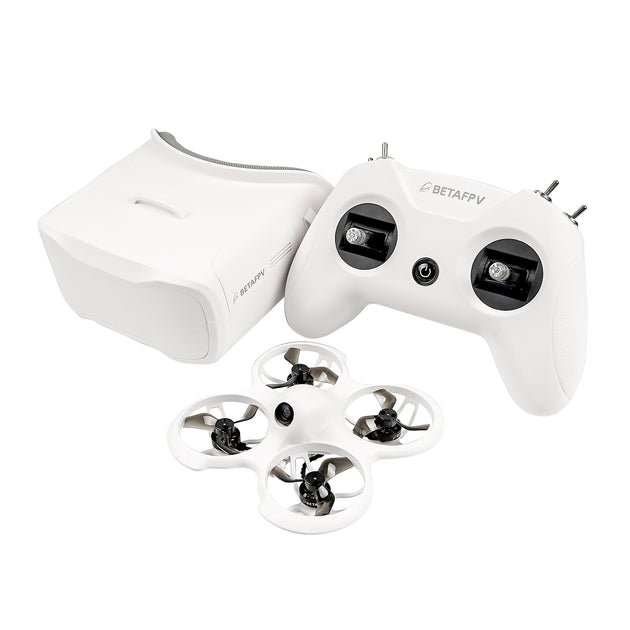
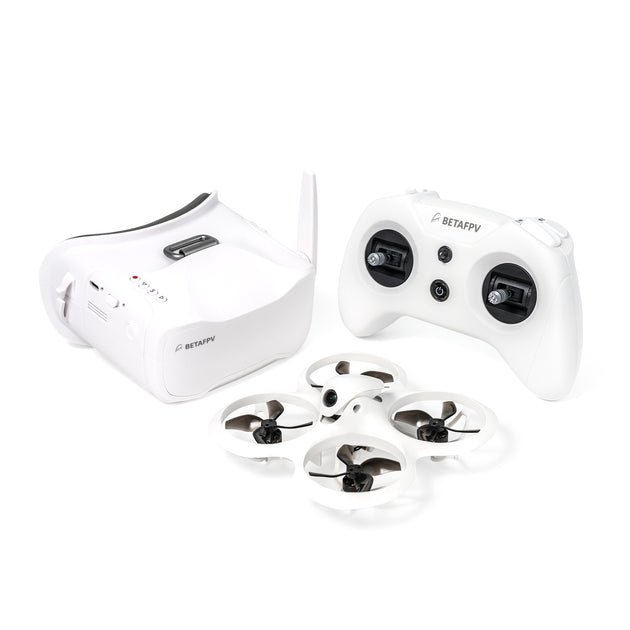
The Cetus Pro is the kit we hand to anyone who has never flown FPV. It is a 65mm brushless whoop with a genuinely clever trick: an optical-flow sensor, barometer and laser rangefinder that let it hover on its own to roughly ±0.2 m horizontally. Let go of the sticks in N mode and it just sits there, which means your very first FPV session is spent learning to look around instead of panicking. As you improve you step through S mode and then M (full acro), each with slow/mid/fast speed settings, so one aircraft covers the whole beginner journey. The bundled LiteRadio 2 SE also plugs into a PC as a USB joystick for simulator practice, and the ducted PA12 frame shrugs off indoor crashes. With 585 Amazon ratings it is also by far the most-reviewed kit here.
✅ Pros- Hands-off hover thanks to optical flow
- Three modes that grow with your skill
- Very durable ducted whoop frame
- Radio doubles as a simulator controller
❌ Cons- Only 4–5 min per 450 mAh pack
- 25 mW VTX and ~80 m range, indoor-first
- Legacy FrSky D8 link, not ELRS
- Locked firmware, no Betaflight tuning
🎯 Verdict: The lowest-risk way into FPV. Buy it if you want to be flying confidently in an afternoon rather than picking a quad out of a hedge.
👉 Check Price on Amazon →
🏅 BEST VALUE · BEST ALL-ROUNDER
2. BETAFPV Aquila16 FPV Kit
⭐ 4.6/5 · The one with real flight time
Buy on Amazon →
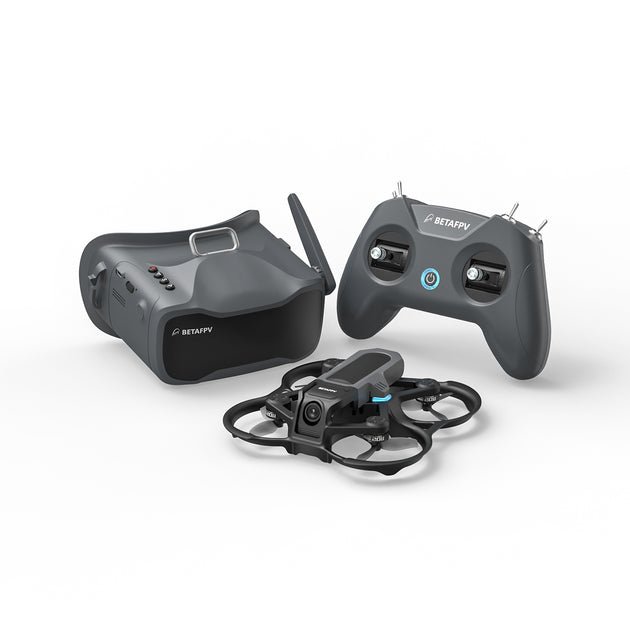
If the Cetus Pro’s four-minute flights put you off, the Aquila16 is the answer. BETAFPV built it around a big 1100 mAh 1S pack and 45mm props on an 86mm frame, and the result is roughly 8 minutes in the air, nearly double most whoops, with a genuine 200 m of usable range on the 350 mW VTX setting. Crucially it ships with a serial ExpressLRS 3.0 receiver and the VR03 goggles with DVR recording, so you can save your flights to a microSD card and keep the radio when you upgrade the quad. It still offers N/S/M modes with slow (1.25 m/s), mid (3.33 m/s) and fast (5 m/s) speed caps, so it is beginner-safe without being a toy. For most people reading this, the Aquila16 is the kit that will actually still be in use six months from now.
✅ Pros- ~8 min flight time, best in this group
- Modern ELRS 3.0 link, 200 m range
- VR03 goggles record DVR to microSD
- Three speed caps make it forgiving
❌ Cons- No optical-flow position hold
- Bigger and less indoor-friendly than a whoop
- Uses a proprietary Aquila16 battery
- Analog 480p video only
🎯 Verdict: The best-balanced kit on this list. Modern radio protocol, double the flight time, and enough performance to still be fun once you can fly acro.
👉 Check Price on Amazon →
🎯 BEST FOR OUTDOOR FREESTYLE · ⭐ 4.5/53. EMAX Tinyhawk III Plus Freestyle RTF
110mm · AVAN Rush 2.5″ props · 12025 7000KV · 62.5 g · F411 6A BLHeli_S 1–2S · ELRS
Buy →

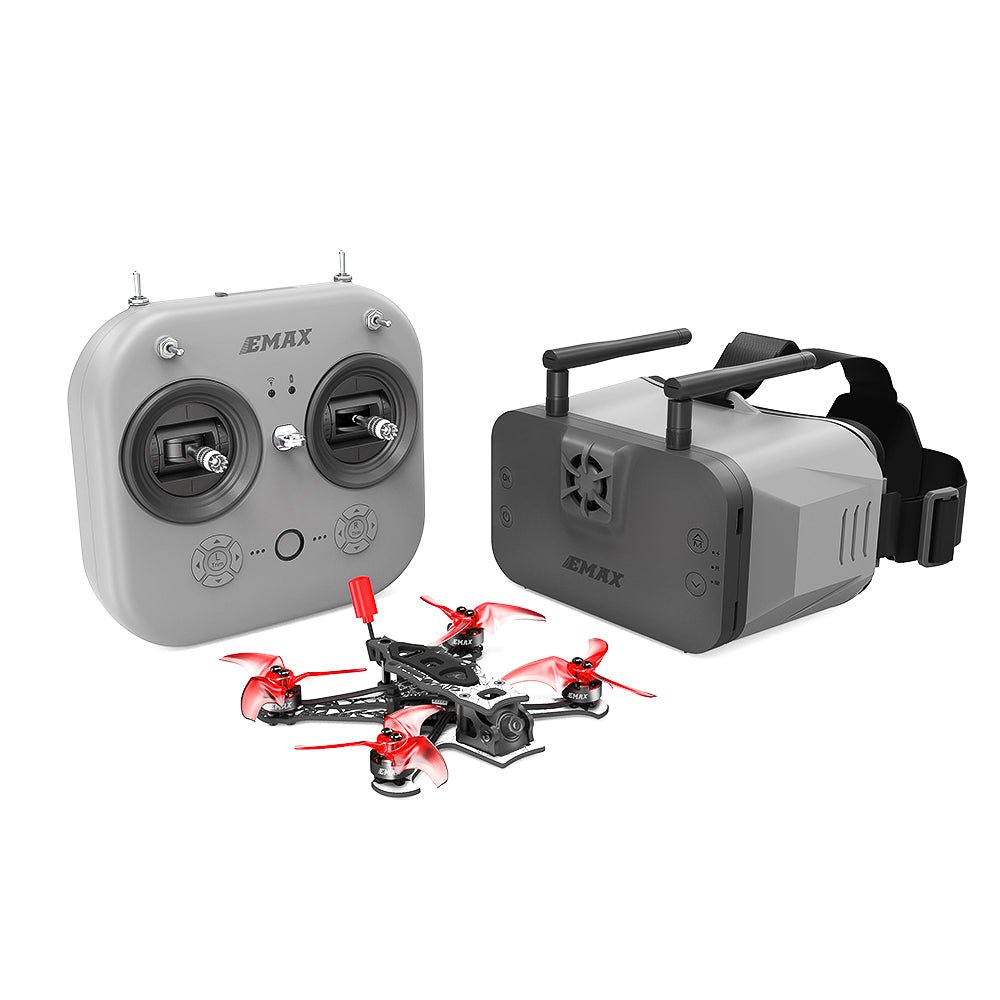
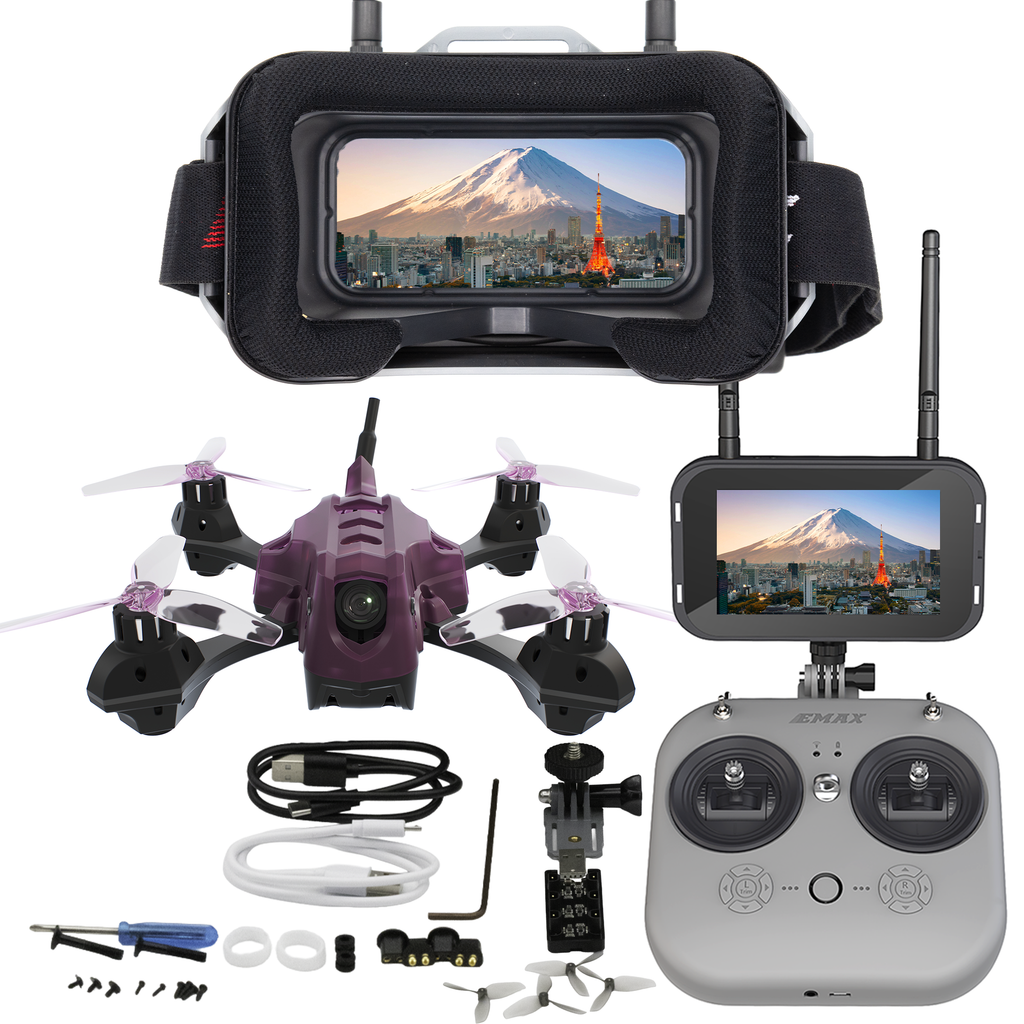
This is the kit for the person who already knows they want to fly, not hover. The Tinyhawk III Plus Freestyle swaps the ducted whoop formula for an open 110mm carbon-fibre frame on 2.5″ AVAN Rush props, and the difference outdoors is night and day. It punches through wind that pins a whoop to the ground. Under the hood it is a proper little freestyle quad: STM32F411 running stock Betaflight, 6A BLHeli_S 4-in-1, RunCam Nano camera and a 40-channel VTX that goes up to 400 mW. The RTF bundle adds the E8 ELRS 2.4 GHz radio, Transporter 2 goggles (4.3″, 480×800), two 1S 650 mAh packs and a charger. Because the FC is unlocked, this is also the kit you can actually tune, reflash and learn from.
✅ Pros: Real outdoor performance in wind; stock Betaflight you can tune; carbon frame; 400 mW ELRS package.
❌ Cons: No self-levelling safety net worth relying on; most expensive analog kit here; only two batteries included.
🎯 Verdict: The best kit here if your goal is outdoor freestyle and you are willing to spend simulator hours first. Skip it if you want a forgiving indoor trainer.
🖥️ BEST HD DIGITAL KIT · ⭐ 4.4/54. CaddxFPV Protos FPV Drone RTF Kit
1.6″ · 1102 14000KV · ~100 g · Walksnail Ascent 1080p/60 · 3 × 840 mAh 2S · 4.5″ goggles
Buy →

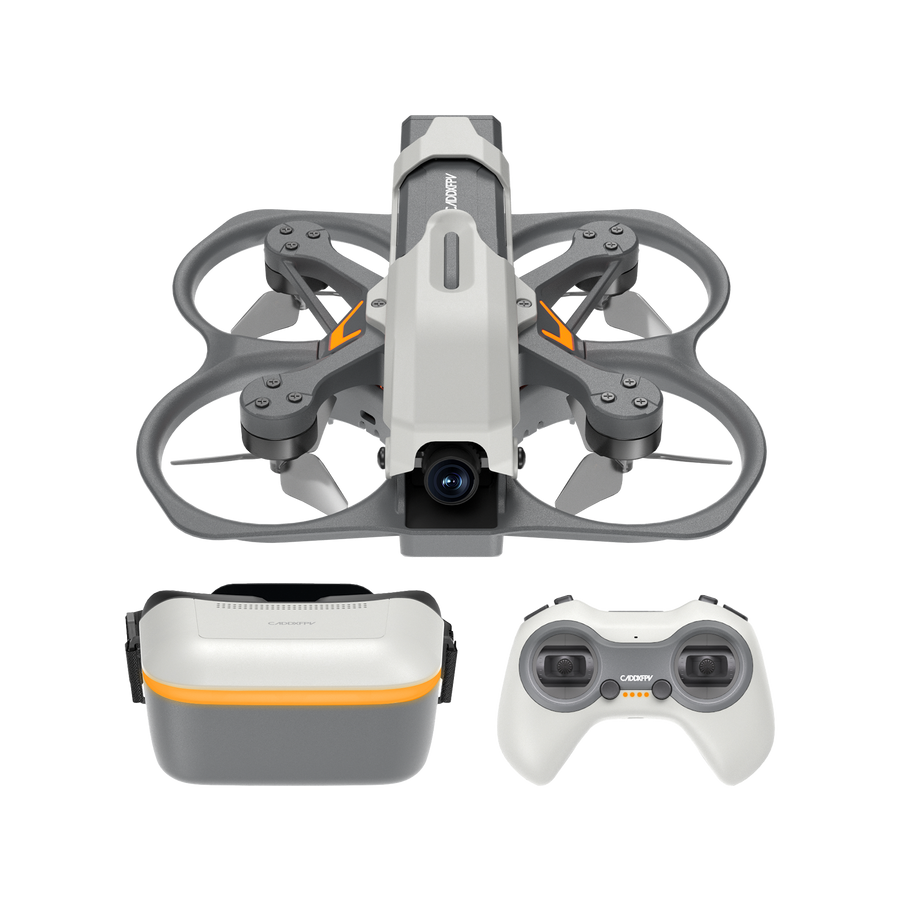
Until recently, digital HD FPV meant spending four figures. The Protos RTF breaks that: it bundles a 1.6″ cinewhoop-style quad carrying a 6 g Walksnail Ascent air unit that streams 1080p at 60 fps with roughly 32–35 ms of latency, plus matching 4.5″ Ascent goggles, an ELRS controller, three 840 mAh 2S packs and a 3-in-1 charger that refills them in about 20 minutes. Three packs at up to ~10 minutes each is a genuinely different session length from a whoop. It also offers position hold, self-stabilised and manual modes, and the 2 MP Starvis II sensor with a 160° lens copes with dusk far better than any analog camera on this list.
✅ Pros: True 1080p/60 digital video; three batteries and a fast hub charger; position hold; Starvis II low-light sensor.
❌ Cons: Clearly above a beginner budget, roughly double the whoop kits; heavier at ~100 g; digital video cuts out abruptly at range.
🎯 Verdict: Yes, it breaks the budget ceiling for a “beginner” kit. But it is the cheapest honest route into HD FPV, and the picture quality alone keeps people flying.
💨 BEST 2S OUTDOOR WHOOP · ⭐ 4.2/55. BETAFPV Cetus X FPV Kit
95mm · 1103 11000KV · Gemfan 2020 4-blade · 1–2S · C04 cam · 25–400 mW · ELRS
Buy →
The Cetus X is the Cetus family grown up: a 95mm frame with 1103 11000KV motors and 360° duct protection that runs on 1S or 2S, so you can fly it gently indoors and then double the power outdoors. The Amazon version we linked is the Betaflight FC build, which means angle/horizon/air modes, turtle mode and full Betaflight Configurator access over ELRS 2.4 GHz, the most “real quad” experience of any whoop kit here. Four 450 mAh packs, the LiteRadio 3 and VR03 DVR goggles are included. Be honest about the trade-off, though: it holds only a 3.5-star Amazon average across 170 ratings, and the recurring complaint is the LiteRadio 3’s gimbals, not the aircraft. Budget for a better radio eventually.
✅ Pros: 1S/2S flexibility; full Betaflight access; four batteries in the box; very crash-tolerant ducts.
❌ Cons: Reported LiteRadio 3 gimbal failures; ~5 min flights; no position hold on the Betaflight version.
🎯 Verdict: The best whoop here for someone who wants to learn Betaflight properly. Just go in knowing the included radio is the weak link.
🛠️ MOST PROVEN ANALOG TRAINER · ⭐ 4.3/56. EMAX Tinyhawk III RTF Kit
76mm · TH0802 II 15000KV · 32 g · MATEKF411RX · RunCam Nano 4 · 25/100/200 mW · FrSky D8/D16
Buy →
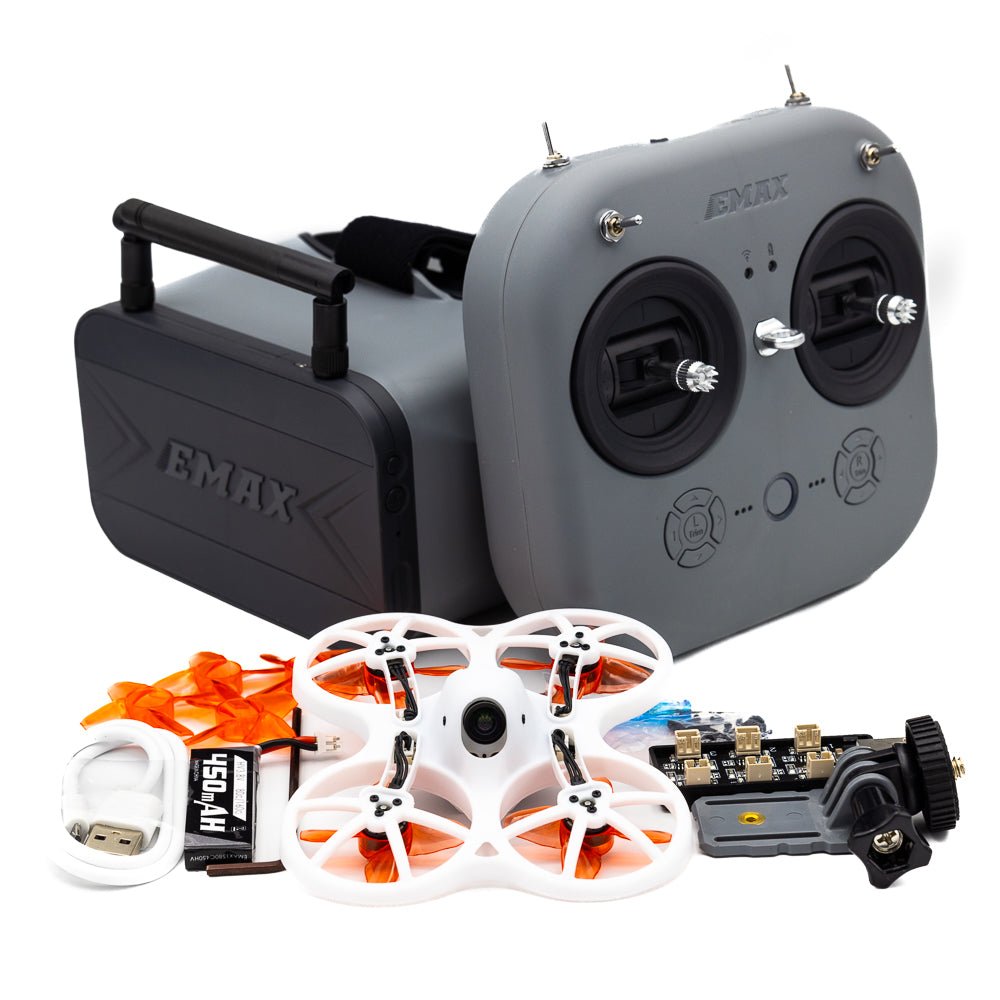
The Tinyhawk III is the kit that taught a whole generation of pilots, and it is still one of the most sensible purchases on this list. It is a 76mm 1–2S whoop weighing just 32 g dry, running a MATEKF411RX flight controller with a 5A BLHeli_S 4-in-1 and a RunCam Nano 4 camera, a genuinely good analog sensor, not a toy module. The 37-channel VTX switches between 25, 100 and 200 mW with Smart Audio. Because it has been on the market for years, spare frames, motors and canopies are everywhere and cheap, and there is a tutorial for every problem you will ever have with it. The one caveat is the link: this bundle uses FrSky D8/D16 over SPI, not ELRS, so the radio will not carry forward to a modern quad.
✅ Pros: Huge community and spare-part supply; RunCam Nano 4 camera; 1–2S flexibility; stock Betaflight.
❌ Cons: FrSky SPI link instead of ELRS; no self-levelling hover aid; older design at a current-model price.
🎯 Verdict: The safest bet on repairability. Buy it if you value “I can find the part and the tutorial” over having the newest radio protocol.
🪶 BEST ULTRA-LIGHT OUTDOOR STARTER · ⭐ 4.2/57. EMAX Tinyhawk Lite Adventure RTF
115mm · 1020 coreless brushed · 65mm 3-blade · ~59 g · F411 · 1S HV 850 mAh · ELRS SPI
Buy →

The Tinyhawk Lite Adventure takes the opposite approach to everything else here: it uses 1020 coreless brushed motors on a 115mm airframe with 65mm three-blade props, so it is quiet, gentle and completely non-threatening, yet it still carries a modern ELRS 2.4 GHz SPI receiver and a proper 32-bit 40-channel VTX that reaches 400 mW. At roughly 59 g it sits comfortably under every registration threshold, and brushed motors are the cheapest, most solder-free part in FPV to replace when you inevitably grind one into grass. On a 1S HV 850 mAh pack it is happy outdoors in calm air and equally at home in a hallway. It is a very new Amazon listing, so there are barely any reviews yet, which is worth knowing before you commit.
✅ Pros: Modern ELRS link on a beginner-gentle brushed airframe; ~59 g; motors are cheap and plug-in; 400 mW VTX.
❌ Cons: Brushed motors fade over time and struggle in wind; very few Amazon reviews so far; modest thrust for acro.
🎯 Verdict: The friendliest way to fly outdoors. Ideal if the whole point is relaxed park flying rather than freestyle.
🧒 BEST FOR KIDS & CLASSROOMS · ⭐ 4.0/58. EMAX EZ Pilot Pro RTF Kit
75mm · 08025 II 15000KV · 32.5 g · MATEKF411 + 6A ESC · 1200TVL E01 · 25/100/200 mW · FrSky D8 SPI
Buy →
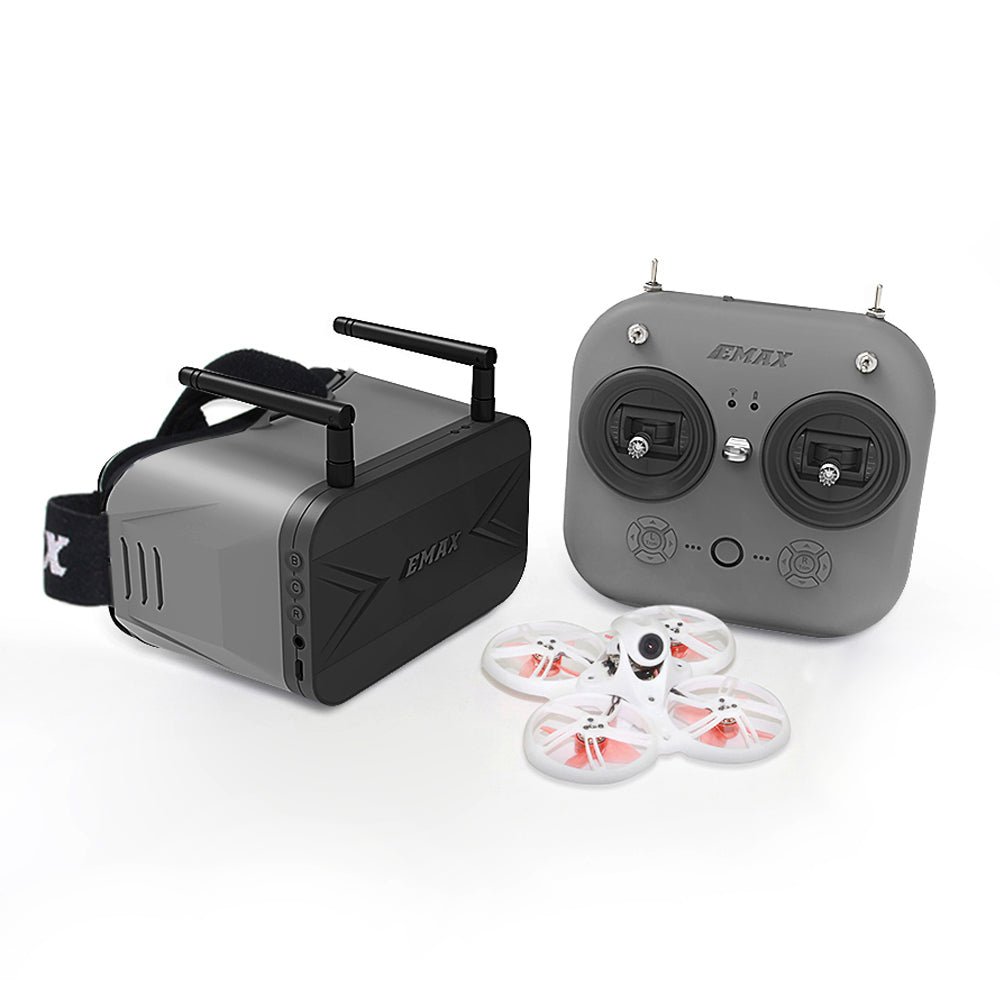
EMAX designed the EZ Pilot Pro around one idea: a first FPV aircraft that a child, a student or a nervous adult can fly without a coach. It is a self-levelling 75mm brushless whoop with 08025 II 15000KV motors, a MATEKF411 flight controller with 6A ESC and a 1200TVL E01 camera, all in a soft, deliberately flexible frame that bounces instead of breaking. The clever part is the goggles: the Transporter 2 screen detaches, so one person can fly in FPV while everyone else watches the same feed on a handheld monitor, which is exactly what you want in a classroom or a living room. It uses FrSky D8 SPI, so treat the radio as part of this kit rather than a long-term investment.
✅ Pros: Genuine self-levelling; detachable screen for shared viewing; very forgiving flexible frame; only 32.5 g.
❌ Cons: FrSky D8 SPI link; short 1S 450 mAh flights; you will outgrow it faster than the Aquila16 or Cetus X.
🎯 Verdict: The right pick when the pilot is a kid or a STEM class. For an adult who intends to progress, spend the same money on the Aquila16 instead.
🛒 How to Choose the Right FPV Kit
🏠
Never flown anything before?
Get the BETAFPV Cetus Pro. Optical-flow hover means it will not fly away from you on flight one.
🎒
Want one kit that lasts?
The Aquila16 pairs ELRS with ~8 minute flights, so it stays useful long after you can fly acro.
🌳
Flying outdoors in wind?
Step up to the Tinyhawk III Plus Freestyle. Its 2.5″ props and carbon frame handle real weather.
🎬
Care about the footage?
The CaddxFPV Protos gives you Walksnail 1080p/60 HD and three batteries for well under DJI money.
🧑💻
Want to tinker in Betaflight?
The Cetus X (Betaflight FC) or any Tinyhawk gives you a stock F4 target you can flash and tune.
👨👩👧
Buying for a kid or a class?
The EZ Pilot Pro self-levels and its screen detaches so a group can watch the same FPV feed.
⚙️ Key Specs Compared, Side by Side
| Spec | Cetus Pro | Aquila16 | Tinyhawk III Plus FS | Protos RTF | Cetus X |
|---|
| Wheelbase / Prop | 65 mm · 40 mm | 86 mm · 45 mm | 110 mm · 2.5″ ⭐ | 1.6″ class | 95 mm · 2020 |
| Motors | 1102 18000KV | 1102 18000KV | 12025 7000KV | 1102 14000KV | 1103 11000KV ⭐ |
| Video System | Analog 25 mW | Analog 25–350 mW | Analog 25–400 mW | Digital 1080p/60 ⭐ | Analog 25–400 mW |
| Radio Link | FrSky D8 | ELRS 3.0 serial ⭐ | ELRS 2.4G | ELRS 2.4G | ELRS 2.4G |
| Flight Time | 4–5 min | ~8 min | ~4 min | ~10 min × 3 packs ⭐ | ~5 min |
| Self-levelling / Hold | Optical flow + laser ⭐ | N/S/M modes | Betaflight angle | Position hold | Angle / horizon |
| Betaflight Access | No | No | Yes (F411) ⭐ | Limited | Yes (F4 2S) ⭐ |
| Weight (dry) | 33 g ⭐ | 47 g | 62.5 g | ~100 g | ~50 g |
Specs are taken from the manufacturers’ own product pages. Flight times are best-case on the supplied packs and drop sharply in cold weather or aggressive flying. Always confirm the exact variant on the live Amazon listing.
❓ Frequently Asked Questions
Do I really need a simulator before flying an FPV drone?
Yes, and it is the single highest-return thing you can do. FPV in acro mode has no self-levelling: the quad holds whatever attitude you leave it in, so recovering from a wobble is a learned reflex, not intuition. Every radio in this guide enumerates as a USB joystick, so plug it into a PC and spend a few hours in Liftoff, Velocidrone, DRL or the free FPV.SkyDive first. Pilots who skip this step typically destroy props, motors and cameras during week one; pilots who do it usually fly their first pack without a single hard crash.
What happened to the Holybro Shuriken, and should I still buy one?
The Shuriken 180 and 250 were excellent racing quads in their day, but that day was 2016–2017. They shipped with F3-era flight controllers, FrSky or Futaba receivers and 25 mW analog VTXs, and Holybro has long since moved on to autopilot and PX4 hardware. The listings you still find are old stock or third-party resellers, and spare frames and arms are effectively gone. If you like the idea of a compact racer, buy a current 2.5″ or 3″ quad such as the Tinyhawk III Plus Freestyle instead. You get ExpressLRS, a modern F4/F7 target and parts you can still order.
Analog or digital video for a first kit?
Start analog unless the footage is the point. Analog 5.8 GHz costs a fraction as much, has essentially zero latency, and, most usefully for a beginner, fails gracefully: as you fly out of range the picture gets noisy long before it disappears, giving you time to turn back. Digital systems such as Walksnail and HDZero look far better and record clean 1080p, but they hold a perfect image right up to the point where they drop out completely, which is a nastier failure mode when you are learning. Move to digital once you can fly home on a snowy analog picture.
Do I need to register these drones or take a test?
Rules vary by country, so check your own regulator. In the United States, every recreational flyer must pass the free online TRUST safety test and carry proof of it, regardless of aircraft weight. FAA registration is required for aircraft weighing 250 g or more, and every kit in this guide is well under that, typically 32–100 g, so registration generally does not apply, but the TRUST test still does. You must also keep the aircraft within visual line of sight, which in practice means having a spotter next to you while you are in goggles.
What should I buy alongside the kit?
Three things, in order. First, more batteries. Four or six extra packs turn a five-minute hobby into an hour-long session, and a multi-port 1S charger such as a WhoopStor pays for itself immediately. Second, spare propellers, which are pennies and are the part you will actually break. Third, a microSD card for the goggles’ DVR if your kit records, because reviewing your own flights is the fastest way to spot bad habits. A cheap soldering iron and a spare motor become worthwhile a month or two in, once you start replacing parts instead of whole aircraft.
🏁 Final Verdict: Best FPV Kit for Every Pilot
The right beginner FPV kit for every goal and budget:
🥇 Best Overall: BETAFPV Cetus Pro, optical-flow hover, three flight modes, safest first flight
Buy →🏅 Best Value: BETAFPV Aquila16, ELRS 3.0, ~8 minute flights, DVR goggles
Buy →🎯 Best for Outdoor Freestyle: EMAX Tinyhawk III Plus Freestyle, a 2.5″ carbon quad on stock Betaflight
Buy →🖥️ Best HD Digital: CaddxFPV Protos RTF, Walksnail 1080p/60, three packs, fast hub charger
Buy →💨 Best 2S Outdoor Whoop: BETAFPV Cetus X, 1S/2S flexibility with full Betaflight access
Buy →🛠️ Most Proven & Repairable: EMAX Tinyhawk III RTF, RunCam Nano 4, spares everywhere
Buy →🪶 Best Ultra-Light Outdoor: EMAX Tinyhawk Lite Adventure, ~59 g, brushed and gentle, ELRS link
Buy →🧒 Best for Kids & Classrooms: EMAX EZ Pilot Pro, self-levelling with a detachable shared screen
Buy →There is no single best FPV kit, only the right one for how you want to start. If you have never flown, the BETAFPV Cetus Pro removes almost all the risk from your first session. If you want one purchase that stays useful, the Aquila16 is the smartest buy on this list thanks to ELRS and genuinely usable flight times. Head outdoors and the Tinyhawk III Plus Freestyle is the one that handles wind; care about footage and the CaddxFPV Protos brings HD digital within reach. Whichever you pick, budget for extra batteries, spend the simulator hours first, and treat the included radio as a starting point rather than a forever purchase. If you enjoy the electronics side as much as the flying, our Arduino, ESP32, STM32 and Raspberry Pi tutorials are a natural next step, because flight controllers are just STM32 boards with very good firmware.
💬 Not sure which kit fits you? Tell us where you plan to fly, whether that is a living room, a park or a football field, and what you want to end up doing, and we will point you to the right pick in the comments below.
All Amazon links above use our affiliate tag (microlab05-20). Purchasing through them supports microcontrollerslab.com at no extra cost to you. Prices, variants and availability change frequently, so always confirm the current listing on Amazon before buying.