⚠️ Affiliate Disclosure: This post contains Amazon affiliate links. If you purchase through our links, we may earn a small commission at no extra cost to you. We only recommend kits we have researched and whose listings we checked live on Amazon. Prices, bundles and stock change constantly, so we deliberately do not print prices here. Always tap through and confirm the current price and variant before buying.
Ultimate Buying Guide
⚙️ Best Tank Robot Kits and Tracked Chassis for Arduino, Raspberry Pi & ROS
7 tracked robot kits and chassis ranked, from a sixty dollar Arduino mini tank to a metal Raspberry Pi tank with a 4-DOF arm and a lidar equipped ROS SLAM platform, plus the bare suspension chassis you should buy if you want to design the electronics yourself.
✅ 7 Tracked Platforms Reviewed
✅ Live Amazon Listings
✅ Arduino · Python · ROS
✅ Honest Pros & Cons
A tank robot solves a problem that wheeled robot cars quietly fail at. Two rubber tracks spread the robot’s weight over a long contact patch instead of four small circles, so a tracked platform climbs carpet edges, door thresholds, gravel, grass and small steps that stop a typical 4WD chassis dead. Tracks also give you skid steering with a genuine zero radius turn, which means the robot can spin in place inside a doorway rather than reversing and shuffling. If your project lives anywhere other than a clean office floor, that difference is the whole reason to buy tracks.
The trade you accept is friction. Skid steering scrubs the tracks sideways every time the robot turns, so a tank draws noticeably more current than a wheeled robot of the same weight, and it is far harder to do accurate odometry because the tracks slip by design. That is why encoder motors and an IMU matter more on a tank than they do on a car. This guide ranks 7 tank robot kits and tracked chassis across three groups: complete kits with electronics and a curriculum, Raspberry Pi tanks with a camera and a robotic arm, and bare chassis for people who want to design their own stack.
💡 Reality check before you buy: Tracks are a maintenance item, not a fit and forget part. Rubber and plastic treads stretch, throw off the sprocket on hard turns and eventually need re-tensioning, so budget a spare set for anything you plan to drive hard. Expect a real build: most of these are screw by screw assemblies of laser cut acrylic or anodised aluminium, and four to six hours is normal for the kits with a robotic arm. Expect a power problem too, because skid steering means both motors are fighting the ground during every turn, and a tank will flatten a battery pack considerably faster than a wheeled car of the same size. Finally, a bare chassis is exactly that: no controller, no motor driver, no battery and no sensors, so price the electronics before you decide a chassis is the cheap option.
🦿 What about the DFRobot Devastator? The Devastator Tank Mobile Platform is the tracked chassis most makers remember, and DFRobot still documents and sells it on its own store. We checked both Amazon listings while writing this guide, the standard Devastator and the metal DC gear motor version, and neither currently has a featured offer or an add to cart button. Because every link in this guide has to point at a listing you can actually buy today, we left it out of the ranking rather than sending you to a dead page. If the Devastator is what you had in mind, the closest live equivalents here are the Hiwonder suspension tracked chassis for a metal platform with encoder motors, and the Hiwonder tank car chassis for a simpler, cheaper Devastator style base. Both take the same DIY approach: you supply the brain.
🤖 Quick Comparison: All 7 Tank Robot Kits and Chassis
| Tank Kit / Chassis | Type | Brain & Sensors | Programming | Best For | Buy |
|---|
| 🥇 ELEGOO Conqueror Tank | Complete kit, steel chassis | UNO R3 + ESP32-WROVER, OV2640 camera, ultrasonic, IR line sensors | Block coding · Arduino IDE | Best Overall | Buy Here → |
| 🦾 Adeept RaspTank Metal | Pi tank, aluminium, 4-DOF arm | Raspberry Pi (not included), camera, ultrasonic, OLED, RGB | Python · OpenCV | Best for Manipulation | Buy Here → |
| 🔰 Keyestudio Mini Tank | Complete beginner kit | Arduino compatible board, ultrasonic, light sensors, 8×16 LED panel | Mixly blocks · Arduino IDE | Best First Tank | Buy Here → |
| 🛰️ XiaoR Geek ROS SLAM Tank | Research platform, alloy tracks | Raspberry Pi 4B 4GB included, XR-Lidar S1, HD camera, 3.5″ touch screen | ROS · Python · C | Best for SLAM & Navigation | Buy Here → |
| 💰 Adeept RaspTank | Pi tank, acrylic, 4-DOF arm | Raspberry Pi (not included), camera, ultrasonic, USB-C charging | Python · OpenCV | Best Value Pi Tank | Buy Here → |
| 🏗️ Hiwonder Suspension Chassis | Bare chassis, sprung metal | None. Encoder DC gear motors, spring suspension, expansion deck | Your choice | Best for Custom Builds | Buy Here → |
| 🧱 Hiwonder Tank Car Chassis | Bare chassis, metal frame | None. High torque DC gear motors, 6–12 V, plastic tracks | Your choice | Cheapest Way Into Tracks | Buy Here → |
Specs come from the current Amazon listings and manufacturer documentation. Several of these platforms sell in multiple bundles, with or without a controller board, with or without batteries, and in different chassis colours and motor options, so check exactly which variant a listing is selling. We deliberately do not publish prices because they move constantly. Tap through and check the live price yourself.
🔍 What to Look for in a Tank Robot Kit
🔗
Track Material and Tensioning
This is the part that fails first, and almost nobody checks it before buying. Moulded rubber tracks grip best and are quietest, but stretch with heat and use. Linked plastic treads are cheap and repairable one link at a time, but they rattle and shed links on sharp turns. What matters more than material is whether the chassis gives you a tensioning adjustment, usually a slotted idler mount you can slide. A platform with no way to re-tension a stretched track is a platform that will start throwing tracks and never stop.
⚙️
Motor Torque and Encoders
Skid steering means both tracks scrub sideways through every turn, so a tank needs meaningfully more torque than a wheeled robot of the same mass. Look at the gear ratio rather than the RPM figure: a 1:48 or slower geared motor will climb, a fast unreduced motor will just spin the tracks. If you intend to write any kind of closed loop control, buy the encoder motor variant from the start. Retrofitting encoders to a tracked chassis is far more painful than paying for them up front, and without them your odometry is guesswork.
🔋
Power Budget and Battery
Tracks are hungry. Stall currents on a loaded tracked platform are high enough that a shared 5 V rail will brown out a Raspberry Pi mid turn, which shows up as random reboots people blame on software. Check whether the kit gives the controller a regulated supply separate from the motor rail, what battery it ships with, and whether you can charge without stripping the robot. Kits that include 18650 cells with USB-C charging save you a genuinely annoying accessory hunt.
📷
Camera, Gimbal and Arm
A tank is a natural inspection and manipulation platform, so the payload on top decides what the project actually becomes. A two axis camera gimbal turns an FPV toy into a target tracking exercise, because a fixed camera makes visual servoing nearly pointless. A 4-DOF arm turns the same chassis into a pick and place problem with real inverse kinematics. Check how the camera is mounted too: several kits rivet the module in place, which means a dead camera is not user replaceable.
📚
Documentation and Open Code
Once the mechanics are bolted together, software support is the entire experience. The vendors worth buying from publish versioned online documentation and a public GitHub repository you can read, fork and fix. The ones worth avoiding ship a download link on the box and a zip that assumes a three year old OS release. Before you buy, open the vendor’s docs site and repo, check the last commit date, and see whether the install steps name a specific Raspberry Pi OS or Arduino IDE version.
🏆 Detailed Reviews: All 7 Tank Robot Kits and Chassis
🥇 BEST OVERALL
1. ELEGOO Conqueror Robot Tank Kit
⭐ 4.5/5 · The Complete Arduino Tank Done Right
Stainless Steel
CHASSIS + SUSPENSION
5 Modes
FPV · IR · AVOID · LINE · FOLLOW
UNO R3 + ESP32
BOTH INCLUDED
~2 Hours
7.4 V PACK, LINE MODE

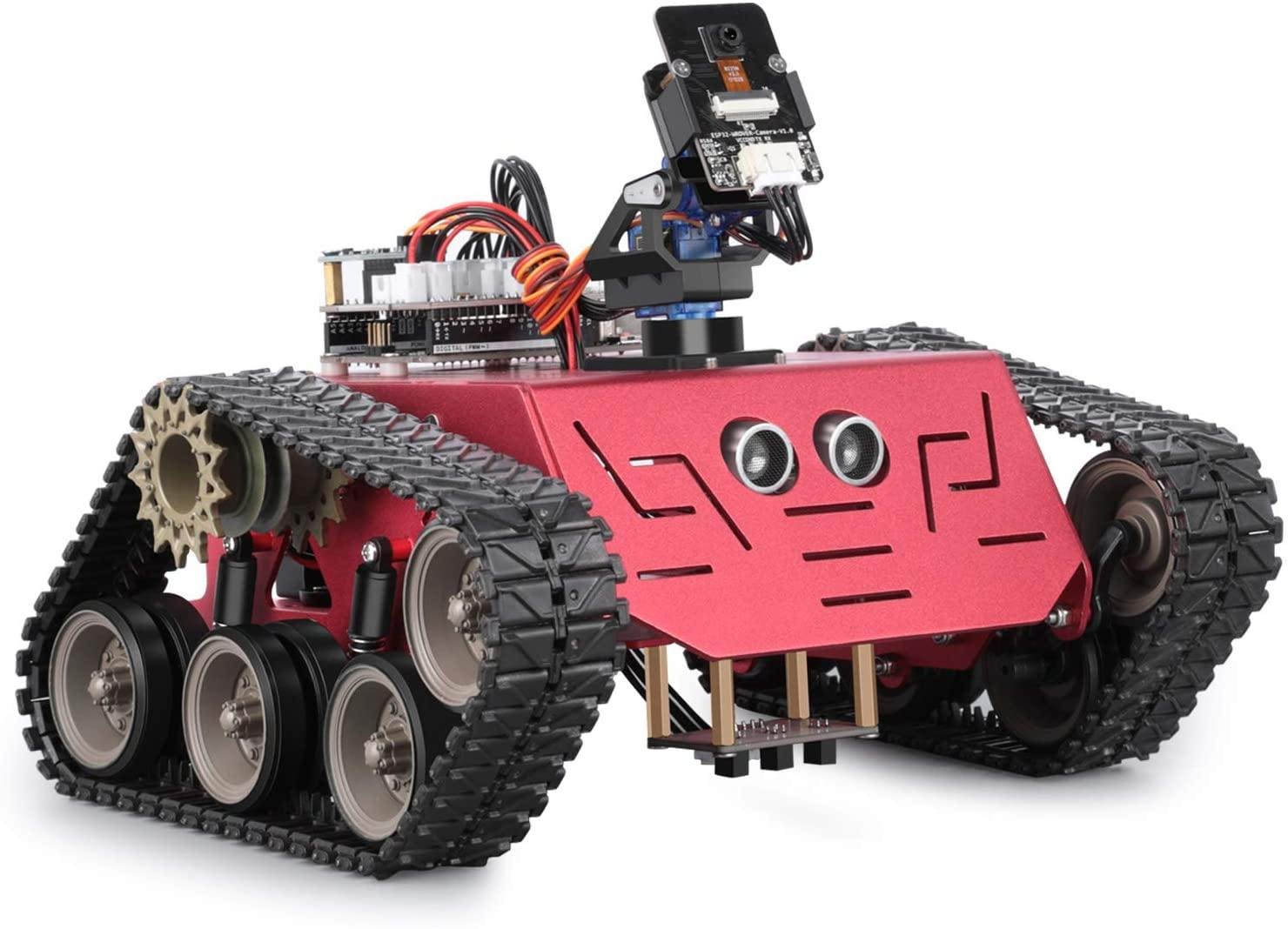
The Conqueror is the tank we would hand to almost anyone who wants a tracked robot that works on the day it is finished, and it is the best rounded package in this guide. The chassis is stainless steel with a sprung road wheel suspension, which is why owners report it climbing terrain that stops plastic robot cars, and it is heavy enough to feel like a machine rather than a toy. Electrically it is two brains working together: an UNO R3 runs the control loop through a dual channel DRV8835 driver into 1:48 geared motors, while an ESP32-WROVER streams OV2640 video over Wi-Fi for FPV driving. On top sits a two degree of freedom gimbal on a pair of SG90 servos, so you can pan and tilt the camera while driving. Five modes ship working out of the box, FPV, IR remote, ultrasonic obstacle avoidance, infrared line tracking and auto follow, and the software path runs from block coding in the ElegooKit app up to editing motor speeds and sensor thresholds in the Arduino IDE. Assembly is solder free and the illustrated instructions are consistently the thing reviewers praise most.
✅ Pros: Genuinely rugged stainless steel chassis with suspension; UNO R3 and ESP32 camera module both included; five working modes on day one; excellent illustrated instructions and no soldering; clean upgrade path from blocks to Arduino IDE; the highest rating and largest review count of any kit here.
❌ Cons: Multiple reviewers report the app connection and camera gimbal controls being flaky over Wi-Fi; the metal frame blocks the IR receiver from most angles, so remote control only works from behind and low; the line tracking module hangs low enough to snag and bottom out on rough ground; priciest of the Arduino kits here.
🎯 Verdict: The best all round tank robot kit on Amazon right now, and the one to buy if you want mechanics you can trust and a curriculum you can grow into. Treat the app as a bonus and the Arduino IDE as the real interface.
👉 Check Price on Amazon →
🦾 BEST FOR MANIPULATION
2. Adeept RaspTank Metal
⭐ 3.8/5 · A Raspberry Pi Tank That Picks Things Up
Aluminium
FULL METAL CHASSIS
Pi 5 → 3B
BOARD NOT INCLUDED
1.5–3 h
ASSEMBLY, AGES 16+

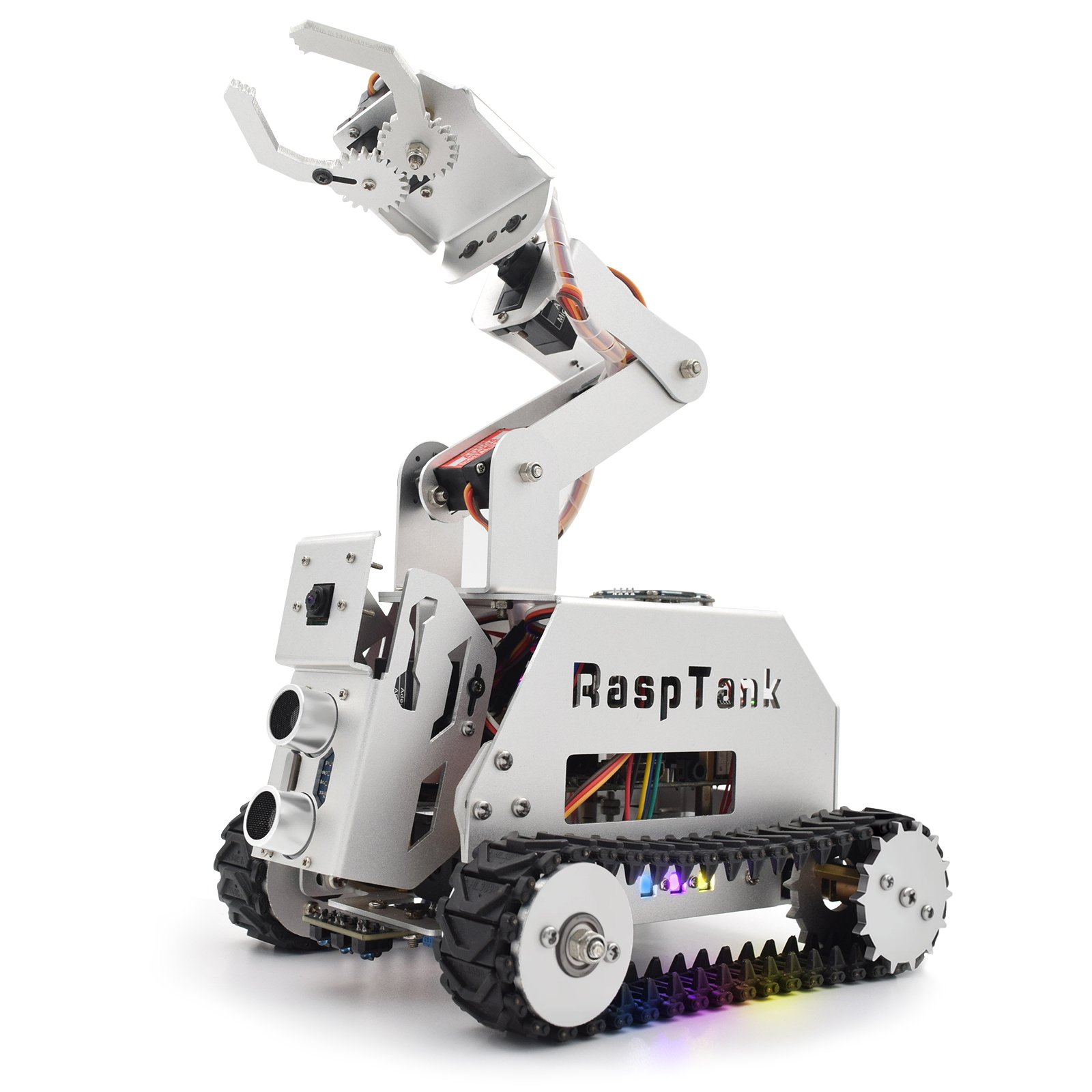
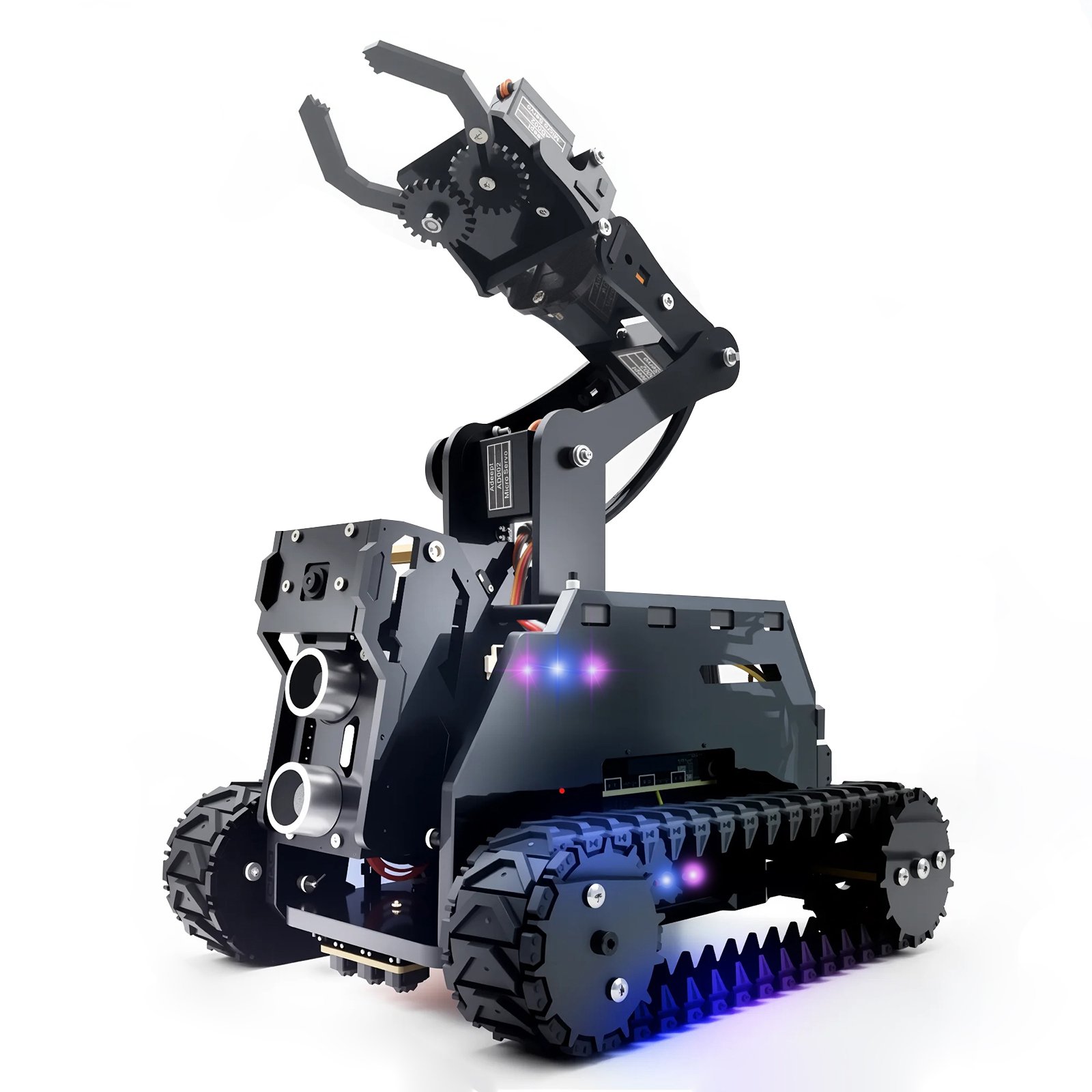
The RaspTank Metal is the kit to buy when you want the tank to do something with its surroundings rather than just drive through them. Everything structural is anodised aluminium alloy, including the 4-DOF robotic arm and gripper on the deck, which is the feature that separates this from every other Pi robot in its price band: you get a mobile base and a manipulator on the same power system, which is the actual shape of a real service robot. Adeept supports Raspberry Pi 5, 4B, 3B and 3B+, and as always the board is not included. The software is Python throughout, with OpenCV driving computer vision line tracking and target recognition alongside the conventional infrared line sensors and ultrasonic obstacle avoidance, plus real time video streaming, an OLED status display and addressable RGB lighting. Adeept publishes proper multi hundred page tutorials and keeps its code on GitHub, which is the main reason we rank it above the several unbranded arm tanks on Amazon. Assembly is quoted at 1.5 to 3 hours and it is genuinely an intermediate build.
✅ Pros: The only kit here that combines tracks with a real 4-DOF arm and gripper; full aluminium construction; supports the Pi 5 as well as older boards; OpenCV vision plus classic sensors in one Python codebase; documented tutorials and public source; faster build than the acrylic version.
❌ Cons: Only a small number of reviews so far and a middling average score; no Raspberry Pi, SD card or batteries in the box, so the real cost is well above the listed price; four hobby servos in the arm will need calibration and eventually a spare; stock on this listing has been thin.
🎯 Verdict: Buy this if the interesting part of your project is what happens after the robot arrives somewhere. Budget for the Pi and cells before you compare it against complete kits.
👉 Check Price on Amazon →
🔰 BEST FIRST TANK · ⭐ 4.1/53. Keyestudio Mini Tank Robot Kit
Arduino compatible · 4 control modes · ultrasonic and light following · 8×16 LED panel · Mixly blocks and Arduino IDE · 15 guided projects
Buy Here →

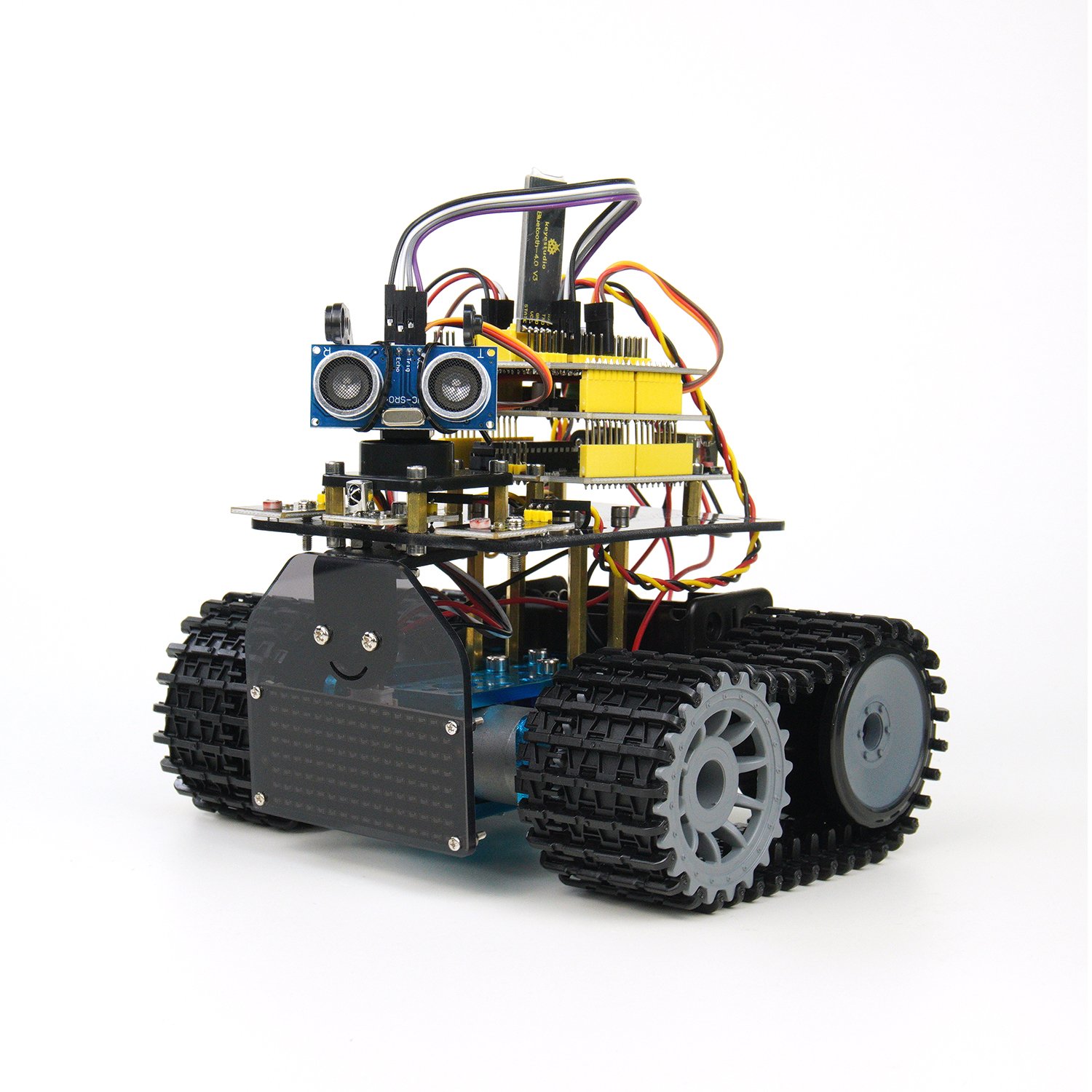
The Keyestudio Mini Tank is the cheapest complete tank robot here and the sensible answer to “I want tracks but I have never built a robot”. It is small, it is Arduino compatible, and Keyestudio structures the learning as 15 online projects that start at blinking an LED and end with the robot fully assembled and driving, which is a much better teaching pattern than handing someone a finished sketch. It gives you four control modes, IR remote, a phone app over an HM-10 Bluetooth module, ultrasonic obstacle avoidance and following, and light following, and the 8×16 LED dot matrix panel on the front is a nice touch because it gives beginners a visible state display for their code. Electrically it is modest and honest: a DRV8833 motor driver, 5 V 200 RPM motors, a 6 to 9 V input, ultrasonic ranging from roughly 2 cm to 3 m, about 10 m of IR range and around 30 m of Bluetooth range. The programming path runs from Mixly graphical blocks into the Arduino IDE. What you are not getting is climbing ability, because this is a small plastic tracked platform with light motors rather than the sprung steel of the Conqueror.
✅ Pros: Cheapest complete tank kit in this guide; genuinely well structured 15 project curriculum; four control modes including a Bluetooth app; LED matrix makes program state visible; good review count for its class; Mixly to Arduino IDE progression suits classrooms.
❌ Cons: No camera and no FPV at all; light plastic build that will not climb what the steel kits climb; small motors and a modest power budget; several listing variants across V2 and V3 with different bundles, so read the title carefully.
🎯 Verdict: The right first tank for a student, a classroom set or anyone who wants to learn Arduino with tracks under it. Buy the Conqueror instead if you want terrain and a camera.
🛰️ BEST FOR SLAM & NAVIGATION · ⭐ 3.9/54. XiaoR Geek ROS SLAM Lidar Tank
Raspberry Pi 4B 4GB, TF card and battery pack included · XR-Lidar S1 · HD camera · 3.5 inch touch display · aluminium tracked chassis · ROS with Python and C
Buy Here →
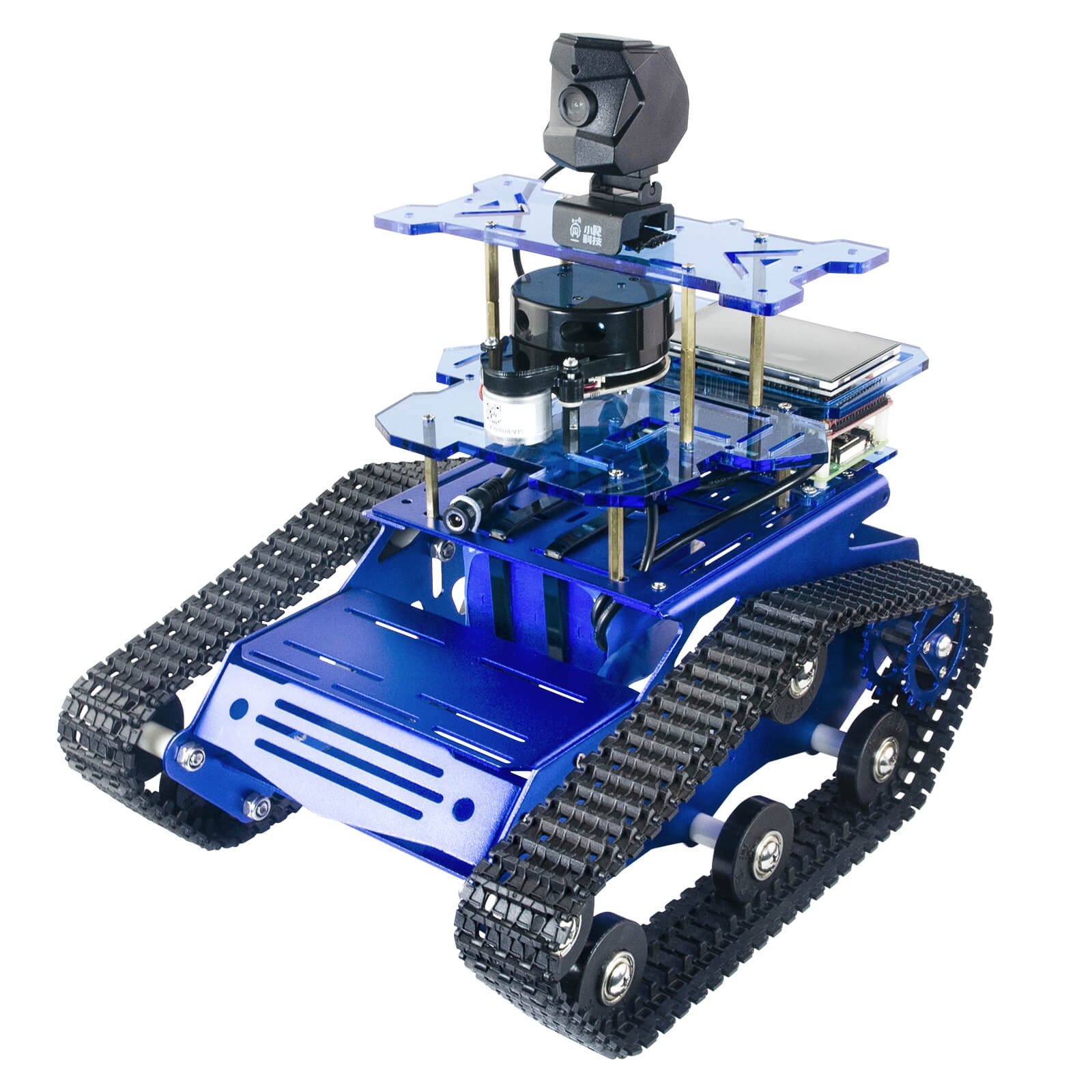
This is the only platform in the guide that arrives ready to do real SLAM, and it is priced accordingly. XiaoR Geek builds it around a Raspberry Pi 4B with 4 GB, and unusually for this category the board, TF card and battery pack are all in the box, which changes the price comparison considerably once you account for what the other Pi kits leave out. The sensing is what you are paying for: an XR-Lidar S1 for scanning and ranging, an HD camera and a 3.5 inch touch display mounted on the deck so you can drive the robot without SSH. On top of ROS it ships mapping, fixed point and multi point navigation, autonomous driving, obstacle avoidance, object tracking and camera patrol, programmable in Python and C. A tracked base is a sensible choice for a SLAM robot because it stays planted on the uneven floors where a small wheeled rover gets stuck, though you should expect track slip to make wheel odometry unreliable and to lean harder on the lidar and IMU. The caveats are the price, the small number of reviews, and documentation that is translated and occasionally rough.
✅ Pros: Lidar, camera, touch screen, Raspberry Pi 4B 4GB and battery all included; a genuine ROS platform rather than a Python demo set; aluminium tracked chassis suits real floors; mapping and multi point navigation work out of the box; strong basis for a university or lab project.
❌ Cons: By far the most expensive option here; low review count and a middling average; documentation is translated and can be rough going; ROS is a steep first step; several confusingly similar XiaoR Geek variants, some with mecanum wheels rather than tracks.
🎯 Verdict: The right buy if your destination is SLAM, navigation stacks and ROS on real hardware. Confirm the listing you open is the tracked variant with the Raspberry Pi included.
💰 BEST VALUE PI TANK · ⭐ 3.4/55. Adeept RaspTank
Laser cut acrylic · 4-DOF arm and gripper · Pi 4B, 3B and 3B+ (not included) · USB-C 18650 charging · OpenCV vision line tracking · 300+ page tutorials, 20+ projects
Buy Here →
The original RaspTank is the acrylic version of the kit above, and for a lot of people it is the smarter buy. You keep the thing that matters, the 4-DOF arm with a gripper on a tracked base, and you give up the anodised aluminium in exchange for laser cut acrylic and a lower price. It has by far the largest review history of any Raspberry Pi tank on Amazon, which is worth something in a category full of listings with single digit review counts. The functional set is close to the metal version: obstacle avoidance, infrared line tracking, OpenCV computer vision line tracking, target recognition, Wi-Fi remote control, real time video and RGB lighting, all in editable Python. The nicest practical detail is the power system, which charges 18650 cells over USB-C with overcharge protection and lets you operate the robot while it charges, so you are not unbolting the chassis to swap cells. Adeept quotes a 4 to 6 hour build for ages 16 and up, and includes over 300 pages of tutorials with more than 20 coding projects. Board support stops at the Pi 4B, so Pi 5 owners want the metal version instead.
✅ Pros: Same 4-DOF arm and OpenCV feature set for less money; much longer review history than any other Pi tank here; USB-C charging with drive while charging; over 300 pages of tutorials and 20+ projects; a great platform for learning inverse kinematics on a budget.
❌ Cons: Mediocre average rating, with build difficulty and servo quality the recurring complaints; acrylic parts are brittle and crack if you overtighten; no Raspberry Pi 5 support; 4 to 6 hour assembly is long for a first robot; board, SD card and cells not included.
🎯 Verdict: The value pick for a Raspberry Pi tank with an arm, as long as you already own a Pi 4B or older and you are patient with acrylic. Pi 5 owners should pay up for the metal version.
🏗️ BEST FOR CUSTOM BUILDS · ⭐ 4.3/56. Hiwonder Suspension Tracked Chassis
Bare chassis · anodised aluminium alloy · 8-channel carbon steel tension spring suspension with micro bearings · encoder DC gear motors · removable top deck · Arduino, Raspberry Pi and Jetson ready
Buy Here →

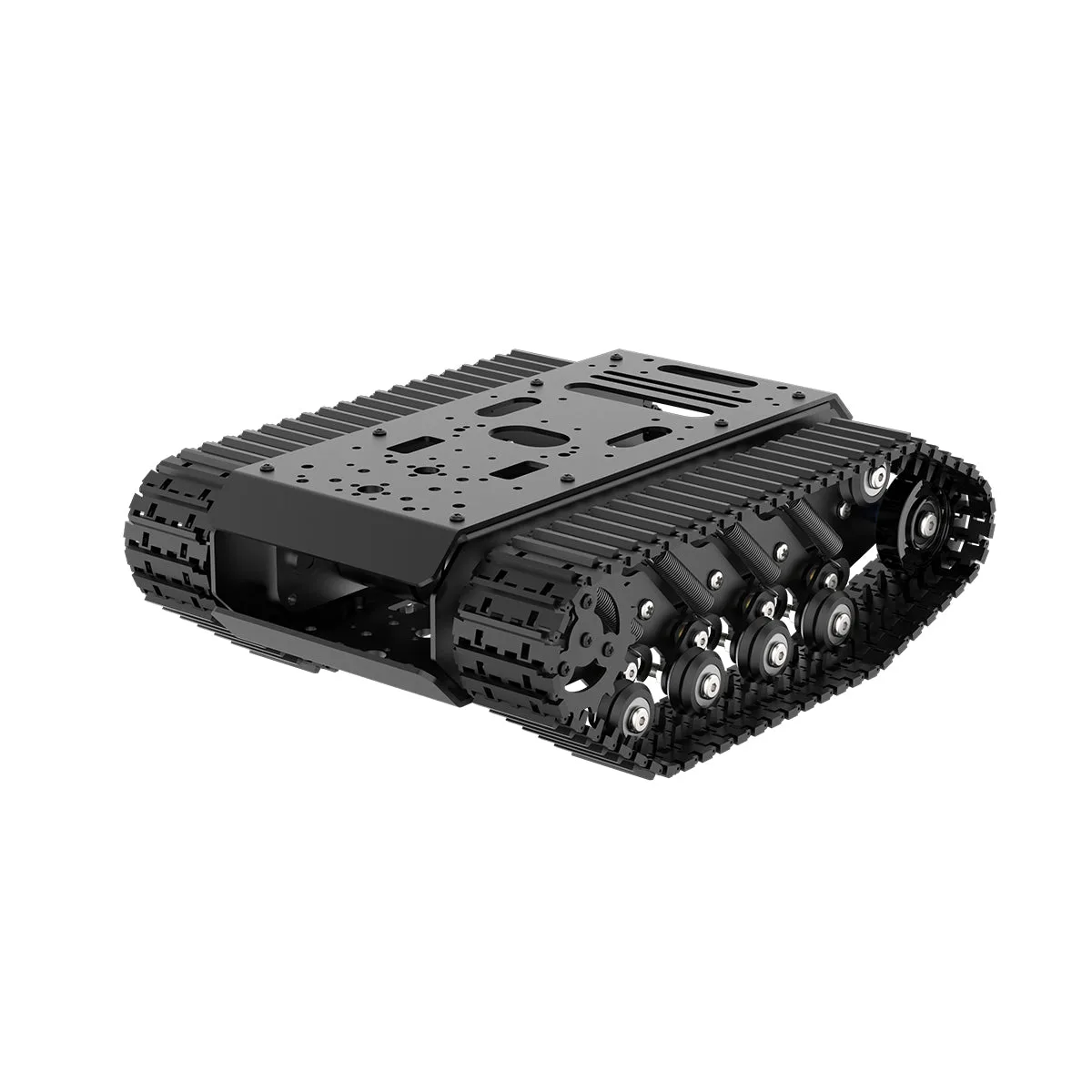
If you are an embedded engineer rather than a kit builder, this is the one to buy. Hiwonder sells it as a bare platform, which means no controller, no driver board, no battery and no sensors, and that is exactly the point: you bring your own stack instead of unpicking someone else’s. The mechanics are the reason to pick it over the cheap chassis on Amazon. The body is anodised aluminium alloy, the running gear uses an eight channel high elasticity carbon steel tension spring suspension riding on micro bearings, and that combination is what lets a tracked robot stay planted and keep both tracks loaded over uneven ground instead of skipping. Crucially, the recommended variant ships encoder DC gear motors, so you can close the loop, implement PID speed control and attempt odometry rather than driving open loop PWM and hoping. The top deck lifts off for wiring, and the frame is drilled with expansion ports for the usual suspects, Arduino, Raspberry Pi and Jetson Nano. This is the platform for an ESP32 or STM32 motor control project, a ROS 2 hardware interface you write yourself, or an outdoor rover.
✅ Pros: Real spring suspension on bearings, not a rigid plate with tracks bolted to it; anodised aluminium build quality; encoder motors make closed loop control and odometry possible; removable top deck makes wiring sane; total freedom over controller, driver and sensors; the highest rated bare chassis we found.
❌ Cons: Nothing electronic in the box, so the true project cost is much higher than the listing; no tutorials or curriculum whatsoever; sold in several motor and colour variants that are easy to confuse, including a cheaper non encoder option; modest review count; you are on your own for the software.
🎯 Verdict: The right chassis if you already know what you want to bolt to it. Make sure the variant you add to the cart is the encoder motor version, because that is the whole reason to choose it.
🧱 CHEAPEST WAY INTO TRACKS · ⭐ 4.2/57. Hiwonder Tank Car Chassis Kit
Bare chassis · full metal frame · high torque DC gear motors · 6–12 V supply · engineering plastic tracks · multiple expansion ports for Arduino, Raspberry Pi and Jetson Nano
Buy Here →

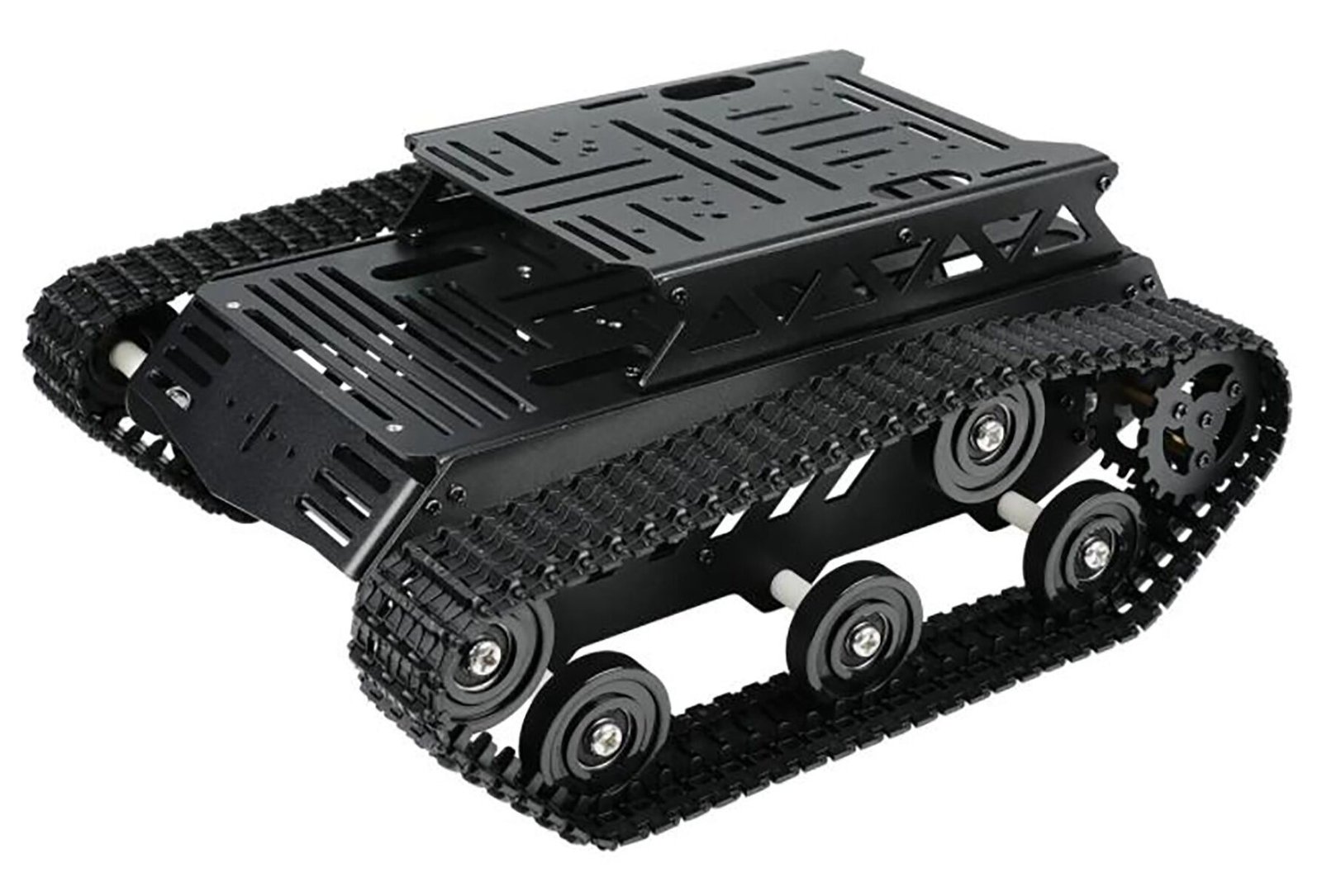
This is the simpler, cheaper sibling of the chassis above and the closest live replacement for the discontinued DFRobot Devastator. You get a full metal frame with a two layer deck, high torque DC gear motors running on anything from 6 to 12 V, and engineering plastic tracks chosen for elasticity and grip rather than looks. There is no suspension linkage and, on the base variant, no encoders, so this is an open loop platform: fine for teleoperation, an FPV rover, a sensor mule or a first tracked robot, and not the thing to pick if you want PID speed control. Where it earns its place is headroom. Running the motors at 12 V gives you noticeably more torque than any of the complete kits in this guide, and the plate is drilled for the usual controllers, so an ESP32-CAM rover, a Raspberry Pi inspection robot or a Jetson Nano vision platform all bolt straight on. It also sells in a couple of colours and motor options, including an encoder variant, so check which one the listing is actually selling.
✅ Pros: Cheapest route to a metal tracked platform; high torque motors that will happily run at 12 V; two layer deck with plenty of mounting holes; grippy engineering plastic tracks; genuinely brand agnostic, so it suits Arduino, ESP32, Pi and Jetson equally.
❌ Cons: No electronics, no battery and no tutorials at all; the base variant has no encoders, so closed loop control means upgrading; no suspension, so it skips more than the sprung chassis on rough ground; several near identical colour and motor variants to sort through before ordering.
🎯 Verdict: The cheapest honest way to get a metal tracked base under a project you are designing yourself. Spend the extra on the suspension chassis if odometry or rough terrain matter.
🛒 How to Choose the Right Tank Robot Kit
🤖
Want one kit that just works?
The ELEGOO Conqueror gives you a sprung stainless steel tank, an UNO R3, an ESP32 FPV camera on a two axis gimbal and five working modes, with no soldering and instructions people actually praise.
🦾
Want the robot to pick things up?
The Adeept RaspTank Metal puts a 4-DOF aluminium arm and gripper on a tracked base with OpenCV vision, which is the shape of a real mobile manipulation project.
🔰
First robot ever, or a class set?
The Keyestudio Mini Tank is the cheapest complete kit here and teaches through 15 staged projects rather than one finished sketch, with Mixly blocks leading into the Arduino IDE.
🗺️
Heading for ROS and SLAM?
The XiaoR Geek ROS SLAM Tank arrives with a lidar, an HD camera, a touch screen and a Raspberry Pi 4B already in the box, and does mapping and multi point navigation out of the box.
💰
Want an arm on a budget?
The acrylic Adeept RaspTank keeps the 4-DOF arm and the OpenCV feature set for less money, and has the longest review history of any Raspberry Pi tank on Amazon.
🏗️
Designing your own electronics?
The Hiwonder suspension tracked chassis gives you sprung aluminium running gear and encoder motors, which is everything you need for PID speed control and nothing you have to unpick first.
🧱
Just want cheap metal tracks?
The Hiwonder tank car chassis is the least expensive metal tracked base here, runs its motors up to 12 V, and takes an ESP32-CAM, a Pi or a Jetson Nano without modification.
⚠️
Buying a bare chassis?
Add a controller, a motor driver rated for the stall current, a battery, a charger and any sensors to your budget before you compare it against a complete kit. That total is usually the honest comparison.
⚙️ Key Specs Compared: Side by Side
| Spec | ELEGOO Conqueror | RaspTank Metal | Keyestudio Mini Tank | XiaoR Geek ROS | Hiwonder Suspension |
|---|
| Chassis material | Stainless steel ⭐ | Aluminium alloy ⭐ | Acrylic and plastic | Aluminium alloy | Anodised aluminium ⭐ |
| Suspension | Sprung road wheels | Rigid | Rigid | Rigid | 8-ch spring, bearings ⭐ |
| Controller included | UNO R3 + ESP32 ⭐ | No, Pi 5/4B/3B | Yes, Arduino compatible | Pi 4B 4GB included ⭐ | None, bring your own |
| Camera | OV2640, 2-DOF gimbal | Yes, on arm assembly | None | HD camera + lidar ⭐ | None |
| Robotic arm | None | 4-DOF + gripper ⭐ | None | None | None |
| Encoder motors | No, 1:48 geared | No | No | Yes | Yes, on encoder variant ⭐ |
| Programming | Blocks · Arduino IDE | Python · OpenCV | Mixly · Arduino IDE | ROS · Python · C ⭐ | Anything you like |
| Assembly time | Moderate, no soldering | 1.5–3 hours | Short, beginner level ⭐ | Largely preassembled | Chassis only |
| Amazon rating | 4.5 / 5 (331) ⭐ | 3.8 / 5 (26) | 4.1 / 5 (258) | 3.9 / 5 (16) | 4.3 / 5 (30) |
Ratings and review counts were read from the live Amazon listings while this guide was written and will drift over time. Bare chassis listings sell in several motor and colour variants, so confirm you are buying the encoder version if closed loop control matters to you.
❓ Frequently Asked Questions
Are tracked robots actually better than wheeled robot cars?
Better at some things, worse at others. Tracks spread the robot’s weight over a long contact patch, so they climb carpet edges, thresholds, gravel and small steps that stop a four wheel chassis, and skid steering gives a true zero radius turn that is very useful indoors. The costs are real though: tracks scrub sideways through every turn, which means higher current draw, more wear and a much shorter battery life than a wheeled robot of the same weight. Tracks also slip by design, so wheel odometry is unreliable and you will lean on an IMU or lidar for pose. If your robot lives on smooth floors and you care about efficiency or dead reckoning accuracy, a wheeled chassis is the better engineering choice.
Should I buy a complete tank kit or a bare chassis?
It depends on which part of the project you actually want to do. A complete kit hands you working firmware, matched sensors and a curriculum, so you are learning software on hardware that already runs, and that is the right choice for a first robot, a classroom or anyone whose goal is the code. A bare chassis is right when the electronics are the project: your own board, your own motor driver, your own power design. Just be honest about the total. Once you add a controller, a driver rated for the stall current, a battery, a charger and sensors, a bare chassis build usually costs more than a complete kit, not less. You are paying for freedom, not savings.
Do I need encoder motors on a tank robot?
If you want closed loop control, yes, and you should buy them with the chassis rather than retrofitting later. Without encoders you are commanding PWM duty and hoping, which means the robot veers as the battery sags, drives at different speeds on carpet and tile, and cannot hold a straight line. Encoders let you run a PID speed loop per track, which fixes all of that and is the foundation for anything resembling odometry. Be aware of the limit though: because tracks slip during skid steering, encoder based odometry on a tank drifts far faster than on a wheeled robot, so treat it as a good velocity estimate rather than a reliable position estimate, and fuse it with an IMU or lidar if position matters.
Why does my tank robot keep throwing a track?
Almost always tension, and it usually shows up on hard turns because that is when the track is being pushed sideways hardest. Work through it in order: re-tension the track using the idler adjustment if the chassis has one, check that the sprocket and idler are parallel and that no screw has worked loose, look for a bent axle or a road wheel that no longer spins freely, and reduce how aggressively you counter rotate the tracks in your turning code. Very tight turns at full duty are the single most common cause. If a track has genuinely stretched past adjustment, replace it. Treat tracks as consumables and keep a spare set for any robot you drive regularly.
Arduino or Raspberry Pi for a tank robot?
Choose by what the tank has to do. An Arduino or ESP32 gives you a deterministic loop, instant boot, microsecond timing and low power, which is what you want for the motor control layer, PID speed loops and reading sensors. A Raspberry Pi gives you Linux, a camera stack, OpenCV, Python libraries, SSH while the robot is moving and enough compute for ROS or machine learning, at the cost of boot time and timing jitter. The honest test is one question: does the project need a camera or a heavy library? If yes, buy a Pi tank. If no, an Arduino tank teaches you more per dollar. Serious builds use both, with the Pi doing perception and a microcontroller running the motor loop, and a tracked chassis with encoder motors is the natural base for exactly that split.
🏁 Final Verdict: Best Tank Robot for Every Build
The right tracked platform for every level, from a first Arduino tank to a lidar equipped ROS rover:
🥇 Best Overall · ELEGOO Conqueror Robot Tank: sprung stainless steel chassis, UNO R3 plus an ESP32 FPV camera on a two axis gimbal, five modes working out of the box
Buy Here →🦾 Best for Manipulation · Adeept RaspTank Metal: a 4-DOF aluminium arm and gripper on tracks, with OpenCV vision and Pi 5 support
Buy Here →🔰 Best First Tank · Keyestudio Mini Tank Robot: the cheapest complete kit here, taught through 15 staged projects from blocks to the Arduino IDE
Buy Here →🛰️ Best for SLAM and Navigation · XiaoR Geek ROS SLAM Tank: lidar, HD camera, touch screen and a Raspberry Pi 4B already in the box
Buy Here →💰 Best Value Pi Tank · Adeept RaspTank: the same 4-DOF arm and OpenCV feature set in acrylic, with the longest review history of any Pi tank
Buy Here →🏗️ Best for Custom Builds · Hiwonder Suspension Tracked Chassis: sprung aluminium running gear on bearings with encoder motors for real PID control
Buy Here →🧱 Cheapest Way Into Tracks · Hiwonder Tank Car Chassis: a metal tracked base with high torque motors that runs happily at 12 V and takes any controller
Buy Here →There is no single best tank robot kit, only the one that matches the project you actually want to build. For most people the ELEGOO Conqueror is the right buy: a sprung steel chassis that genuinely climbs, an UNO R3 and an ESP32 camera in the same box, and a clean path from block coding to the Arduino IDE. Take the Adeept RaspTank Metal if the interesting part is picking things up, the Keyestudio Mini Tank if this is a first robot or a class set, the XiaoR Geek ROS SLAM Tank if you are heading for mapping and navigation on real hardware, the acrylic RaspTank if you want that arm on a smaller budget, and one of the two Hiwonder chassis if the electronics are the project and you would rather design them yourself. Whichever you pick, buy a spare set of tracks, size your motor driver for stall current rather than running current, and then pair the build with our Raspberry Pi, ESP32, STM32 and Arduino tutorials so you end up writing your own control code instead of running the vendor demos forever.
💬 Not sure which tank robot kit fits your project? Tell us what you are building, whether that is an FPV inspection rover, a mobile manipulator, a ROS 2 learning platform or a classroom set, in the comments below, and we will point you to the right platform.
All Amazon links above use our affiliate tag (microlab05-20). Purchasing through them supports microcontrollerslab.com at no extra cost to you. Prices, bundles and availability change frequently, so always confirm the current listing and variant on Amazon before buying.