⚠️ Affiliate Disclosure: This post contains Amazon affiliate links. If you purchase through our links, we may earn a small commission at no extra cost to you. We only recommend products we have thoroughly researched and verified.
Ultimate Buying Guide 2026
⚡ Best Current & Voltage Sensors for Microcontrollers
6 sensors ranked for Arduino, ESP32, STM32 & Raspberry Pi — DC I²C monitors, analog Hall-effect sensors, AC voltage & non-invasive clamp CTs — with verified ASINs, real specs, and direct Amazon links.
✅ 6 Sensors Reviewed
✅ Verified Amazon ASINs
✅ Updated June 2026
✅ Honest Pros & Cons
Whether you’re building a battery management system, an energy monitor, a solar charge controller, or a motor-current watchdog, accurate current and voltage sensing is the backbone of your design. A wrong sensor choice — wrong voltage range, wrong interface, wrong accuracy — means bad data at best and fried hardware at worst. The market is full of cheap modules with vague specs and inconsistent quality, making it hard to know what will actually work reliably with your Arduino, ESP32, STM32, or Raspberry Pi.
This guide cuts through the noise. We’ve researched and ranked 6 of the best current and voltage sensor modules available on Amazon, covering every use case: precision I²C DC power monitoring, analog Hall-effect sensing, AC mains voltage measurement, and non-invasive clamp-on current transformers — from beginner-friendly combo kits under $10 to professional-grade monitors with 16-bit resolution and 36V range.
💡 Reality Check Before You Buy
- DC vs. AC: I²C modules (INA219, INA226, INA260) only measure DC. For AC mains sensing you need a ZMPT101B (voltage) or SCT-013 clamp (current).
- Voltage range: Most I²C sensors top out at 26V or 36V. Don’t use them on AC mains directly — you’ll destroy the chip.
- ACS712 needs a clean 5V supply — noisy bench supplies produce junk readings. Add decoupling caps.
- SCT-013 clamps need a burden resistor (for the 000 current-output version) and a DC bias network to shift the AC signal into the ADC’s positive range.
- I²C address conflicts: INA219 has 4 selectable addresses; INA226 has 16 — both let you run multiple sensors on one bus.
- Prices change frequently — always confirm the live price on Amazon before purchasing.
⚡ Quick Comparison — All 6 Sensors
| Sensor | Type | Interface | Range | Best For | Buy |
|---|
| 🥇 HiLetgo INA219 (2pcs) | I²C DC | I²C | 26V / ±3.2A | Best Budget I²C | View → |
| 🏅 Adafruit INA260 | I²C DC | I²C | 36V / 15A | Best Premium DC | View → |
| 🎓 ACS712 Combo Kit | Analog Hall | Analog | 0–25V / ±30A | Best for Beginners | View → |
| ⚡ HiLetgo ZMPT101B (3pcs) | AC Voltage | Analog | 0–250V AC | Best AC Voltage | View → |
| 🔌 JANSANE SCT-013-000 | AC Clamp CT | Analog (CT) | 0–100A AC | Best Non-Invasive | View → |
| 🏆 HiLetgo INA226 (2pcs) | I²C DC | I²C | 36V / 20A | Best High-Range I²C | View → |
🔍 What to Look for in a Current & Voltage Sensor
🔗
Interface: I²C vs Analog
I²C sensors (INA219, INA226, INA260) give digital readings directly. Analog sensors (ACS712, ZMPT101B, SCT-013) output a voltage you read with analogRead() — simpler wiring but noisier.
⚡
DC vs. AC Measurement
I²C modules only handle DC. For AC mains monitoring (household power, energy meters) you need the ZMPT101B for voltage and the SCT-013 clamp for current — never use DC-only chips on AC lines.
📏
Voltage & Current Range
Match the sensor’s maximum range to your circuit. INA219 handles up to 26V / 3.2A; INA226 goes to 36V / 20A; INA260 handles 36V / 15A. ACS712 covers ±5A, ±20A, or ±30A depending on variant.
🎯
Resolution & Accuracy
INA219 uses a 12-bit ADC with ±1% accuracy. INA226 and INA260 are 16-bit with 0.1% gain error — far better for precision power metering. ACS712 accuracy is ±1.5% at best and degrades with noise.
🔒
Isolation & Safety
The SCT-013 is galvanically isolated — safe for measuring mains current without connecting your MCU to the AC line. For AC voltage, the ZMPT101B uses a miniature transformer for isolation. Never connect I²C modules directly to mains.
🏆 Detailed Reviews — All 6 Sensors
🥇 BEST BUDGET I²C
HiLetgo INA219 — ⭐ 4.0/5 · #1 Best Seller in Current Sensors

The HiLetgo INA219 is the #1 Best Seller in Current Sensors on Amazon for good reason — it delivers true I²C digital readings of current, voltage, and power for under $9. The INA219 chip measures up to +26V on the high side and ±3.2A through the onboard 0.1 Ω shunt resistor with 0.8 mA resolution. With 12-bit ADC accuracy and 4 selectable I²C addresses, you can run four of these on one bus to monitor multiple rails simultaneously. Works out-of-the-box with Adafruit’s Arduino and CircuitPython libraries.
✅ PROS
- #1 Best Seller, huge community
- I²C digital — no MCU ADC needed
- 2 modules included
- 4 selectable I²C addresses
- 3.3V and 5V compatible
❌ CONS
- Some DOA units reported
- DC only — not for AC
- Limited to ±3.2A max
- 12-bit (less than INA226/INA260)
🎯 Verdict: The best entry point for I²C DC sensing. Cheap, proven, and library-ready — ideal for battery monitors, solar trackers, and MCU power rails under 26V.
👉 Check on Amazon →
🏅 BEST PREMIUM DC
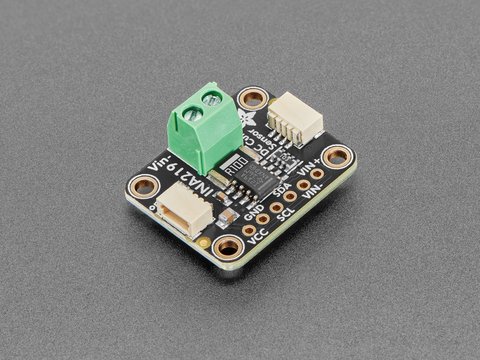
Adafruit INA260 — ⭐ 4.4/5 · Integrated Shunt, 16-bit ADC
The Adafruit INA260 is the sensor you buy when accuracy is non-negotiable. Unlike the INA219, the INA260 integrates its own precision 2 mΩ shunt resistor — no external shunt needed — and measures up to 36V at 15A continuous on either the high or low side. The 16-bit ADC delivers 1.25 mV voltage resolution and 1.5 mA current resolution with better than 1% accuracy over the full range. Adafruit’s comprehensive library, CircuitPython and Arduino support, and excellent tutorial make integration trivial. This is the go-to choice for solar charge controllers, bench power supplies, and EV cell monitors.
✅ PROS
- Integrated precision shunt
- 16-bit / 1.5mA resolution
- High or low side support
- 36V / 15A range
- Excellent Adafruit library
❌ CONS
- DC only — not for AC
- Price varies (check live)
- 15A max (not for heavy loads)
- Soldering required
🎯 Verdict: The premium DC sensing choice. Integrated shunt + 16-bit accuracy + high/low side flexibility makes it the best all-in-one DC power monitor for serious projects.
👉 Check on Amazon →
🎓 BEST FOR BEGINNERS
⭐ 3.8/5
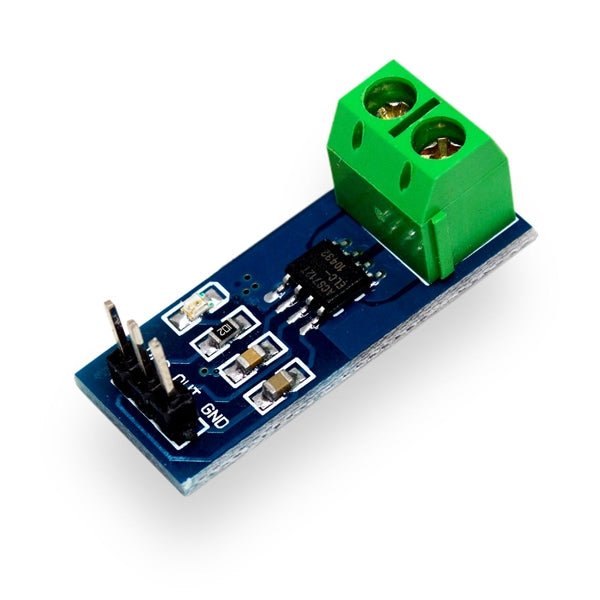
3. ACS712 Combo Kit — Analog Hall Effect (5A / 20A / 30A + Voltage Sensor)
Analog · 0–25V / ±30A · 5V supply · Best analog starter set

The ACS712 Combo Kit includes three Hall-effect current sensor modules (5A, 20A, and 30A variants) plus a DC 0–25V voltage sensor — everything a beginner needs to start measuring power in a single affordable package. The ACS712 chip outputs an analog voltage proportional to the measured current: 2.5V at 0A, scaling up/down with positive/negative current. No I²C setup needed — just read an analog pin. Compatible with any 5V MCU, including Arduino Uno, Mega, and ESP8266. The included voltage divider module handles 0–25V (or 0–16.5V on 3.3V systems).
✅ PROS
- 4-in-1 value combo
- Dead-simple analog interface
- 3 current ranges included
- AC or DC current sensing
❌ CONS
- Sensitive to magnetic noise
- Terminal too small for 30A wire
- Needs 5V (not 3.3V native)
- Lower accuracy than I²C
🎯 Verdict: The best beginner starter kit — four modules for under $10, ideal for learning current/voltage sensing on Arduino before moving to precision I²C sensors.
⚡ BEST AC VOLTAGE SENSOR
⭐ 4.8/5
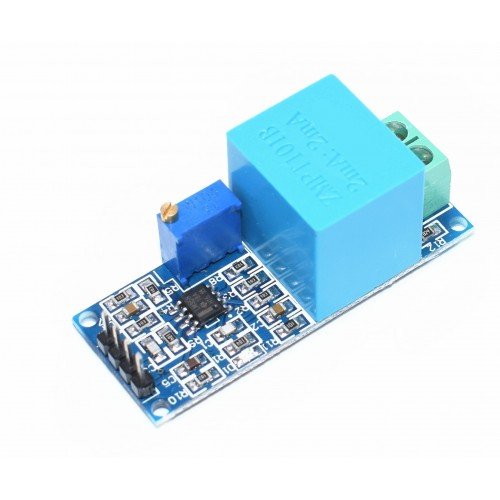
4. HiLetgo ZMPT101B 3pcs — Single Phase AC Voltage Sensor
Analog · Up to 250V AC · Isolated transformer · 3 modules

The ZMPT101B is the go-to module for measuring single-phase AC mains voltage with a microcontroller. Built around the ZMPT101B precision miniature voltage transformer, it galvanically isolates your MCU from the dangerous AC line while outputting a scaled, centered analog sine wave you sample with analogRead(). An onboard potentiometer lets you adjust the output amplitude. Power the module with 5–30V DC; connect OUT to any ADC pin. This HiLetgo 3-pack gives you three modules — great value for multi-phase or multi-circuit monitoring projects. Rated 4.8 stars.
✅ PROS
- Isolated — safe for mains
- Measures up to 250V AC
- 3 modules included
- 4.8 stars high rating
❌ CONS
- Requires careful calibration
- Analog — noise sensitive
- Voltage sensing only
- AC wiring caution needed
🎯 Verdict: Best AC voltage sensor for MCUs. Three isolated modules — pair with the SCT-013 for a complete AC energy monitor.
🔌 BEST NON-INVASIVE AC
⭐ 4.3/5
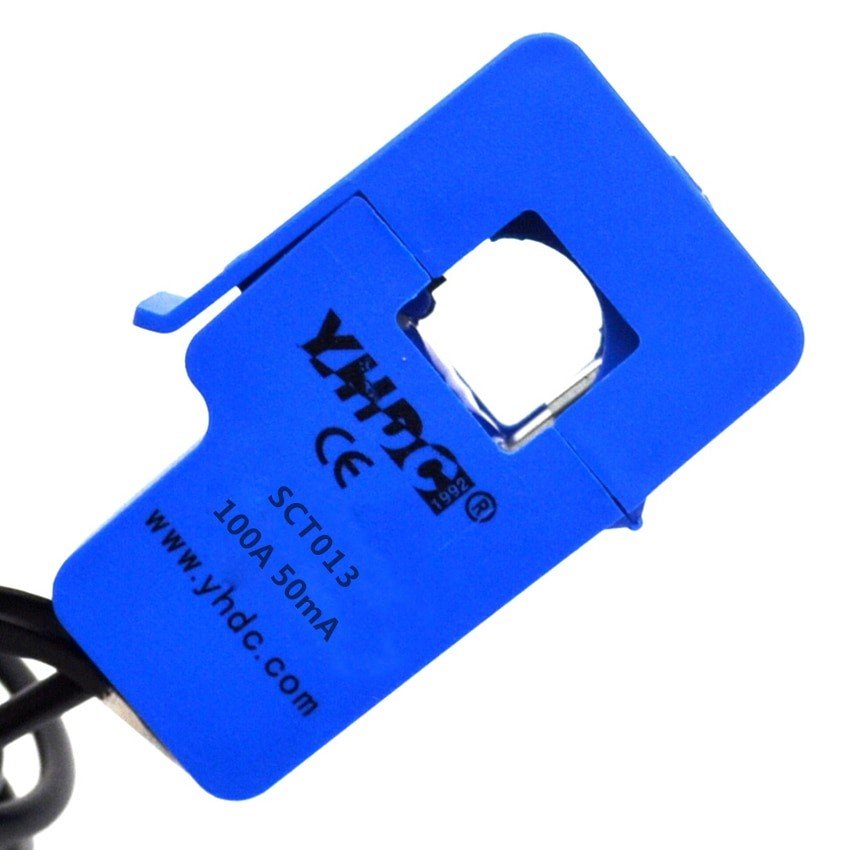
5. JANSANE SCT-013-000 — 100A Non-Invasive AC Current Sensor
Clamp CT · 0–100A AC · 3.5mm jack output · No wire cutting

The JANSANE SCT-013-000 is a split-core clamp current transformer (CT) that clips around a wire without cutting or splicing — making it ideal for monitoring home energy, motor loads, and appliance current safely. The 100A rating and 1800:1 turns ratio mean you can monitor even heavy appliances. The 13 × 13 mm jaw fits most household cables. This is the “-000” current output variant (50 mA out) — you’ll need a burden resistor and a DC bias network to interface with an Arduino ADC. The OpenEnergyMonitor project provides excellent libraries and circuit guides for this exact sensor.
✅ PROS
- No wire cutting needed
- Galvanic isolation — safe
- Up to 100A range
- EmonLib / OEM compatible
❌ CONS
- Needs burden resistor + bias
- Jaw fits 13×13mm wire only
- AC only — no DC sensing
- More complex calibration
🎯 Verdict: Best non-invasive AC current sensor. Clip it around any wire and measure mains current safely — ideal for energy monitors and EV charger tracking.
🏆 BEST HIGH-RANGE I²C
⭐ 4.2/5
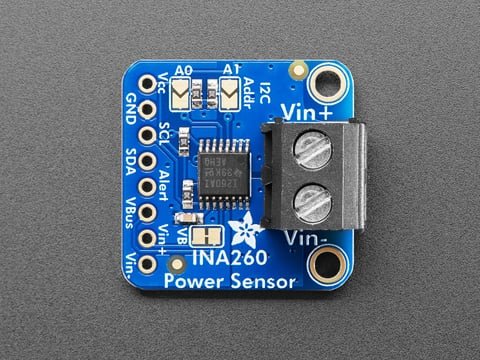
6. HiLetgo INA226 2pcs — 36V 20A 16-bit I²C Power Monitor with Alarm
I²C · 0–36V / ±20A · 16-bit · 16 programmable addresses

The HiLetgo INA226 is the step up from the INA219 when you need more range and more precision. With a 36V bus voltage range, ±20A current sensing (with the right external shunt), 16-bit ADC, 0.1% gain error, and up to 16 programmable I²C addresses, it’s built for serious power management: telecom racks, server monitoring, battery chargers, and multi-rail embedded systems. The onboard ALERT/ALARM pin can trigger an interrupt when voltage or current exceeds a set threshold — ideal for over-current protection without polling. Two modules included at exceptional value.
✅ PROS
- 16-bit / 0.1% accuracy
- 16 programmable I²C addresses
- Alarm/alert interrupt pin
- 36V / 20A range
- 2 modules included
❌ CONS
- DC only
- External shunt for high current
- Fewer reviews than INA219
- Slightly more complex setup
🎯 Verdict: Best high-range I²C power monitor. Wider voltage, better accuracy, and alarm interrupts make this the upgrade path from INA219 for demanding projects.
🛒 How to Choose the Right Sensor for Your Project
🔋
Battery / Solar / DC Power?
Get the HiLetgo INA219 for projects under 26V/3.2A, or the HiLetgo INA226 for systems up to 36V. Both deliver digital I²C readings with no analog noise headaches.
🏭
Precision Power Monitoring?
Choose the Adafruit INA260 — integrated shunt, 16-bit, high or low side, up to 36V/15A. Zero-hassle wiring and the best Adafruit library in the category.
🎓
Just Learning? First Project?
Start with the ACS712 Combo Kit — four modules, dead-simple analog analogRead(), no I²C setup. Great for Arduino Uno beginner projects.
🏠
Monitoring AC Mains Voltage?
The HiLetgo ZMPT101B 3pcs is the answer — transformer-isolated, adjustable output, safely measures up to 250V AC with any MCU ADC.
⚡
Non-Invasive AC Current Clamp?
The JANSANE SCT-013-000 clips around any wire without cutting. Perfect for home energy monitoring, motor current measurement, and over-current detection.
🔬
Multi-Rail / Server / Telecom?
The HiLetgo INA226 offers 16 I²C addresses, 16-bit precision, and an alarm interrupt — monitor up to 16 rails on one bus with over-current alerts built in.
⚙️ Key Specs Compared — Side by Side
| Spec | INA219 | INA260 | ACS712 Kit | ZMPT101B | SCT-013-000 | INA226 |
|---|
| Signal Type | DC | DC | DC/AC | AC | AC | DC |
| Max Voltage | 26V | 36V ⭐ | 25V | 250V AC ⭐ | 660V AC | 36V ⭐ |
| Max Current | ±3.2A | 15A | ±30A ⭐ | — | 100A AC ⭐ | 20A |
| Interface | I²C | I²C | Analog | Analog | Analog CT | I²C |
| ADC Resolution | 12-bit | 16-bit ⭐ | MCU ADC | MCU ADC | MCU ADC | 16-bit ⭐ |
| Accuracy | ±1% | <1% | ±1.5% | ~1–2% | ±1% | 0.1% ⭐ |
| I²C Addresses | 4 | 4 | — | — | — | 16 ⭐ |
❓ Frequently Asked Questions
What is the difference between INA219, INA226, and INA260?
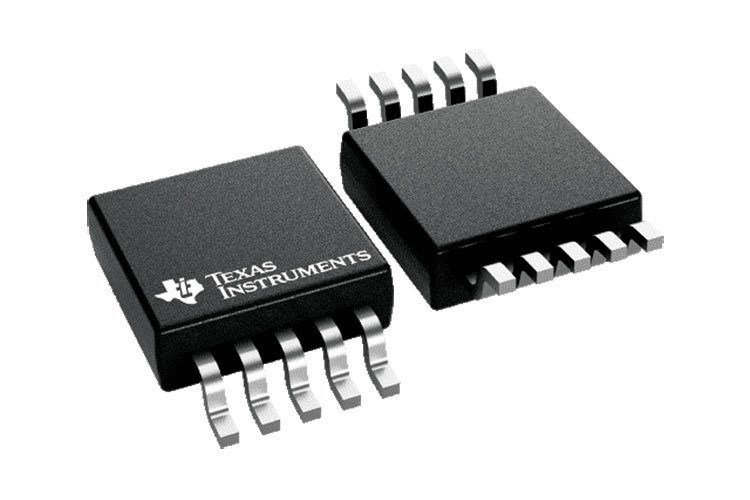
All three are Texas Instruments I²C DC power monitors. The INA219 is the most popular (12-bit, 26V, ±3.2A) — cheap, widely supported, great for most projects. The INA226 is the precision upgrade (16-bit, 36V, ±20A with external shunt, 16 addresses, alarm output) — better for demanding multi-rail systems. The INA260 has the same 16-bit resolution as the INA226 but integrates a precision 2 mΩ shunt resistor — the easiest to wire for up to 36V/15A, no external shunt needed.
Can I use these sensors with a 3.3V MCU like ESP32 or STM32?
Yes — the INA219, INA226, and INA260 all operate from 2.7–5.5V and their I²C lines are 3.3V compatible (most breakout boards include pull-ups). The ACS712 requires 5V for the sensor chip; you’d need a 5V supply and a voltage divider on the output for a 3.3V ADC. The ZMPT101B works from a 5–30V supply. The SCT-013 outputs are passively conditioned and work with any ADC.
How do I connect an SCT-013-000 to an Arduino?
The SCT-013-000 is a current-output type (50 mA at 100A input). You need to: (1) Add an 18–33 Ω burden resistor across the output to convert current to voltage. (2) Add a DC bias network (two equal resistors forming a voltage divider from 5V) to shift the AC signal into the Arduino’s 0–5V ADC range. (3) Clip the sensor around only one wire of the AC cable (live only). Use the OpenEnergyMonitor EmonLib library and their well-documented wiring guide for the complete circuit.
Is the ACS712 safe for 30A loads?
The ACS712ELC-30A chip is rated for 30A continuous, but the terminal block on most budget breakout modules uses thin PCB traces and small screw connectors that are not rated for that current. For loads above ~10A, use properly rated thick-gauge wires, or switch to a non-invasive SCT-013 clamp solution. The 5A variant is the most practically useful for MCU project work.
Can I run multiple current sensors on one Arduino?
Absolutely. I²C sensors (INA219, INA226, INA260) are designed for multi-sensor I²C buses: INA219 and INA260 support 4 addresses each, INA226 supports 16 — letting you monitor up to 16 rails with one I²C bus. Analog sensors (ACS712, ZMPT101B) each need their own analog pin, so you’re limited by available ADC pins on your board. The SCT-013 also needs one analog pin per sensor.
🏁 Final Verdict — Best Pick for Every Use Case
🥇 BEST BUDGET I²C DC SENSOR
HiLetgo INA219 — 26V, ±3.2A, I²C, #1 Best Seller
🏅 BEST PREMIUM DC SENSOR
Adafruit INA260 — 36V, 15A, 16-bit, integrated shunt
🎓 BEST FOR BEGINNERS
ACS712 Combo Kit — 4 modules (5A/20A/30A + Voltage)
⚡ BEST AC VOLTAGE SENSOR
HiLetgo ZMPT101B — 3 pcs, 250V AC, isolated transformer
🔌 BEST NON-INVASIVE AC CURRENT
JANSANE SCT-013-000 — 100A clamp CT, no wire cutting
🏆 BEST HIGH-RANGE I²C MONITOR
HiLetgo INA226 — 36V, 20A, 16-bit, 16 addresses, alarm
No matter what you’re building — a battery-powered IoT sensor, an Arduino energy meter, an ESP32 solar controller, or a multi-rail embedded system — one of these six sensors will measure current and voltage precisely and reliably. Start with the HiLetgo INA219 if you need simple I²C DC sensing on a budget; upgrade to the INA226 or Adafruit INA260 when you need wider range or tighter accuracy; and reach for the ZMPT101B + SCT-013 pair when your project touches the AC mains. Ready to wire it up? Check our Arduino, ESP32, STM32, and Raspberry Pi tutorials at Microcontrollers Lab for step-by-step interfacing guides for each of these sensors.
💬 Have a question about which sensor fits your project? Drop it in the comments below — we read and reply to every one!
All Amazon links above use our affiliate tag (microlab05-20). Purchasing through them supports Microcontrollers Lab at no extra cost to you.