⚠️ Affiliate Disclosure: This post contains Amazon affiliate links. If you purchase through our links, we may earn a small commission at no extra cost to you. We only recommend meters we have researched and whose listings we checked live on Amazon. Prices change constantly, so we deliberately don’t print them here. Always tap through and confirm the current price on Amazon before buying.
Ultimate Buying Guide
📐 Best LCR Meters for Electronics Engineers, Makers & Repair Techs
8 LCR meters ranked, from the cult-favorite DER EE DE-5000 and the lab-grade Keysight U1733C to budget 100 kHz testers and SMD tweezers, with real specs, honest verdicts and direct Amazon links.
✅ 8 LCR Meters Reviewed
✅ Verified Amazon ASINs
✅ Specs From Datasheets
✅ Honest Pros & Cons
A regular multimeter can tell you a capacitor is “about 10 µF”, but it can’t tell you whether that capacitor still works at the switching frequency of your buck converter, what its ESR is, or whether the inductor in your filter still has the Q you designed for. An LCR meter answers those questions. It drives the part with a small AC test signal at a chosen frequency, measures the complex impedance, and reports inductance (L), capacitance (C) and resistance (R) along with secondary parameters like D, Q, phase angle θ and ESR. For anyone designing power supplies, RF front-ends, audio crossovers, or simply sorting a bin of unmarked SMD parts, it is one of the most useful instruments on the bench.
Choosing one is harder than it looks. Meters differ in test frequency range (a 10 kHz ceiling vs. 100 kHz or more), basic accuracy (0.2% vs. 1% or worse), display resolution, fixture options (Kelvin clips, SMD tweezers), and extras like USB logging and component sorting. This guide ranks 8 LCR meters across every budget, from pocket testers to professional handhelds, on the specs that actually matter for embedded and electronics work.
💡 Reality check before you buy: A handheld LCR meter is not a benchtop impedance analyzer. The headline “0.2% accuracy” applies only at the best range and frequency (usually 1 kHz, mid-range values); accuracy degrades at very small capacitances, very low inductances and at 100 kHz. Test leads matter as much as the meter: long alligator leads add stray capacitance and inductance, so always run open and short calibration with the fixture you’ll actually use. Budget meters often quote a wide range but low repeatability at the extremes. And remember that an LCR meter measures the part out of circuit; in-circuit readings are almost always misleading.
📊 Quick Comparison: All 8 LCR Meters
| LCR Meter | Type | Test Frequencies | Basic Accuracy | Best For | Buy |
|---|
| 🥇 DER EE DE-5000 | Handheld · 100 kHz | 100 Hz to 100 kHz (5) | ~0.2% to 0.5% | Best Overall | Buy Here → |
| 🏅 Keysight U1733C | Handheld · 100 kHz | 100 Hz to 100 kHz (5) | 0.2% | Best Professional | Buy Here → |
| 💰 East Tester ET430 | Handheld · 100 kHz | 100 Hz to 100 kHz (6) | 0.3% | Best Value 100 kHz | Buy Here → |
| 🎓 B&K Precision 879B | Handheld · 10 kHz | 100 Hz to 10 kHz (4) | ~0.5% | Best for Labs & Classrooms | Buy Here → |
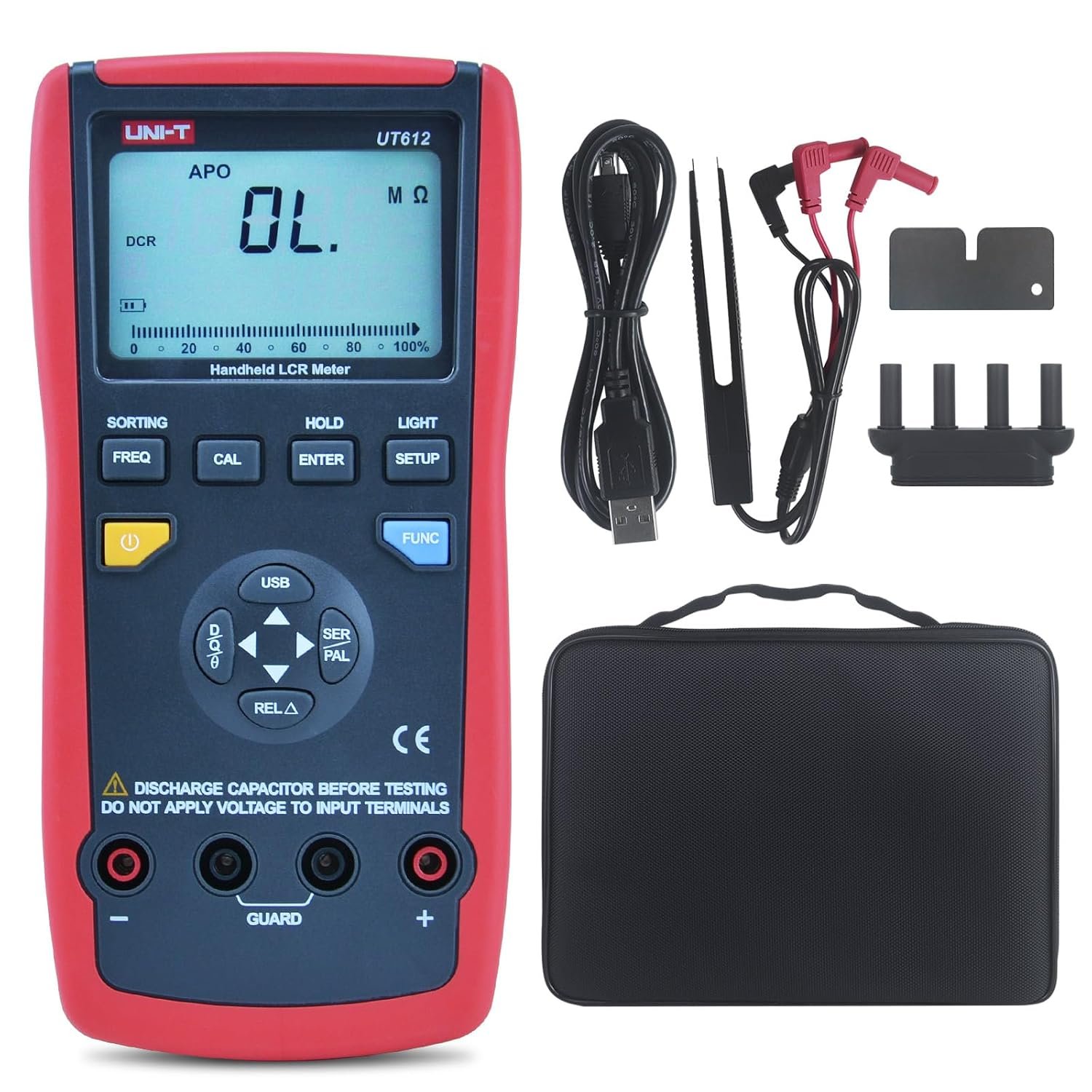
| 💾 UNI-T UT612 | Handheld · 100 kHz | 100 Hz to 100 kHz (5) | 0.3% (R), 0.5% (L/C) | Best for USB Data Logging | Buy Here → |
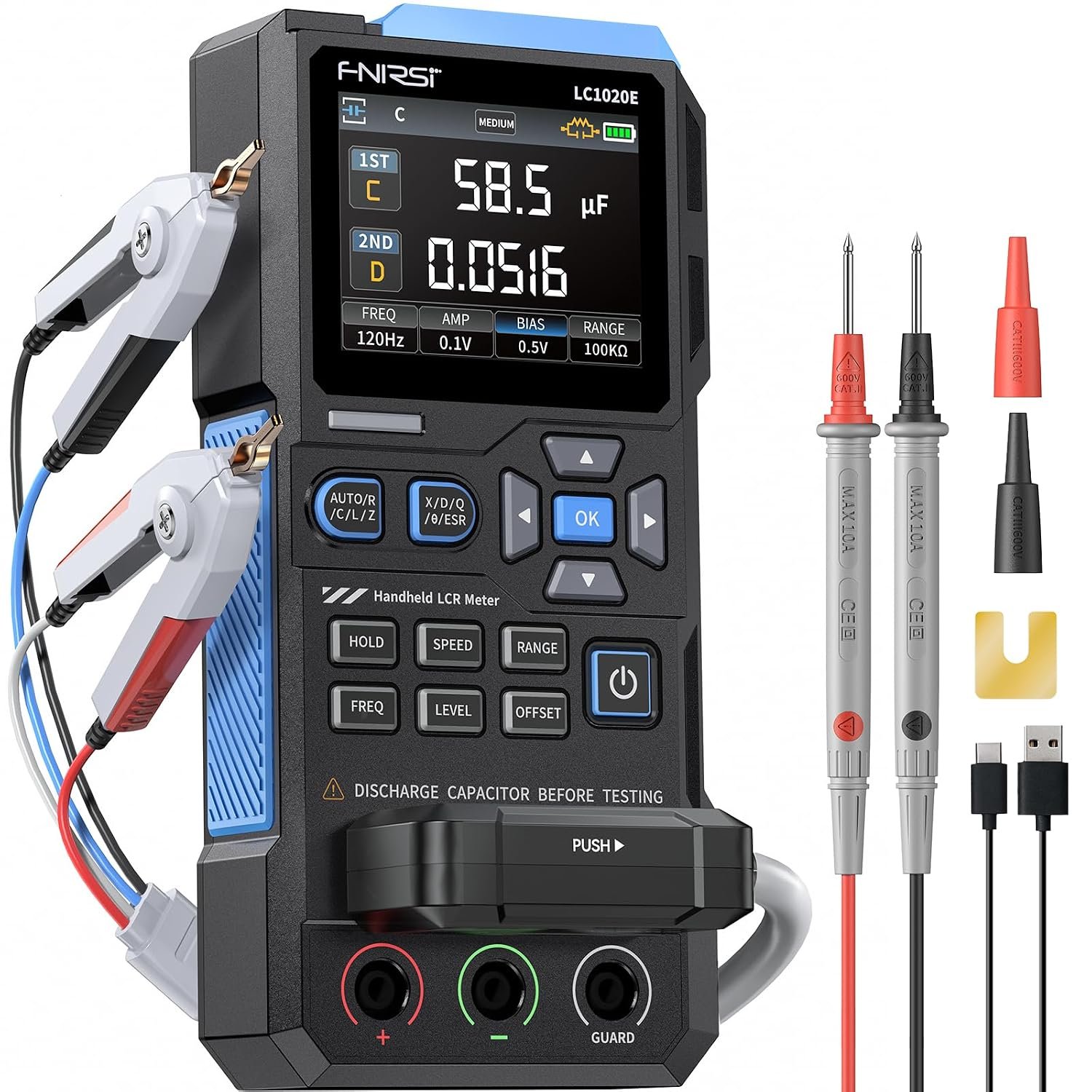
| 🔰 FNIRSI LC1020E | Handheld · 100 kHz · TFT | 100 Hz to 100 kHz (5) | See listing | Best Budget | Buy Here → |
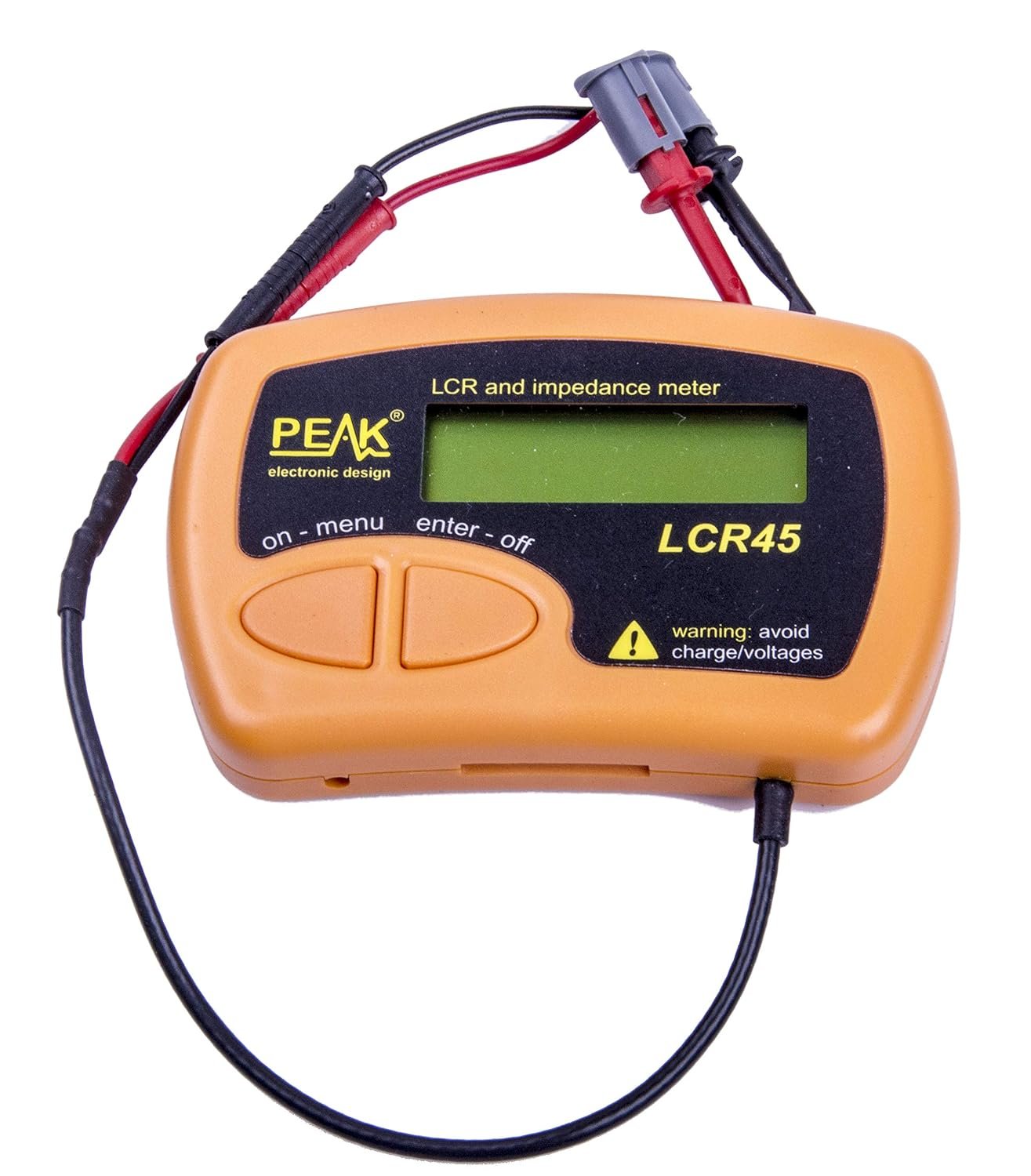
| 🧲 Peak Atlas LCR45 | Pocket · Auto freq | DC, 1k, 15k, 200 kHz | ±1 to 1.5% | Best for Inductors & Coils | Buy Here → |
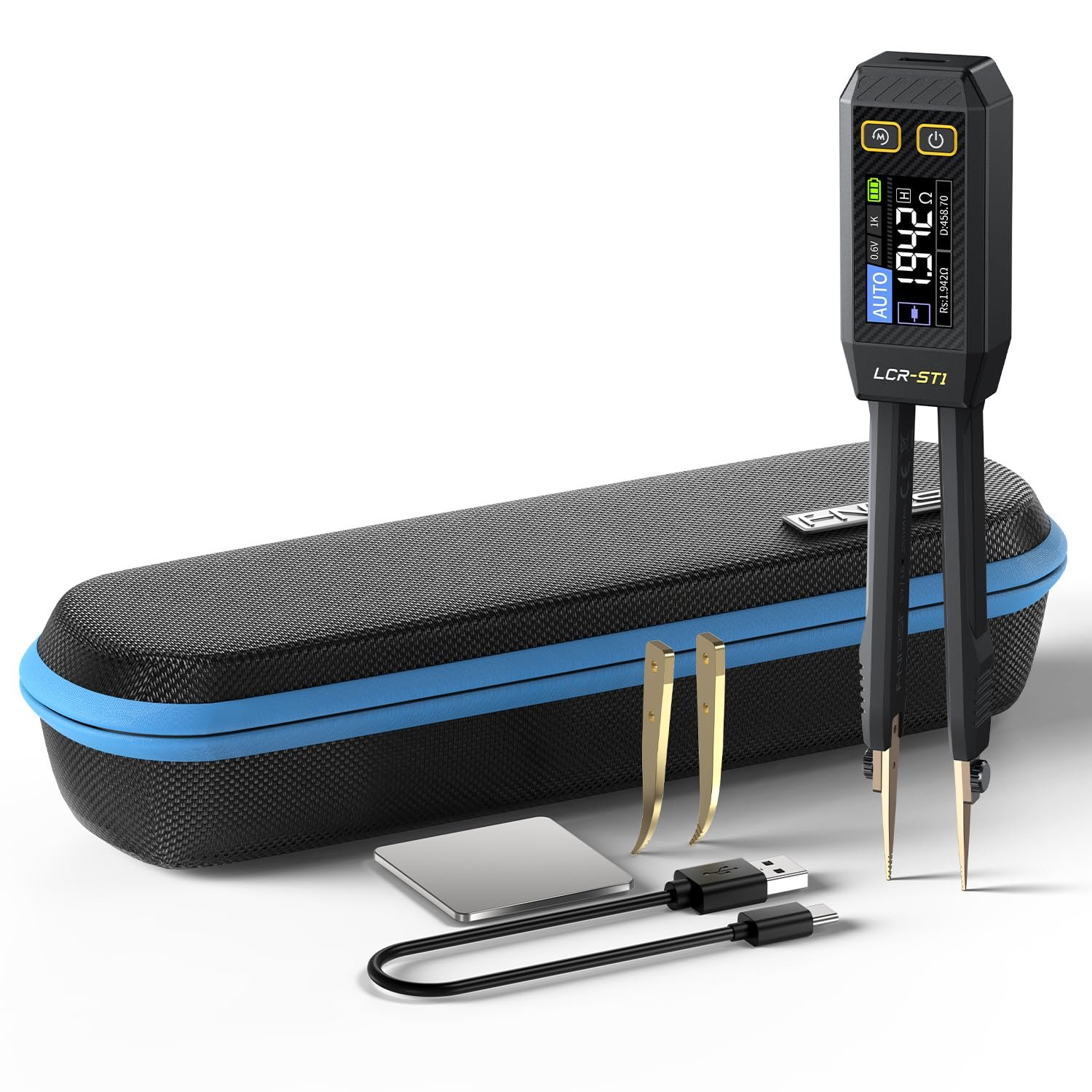
| 🔬 FNIRSI LCR-ST1 | Smart Tweezers | 100 Hz, 1 kHz, 10 kHz | Hobby grade | Best for SMD Parts | Buy Here → |
Accuracy figures are the manufacturer’s best-case basic accuracy (typically at 1 kHz, mid-range). Prices change often, so we don’t list them: tap “Buy Here” to see the live price and stock on Amazon.
🔍 What to Look for in an LCR Meter
📶
Test Frequency Range
The most important spec. Electrolytics are usually rated at 100/120 Hz, film and ceramic caps at 1 kHz, and switching-supply inductors and low-ESR caps should be checked at 10 kHz to 100 kHz. A 100 kHz meter covers nearly every hobby and power-electronics job.
🎯
Basic Accuracy
Look for 0.2% to 0.5% basic accuracy if you’re matching components or verifying designs. Remember it’s a best-case number; check the accuracy table in the manual for your actual range and frequency.
🧮
Secondary Parameters
D (dissipation), Q (quality factor), θ (phase) and ESR tell you far more than the primary value. ESR at 100 kHz is the fastest way to spot a dried-out electrolytic in a failing power supply.
🔌
Fixtures & Calibration
Kelvin (4-wire) clips, SMD tweezers and a 3-slot socket make a huge difference at low impedances. Open/short calibration removes lead errors; never trust a meter that can’t do it.
💾
Logging & Sorting
USB or IR-USB logging, tolerance sorting and relative mode speed up incoming inspection and matching parts for audio or filter work. Nice to have, essential for production.
🏆 Detailed Reviews: All 8 LCR Meters
🥇 BEST OVERALL
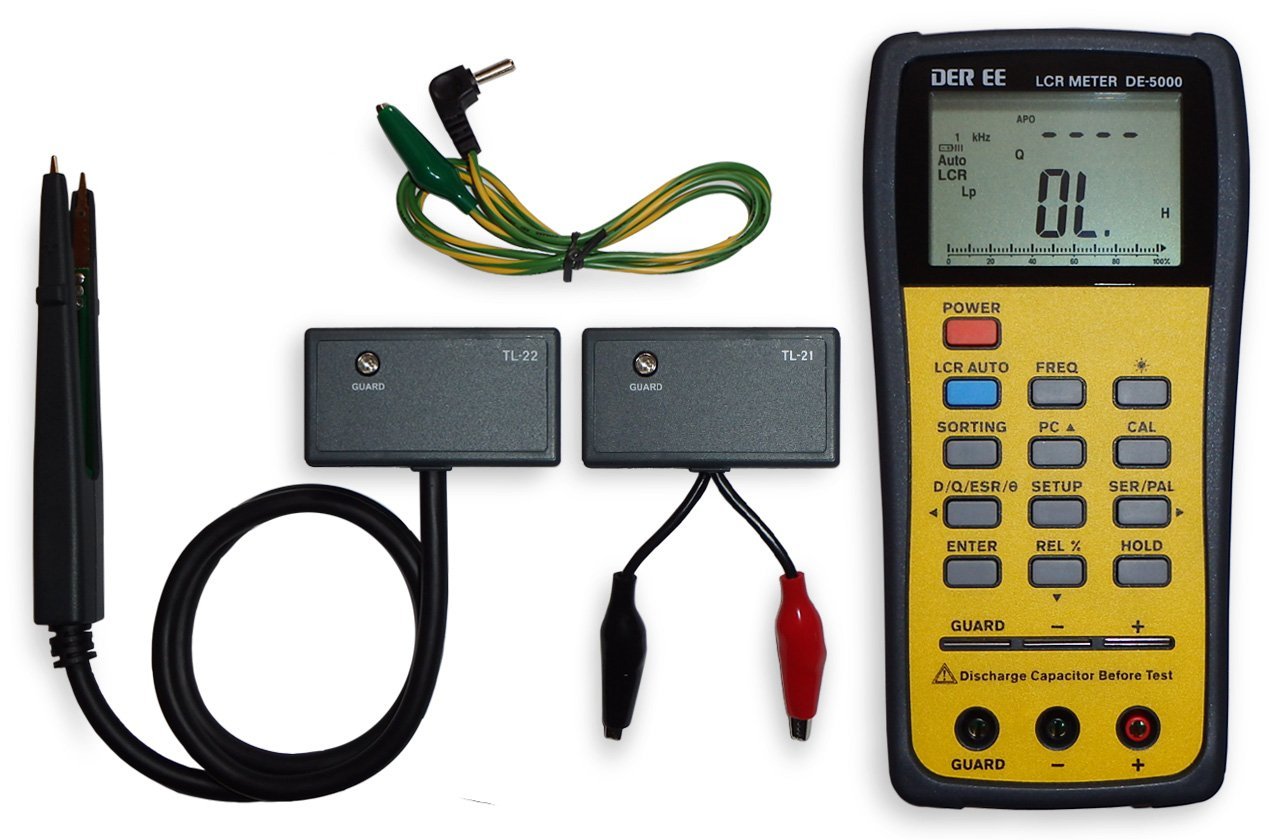
1. DER EE DE-5000
⭐ 4.8/5 · The Hobbyist’s Reference Meter
TL-21 + TL-22
CLIPS + TWEEZERS

The DER EE DE-5000 has earned a near-legendary reputation among electronics hobbyists and repair techs, and for good reason. It offers five test frequencies (100 Hz, 120 Hz, 1 kHz, 10 kHz and 100 kHz), a dual 19,999/1,999-count display, and a full set of secondary parameters: Ls/Lp, Cs/Cp, Rs/Rp and DCR with D, Q, θ and ESR. The smart AUTO-LCR mode identifies the part for you and picks series or parallel mode automatically, and the sorting mode speeds up matching a bag of capacitors. The Amazon listing we link ships with both the TL-21 alligator clips and TL-22 SMD tweezers, which covers through-hole and surface-mount parts from day one. An optional IR-to-USB cable adds PC logging.
✅ Pros- Full 100 Hz to 100 kHz range
- D, Q, θ, ESR and DCR on a dual display
- Clips and SMD tweezers included
- Huge community, easy to calibrate
❌ Cons- Segment LCD, not a graphic display
- PC link needs an optional IR cable
- Stock on Amazon is sometimes limited
🎯 Verdict: The best all-round LCR meter for most engineers and makers. It does 90% of what a pro handheld does at a much friendlier price.
👉 Check Price on Amazon →
🏅 BEST PROFESSIONAL

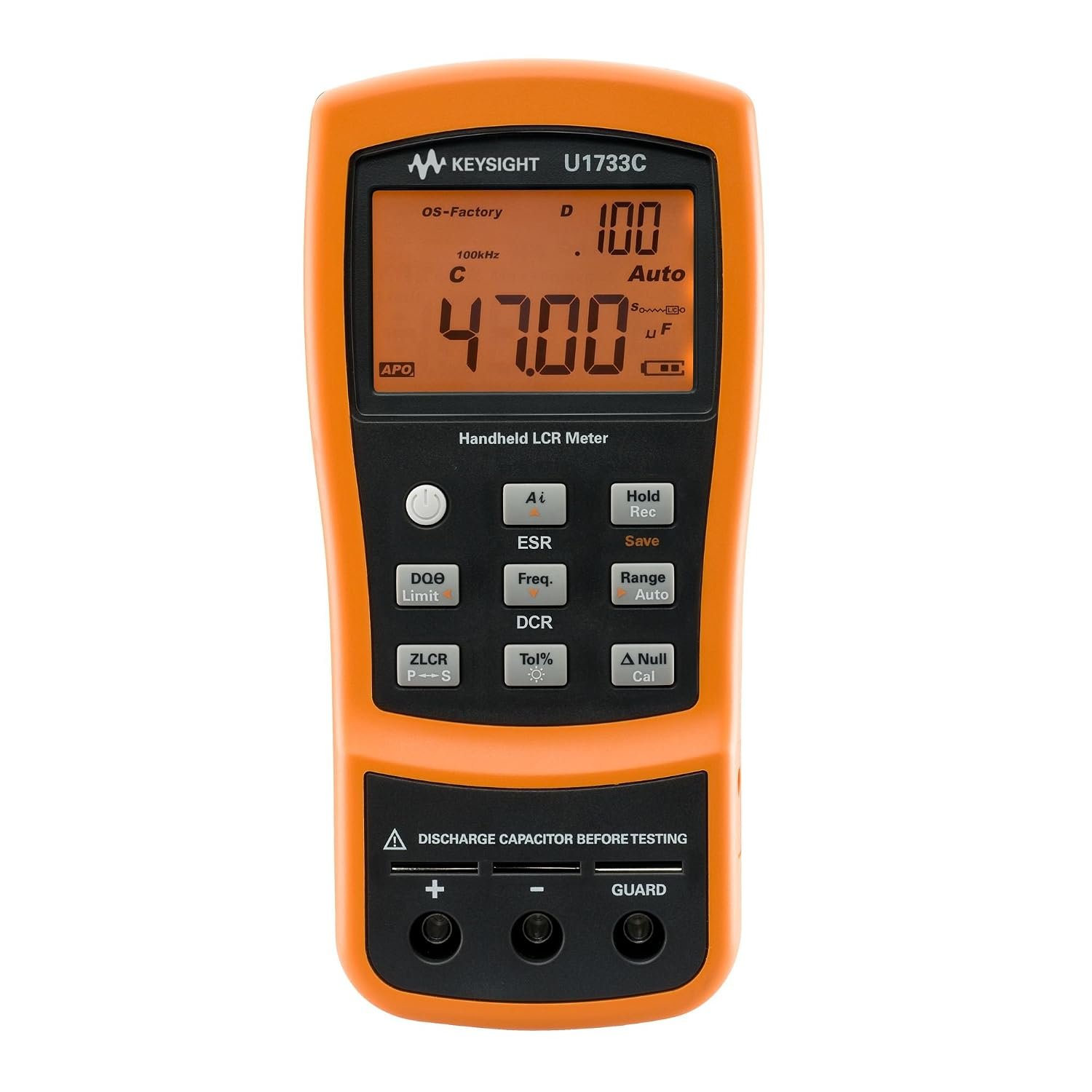
The Keysight U1733C is the handheld you buy when the reading has to stand up in a design review or a quality report. It’s the top model in Keysight’s U1730C series, with 0.2% basic accuracy, a 20,000-count dual display and five test frequencies up to 100 kHz. It measures L, C, R, Z, DCR, ESR, D, Q and θ, and its Auto Identification (Ai) mode recognises the component and sets the function for you. Tolerance and recording modes, IR-to-USB logging and up to 16 hours of battery life round it out. Build quality, documentation and calibration traceability are exactly what you’d expect from Keysight.
✅ Pros- 0.2% basic accuracy, 20,000 counts
- Five frequencies up to 100 kHz
- Auto component identification
- Keysight build, calibration support
❌ Cons- Most expensive meter in this guide
- Amazon listing is often via third-party sellers
- Test leads and IR cable can be extra
🎯 Verdict: The professional choice. If you need traceable, repeatable numbers in a handheld, this is the one to beat.
👉 Check Price on Amazon →
💰 BEST VALUE 100 KHZ · ⭐ 4.5/53. East Tester ET430
100 Hz to 100 kHz (6 freqs incl. 40 kHz) · 0.3% basic · 0.6 Vrms · L to 2000 H · C to 20 mF · R to 200 MΩ
Buy →
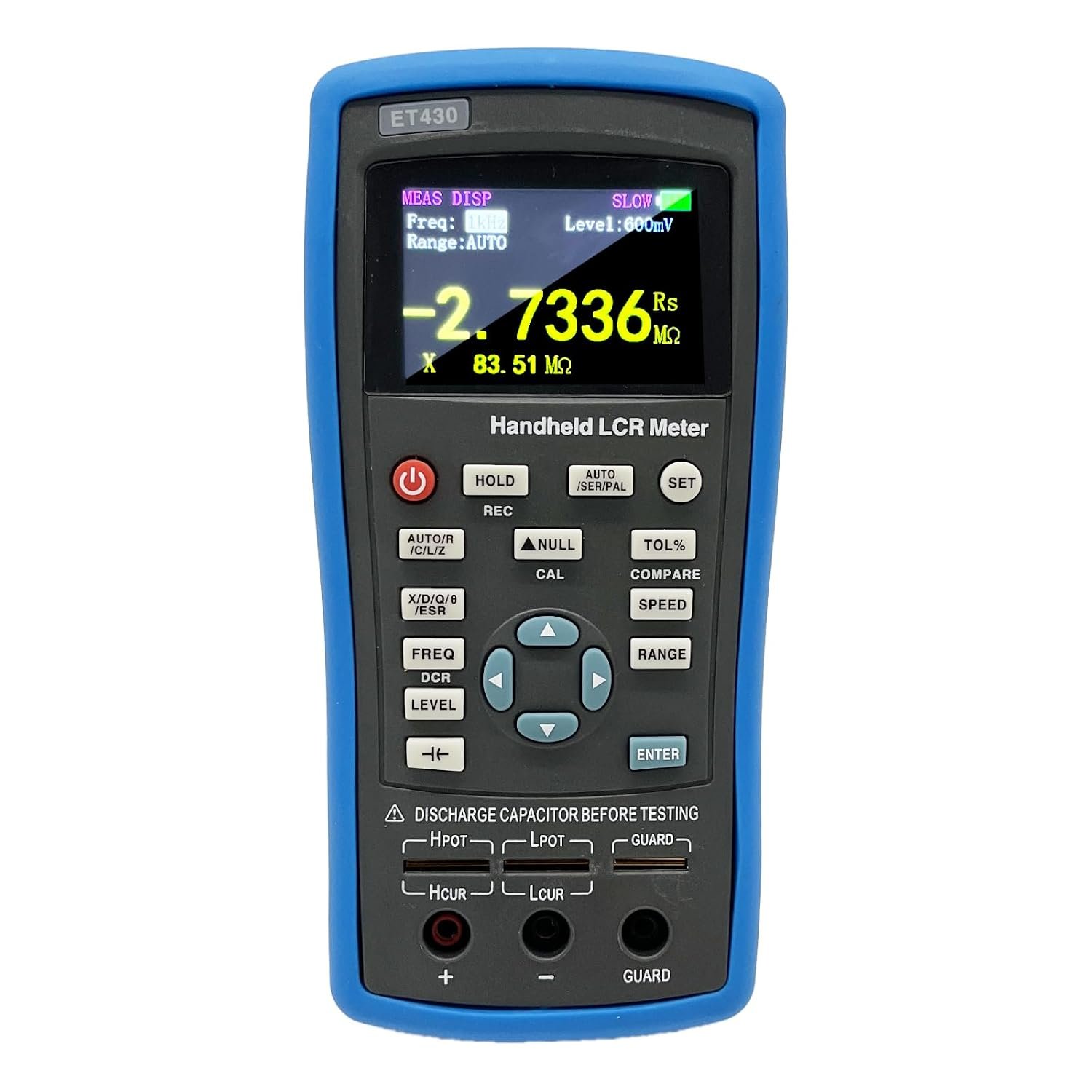
The ET430 from East Tester punches well above its price. It adds a 40 kHz step between 10 kHz and 100 kHz, reads primary and secondary parameters to five digits, and quotes a respectable 0.3% basic accuracy. For hobbyists who want real 100 kHz ESR and inductor measurements without paying for a big-name badge, it’s a very compelling alternative to the DE-5000.
✅ Pros: Six test frequencies up to 100 kHz; 0.3% basic accuracy; wide L/C/R ranges; strong value.
❌ Cons: Lesser-known brand; manual and support are basic; stock on Amazon fluctuates.
🎯 Verdict: The best value if you want 100 kHz testing and near-DE-5000 capability on a tighter budget.
👉 Check Price on Amazon →
🎓 BEST FOR LABS & CLASSROOMS · ⭐ 4.5/54. B&K Precision 879B
100 Hz / 120 Hz / 1 kHz / 10 kHz · 40,000 + 10,000 counts · L, C, R, Z, D, Q, θ, ESR · 0.3/0.6/1 Vrms · USB
Buy →

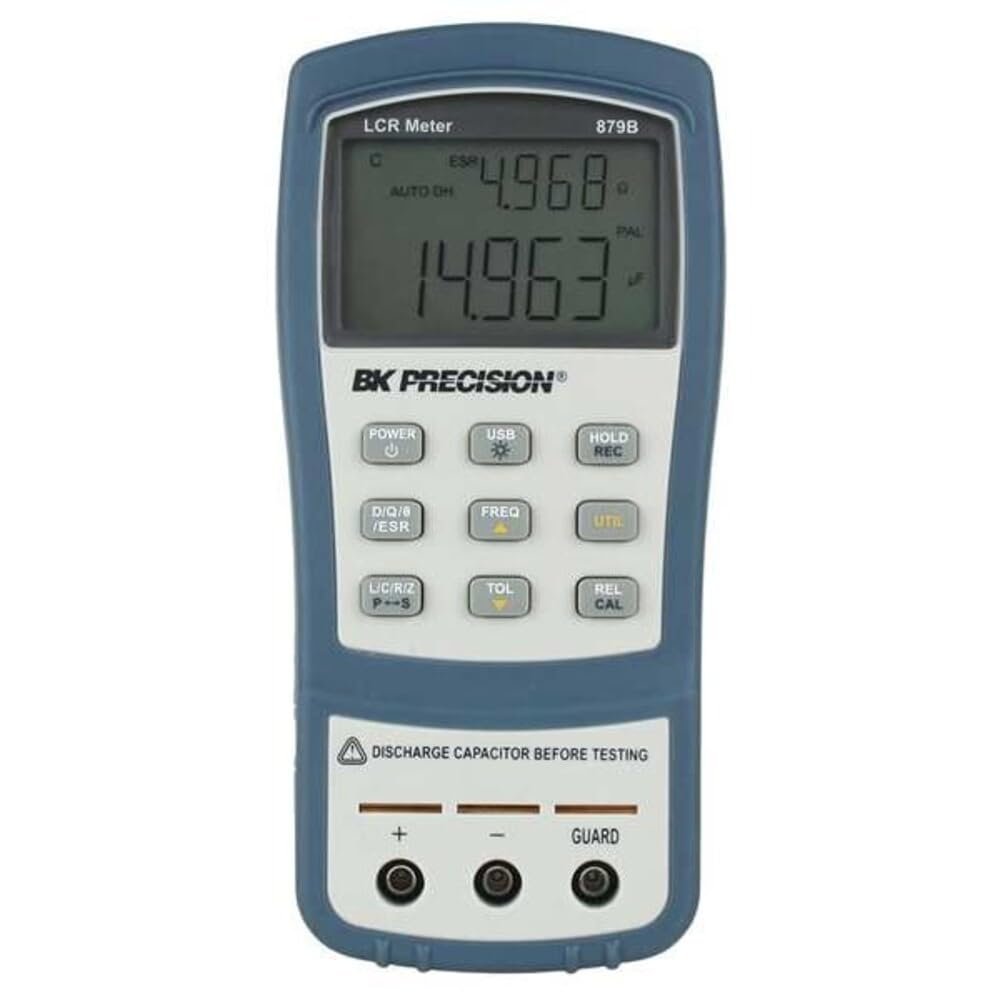
The B&K Precision 879B is a staple of university labs and service benches. Its 40,000-count primary display, backlit dual screen, selectable test levels and USB (virtual COM) interface with SCPI-style commands make it easy to integrate into automated test or lab exercises. It tops out at 10 kHz, so it’s less suited to high-frequency ESR work, but for general component checks it is rugged, well documented and backed by a respected brand.
✅ Pros: High-resolution 40,000-count display; USB with SCPI commands; selectable test voltage; trusted brand and support.
❌ Cons: Maximum 10 kHz test frequency; bulkier than newer meters; pricier than Chinese 100 kHz meters.
🎯 Verdict: The safest pick for classrooms and service benches where durability, documentation and USB control matter more than 100 kHz.
👉 Check Price on Amazon →
💾 BEST FOR USB DATA LOGGING · ⭐ 4.4/55. UNI-T UT612
100 Hz to 100 kHz (5 freqs) · 20,000 counts · 0.3% (R) / 0.5% (L, C) · D/Q/θ/ESR/DCR · USB logging
Buy →
The UNI-T UT612 is a well-rounded 100 kHz handheld from a brand that’s already on many makers’ benches. It measures L, C, R and DCR with D, Q, θ and ESR, supports series and parallel modes, and its USB interface can log readings to a PC, which is handy for component inspection and incoming QC. It also runs from USB power, saving the 9 V battery during long sessions.
✅ Pros: Five frequencies up to 100 kHz; USB data logging and USB power; backlit LCD with bar graph; recognised brand.
❌ Cons: L/C accuracy (0.5%) behind the Keysight; bundled leads are basic; bulky compared with pocket testers.
🎯 Verdict: A solid DE-5000 alternative, and the better choice if PC data logging is part of your workflow.
👉 Check Price on Amazon →
🔰 BEST BUDGET · ⭐ 4.3/56. FNIRSI LC1020E
100 Hz to 100 kHz · 19,999 counts · 0.1/0.3/0.6 V test level · 0/0.5 V bias · Kelvin jacks · 2.8″ TFT · USB-C
Buy →
The FNIRSI LC1020E is the newest meter in this list and the most modern to use. A bright 2.8-inch colour TFT shows primary and secondary parameters together, and it brings features normally found on bench meters: adjustable test voltage and DC bias, 4-terminal (Kelvin) jacks, a 3-slot component socket, and a sorting/comparison mode with pass/fail alerts. A 3000 mAh battery charges over USB-C.
✅ Pros: Up to 100 kHz on a budget; colour TFT; adjustable test level and bias; sorting mode; rechargeable.
❌ Cons: Newer model with a short track record; accuracy spec not as clearly documented; FNIRSI firmware quirks.
🎯 Verdict: The best budget buy if you want 100 kHz testing and a modern interface without spending DE-5000 money.
👉 Check Price on Amazon →
🧲 BEST FOR INDUCTORS & COILS · ⭐ 4.4/57. Peak Atlas LCR45
DC, 1 kHz, 15 kHz, 200 kHz (auto) · 0.2 µH / 0.2 pF / 0.2 Ω resolution · complex impedance · 12 V battery
Buy →

The UK-made Peak Atlas LCR45 takes a different approach: it’s a pocket-sized meter that automatically chooses the best test frequency (up to 200 kHz) and shows the complex impedance of the part. That makes it excellent for small inductors, RF chokes and coils where the 0.2 µH resolution and 200 kHz test signal shine. Its accuracy (around 1 to 1.5%) is lower than the handhelds above, but it’s simple, fast and very well built.
✅ Pros: Auto frequency selection up to 200 kHz; great for small inductors; compact and simple; excellent build.
❌ Cons: ±1 to 1.5% accuracy; smaller ranges (C to 10,000 µF, R to 2 MΩ); uses a 12 V A23 battery.
🎯 Verdict: The best choice for winding coils, checking RF inductors and quick one-handed impedance checks.
👉 Check Price on Amazon →
🔬 BEST FOR SMD PARTS · ⭐ 4.2/58. FNIRSI LCR-ST1
100 Hz / 1 kHz / 10 kHz · 0.3/0.6 Vrms · R 10 mΩ to 10 MΩ · C 1 pF to 22 mF · L 1 µH to 10 H · rechargeable
Buy →
The FNIRSI LCR-ST1 puts an LCR meter into a pair of smart tweezers. Pinch a 0402 capacitor or an SMD inductor and it auto-detects the part, shows the primary value plus D, Q, Z, ESR and more on a small colour screen, and it even tests diodes. It’s not a precision instrument, but for sorting unmarked SMD parts and quick rework checks it’s far faster than any handheld with clips.
✅ Pros: Very affordable; ideal for SMD parts; auto recognition; rechargeable and pocketable.
❌ Cons: Tops out at 10 kHz; hobby-grade accuracy; tiny screen; not for large inductors or electrolytics.
🎯 Verdict: A must-have companion tool for SMD work, not a replacement for a proper LCR meter.
👉 Check Price on Amazon →
🛒 How to Choose the Right LCR Meter
🛠️
General electronics & repair?
Get the DER EE DE-5000: 100 kHz, full secondary parameters, clips and SMD tweezers in the box.
🏢
Professional or QA work?
The Keysight U1733C gives 0.2% accuracy, 20,000 counts and a brand your customers and auditors trust.
💰
Want 100 kHz on a budget?
The ET430 or FNIRSI LC1020E both reach 100 kHz for far less than the big names.
🎓
Equipping a lab or classroom?
The B&K Precision 879B is rugged, well documented and USB/SCPI controllable.
💾
Need to log readings to a PC?
The UNI-T UT612 logs over USB and can run from USB power during long sessions.
🧲
Winding coils or checking RF chokes?
The Peak Atlas LCR45 auto-selects up to 200 kHz with 0.2 µH resolution.
🔬
Mostly SMD rework?
Add the FNIRSI LCR-ST1 tweezers for fast, one-handed checks of tiny parts.
⚙️ Key Specs Compared: Side by Side
| Spec | DER EE DE-5000 | Keysight U1733C | East Tester ET430 | UNI-T UT612 | B&K Precision 879B |
|---|
| Max Test Frequency | 100 kHz | 100 kHz | 100 kHz | 100 kHz | 10 kHz |
| Test Frequencies | 5 | 5 | 6 ⭐ | 5 | 4 |
| Basic Accuracy | ~0.2 to 0.5% | 0.2% ⭐ | 0.3% | 0.3 to 0.5% | ~0.5% |
| Display Counts | 19,999 | 20,000 | 5-digit | 20,000 | 40,000 ⭐ |
| Secondary Params | D/Q/θ/ESR/DCR | D/Q/θ/ESR/DCR/Z ⭐ | D/Q/θ/ESR | D/Q/θ/ESR/DCR | D/Q/θ/ESR/Z |
| PC Interface | IR-USB (optional) | IR-USB | None listed | USB ⭐ | USB + SCPI ⭐ |
| SMD Tweezers Included | Yes (TL-22) ⭐ | Check listing | Check listing | Check listing | No |
Specs are taken from manufacturer datasheets and the Amazon listings. Bundled accessories vary by seller, so confirm what’s in the box on the live listing.
❓ Frequently Asked Questions
What’s the difference between an LCR meter and a multimeter’s capacitance mode?
A multimeter measures capacitance with a slow DC charge/discharge method, so it only gives a single value and can’t measure inductance properly or tell you anything about losses. An LCR meter drives the part with an AC signal at a known frequency and measures real impedance, so it reports L, C and R plus D, Q, θ and ESR, at the frequency the part will actually see in your circuit. For inductors, low-value capacitors and ESR checks, a multimeter simply isn’t the right tool.
Which test frequency should I use?
Match the frequency to how the part is used and how it’s specified. Aluminium electrolytics are usually rated at 100 or 120 Hz, film and ceramic capacitors at 1 kHz, and power inductors plus low-ESR capacitors in switching supplies are best checked at 10 kHz to 100 kHz. As a rule of thumb, small capacitances and small inductances measure more accurately at higher frequencies, while large capacitors and large inductors measure better at lower frequencies.
Should I use series or parallel measurement mode?
Use series mode (Cs, Ls, Rs) for low-impedance parts: large capacitors, small inductors and low resistances, where series resistance dominates. Use parallel mode (Cp, Lp, Rp) for high-impedance parts: small capacitors, large inductors and high resistances, where leakage dominates. Meters like the DE-5000 and U1733C choose automatically in auto mode, which is the right default for most users.
Can an LCR meter find a bad capacitor on a circuit board?
Measuring in circuit is unreliable because other components in parallel change the reading. The dependable approach is to lift one leg (or remove the part) and measure it out of circuit. That said, ESR measured at 100 kHz is the quickest way to confirm a suspect electrolytic: a dried-out capacitor can still read close to its rated capacitance while its ESR has climbed several times above the datasheet value.
Why do I need open and short calibration?
Test leads, clips and tweezers add their own stray capacitance, inductance and resistance, which can swamp the reading on small parts such as a few picofarads or a sub-microhenry inductor. Open calibration (leads apart) and short calibration (leads shorted) let the meter measure and subtract those errors. Recalibrate whenever you change fixtures or test frequency, and use the shortest leads you can.
🏁 Final Verdict: Best LCR Meter for Every Bench
The right LCR meter for every job and budget:
🥇 Best Overall · DER EE DE-5000: 100 kHz, D/Q/θ/ESR, clips and SMD tweezers included
Buy →🏅 Best Professional · Keysight U1733C: 0.2% accuracy, 20,000 counts, IR-USB logging
Buy →💰 Best Value 100 kHz · ET430: six frequencies to 100 kHz with 0.3% basic accuracy
Buy →🎓 Best for Labs & Classrooms · B&K Precision 879B: 40,000 counts, USB with SCPI control
Buy →💾 Best for USB Data Logging · UNI-T UT612: 100 kHz with USB logging and USB power
Buy →🔰 Best Budget · FNIRSI LC1020E: 100 kHz, colour TFT, adjustable bias
Buy →🧲 Best for Inductors & Coils · Peak Atlas LCR45: auto frequency up to 200 kHz
Buy →🔬 Best for SMD Parts · FNIRSI LCR-ST1: smart tweezers for fast SMD checks
Buy →No single LCR meter suits every bench, but every pick here earns its place. For most engineers and makers the DER EE DE-5000 is the one to buy: real 100 kHz measurements with ESR, D and Q at a sensible price. If your readings go into reports or design reviews, step up to the Keysight U1733C. On a tighter budget the ET430 and FNIRSI LC1020E both reach 100 kHz, labs will appreciate the B&K 879B, loggers the UNI-T UT612, coil winders the Peak Atlas LCR45, and every SMD rework station deserves a pair of LCR-ST1 tweezers. Once your meter arrives, put it to work with our Arduino, ESP32 and embedded electronics tutorials on microcontrollerslab.com.
💬 Not sure which LCR meter fits your work? Tell us what you’re measuring (power inductors, audio caps, RF coils or SMD parts) in the comments below, and we’ll point you to the right pick.
All Amazon links above use our affiliate tag (microlab05-20). Purchasing through them supports microcontrollerslab.com at no extra cost to you. Prices and availability change frequently, so always confirm the current price on Amazon before buying.
| Arduino Components | Amazon Links |
|---|
| Arduino Starter Kit | Buy Now |
| Arduino Development Kit | Buy Now |
| Arduino Smart Robot Car Kit V4 | Buy Now |
| Arduino Sensors Kit | Buy Now |