⚠️ Affiliate Disclosure: This post contains Amazon affiliate links. If you purchase through our links, we may earn a small commission at no extra cost to you. We only recommend modules we have researched and whose listings we checked live on Amazon. Prices change constantly, so we deliberately don’t print them here. Tap through and confirm the current price on Amazon before buying.
Ultimate Buying Guide
🎙️ Best Sound Sensor & Microphone Modules for Arduino, ESP32 & Raspberry Pi
7 microphone and sound sensor modules ranked for makers and embedded developers: INMP441 and SPH0645 I2S MEMS mics, MAX4466 and MAX9814 analog amplifiers, the SparkFun Sound Detector and KY-037 / LM393 sound triggers, with real specs, honest verdicts and direct Amazon links.
✅ 7 Modules Reviewed
✅ Verified Amazon ASINs
✅ Digital, Analog & Trigger Picks
✅ Honest Pros & Cons
Giving a microcontroller “ears” opens up a whole class of projects: clap switches, baby monitors, noise loggers, audio-reactive LED strips, voice assistants and TinyML keyword spotting. The sound sensor or microphone module you pick decides which of those you can actually build. A $1 comparator board can tell you that a sound happened, but it cannot record a word. A digital MEMS microphone can stream clean 24-bit audio into an ESP32, but it is useless on a classic Arduino Uno that has no I2S peripheral.
Search Amazon and you will see the same handful of chips over and over: INMP441 and SPH0645 I2S MEMS microphones, MAX4466 and MAX9814 electret amplifier boards, and the cheap KY-037 / KY-038 / LM393 sound detection modules. They differ in output type (digital I2S, analog audio, or a simple threshold pin), gain control, supply voltage and noise. This guide ranks 7 sound and microphone modules on the specs that actually matter for embedded work, so you can match the module to your board and your project.
💡 Reality check before you buy: None of these modules is a calibrated sound level meter. You can estimate relative loudness, but reading accurate dB(A) values needs calibration against a real meter. The cheap KY-037, KY-038 and LM393 boards are sound detectors, not audio microphones: their output is fine for “was there a clap?” and poor for recording or FFT. Most INMP441, MAX4466 and LM393 listings are generic clones sold under many brand names, so expect some batch-to-batch variation and the odd dead unit (which is why multi-packs are worth it). Finally, I2S mics only work with boards that have an I2S peripheral (ESP32, RP2040, STM32, Raspberry Pi, SAMD), not with an Arduino Uno or Nano.
🎙️ Quick Comparison: All 7 Sound & Microphone Modules
| Module | Output | Supply | Gain / Key Spec | Best For | Buy |
|---|
| 🥇 Teyleten INMP441 (5-Pack) | Digital 24-bit I2S | 1.8–3.3V | 61 dBA SNR | Best Overall / ESP32 Audio | Buy Here → |
| 🏅 Adafruit MAX9814 AGC | Analog audio | 2.7–5.5V | Auto gain, 40/50/60 dB max | Best Analog Microphone | Buy Here → |
| 🎚️ Weewooday MAX4466 (6-Pack) | Analog audio | 2.4–5.5V | 25x–125x trimmer gain | Best Value Analog Mic | Buy Here → |
| 📘 Adafruit SPH0645LM4H | Digital I2S | 1.6–3.6V | ~50 Hz–15 kHz | Best Documented I2S Mic | Buy Here → |
| 📈 SparkFun Sound Detector | Audio + envelope + gate | 3.5–5.5V | Resistor-set gain | Best for Sound Level & Clap | Buy Here → |
| 🔔 SHILLEHTEK KY-037 | Analog + digital (LM393) | 3.3–5V | Pot-set threshold | Best Beginner Sound Trigger | Buy Here → |
| ⚡ Stemedu LM393 3-Pin (5-Pack) | Digital only | 3.3–5V | Pot-set threshold | Best Budget Multi-Pack | Buy Here → |
Specs are taken from the manufacturer datasheets and Amazon listings. Generic modules can vary slightly between batches, so confirm details on the live listing. Prices change often, so tap “Buy Here” to see the current price.
🔍 What to Look for in a Sound Sensor or Microphone Module
🔌
Output Type
Pick the output first. I2S digital (INMP441, SPH0645) gives the cleanest audio but needs an I2S peripheral. Analog audio (MAX4466, MAX9814) works with any ADC pin. Digital threshold (KY-037, LM393) only says “sound above the set level”.
🎚️
Gain Control
Fixed gain clips on loud sounds or misses quiet ones. A trimmer pot (MAX4466) lets you tune for one environment, while automatic gain control (MAX9814) adapts on its own when levels change.
🔋
Supply Voltage
MEMS I2S mics are 3.3V-only and can be damaged by 5V. Electret amp boards run from about 2.4–5.5V. On an Arduino, power analog mics from the quieter 3.3V rail for less noise.
📊
Noise & Frequency Range
Signal-to-noise ratio (SNR) decides how clean quiet speech sounds. Voice sits roughly between 100 Hz and 8 kHz, so a 50–60 Hz to 15 kHz MEMS mic covers speech recognition and most audio-reactive work.
🧩
Board Compatibility
Arduino Uno/Nano: analog or threshold modules. ESP32, RP2040, STM32, Raspberry Pi: anything, and I2S is the best match. Check for library support (ESP-IDF I2S driver, Arduino I2S, CircuitPython audiobusio) before you buy.
🏆 Detailed Reviews: All 7 Sound & Microphone Modules
🥇 BEST OVERALL · BEST FOR ESP32 AUDIO
Teyleten Robot INMP441 I2S MEMS Microphone (5-Pack)
⭐ 4.6/5 · Digital Microphone for Voice & Audio
60 Hz–15 kHz
FLAT RESPONSE

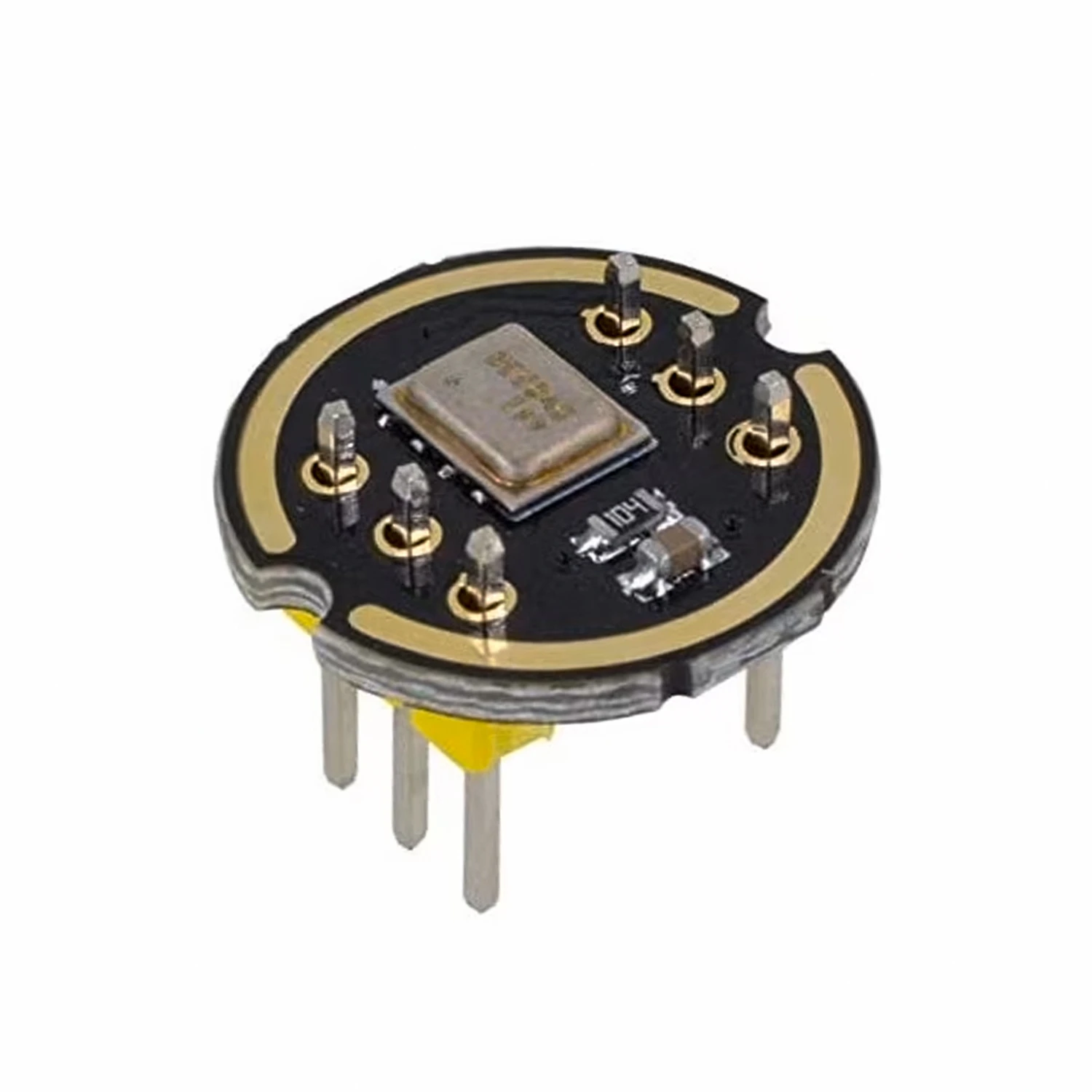
The INMP441 is the microphone most ESP32 audio projects end up using, and for good reason. The tiny round board packs a bottom-port MEMS sensor, ADC, anti-aliasing filter and a standard 24-bit I2S interface, so it connects straight to an ESP32, ESP32-S3, RP2040 or STM32 without an external codec. With a 61 dBA SNR, a −26 dBFS sensitivity and a flat 60 Hz to 15 kHz response, it is clean enough for voice assistants, wake-word and TinyML keyword spotting, web-streamed baby monitors and FFT spectrum displays. The L/R pin selects the channel, so two mics on one bus give you stereo. This Teyleten listing is a 5-pack, which matters with generic modules.
✅ Pros- Clean digital audio, no analog noise pickup
- Direct I2S link to ESP32, RP2040, STM32
- Stereo with two mics via L/R pin
- Five modules per pack
❌ Cons- No I2S on Arduino Uno/Nano
- 3.3V only; 5V will damage it
- Generic clone; little official documentation
🎯 Verdict: The best all-round microphone module for modern 32-bit boards. If you are using an ESP32 and want real audio, start here.
👉 Check Price on Amazon →
🏅 BEST ANALOG MICROPHONE · AUTOMATIC GAIN
Adafruit MAX9814 Electret Microphone Amplifier with AGC
⭐ 4.6/5 · Works With Any ADC Pin
40/50/60 dB
MAX GAIN (JUMPER)

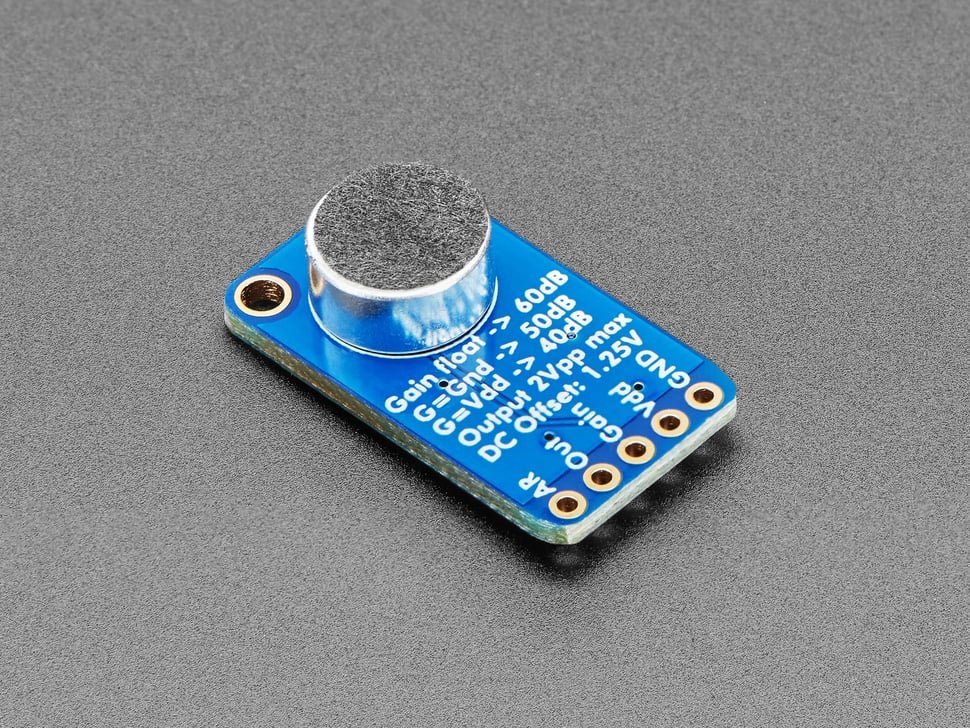
If your board has no I2S, or you simply want an analog signal you can read with analogRead(), the Adafruit MAX9814 is the one to get. The Maxim MAX9814 chip adds automatic gain control: loud nearby sounds are turned down before they clip, and quiet distant sounds are boosted, so you rarely touch a trimmer. Maximum gain defaults to 60 dB and can be jumpered to 50 or 40 dB, and the attack/release ratio is selectable too. The output swings about 2 Vpp on a 1.25V bias, which keeps it inside the range of 3.3V ADCs on an ESP32, Pico or STM32 as well as a 5V Arduino. This is the genuine Adafruit board, sold by Adafruit on Amazon, with a full Learn guide behind it.
✅ Pros- AGC handles changing sound levels
- Output safe for 3.3V ADCs
- Works on any board with an ADC
- Genuine Adafruit with tutorials
❌ Cons- AGC can “pump” in quiet rooms
- Single board per order
- Audio quality limited by your MCU’s ADC
🎯 Verdict: The best analog microphone module. Pick it for Arduino audio projects and any environment where sound levels swing a lot.
👉 Check Price on Amazon →
🎚️ BEST VALUE ANALOG MIC · ⭐ 4.4/53. Weewooday MAX4466 Electret Microphone Amplifier (6-Pack)
2.4–5.5V · 25x–125x adjustable gain · 20 Hz–20 kHz electret · output biased at VCC/2 · 3-pin OUT/GND/VCC
Buy Here →

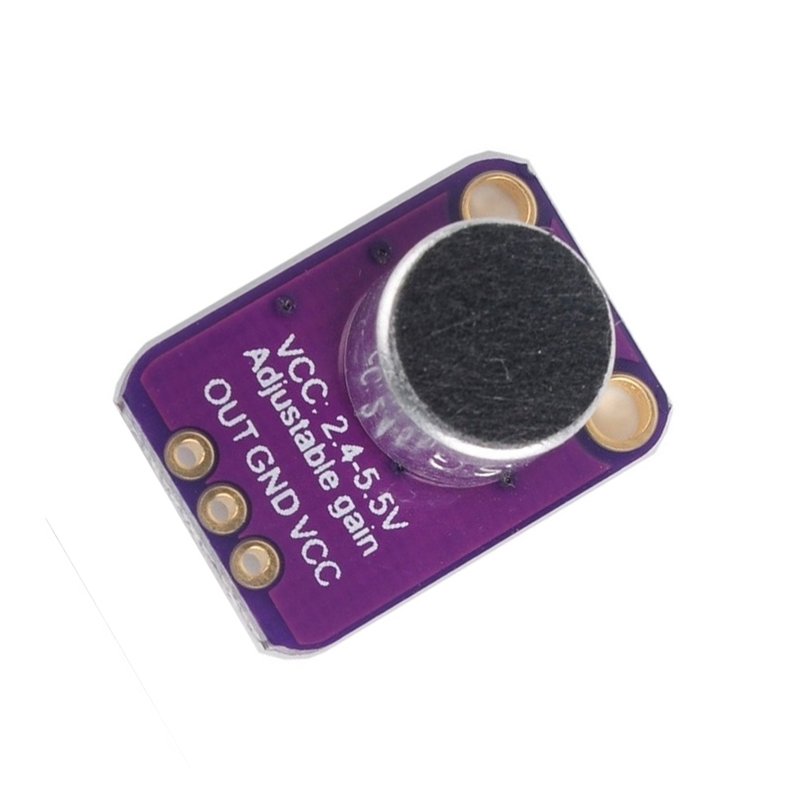
The MAX4466 is the classic electret mic amplifier, and this Weewooday listing gives you six purple GY-MAX4466 boards for roughly the price of one branded module. The MAX4466 op-amp has excellent power-supply rejection, so it is noticeably less hissy than a bare LM358 circuit, and a small trimmer on the back sets the gain anywhere from 25x to 125x. Output idles at half the supply voltage, so you can wire OUT straight to an ADC pin. It is a great fit for audio-reactive LEDs, VU meters, FFT spectrum analysers and simple voice changers where the sound level is fairly predictable.
✅ Pros: Six boards per pack; adjustable gain; low noise for the price; works from 3.3V or 5V.
❌ Cons: Fixed gain clips on loud sounds; trimmer is tiny and fiddly; generic clone quality varies.
🎯 Verdict: The best-value analog microphone. Buy the 6-pack for classrooms, workshops or multi-mic experiments.
👉 Check Price on Amazon →
📘 BEST DOCUMENTED I2S MIC · ⭐ 4.4/54. Adafruit I2S MEMS Microphone Breakout SPH0645LM4H
1.6–3.6V · I2S digital · ~50 Hz–15 kHz · L/R select pin · bottom port · 16.7×12.7mm
Buy Here →
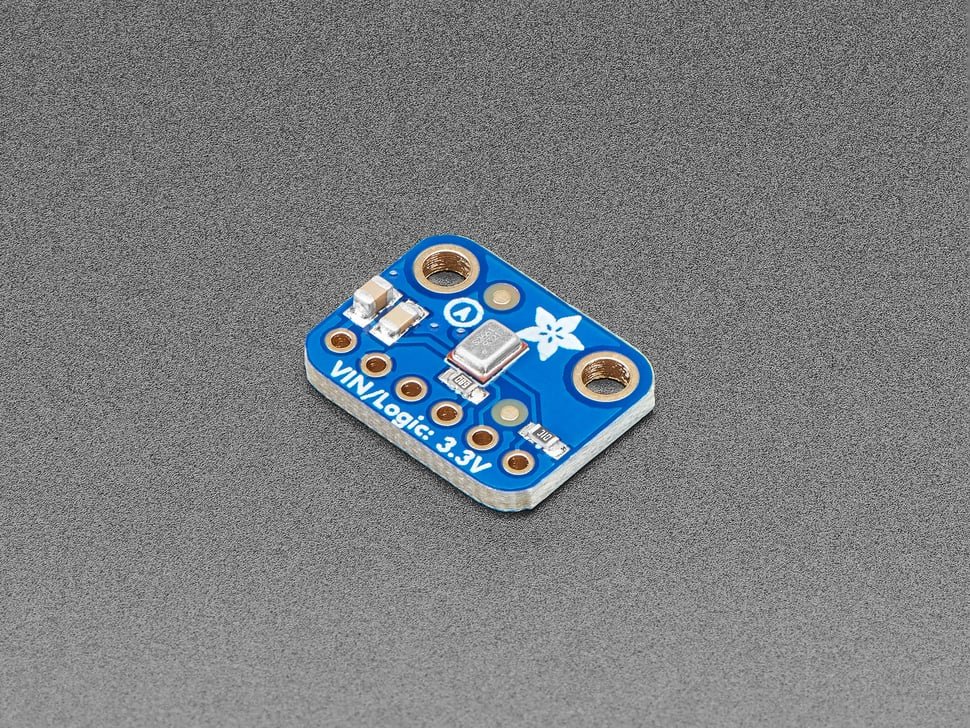
Prefer a branded board with proper documentation? Adafruit’s SPH0645LM4H breakout is a purely digital I2S MEMS microphone with a frequency range of roughly 50 Hz to 15 kHz, a SEL pin for left/right channel selection, and a detailed Learn guide covering Raspberry Pi, Feather M0/M4 and CircuitPython. It is ideal for Pi-based voice projects and SAMD or nRF52 boards. One honest caveat: the SPH0645 has known I2S timing quirks on the ESP32 and needs its samples shifted in software, which is why most ESP32 users choose the INMP441 instead.
✅ Pros: Genuine Adafruit quality; excellent tutorials; great with Raspberry Pi and CircuitPython; stereo-capable.
❌ Cons: ESP32 timing quirks; 3.3V only; costs more per mic than INMP441 packs.
🎯 Verdict: The best I2S mic when you value documentation and support, especially on Raspberry Pi and Adafruit boards.
👉 Check Price on Amazon →
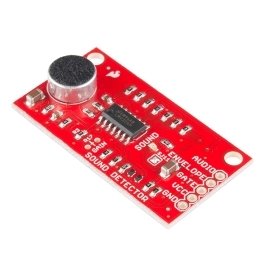
📈 BEST FOR SOUND LEVEL & CLAP DETECTION · ⭐ 4.5/55. SparkFun Sound Detector (SEN-12642)
3 simultaneous outputs: AUDIO, ENVELOPE, GATE · LMV324 op-amp · resistor-adjustable gain · 0.1″ header pads
Buy Here →

The SparkFun Sound Detector solves the problem most hobbyists actually have: “how loud is it, and did something just happen?” It gives you three outputs at once. AUDIO is the raw amplified signal, ENVELOPE is a smoothed analog voltage that tracks loudness (read it slowly with analogRead(), no sampling or FFT needed), and GATE is a digital pin that goes high when sound is present. That makes clap switches, noise loggers, classroom volume meters and “is the room occupied” sensors almost trivial. Gain and gate threshold are set by soldering a through-hole resistor; SparkFun also sells a version with headers pre-soldered.
✅ Pros: Envelope output makes loudness easy; three outputs at once; well documented hookup guide; genuine SparkFun.
❌ Cons: Gain change needs soldering; headers not included on this version; not designed for 3.3V supply.
🎯 Verdict: The best module for measuring loudness or triggering on sound without writing signal-processing code.
👉 Check Price on Amazon →
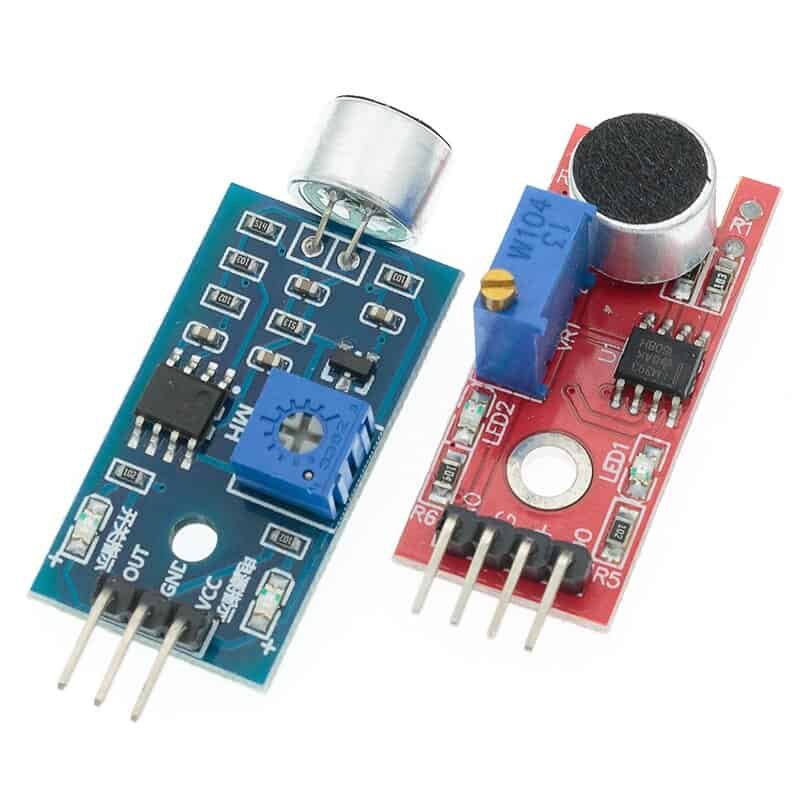
🔔 BEST BEGINNER SOUND TRIGGER · ⭐ 3.9/56. SHILLEHTEK KY-037 High Sensitivity Sound Sensor Module
3.3–5V · large electret mic · LM393 comparator · AO + DO outputs · threshold potentiometer · status LEDs
Buy Here →
The KY-037 is the module in almost every Arduino sensor kit, and it is the easiest way to learn sound detection. A large electret capsule feeds an LM393 comparator: the digital DO pin flips when sound crosses the threshold you set with the blue potentiometer, and the analog AO pin gives a rough level reading. The KY-038 is the same circuit with a smaller, less sensitive mic. Use it for clap lamps, knock detectors and “make an LED blink on noise” lessons. Do not expect clean audio or meaningful FFT from the AO pin, since there is very little amplification. Listing reviews are mixed (mostly about tuning the pot), so we score it lower than the others.
✅ Pros: Very cheap; analog and digital outputs; onboard LEDs help tuning; tons of tutorials.
❌ Cons: Not a real audio mic; threshold drifts and needs careful tuning; mixed listing reviews.
🎯 Verdict: The cheapest way to make a project react to a clap or knock. Learn with it, then move up to a MAX4466 or MAX9814 for real audio.
👉 Check Price on Amazon →
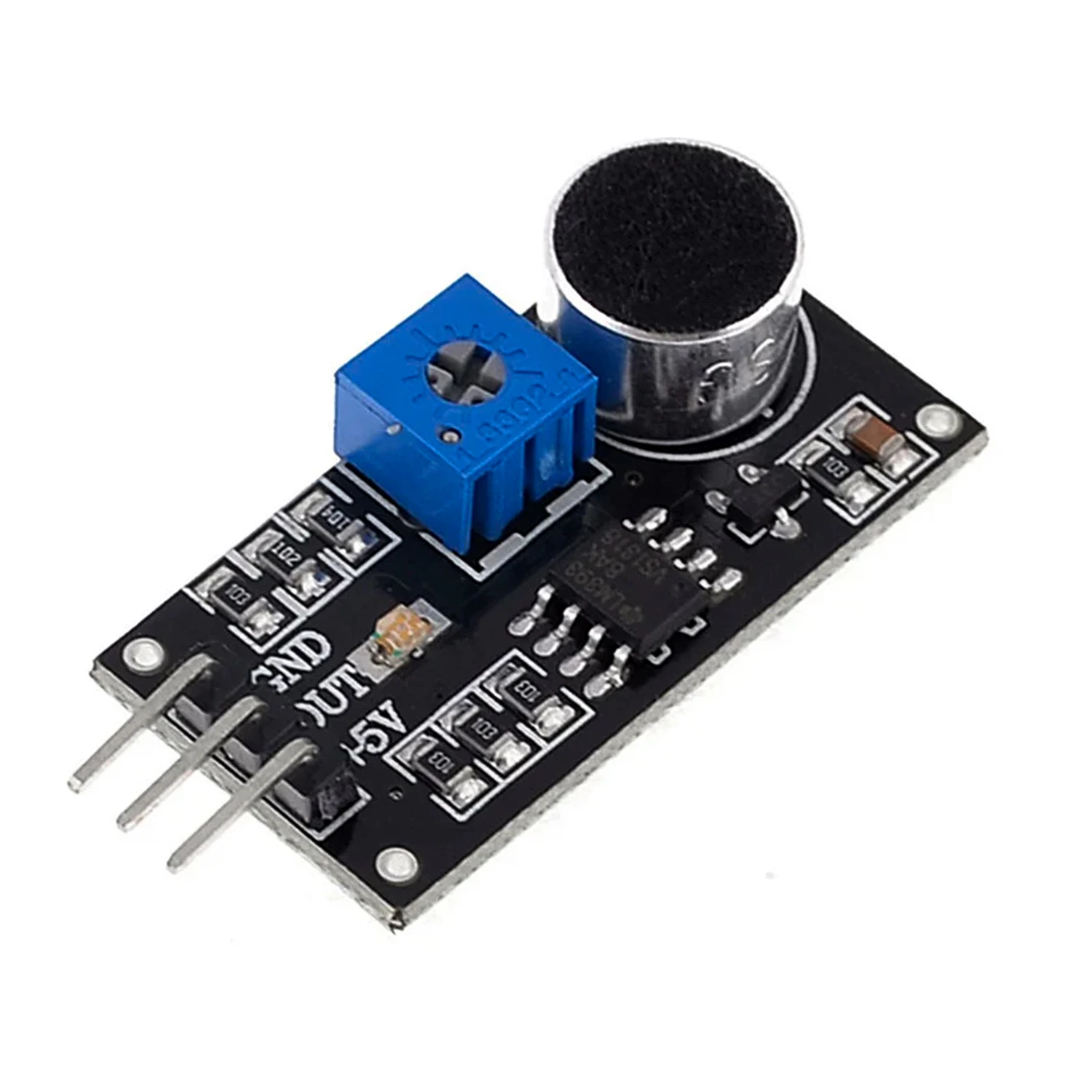
⚡ BEST BUDGET MULTI-PACK · ⭐ 4.0/57. Stemedu LM393 3-Pin Sound Detection Sensor (5-Pack)
3.3–5V · digital OUT only · LM393 comparator · threshold potentiometer · sound LED · mounting hole
Buy Here →
When all you need is a yes/no sound signal on a GPIO pin, the 3-pin LM393 sound detection module is the simplest option, and this Stemedu listing gives you five. It runs from 3.3V or 5V, so it is happy on an ESP32, ESP8266 or Pico as well as an Arduino, and the OUT pin goes low (with the onboard LED lit) when sound passes the threshold set by the potentiometer. The listing itself is clear that it detects only the presence of sound, not loudness or frequency, which is exactly right. Use it for sound-activated wake-up, interrupts in low-power devices, and classroom projects where you need several identical sensors.
✅ Pros: Five sensors per pack; 3.3V-friendly; simple digital interrupt; mounting hole.
❌ Cons: No analog output; cannot measure loudness; short detection range in noisy rooms.
🎯 Verdict: The best budget pick when you just need a digital “sound detected” interrupt on several devices.
👉 Check Price on Amazon →
🛒 How to Choose the Right Sound Sensor or Microphone
🗣️
Voice assistant, TinyML or audio streaming on ESP32?
Get the INMP441: clean 24-bit I2S audio straight into the ESP32 with no ADC noise.
🎛️
Arduino Uno or Nano audio project?
Use the Adafruit MAX9814 for changing sound levels, or the MAX4466 6-pack if levels are predictable.
🌈
Music-reactive LEDs or FFT spectrum display?
The MAX4466 with gain tuned for your room, or the INMP441 on an ESP32 for higher resolution.
🍓
Raspberry Pi or CircuitPython project?
The Adafruit SPH0645 has the best step-by-step guides for Pi and Adafruit boards.
📢
Noise logger or loudness meter?
The SparkFun Sound Detector‘s envelope output gives a loudness voltage with no DSP code.
👏
Clap switch or simple sound trigger?
A KY-037 for analog plus digital output, or the LM393 3-pin 5-pack for cheap digital interrupts.
🎙️ Key Specs Compared: Side by Side
| Spec | INMP441 | MAX9814 (Adafruit) | MAX4466 | SparkFun Sound Det. | KY-037 |
|---|
| Output | 24-bit I2S digital ⭐ | Analog audio | Analog audio | Audio + envelope + gate ⭐ | Analog + digital |
| Supply | 1.8–3.3V | 2.7–5.5V ⭐ | 2.4–5.5V ⭐ | 3.5–5.5V | 3.3–5V |
| Gain Control | Fixed (digital) | Automatic (AGC) ⭐ | Trimmer, 25x–125x | Resistor swap | Threshold pot only |
| Audio Quality | 61 dBA SNR ⭐ | Good (ADC-limited) | Good (ADC-limited) | Fair | Detection only |
| Works on Arduino Uno | No (needs I2S) | Yes ⭐ | Yes ⭐ | Yes ⭐ | Yes ⭐ |
| Loudness Reading | Compute RMS in code | Sample + compute | Sample + compute | Envelope pin ⭐ | Rough AO value |
| Pack Size | 5 modules ⭐ | 1 board | 6 modules ⭐ | 1 board | 1 module |
Specs are taken from manufacturer datasheets and the Amazon listings. ⭐ marks the strongest value in each row. Always confirm details on the live Amazon listing.
❓ Frequently Asked Questions
What is the difference between a sound sensor and a microphone module?
A sound sensor such as the KY-037, KY-038 or LM393 board uses a comparator to answer one question: is the sound louder than the threshold I set? Its digital output is a simple high or low. A microphone module such as the MAX4466, MAX9814 or INMP441 delivers the actual audio waveform, either as an analog voltage or as digital I2S samples, so you can record it, measure its level properly, run an FFT or feed it to speech recognition. If you only need a trigger, a sound sensor is enough; for anything involving the sound itself, buy a microphone module.
MAX4466 or MAX9814: which should I buy?
Both are electret microphone amplifiers with an analog output. The MAX4466 has a fixed gain you set with a trimmer (25x to 125x), which is ideal when the sound level is predictable, such as a mic placed in front of a speaker for music-reactive LEDs. The MAX9814 adds automatic gain control, so it copes with both a whisper across the room and a shout up close without clipping. Choose the MAX9814 for voice and general-purpose recording, and the MAX4466 when you want consistent, unprocessed levels for FFT or VU meters.
Can I use the INMP441 with an Arduino Uno?
No. The INMP441 outputs I2S digital audio, and the ATmega328P in the Uno and Nano has no I2S peripheral and nowhere near enough RAM or speed for audio streams. Use it with an ESP32, ESP32-S3, Raspberry Pi Pico (RP2040/RP2350 via PIO), STM32, SAMD21/SAMD51 or a Raspberry Pi. On a typical ESP32 wiring, SCK goes to GPIO14, WS to GPIO15, SD to GPIO32 and L/R to GND, powered from 3.3V. If you are stuck with an Uno, choose the MAX9814 or MAX4466 instead. See our ESP32 development board guide if you need a board.
Can these modules measure decibels (dB)?
Only approximately. You can compute an RMS level from a MAX4466, MAX9814 or INMP441 and convert it to a relative dB value, and the SparkFun Sound Detector’s envelope pin gives a ready-made loudness voltage. To get real dB SPL or dB(A) numbers you must calibrate against a proper sound level meter, and the MAX9814’s automatic gain makes absolute readings unreliable. The KY-037’s analog output is too crude for meaningful dB values. Our ESP32 sound pollution monitor project shows the approach and its limits.
Why does my sound sensor output stay HIGH or never trigger?
On KY-037, KY-038 and LM393 boards the threshold potentiometer is almost always the cause. Power the module, watch the second (signal) LED and turn the pot slowly until the LED just goes off in a quiet room; then a clap should flash it. These pots are multi-turn on some boards, so it can take many turns. Also check that you are reading the DO pin with digitalRead() and AO with analogRead(), that the grounds are shared, and that a noisy USB supply is not keeping the comparator tripped. Our KY-038 sound sensor tutorial walks through calibration with code.
🏁 Final Verdict: Best Sound & Microphone Module for Every Project
The right microphone or sound sensor for every board and budget:
🥇 Best Overall: Teyleten INMP441 5-pack, clean 24-bit I2S audio for ESP32 and other 32-bit boards
Buy Here →🏅 Best Analog Microphone: Adafruit MAX9814 with automatic gain control, works with any ADC
Buy Here →🎚️ Best Value Analog Mic: Weewooday MAX4466 6-pack with 25x–125x adjustable gain
Buy Here →📘 Best Documented I2S Mic: Adafruit SPH0645LM4H for Raspberry Pi and CircuitPython
Buy Here →📈 Best for Sound Level & Clap: SparkFun Sound Detector with audio, envelope and gate outputs
Buy Here →🔔 Best Beginner Sound Trigger: SHILLEHTEK KY-037 with analog and digital outputs
Buy Here →⚡ Best Budget Multi-Pack: Stemedu LM393 3-pin 5-pack for simple digital sound interrupts
Buy Here →No single module suits every project, but each pick here earns its place. For most modern builds the INMP441 is the one to buy: clean digital audio, a 5-pack and native support on the ESP32. Arduino users and anyone who wants a plain analog signal should choose the Adafruit MAX9814 (or the MAX4466 6-pack on a budget), Raspberry Pi and CircuitPython fans will appreciate the Adafruit SPH0645, loudness meters belong on a SparkFun Sound Detector, and simple clap or knock triggers only need a KY-037 or an LM393 board. Get started with our KY-038 microphone sound sensor tutorial with Arduino, build the IoT sound pollution monitor with ESP32, and explore more Arduino, ESP32, STM32 and Raspberry Pi tutorials on Microcontrollers Lab. Planning voice or keyword-spotting projects? See our TinyML and edge AI kit guide.
💬 Not sure which microphone fits your project? Tell us what you’re building (a voice assistant, a clap switch, a noise logger or music-reactive LEDs) and which board you’re using in the comments below, and we’ll point you to the right pick.
All Amazon links above use our affiliate tag (microlab05-20). Purchasing through them supports microcontrollerslab.com at no extra cost to you. Prices and availability change frequently, so always confirm the current price on Amazon before buying.
| Arduino Components | Amazon Links |
|---|
| Arduino Starter Kit | Buy Now |
| Arduino Development Kit | Buy Now |
| Arduino Smart Robot Car Kit V4 | Buy Now |
| Arduino Sensors Kit | Buy Now |