⚠️ Affiliate Disclosure: This post contains Amazon affiliate links. If you purchase through our links, we may earn a small commission at no extra cost to you. We only recommend boards we have researched and verified against live listings. Prices on single-board computers move constantly, so we don’t print them here — always tap through and confirm the current price and stock on Amazon before buying.
Ultimate Buying Guide
🐶 Best BeagleBone Boards for Embedded Linux & Real-Time Projects
8 BeagleBone-family boards ranked for embedded engineers, students and makers — from the classic AM3358 BeagleBone Black to the pocket-sized PocketBeagle 2, the wireless Green Gateway and the DSP-heavy BeagleBoard X15 — with verified specs, honest verdicts and direct Amazon links.
✅ 8 Boards Reviewed
✅ Verified Live Listings
✅ PRU & Real-Time Focus
✅ Honest Pros & Cons
The BeagleBone family occupies a space almost nothing else does. A Raspberry Pi gives you a fast application processor and a huge community; an STM32 or ESP32 gives you deterministic, cycle-accurate control. A BeagleBone gives you both on one die — a Linux-capable ARM core sitting next to independent Programmable Real-Time Units (PRUs) that execute in fixed, jitter-free cycles. That is why BeagleBones still turn up in CNC controllers, LED matrix drivers, industrial data loggers, protocol analyzers and motor-control rigs long after “faster” boards arrived.
The trade-off is that the family is now spread across very different silicon generations, and stock on Amazon is genuinely patchy. A ten-year-old AM3358 BeagleBone Black is still the right answer for most PRU and cape work, while newer AM62-class and AM57-class boards target low-power portables and DSP-heavy vision respectively. This guide ranks 8 BeagleBone and BeagleBoard options you can actually buy on Amazon right now, explains where the headline BeagleBone AI-64 fits, and tells you honestly which one matches your project.
💡 Reality check before you buy: BeagleBone pricing on Amazon is not the same as distributor pricing. The BeagleBone Black has an official MSRP well under what most Amazon sellers charge, so listings routinely sit far above what DigiKey, Mouser or element14 ask — you are paying for convenience and fast shipping. Stock is also volatile: several well-known BeagleBone listings are “currently unavailable” at any given moment, and unbranded “for BeagleBone Black” clones vary in build quality, eMMC grade and bootloader state. Expect to reflash the eMMC on arrival. Finally, the BeagleBone AI-64 is not stocked on Amazon at all — we cover it below and point you to the closest board that is.
🐶 Quick Comparison — All 8 BeagleBone Boards
| Board | SoC / CPU | RAM / Storage | Connectivity | Best For | Buy |
|---|
| 🥇 BeagleBone Black Rev C (Element14) | AM3358 · 1 GHz Cortex-A8 | 512 MB / 4 GB eMMC | 10/100 Eth · microHDMI | Best Overall | Buy → |
| 🏅 AmpOhm360 BeagleBone Black | AM3358 · 1 GHz Cortex-A8 | 512 MB / 4 GB eMMC | 10/100 Eth · HDMI | Best Value | Buy → |
| 🧩 PocketBeagle 2 (AM6232) | AM6232 · Dual 1.4 GHz A53 + M4F | 512 MB / microSD | USB · 52 GPIO · 8 ADC | Best Ultra-Compact | Buy → |
| 📡 BeagleBone Green Gateway | AM3358 · 1 GHz Cortex-A8 | 512 MB / 4 GB eMMC | WiFi + BT 4.1 · Ethernet | Best IoT Gateway | Buy → |
| 🚀 BeagleBoard X15 (AM5728) | AM5728 · 2× 1.5 GHz A15 + 2× C66x DSP | 2 GB / 4 GB eMMC | 2× GbE · 3× USB 3.0 · eSATA | Best High-Performance | Buy → |
| 🔰 BeagleBone Black Starter Kit | AM3358 · 1 GHz Cortex-A8 | 512 MB / 4 GB eMMC | 10/100 Eth · microHDMI | Best Starter Bundle | Buy → |
| 🧪 Grove Starter Kit for BBG | Cape / sensor bundle | 10 Grove modules | I2C · UART · OLED | Best Sensor Bundle | Buy → |
| 🔁 Waveshare BeagleBone Black Rev C | AM3358 · 1 GHz Cortex-A8 | 512 MB / 4 GB eMMC | 10/100 Eth · microHDMI | Best Backup Listing | Buy → |
Specs are taken from the manufacturer documentation and the live Amazon listings at the time of writing. BeagleBone stock rotates fast — if a listing shows as unavailable, try the backup listing in the last row. Always confirm the current price on Amazon before buying.
🔍 What to Look for in a BeagleBone Board
⏱️
PRU Count & Speed
The Programmable Real-Time Units are the reason to pick a BeagleBone at all. The AM3358 gives you two 200 MHz 32-bit PRUs with single-cycle GPIO access — deterministic timing Linux can never offer. The AM5728 has four; AM62-class parts have two at 333 MHz. If your project needs bit-banged protocols or hard timing, count PRUs first.
🔌
Cape Header Compatibility
The 2×46-pin BeagleBone Black header is the family’s ecosystem. Boards that keep it (Green, Green Gateway, AI-64) inherit a decade of capes — LCD, CAN, relay, motor, PRU-driven LED drivers. PocketBeagle uses its own smaller 72-pin layout, so check before you buy a cape.
💾
eMMC vs microSD Boot
Onboard eMMC boots faster and survives vibration far better than an SD card, which matters in industrial deployments. But 4 GB fills up quickly with a full Debian image plus toolchains — plan to keep source and data on microSD, or flash a trimmed image.
📶
Wireless On Board or Not
Only some variants ship WiFi and Bluetooth. The plain BeagleBone Black has none — you add a USB dongle and lose a port. The Green Gateway integrates 2.4 GHz WiFi plus BT 4.1 LE alongside wired Ethernet, which is what you want for a field gateway.
⚡
Power Budget & Supply
A BeagleBone Black is happy on 5 V via the barrel jack; USB alone can brown out once you attach a cape or a USB peripheral. Higher-end boards such as the X15 want a proper 5 V supply with real headroom. PocketBeagle 2 adds a LiPo charger for battery-powered builds.
🏆 Detailed Reviews — All 8 BeagleBone Boards
🥇 BEST OVERALL
BeagleBone Black Rev C (Element14)
⭐ 4.3/5 · The Reference Embedded Linux Board
Buy on Amazon →

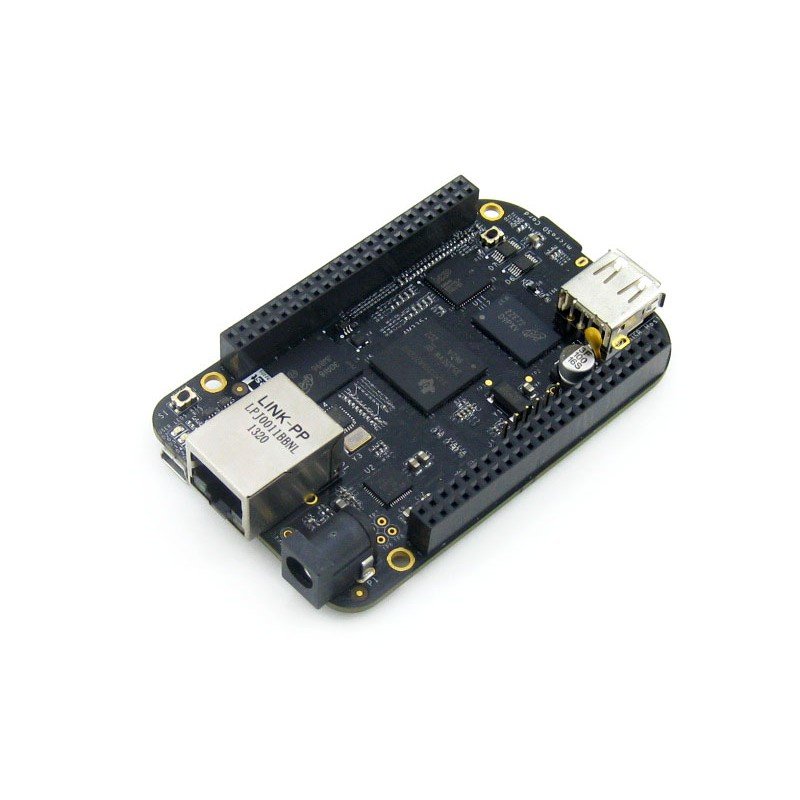
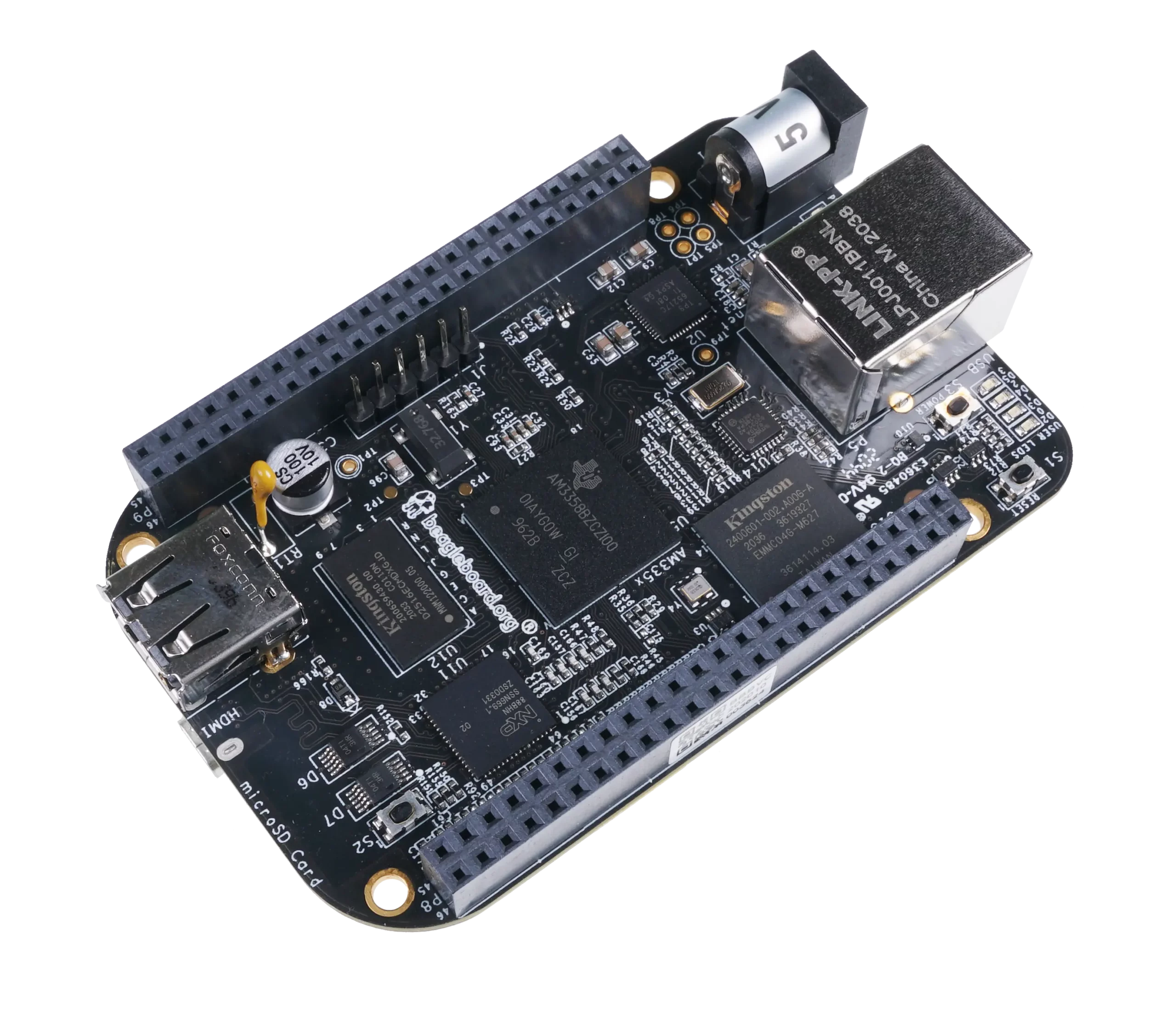
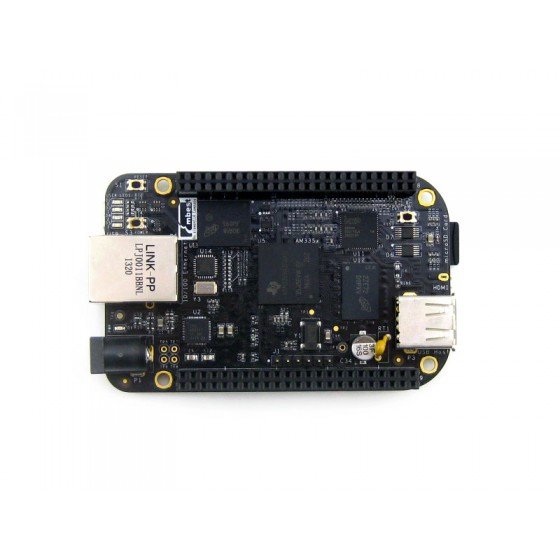
This is the board that defines the family, sold here as the genuine Element14-manufactured Rev C through the Waveshare storefront. The TI Sitara AM3358 pairs a 1 GHz Cortex-A8 with an SGX530 3D engine, a NEON FPU and — crucially — two 200 MHz Programmable Real-Time Units that run independently of Linux. Rev C brought the eMMC to 4 GB so a full Debian image ships preloaded and boots in seconds over a single USB cable. Between the 2×46 cape headers, 7 analog inputs, microHDMI, 10/100 Ethernet and a decade of documentation, it remains the most predictable BeagleBone to build against.
✅ Pros- Genuine Element14 build, not a clone
- 2× PRUs for hard real-time I/O
- Boots Debian from eMMC in seconds
- Enormous cape and tutorial ecosystem
❌ Cons- Amazon price sits well above distributor MSRP
- 512 MB RAM is tight for modern desktops
- No onboard WiFi or Bluetooth
- 10/100 Ethernet only
🎯 Verdict: Still the default BeagleBone. If you want PRU-grade determinism with a real Linux userspace and every cape and driver on the shelf, buy this one.
👉 Check Price on Amazon →
🏅 BEST VALUE
AmpOhm360 BeagleBone Black (SKU-8103)
⭐ 4.2/5 · Cheapest Route Into the Family
Buy on Amazon →

If the Element14 price makes you wince, this is the escape route. AmpOhm360’s board carries the same 1 GHz AM3358, 512 MB DDR3 and 4 GB Rev C eMMC, with HDMI, 10/100 Ethernet, USB host and client, microSD and the standard expansion headers exposing ADC, I2C, SPI and PWM. It boots the same Debian images, drives the same 7-inch capacitive touch capes, and exposes the same PRUs. It typically lands at a fraction of the branded listing, which makes it the sensible choice when you need two or three boards for a class, a test rig or a spare.
✅ Pros- By far the lowest entry price in this guide
- Full Rev C spec: 4 GB eMMC, HDMI, Ethernet
- Runs stock BeagleBoard.org Debian images
- Ideal for buying multiples
❌ Cons- Third-party build, not Element14/BeagleBoard.org
- Bootloader state on arrival varies
- Little published QA or revision history
- Support is the seller, not the community vendor
🎯 Verdict: The best BeagleBone Black per dollar on Amazon. Plan to reflash the eMMC with a fresh image on day one and it behaves like the real thing.
👉 Check Price on Amazon →
🧩 BEST ULTRA-COMPACT · ⭐ 4.4/53. PocketBeagle 2 (AM6232, 102110780)
Dual Cortex-A53 @1.4 GHz · Cortex-M4F · 52 digital I/O · 8 analog in · USB 2.0 · microSD
Buy →

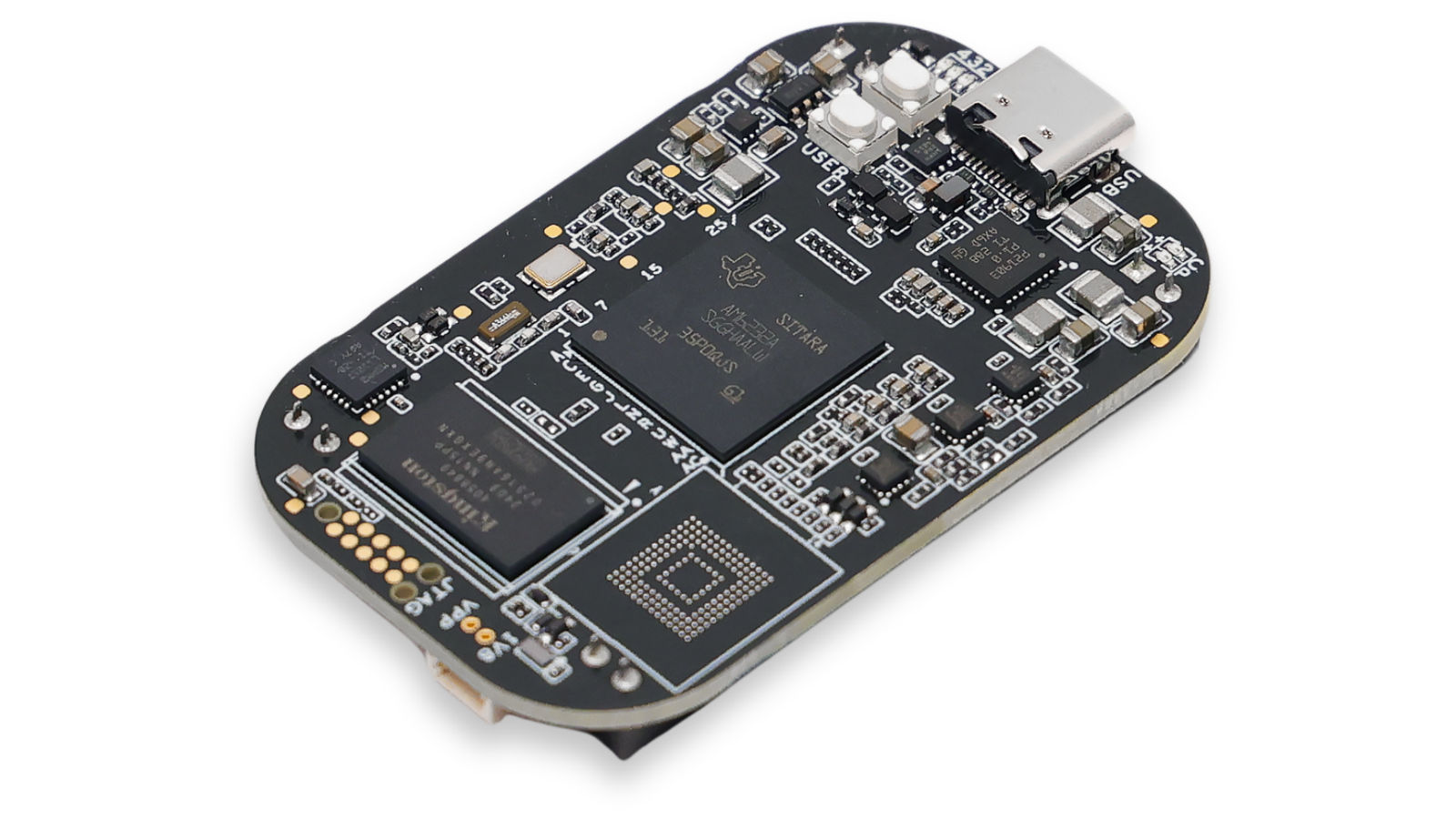
The PocketBeagle 2 is what happens when you shrink a BeagleBone to roughly the size of a stick of gum and modernise the silicon. TI’s AM6232 brings a dual-core Cortex-A53 at up to 1.4 GHz plus a Cortex-M4F for real-time control, and the board exposes 52 digital I/Os and 8 analog inputs across its 72-pin headers. Integrated power management and a LiPo charging path make it genuinely practical for battery-powered wearables, data loggers and handheld instruments — the kind of build where a full-size BeagleBone Black is simply too large and too thirsty. Note that the header layout is PocketBeagle-specific, so standard BeagleBone capes do not fit.
✅ Pros: 64-bit dual A53 plus an M4F for real-time; tiny 55×35 mm footprint; battery/PMIC built in; 52 GPIO and 8 ADC in a pocket board.
❌ Cons: No onboard eMMC — microSD boot only; incompatible with 2×46 BeagleBone capes; no Ethernet or video out; smaller ecosystem than BBB.
🎯 Verdict: The best BeagleBone for portable and battery-powered work, and the most modern silicon you can get from the family on Amazon.
📡 BEST IoT GATEWAY · ⭐ 4.4/54. BeagleBone Green Gateway
AM3358 1 GHz · 512 MB DDR3 · 4 GB eMMC · WiFi b/g/n + BT 4.1 LE · 10/100 Ethernet · 2× Grove
Buy →

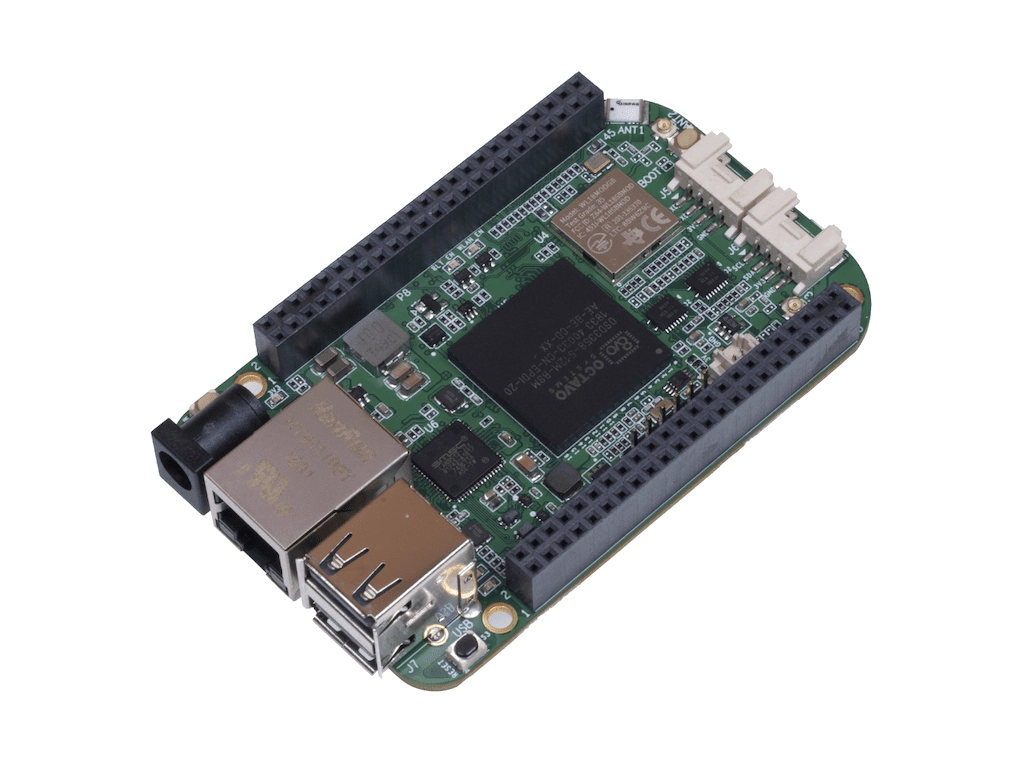
Seeed’s Green Gateway is the BeagleBone Black reworked for connectivity duty. You keep the AM3358, 512 MB DDR3 and 4 GB eMMC, but gain 2.4 GHz WiFi 802.11 b/g/n and Bluetooth 4.1 LE alongside wired 10/100 Ethernet, two USB 2.0 host ports and a 12 V DC jack for industrial supplies. Two Grove connectors (one I2C, one UART) let you attach sensors without soldering, which is exactly what you want when the board’s job is to sit in a cabinet aggregating field data and pushing it to a broker. It stays compatible with the BeagleBone Black and Green cape headers; the trade-off is that HDMI was dropped to make room.
✅ Pros: WiFi + BLE + Ethernet in one board; 12 V DC input suits industrial rails; plug-and-play Grove sensors; BBB cape compatible.
❌ Cons: No HDMI or video output; 2.4 GHz WiFi only, no 5 GHz; same 512 MB RAM ceiling; priced above a plain BBB.
🎯 Verdict: The one to buy for headless IoT gateways and sensor aggregation. Wireless and wired connectivity on the same board saves a dongle and a USB port.
🚀 BEST HIGH-PERFORMANCE · ⭐ 4.3/55. BeagleBoard X15 (AM5728)
2× Cortex-A15 @1.5 GHz · 2× C66x DSP · 2× M4 · 4× PRU · 2 GB DDR3 · 4 GB eMMC · 2× GbE · 3× USB 3.0
Buy →

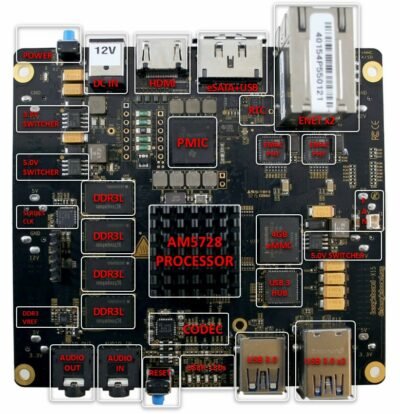
With the AI-64 absent from Amazon, the BeagleBoard X15 is the heavyweight of this list. TI’s AM5728 stacks two 1.5 GHz Cortex-A15 cores, two C66x DSPs, two Cortex-M4 cores and four PRUs onto one SoC, backed by 2 GB of DDR3 and 4 GB of eMMC. The I/O is in a different class too: two Gigabit Ethernet ports, three SuperSpeed USB 3.0 hosts, eSATA, full-size HDMI and four 60-pin expansion headers carrying PCIe, LCD, CAN, SPI and mSATA. For DSP-accelerated audio, machine vision preprocessing, multi-network industrial gateways or anything needing genuine compute headroom, it is the most capable BeagleBoard you can order here — at a price to match.
✅ Pros: Dual A15 + dual C66x DSP + 4 PRUs; 2 GB RAM; dual Gigabit Ethernet; USB 3.0 and eSATA; huge 4× 60-pin expansion.
❌ Cons: Sits far above this guide’s price range; 4″×4.2″ board is not compact; no BBB cape compatibility; DSP toolchain has a real learning curve.
🎯 Verdict: Overkill for hobby work and priced accordingly, but the right board when you need DSP acceleration, two Gigabit interfaces and four PRUs on one platform.
🔰 BEST STARTER BUNDLE · ⭐ 4.3/56. BeagleBone Black Rev C Starter Kit (XYGStudy)
AM3358 1 GHz Cortex-A8 · 512 MB · 4 GB eMMC · boots Linux in under 10 seconds over one USB cable
Buy →

This is the listing to pick if you want a BeagleBone Black that arrives ready to switch on rather than a bare board in an anti-static bag. It ships the standard Rev C configuration and, as the seller puts it, boots Linux in under ten seconds so you can be developing within five minutes on a single USB cable. XYGStudy also sells the same board in several bundle tiers, so check the variant selector on the listing before you add to cart — the “Standard” option is the plain board, while higher tiers add supplies, cables and displays. With over 4 stars across a long review history, it is one of the better-established BeagleBone listings on Amazon.
✅ Pros: Long-standing listing with solid ratings; multiple bundle tiers; genuine Rev C spec; fast out-of-box Linux boot.
❌ Cons: Bundle contents differ by variant, so read carefully; reseller packaging rather than official retail; stock can be thin.
🎯 Verdict: The friendliest first BeagleBone purchase. Pick the variant that matches what you already own and you are running Debian the same evening.
🧪 BEST SENSOR BUNDLE · ⭐ 4.2/57. Grove Starter Kit for BeagleBone Green
10 Grove modules · I2C hub · ADXL345 accelerometer · 0.96″ OLED · relay · I2C ADC · solderless
Buy →

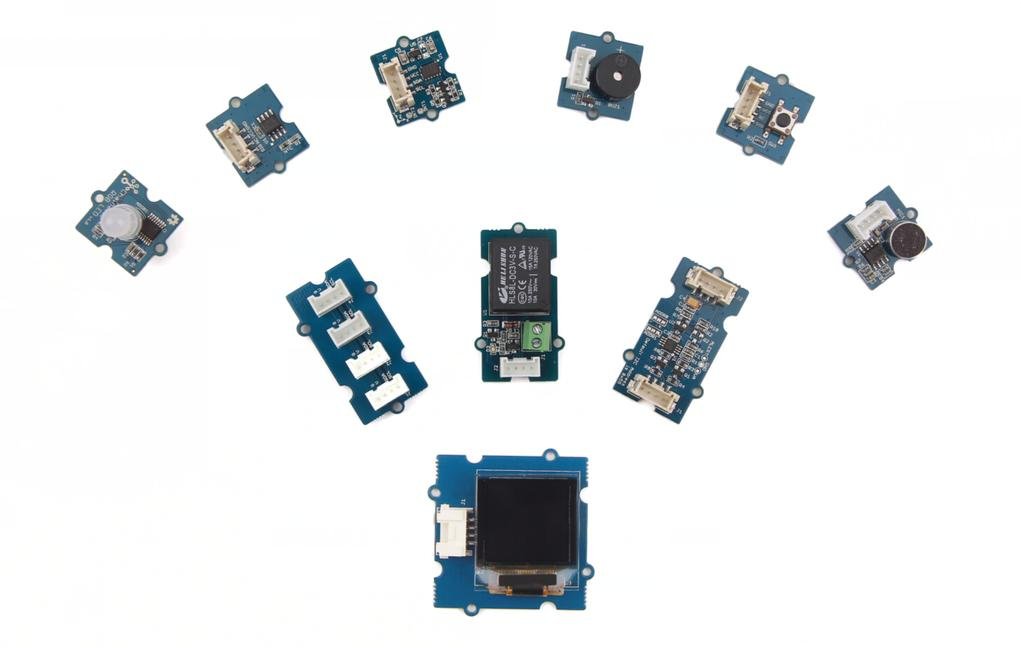
A BeagleBone is only as interesting as what you connect to it, and this kit removes every soldering excuse. Seeed’s Grove bundle for the BeagleBone Green ships ten plug-in modules: an I2C hub that fans out to seven devices, a 12-bit I2C ADC, a thermistor temperature sensor, a sound sensor, an ADXL345 three-axis accelerometer, a 250 V/10 A relay, a button, a buzzer, a chainable RGB LED and a 0.96-inch OLED display. Everything uses the same keyed 4-pin cable, so a student can wire an entire sensing project in minutes and spend the session on Python and device-tree overlays instead of jumper wires. Note that this is an accessory bundle — you need a BeagleBone Green or Green Gateway to plug it into.
✅ Pros: Ten genuinely useful modules including OLED and accelerometer; zero soldering; well-documented Seeed wiki examples; excellent for classrooms.
❌ Cons: Board not included; only two Grove ports on the BBG so the I2C hub is essential; some modules are dated designs.
🎯 Verdict: The fastest way to get a BeagleBone Green sensing the real world. Buy it alongside the Green Gateway for a complete teaching or prototyping setup.
🔁 BEST BACKUP LISTING · ⭐ 4.3/58. Waveshare BeagleBone Black Rev C (Single Board)
AM3358 1 GHz Cortex-A8 · 512 MB DDR3 · 4 GB 8-bit eMMC · 2× PRU · microSD · 10/100 Ethernet
Buy →

BeagleBone stock on Amazon evaporates without warning, and this is the listing to fall back on. It is Waveshare’s own Rev C single board — same AM3358, same 512 MB DDR3 and 4 GB eMMC, same 2×46 headers and PRU subsystem as our top pick — but sold as a separate SKU with its own inventory pool and a longer review history. When the Element14 listing shows “only 5 left” or drops out entirely, this one is usually still shipping, often at a slightly lower price. Functionally there is nothing to choose between them; treat it as insurance against a stockout mid-project.
✅ Pros: Independent stock pool from the top pick; longest review history of the Waveshare BBB listings; identical Rev C hardware.
❌ Cons: Still priced above distributor MSRP; no accessories included; description does not always name the manufacturer.
🎯 Verdict: Bookmark this one. Same board, different inventory — the practical answer when your first choice is out of stock.
📌 EDITOR’S NOTE · NOT SOLD ON AMAZON
Where does the BeagleBone AI-64 fit?

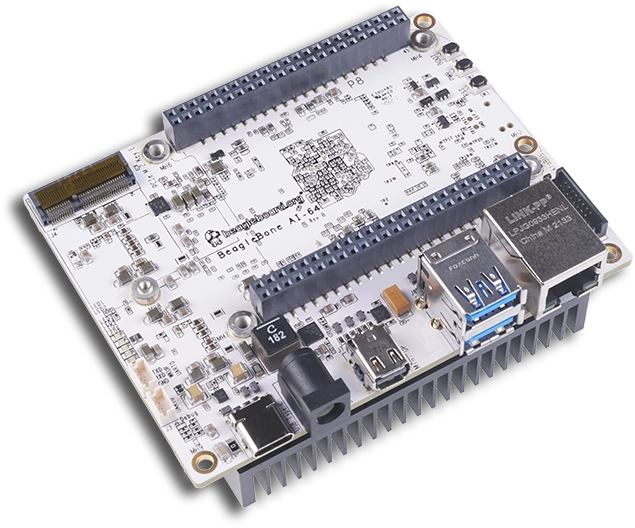
The BeagleBone AI-64 is the family’s edge-AI flagship, and it is a serious piece of silicon: TI’s TDA4VM with dual 64-bit Cortex-A72 cores at up to 2.0 GHz, a C7x vector DSP, a deep-learning matrix accelerator rated at 8 TOPS, two C66x DSPs, six Cortex-R5F cores and a PowerVR Rogue 8XE GPU — backed by 4 GB LPDDR4 and 16 GB eMMC, USB 3.0 Type-C, M.2 E-key, two 4-lane CSI camera connectors, Gigabit Ethernet and BeagleBone Black header compatibility.
We searched Amazon thoroughly and could not find a live listing for the AI-64 board itself — only cases and accessories for it. Rather than send you to a guessed or mismatched listing, we are telling you plainly: buy the AI-64 from an authorised distributor such as DigiKey, Mouser, element14/Farnell or RS (part number 102110646). If you need comparable compute from something you can order on Amazon today, the BeagleBoard X15 is the closest match on DSP and I/O, though it has no dedicated deep-learning accelerator.
🎯 Bottom line: The AI-64 is the right board for camera-based edge inference on the BeagleBone form factor — just not an Amazon purchase.
🧭 How to Choose the Right BeagleBone
⏱️
Need hard real-time I/O?
Any AM3358 board gives you two 200 MHz PRUs. The BeagleBone Black Rev C is the best-documented route into PRU assembly and remoteproc.
💰
Buying several for a lab?
The AmpOhm360 BeagleBone Black is the cheapest full Rev C spec here — reflash the eMMC on arrival and it behaves identically.
🔋
Battery-powered or wearable?
The PocketBeagle 2 packs a dual A53 plus an M4F and a LiPo charging path into 55×35 mm — the only sensible portable choice.
📡
Building a field gateway?
The BeagleBone Green Gateway combines WiFi, BLE and Ethernet with a 12 V input and Grove sensor ports — no dongles required.
🚀
Need DSP or serious compute?
The BeagleBoard X15 brings dual C66x DSPs, four PRUs, 2 GB RAM and dual Gigabit Ethernet for vision and industrial workloads.
🎓
Teaching a class?
Pair a Green Gateway with the Grove Starter Kit so students wire sensors in seconds and spend the lab on code, not jumper wires.
⚙️ Key Specs Compared — Side by Side
| Spec | BeagleBone Black Rev C | PocketBeagle 2 | Green Gateway | BeagleBoard X15 | BeagleBone AI-64* |
|---|
| SoC | AM3358 | AM6232 | AM3358 | AM5728 | TDA4VM ⭐ |
| CPU | 1× Cortex-A8 @1 GHz | 2× Cortex-A53 @1.4 GHz | 1× Cortex-A8 @1 GHz | 2× Cortex-A15 @1.5 GHz | 2× Cortex-A72 @2 GHz ⭐ |
| RAM | 512 MB DDR3L | 512 MB DDR4 | 512 MB DDR3 | 2 GB DDR3 | 4 GB LPDDR4 ⭐ |
| Onboard Storage | 4 GB eMMC | microSD only | 4 GB eMMC | 4 GB eMMC | 16 GB eMMC ⭐ |
| Real-Time Cores | 2× PRU @200 MHz | Cortex-M4F + PRUSS | 2× PRU @200 MHz | 4× PRU + 2× M4 ⭐ | 4× PRU + 6× R5F |
| AI / DSP | None | None | None | 2× C66x DSP | 8 TOPS MMA + C7x ⭐ |
| Networking | 10/100 Ethernet | None (USB) | Ethernet + WiFi + BLE | 2× Gigabit ⭐ | Gigabit + M.2 WiFi |
| BBB Cape Compatible | Yes ⭐ | No (72-pin) | Yes ⭐ | No (4× 60-pin) | Yes ⭐ |
| On Amazon? | Yes ⭐ | Yes ⭐ | Yes ⭐ | Yes ⭐ | No — distributors only |
*The BeagleBone AI-64 column is included for comparison only — at the time of writing the board is not listed on Amazon and must be bought from an authorised distributor. Specs are from manufacturer documentation; always confirm details on the live listing.
❓ Frequently Asked Questions
BeagleBone Black or Raspberry Pi — which should I buy?
If your project is about raw application performance, media, or a big software ecosystem, buy a Raspberry Pi: it has more RAM, faster cores and a far larger community. Buy a BeagleBone when timing matters. The AM3358’s two PRUs execute deterministic code completely outside Linux scheduling, so you can bit-bang a protocol, drive an LED matrix or generate step pulses with no jitter — something a Pi cannot do without extra hardware. The BeagleBone also exposes far more usable GPIO (65 pins across two headers) and seven analog inputs, which the Pi lacks entirely.
Is the BeagleBone Black still worth buying?
For real-time and industrial work, yes. The silicon is old but the PRU subsystem, the seven-year-plus TI longevity commitment on Sitara parts, the mature mainline kernel support and the depth of published cape designs are things newer boards have not replaced. Where it struggles is anything RAM-hungry or graphical: 512 MB and a 1 GHz single core will not run a modern desktop, a browser or a container stack comfortably. Treat it as a real-time controller with a Linux userspace attached, not as a small PC, and it is still an excellent buy.
What exactly are the PRUs and when do I need them?
The Programmable Real-Time Unit Subsystem is a pair of 32-bit RISC cores running at 200 MHz with their own instruction and data memory and direct, single-cycle access to a set of GPIO pins. Because they share no cache or interrupt path with the Cortex-A8, their execution timing is fixed and predictable to the clock cycle. You write PRU firmware in C or assembly, load it from Linux via remoteproc, and communicate through shared memory. Reach for them when software timing on Linux is not good enough: quadrature decoding, stepper generation, WS2812 LED strings, custom serial protocols, high-rate ADC sampling and logic analysis.
Why is the BeagleBone AI-64 not in the buy list?
Because it is not sold on Amazon. We searched the marketplace directly and found cases and enclosures for the AI-64, but no live listing for the board itself. Since every pick in this guide is verified against a real Amazon listing, we would rather say so than point you at a guessed part number. The AI-64 is widely available from DigiKey, Mouser, element14/Farnell and RS Components under part number 102110646. If you want that class of compute from something Amazon actually stocks, the BeagleBoard X15 is the nearest option, though it trades the 8 TOPS deep-learning accelerator for a pair of C66x DSPs.
Do BeagleBone capes work across all these boards?
Only across the boards that keep the 2×46-pin header: BeagleBone Black, Green, Green Gateway and AI-64 are cape-compatible, though individual capes may still need a different device-tree overlay or may collide on a pin function. PocketBeagle and PocketBeagle 2 use a smaller 72-pin layout with their own cape range, and the BeagleBoard X15 uses four 60-pin connectors that share nothing with the classic header. Always check the cape’s EEPROM support and pin-mux requirements against your specific board before buying, and remember that boards without HDMI cannot drive an LCD cape that expects the video pins.
🏁 Final Verdict — Best BeagleBone for Every Build
The right BeagleBone board for every project and budget:
🥇 Best Overall — BeagleBone Black Rev C (Element14): AM3358, 2× PRU, 4 GB eMMC, full cape ecosystem
Buy →🏅 Best Value — AmpOhm360 BeagleBone Black: same Rev C spec at the lowest price here
Buy →🧩 Best Ultra-Compact — PocketBeagle 2: dual A53 + M4F with LiPo charging in 55×35 mm
Buy →📡 Best IoT Gateway — BeagleBone Green Gateway: WiFi + BLE + Ethernet with Grove ports
Buy →🚀 Best High-Performance — BeagleBoard X15: dual A15, 2× C66x DSP, 4× PRU, dual Gigabit
Buy →🔰 Best Starter Bundle — BeagleBone Black Rev C Starter Kit: ready to boot out of the box
Buy →🧪 Best Sensor Bundle — Grove Starter Kit for BeagleBone Green: 10 solderless modules
Buy →No single BeagleBone suits every project, but each pick here earns its place. For most embedded Linux and real-time work the BeagleBone Black Rev C remains the board to buy — the PRU subsystem and cape ecosystem are still unmatched at this price. If you need several boards, the AmpOhm360 listing gets you the same silicon for far less. Portable and battery builds belong on the PocketBeagle 2; field gateways on the Green Gateway; DSP and multi-network workloads on the BeagleBoard X15. And if edge AI inference is the goal, the BeagleBone AI-64 is the right board — just order it from a distributor rather than Amazon. Pair whichever you choose with our Arduino, ESP32, STM32, Raspberry Pi and embedded Linux tutorials and start building today.
💬 Not sure which BeagleBone fits your project? Tell us what you are building — a CNC controller, an industrial gateway, a data logger or an edge-vision rig — in the comments below, and we will point you to the right board.
All Amazon links above use our affiliate tag (microlab05-20). Purchasing through them supports microcontrollerslab.com at no extra cost to you. Prices, stock and availability on BeagleBone listings change frequently — always confirm the current price on Amazon before buying.