⚠️ Affiliate Disclosure: This post contains Amazon affiliate links. If you purchase through our links, we may earn a small commission at no extra cost to you. We only recommend products we have thoroughly researched and verified. Prices change frequently, so we don’t list them here — always tap through and confirm the live price on Amazon before buying.
Ultimate Buying Guide 2026
🤖 Best Servo Motors for Robotics & Embedded Projects
8 servo motors ranked for makers, students and roboticists — from a 9g micro SG90 to a 35kg coreless monster and a smart serial-bus servo for robot arms — with real specs, honest verdicts, and direct Amazon links.
✅ 8 Servos Reviewed
✅ Verified Amazon ASINs
✅ Updated July 2026
✅ Honest Pros & Cons
A servo motor is the muscle behind almost every hobby robot, RC model and animatronic build. Unlike a plain DC motor that just spins, a servo takes a simple PWM signal from your Arduino, ESP32, Raspberry Pi Pico or PIC and holds a precise angular position — perfect for robot-arm joints, pan-tilt camera mounts, walking robots, steering linkages and grippers. Learning to drive one cleanly is one of the first real milestones in embedded robotics.
The hard part is choosing the right one. Servos vary enormously in torque (from under 2 kg·cm to over 35 kg·cm), gear material (fragile plastic vs. bomb-proof metal), rotation range (180°, 270°, or full 360° continuous), and control type (classic analog PWM vs. modern digital and even smart serial-bus servos with position feedback). This guide ranks 8 servo motors across every budget and use-case — micro to heavy-duty — on the specs that actually matter for embedded and robotics work.
💡 Reality check before you buy: Cheap servos and their clones vary wildly in quality — the headline “20kg” torque is a stall figure at the highest rated voltage, and continuous holding torque is far lower. Budget SG90/MG996R clones often ship with weaker gears, noisier pots and torque a bit below spec. Never power more than one or two small servos straight from a board’s 5V pin — they draw heavy stall current and will brown-out your microcontroller; use a separate 5–6V supply with a common ground. And remember a standard servo only turns ~180° — if you want a wheel, you need a continuous-rotation servo, not a stronger standard one.
🤖 Quick Comparison — All 8 Servo Motors
| Servo | Type | Stall Torque | Rotation / Gear | Best For | Buy |
|---|
| 🥇 ANNIMOS DS3218 | Digital · MG | ~20 kg·cm | 270° · Metal | Best Overall | View → |
| 🏅 MG996R | Analog · MG | ~11 kg·cm | 180° · Metal | Best Value | View → |
| 🔰 SG90 | Analog · Micro | ~1.8 kg·cm | 180° · Plastic | Best for Beginners | View → |
| 🦾 MG90S | Analog · Micro MG | ~2.2 kg·cm | 180° · Metal | Best Metal-Gear Micro | View → |
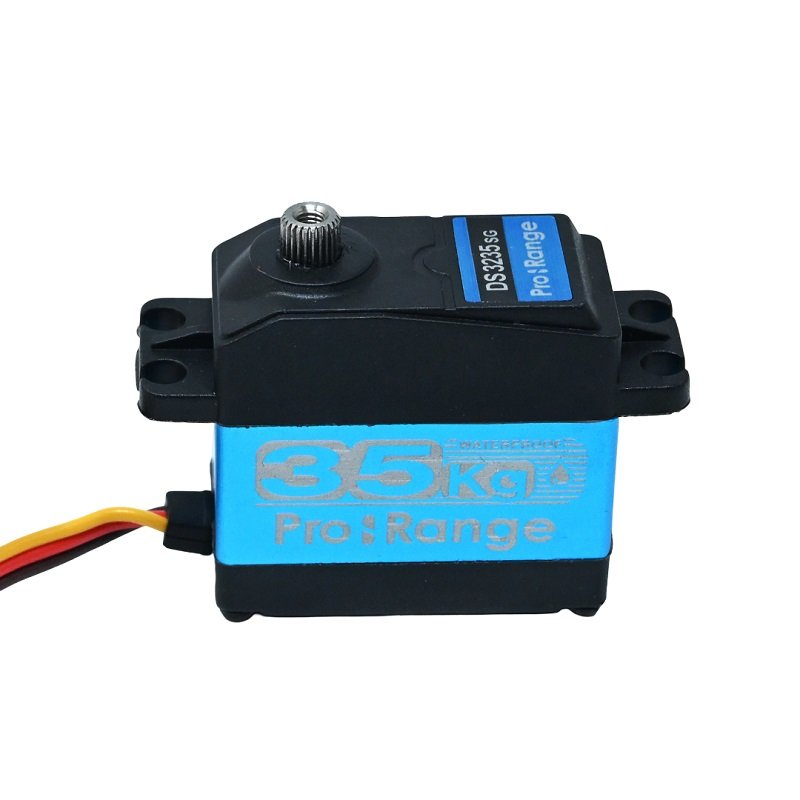
| 💪 ANNIMOS DS3235 | Coreless · Digital | ~35 kg·cm | 270° · Steel | Best High-Torque | View → |
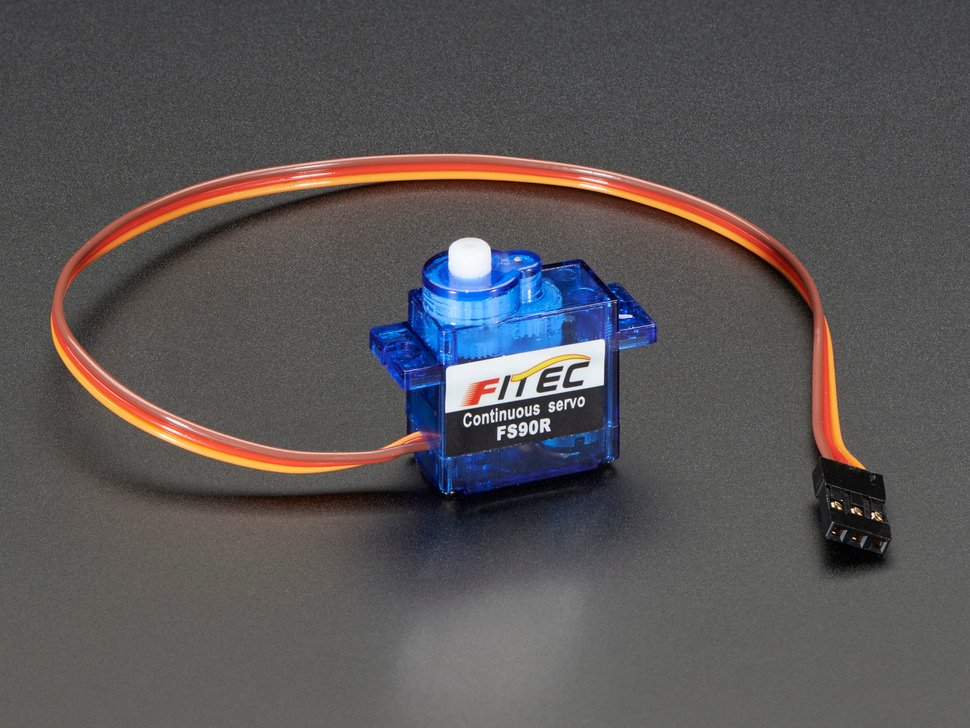
| 🔄 FEETECH FS90R | Continuous · Micro | ~1.5 kg·cm | 360° · Plastic | Best Continuous Rotation | View → |
| 🧠 FeeTech STS3215 | Smart · Serial Bus | ~19 kg·cm | 360° · Metal | Best Smart / Robot Arm | View → |
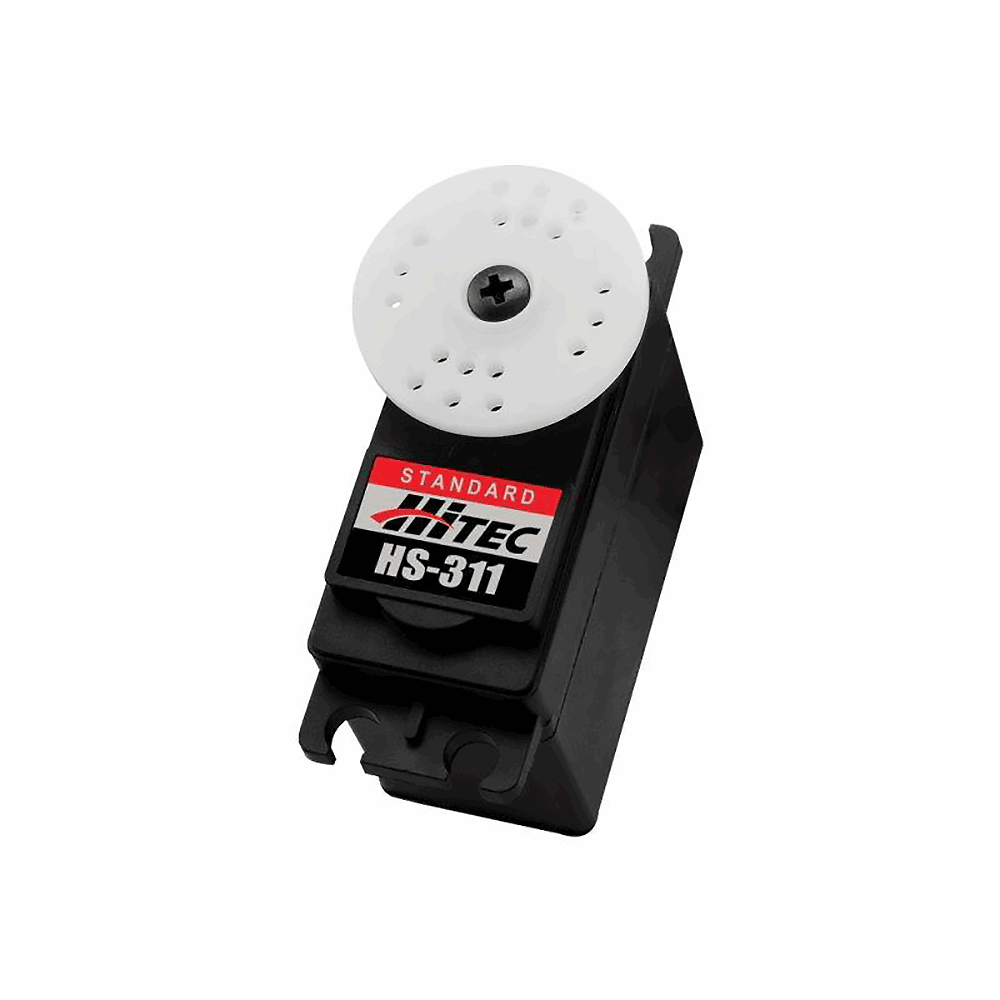
| 🛠️ Hitec HS-311 | Analog · Standard | ~3.7 kg·cm | 180° · Nylon | Best Name-Brand Standard | View → |
Torque figures are approximate stall values at the servo’s highest rated voltage. Many budget models are sold in multi-packs — check the listing. Always confirm the live price on Amazon before buying.
🔍 What to Look for in a Servo Motor
💪
Torque (kg·cm)
The single most important number. It’s the force at a 1cm arm — so a 20 kg·cm servo lifts ~20kg at 1cm, but only ~10kg at 2cm. Size it to the actual load and lever length of your joint, with margin.
⚙️
Gear Material
Plastic/nylon gears are quiet and cheap but strip under shock loads. Metal (brass/steel) gears survive crashes, high torque and stalls — essential for robot arms, crawlers and anything that takes a knock.
🔄
Rotation Range
Most standard servos sweep ~180° (some 270°) and hold position. A continuous-rotation servo spins 360° like a geared motor with speed/direction control — use it for wheels, not for precise angles.
⚡
Analog vs Digital
Digital servos refresh the motor far faster than analog — giving crisper holding, better precision and higher torque, at the cost of more current. Analog is fine for learning and light hobby use.
🔋
Voltage & Current
Higher voltage (6V, 7.4V) means more torque and speed — but watch stall current. Power servos from a dedicated 5–7.4V supply with a shared ground, never straight from a microcontroller’s regulator.
🏆 Detailed Reviews — All 8 Servo Motors
🥇 BEST OVERALL

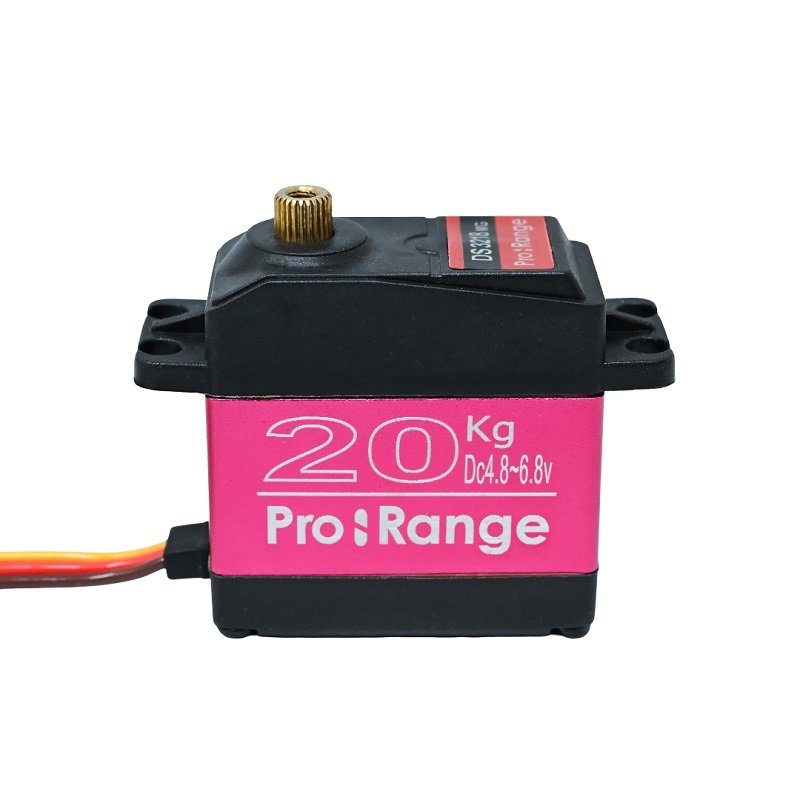
The ANNIMOS DS3218 is the servo we hand to anyone building a serious robot arm, crawler or pan-tilt rig. It combines roughly 20 kg·cm of stall torque with a full metal gear train, a waterproof-sealed case and a genuine digital control board that holds position tightly with very little buzz. The wide 270° range and 4.8–6.8V operation make it flexible, and its huge install base means endless Arduino, ESP32 and PWM-driver tutorials. For most makers it’s the sweet spot of power, precision and price.
✅ Pros- Big ~20 kg·cm digital torque
- Full metal gears + waterproof case
- Wide 270° range, 4.8–6.8V
- Massive community & tutorials
❌ Cons- Draws heavy stall current
- Needs a real 6V supply for full torque
- Overkill for tiny micro projects
🎯 Verdict: The best all-round servo for robotics. Enough torque and precision for real joints, without stepping up to industrial prices.
👉 Check Price on Amazon →
🏅 BEST VALUE

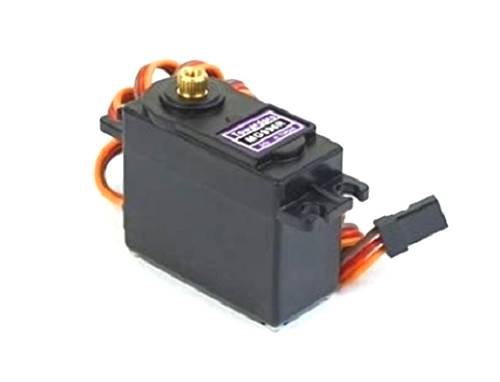
The MG996R is the servo that has powered a million first robot arms. For pennies per unit (it’s usually sold in multi-packs) you get a full metal gear train, roughly 11 kg·cm of torque and a standard 40×20×40mm footprint that fits every bracket and tutorial ever written. It isn’t the most precise or best-built servo here — clone quality varies — but nothing beats it on capability-per-dollar for grippers, steering, pan-tilt and general experimentation. Buy a four-pack and you’re stocked for a dozen projects.
✅ Pros- Unbeatable torque per dollar
- Metal gears, standard size
- Sold in cheap multi-packs
- Endless tutorials & brackets
❌ Cons- Clone quality is inconsistent
- Analog — some buzz/jitter
- High idle/stall current draw
🎯 Verdict: The best value in hobby robotics. If you’re learning or prototyping, buy a pack of these and don’t look back.
👉 Check Price on Amazon →
🔰 BEST FOR BEGINNERS · ⭐ 4.5/53. SG90 9g Micro Servo
~1.8 kg·cm · 0.1 s/60° · 9 g · plastic gear · 180° · 4.8–6V
Buy →

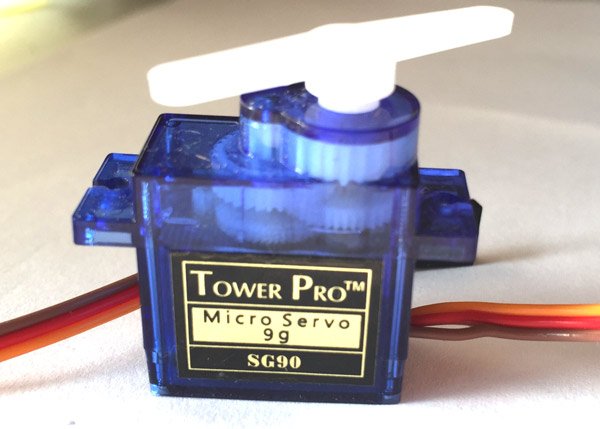
The SG90 is the servo almost everyone starts with. At just 9 grams and a couple of dollars each (in multi-packs), it’s the perfect first actuator for learning PWM control on an Arduino, ESP32 or Pico. It has enough torque for light grippers, small pan-tilt mounts, robot claws and flaps — and if you burn one out, you’ve lost pocket change. Just don’t ask its plastic gears to do heavy lifting.
✅ Pros: Dirt cheap; tiny & light; perfect for learning PWM; huge tutorial base.
❌ Cons: Weak plastic gears; low torque; can jitter at end-stops.
🎯 Verdict: The best first servo. Buy a multi-pack, learn on them, and don’t worry about the occasional casualty.
🦾 BEST METAL-GEAR MICRO · ⭐ 4.5/54. MG90S Micro Servo
~2.2 kg·cm · 0.1 s/60° · 13.4 g · metal gear · 180° · 4.8–6V
Buy →

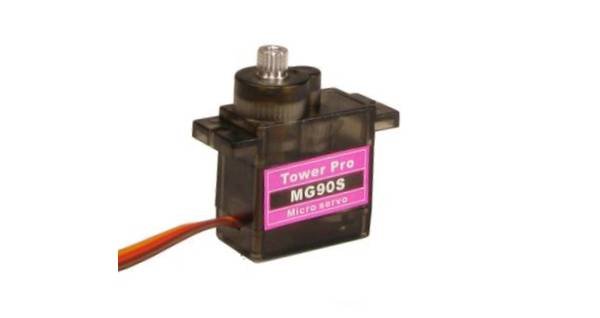
The MG90S is the drop-in upgrade to the SG90: same tiny footprint and pinout, but with metal gears and a bit more torque. That gearset makes a real difference in small robot arms, hexapod legs and camera gimbals where plastic gears would strip. It runs a touch warmer and costs a little more, but for any micro build that actually takes load, it’s the smarter buy.
✅ Pros: Metal gears in a 9g-class body; SG90-compatible; great for micro arms/legs.
❌ Cons: Still low absolute torque; runs warm; clone quality varies.
🎯 Verdict: The best micro servo for load-bearing builds. Metal-gear durability at almost SG90 size.
💪 BEST HIGH-TORQUE · ⭐ 4.6/55. ANNIMOS DS3235
~35 kg·cm · 0.13 s/60° · coreless · stainless gear · IP66 · 270°
Buy →
When 20 kg·cm isn’t enough, the ANNIMOS DS3235 steps up to a coreless motor, stainless-steel gears and around 35 kg·cm of torque (more at 7.4–8.4V). It’s built for 1/8 and 1/10 crawlers, large robot arms, animatronics and steering under real load, with an IP66-sealed case for outdoor and dusty environments. It’s heavier and thirstier than the DS3218 — you’ll want a proper battery/BEC — but nothing else here moves this much weight so precisely.
✅ Pros: Huge ~35 kg·cm torque; coreless + steel gears; IP66 waterproof; fast.
❌ Cons: Heavy current draw; needs a strong supply/BEC; overkill for light builds.
🎯 Verdict: The best high-torque servo. Reach for it when your joint has to move serious weight.
🔄 BEST CONTINUOUS ROTATION · ⭐ 4.4/56. FEETECH FS90R
~1.5 kg·cm · ~130 RPM · 9 g · 360° continuous · 4.8–6V
Buy →

The FEETECH FS90R is a micro continuous-rotation servo — it spins fully forward or backward with speed set by the PWM signal, rather than holding an angle. That makes it the easiest way to add driven wheels to a small robot without a separate motor driver: just wire it to a pin and use the Servo library. It’s the go-to for line-followers, micro:bit buggies and tiny two-wheel bots. Pop-on wheels are widely available to match.
✅ Pros: Wheels with no motor driver; light & cheap; standard Servo-library control.
❌ Cons: Low torque; needs stop-point calibration; not for holding position.
🎯 Verdict: The best continuous-rotation micro. The simplest path to a driven wheel on a small robot.
🧠 BEST SMART / ROBOT ARM · ⭐ 4.7/57. FeeTech STS3215
~19 kg·cm · serial TTL bus · 12-bit encoder · 360° · position feedback · 6–7.4V
Buy →

The FeeTech STS3215 is a different class of servo: a smart serial-bus servo with a 12-bit magnetic encoder that reports back its exact position, speed, load, temperature and voltage over a single daisy-chained TTL bus. That feedback is why it’s become the standard actuator for open-source robot arms like the LeRobot SO-ARM100/101. Instead of blind PWM, you address each servo by ID and read real angles — ideal for repeatable, closed-loop robotics. It’s pricier and needs a bus driver board, but nothing else here is this capable for arm builds.
✅ Pros: Real position/load feedback; daisy-chain bus; standard for SO-ARM100 arms.
❌ Cons: Needs a TTL bus driver board; steeper learning curve; costs more.
🎯 Verdict: The best smart servo for serious robotics. If you’re building a feedback-driven robot arm, start here.
🛠️ BEST NAME-BRAND STANDARD · ⭐ 4.5/58. Hitec HS-311
~3.7 kg·cm · 0.15 s/60° · 43 g · nylon gear · analog · 4.8–6V
Buy →

If you’re tired of clone-quality lottery, the Hitec HS-311 is a genuine name-brand standard servo backed by a real manufacturer and a two-year warranty. It’s an honest analog workhorse: ~3.7 kg·cm, reliable three-pole motor, durable resin gears and a universal connector that fits every board and bracket. It won’t win torque contests, but for classroom kits, trainer aircraft and dependable general-purpose motion, its consistency is worth the small premium over no-name servos.
✅ Pros: Trusted brand + 2-yr warranty; consistent quality; universal fit.
❌ Cons: Modest torque; resin (not metal) gears; pricier than clones.
🎯 Verdict: The best name-brand standard servo. Pay a little more for reliability you can count on.
🛒 How to Choose the Right Servo
🤖
Building a robot arm or crawler?
Get the ANNIMOS DS3218 — ~20 kg·cm of digital metal-gear torque with a wide 270° range.
💵
Prototyping on a budget?
Grab a multi-pack of MG996R metal-gear servos — the best torque-per-dollar in hobby robotics.
🔰
Just learning servos?
Start with cheap SG90 micros (or metal-gear MG90S for load) and practise PWM safely.
💪
Moving serious weight?
The coreless ANNIMOS DS3235 delivers ~35 kg·cm with steel gears and an IP66 case.
🔄
Need driven wheels?
Use continuous-rotation FEETECH FS90R servos — wheels without a separate motor driver.
🧠
Want closed-loop feedback?
The FeeTech STS3215 serial-bus servo reports real position/load — perfect for robot arms.
⚙️ Key Specs Compared — Side by Side
| Spec | ANNIMOS DS3218 | ANNIMOS DS3235 | MG996R | MG90S | FeeTech STS3215 |
|---|
| Stall Torque | ~20 kg·cm | ~35 kg·cm ⭐ | ~11 kg·cm | ~2.2 kg·cm | ~19 kg·cm |
| Rotation | 270° | 270° | 180° | 180° | 360° ⭐ |
| Gear Material | Metal | Stainless Steel ⭐ | Metal | Metal | Metal |
| Speed (60°) | 0.14 s | 0.13 s ⭐ | 0.17 s | 0.10 s | 0.19 s |
| Control / Feedback | Digital PWM | Digital PWM | Analog PWM | Analog PWM | Serial bus + encoder ⭐ |
| Voltage | 4.8–6.8V | 4.8–8.4V ⭐ | 4.8–7.2V | 4.8–6V | 6–7.4V |
| Waterproof | Yes (IP66) ⭐ | Yes (IP66) ⭐ | No | No | No |
Specs are approximate and vary with voltage and seller/clone. Always confirm details on the live Amazon listing.
❓ Frequently Asked Questions
What’s the difference between an analog and a digital servo?
Both take the same PWM signal, but a digital servo’s internal chip pulses the motor several hundred times per second instead of ~50Hz. That gives it faster response, tighter holding torque and better precision at the end-stops — you feel it “lock” into position. The trade-off is higher current draw and a bit more cost. For learning and light hobby work, analog (SG90, MG996R, HS-311) is perfectly fine; for robot joints that must hold accurately under load, digital (DS3218, DS3235) is worth it.
How much torque do I actually need?
Torque is quoted in kg·cm — the load a servo can hold at a 1cm arm. Because it scales with lever length, a joint 4cm out only gets a quarter of the rated figure. Estimate your load and its distance from the shaft, then pick a servo with 2–3× headroom so it isn’t stalling. Light flaps and small grippers are happy with an SG90/MG90S; a two-link robot arm usually wants MG996R-class or a DS3218; heavy crawlers and big arms need the DS3235.
Can I power a servo directly from my Arduino or ESP32?
Only for the smallest servos, briefly. Servos draw large current spikes when they start moving or stall — easily hundreds of milliamps to several amps — which will crash a board powered from USB or its onboard regulator. Use a separate 5–6V (or 7.4V for high-torque digital) supply sized for the stall current, connect the servo’s power to that, and tie the supply ground to your microcontroller’s ground. Only the signal wire goes to the MCU pin. A capacitor across the servo supply also helps tame the spikes.
What’s the difference between a standard and a continuous-rotation servo?
A standard servo moves to and holds a specific angle (typically within ~180°) — you command a position. A continuous-rotation servo (like the FS90R) has its feedback pot disconnected, so the same signal instead sets speed and direction and it spins freely 360°. Use standard servos for arms, steering and pan-tilt; use continuous-rotation servos as simple driven wheels. You can’t get precise angle control from a continuous servo, and a standard servo can’t be a wheel without modification.
What is a smart / serial-bus servo and do I need one?
A smart servo like the FeeTech STS3215 replaces one-way PWM with a two-way digital bus: you address each servo by ID over a shared TTL line and it reports back position, speed, load, temperature and voltage from a built-in encoder. That lets you daisy-chain many servos on a few wires and run true closed-loop control — which is why they power open-source robot arms like the SO-ARM100/101. You don’t need one for simple projects, but for a multi-joint arm where repeatability and feedback matter, they’re transformative.
🏁 Final Verdict — Best Servo for Every Build
The right servo motor for every project and budget:
🥇 Best Overall — ANNIMOS DS3218: ~20 kg·cm digital, metal gears, 270°, waterproof
Buy →🏅 Best Value — MG996R: metal-gear ~11 kg·cm, sold in cheap multi-packs
Buy →🔰 Best for Beginners — SG90 / MG90S: tiny, cheap, perfect for learning PWM
Buy →💪 Best High-Torque — ANNIMOS DS3235: coreless ~35 kg·cm, steel gears, IP66
Buy →🔄 Best Continuous Rotation — FEETECH FS90R: micro wheels, no motor driver needed
Buy →🧠 Best Smart / Robot Arm — FeeTech STS3215: serial bus + feedback for SO-ARM builds
Buy →No single servo is right for every build, but every pick here earns its place. For most robotics projects the ANNIMOS DS3218 is the one to buy — real digital metal-gear torque you won’t outgrow. If you’re prototyping on a budget, stock up on MG996R packs; beginners should learn on cheap SG90 or metal-gear MG90S micros; heavy builds need the DS3235; wheels want the continuous FS90R; and if you’re building a feedback-driven robot arm, the smart FeeTech STS3215 is in a class of its own. Pair your servos with our Arduino, ESP32, STM32 and Raspberry Pi tutorials and start building today.
💬 Not sure which servo fits your project? Tell us what you’re building — a robot arm, a rover, a camera gimbal or an animatronic — in the comments below, and we’ll point you to the right pick.
All Amazon links above use our affiliate tag (microlab05-20). Purchasing through them supports microcontrollerslab.com at no extra cost to you. Prices and availability change frequently — always confirm the current price on Amazon before buying.