⚠️ Affiliate Disclosure: This post contains Amazon affiliate links. If you purchase through our links, we may earn a small commission at no extra cost to you. We only recommend products we have thoroughly researched and verified. Prices change frequently — always check the live price on Amazon before buying.
Ultimate Buying Guide 2026
👁️ Best USB Cameras for Machine Vision
10 dedicated machine-vision USB camera modules ranked for makers, robotics builders and inspection benches — global shutter, high frame rate, low light and high resolution picks from Arducam and ELP, all verified on Amazon.
✅ 10 Cameras Reviewed
✅ Verified Amazon ASINs
✅ Updated July 2026
✅ Honest Pros & Cons
A regular webcam is built to make a face look good in a video call. A machine-vision USB camera is built to give an algorithm exactly what it needs: a distortion-free image with a known exposure, a global shutter that freezes motion without smear, frame rates fast enough to track moving parts, and manual control over every parameter. Whether you’re reading barcodes on a conveyor, guiding a robot arm, aligning a laser engraver, tracking a ball for a golf simulator, or feeding OpenCV on a Raspberry Pi or Jetson, the camera module — not the model — is usually what decides whether your pipeline works.
The good news is that you no longer need a $500+ industrial GigE camera to get machine-vision-grade imaging. Dedicated UVC (plug-and-play) USB camera modules from Arducam and ELP now deliver global shutter sensors, 100–200fps frame rates, external trigger support and interchangeable M12/CS lenses at hobbyist prices. This guide ranks 10 USB machine-vision cameras — from a sub-$50 global-shutter starter board to a 48MP inspection module — on the specs that actually matter: shutter type, frame rate, resolution, lens flexibility and software compatibility.
💡 Reality check before you buy: Board-level cameras trade polish for capability — expect bare PCBs (or basic metal cases), short 1m cables, and bundled Windows software that’s often clunky (use OpenCV, AMCap or your own code instead). Headline frame rates usually apply only to MJPG compression at reduced resolutions — uncompressed YUY2 is far slower, and several buyers report real-world rates 20–30% below spec on slower USB controllers. Monochrome sensors beat color for most vision tasks but are useless if you need color features. And remember: lighting matters more than the camera — a cheap global-shutter module under good, constant illumination will outperform an expensive one in bad light.
👁️ Quick Comparison — All 10 Machine Vision Cameras
| Camera | Sensor | Shutter | Max Rate | Best For | Buy |
|---|
| 🥇 Arducam OV9281 1MP | OV9281 mono | Global | 100fps @ 800P | Best Overall | View → |
| 🏅 ELP AR0234 USB3.0 | AR0234 color | Global | 200fps @ 720P | Best High-Speed | View → |
| 🔬 Arducam OV2311 2MP | OV2311 mono | Global | 50fps @ 1200P | Best Mono Resolution | View → |
| 🎨 ELP AR0234 USB2.0 | AR0234 color | Global | 90fps @ 1080P | Best Color All-Rounder | View → |
| 💵 Arducam OV9782 1MP | OV9782 color | Global | 100fps @ 800P | Best Budget Color GS | View → |
| 📸 ELP 5MP Global Shutter | OX05B10 color | Global | 50fps @ 5MP | Best High-Res GS | View → |
| 🔭 ELP AR0234 Varifocal | AR0234 color | Global | 90fps @ 1080P | Best Adjustable Lens | View → |
| 🌙 Arducam IMX291 2MP | IMX291 color | Rolling (WDR) | 30fps @ 1080P | Best Low-Light | View → |
| 🔍 ELP 4K IMX415 | IMX415 color | Rolling | 30fps @ 4K | Best 4K Inspection | View → |
| 🧿 ELP 48MP Autofocus | 48MP color | Rolling | 30fps @ 1080P | Best Ultra-High-Res | View → |
Prices change frequently on these listings, so we’ve linked you straight to each product — tap “View →” to see the live price on Amazon.
🔍 What to Look for in a Machine Vision USB Camera
📷
Global vs Rolling Shutter
A global shutter exposes every pixel at once, freezing fast motion without skew or wobble — essential for conveyor lines, drones and ball tracking. Rolling shutter is fine for static inspection and gives you cheaper high-resolution sensors.
⚡
Frame Rate & Interface
USB 2.0 tops out around 90–100fps with MJPG compression; genuine 120–200fps needs USB 3.0. Check the rate for the format you’ll actually use — uncompressed YUY2 is often 10fps or less at full resolution.
🎯
Resolution vs Speed
More pixels = slower frames and heavier processing. 1MP at 100fps beats 8MP at 15fps for motion tasks; high resolution only wins for static measurement, OCR and defect inspection. Match the sensor to the job.
🔭
Lens Mount & FOV
M12 and CS mounts let you swap lenses to change field of view and working distance — a huge advantage over fixed-lens webcams. Low-distortion lenses save you calibration headaches in measurement work.
🔌
UVC & External Trigger
UVC-compliant cameras work driver-free with OpenCV, Linux, Windows, Raspberry Pi and Jetson. For synchronized multi-camera rigs or strobe lighting, look for boards with external trigger pins — several Arducam modules have them.
🏆 Detailed Reviews — All 10 Machine Vision Cameras
🥇 BEST OVERALL
Arducam OV9281 1MP Global Shutter
⭐ 4.7/5 · The Machine Vision Workhorse
Buy on Amazon →

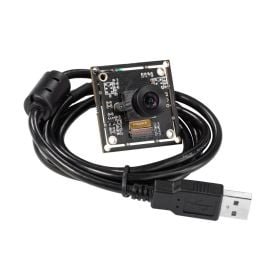
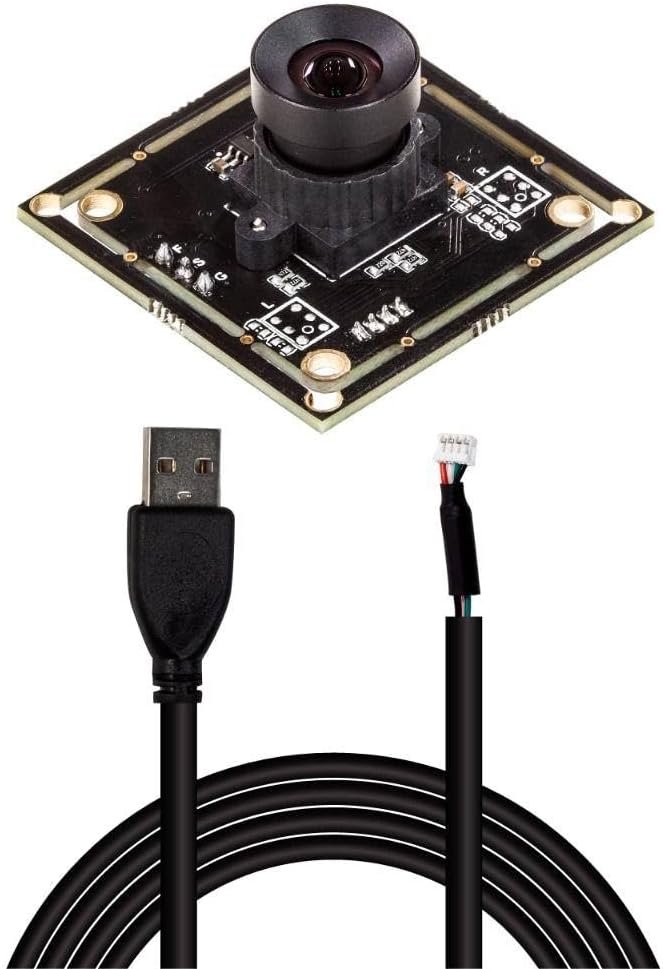
The Arducam OV9281 is the camera we recommend to anyone starting in machine vision — and the one many stick with. Its 1MP monochrome global shutter sensor delivers crisp, smear-free frames of fast-moving objects at 100fps (MJPG, 1280×800), it’s fully UVC plug-and-play with OpenCV on Windows, Linux, Mac, Raspberry Pi and Jetson, and it even has reserved external trigger ports for synchronized capture — a feature normally found on industrial cameras costing several times more. The 70° M12 lens is low-distortion and IR-sensitive (no IR filter), making it a favorite for IR point tracking, eye tracking and golf-simulator builds.
✅ Pros- Global shutter + 100fps at board-camera money
- External trigger support
- Excellent low-light & IR sensitivity
- 4.7★ owner rating, proven in tracking rigs
❌ Cons- Monochrome only
- Some users measure ~70fps, not 100
- Bundled Windows software is poor — use OpenCV
🎯 Verdict: The best first machine-vision camera. Global shutter, high frame rate, trigger port and rock-solid UVC support — nothing else this cheap does all four.
👉 Check Price on Amazon →
🏅 BEST HIGH-SPEED
ELP AR0234 USB 3.0 High-Speed
⭐ 4.5/5 · 200fps Without the Industrial Price
Buy on Amazon →

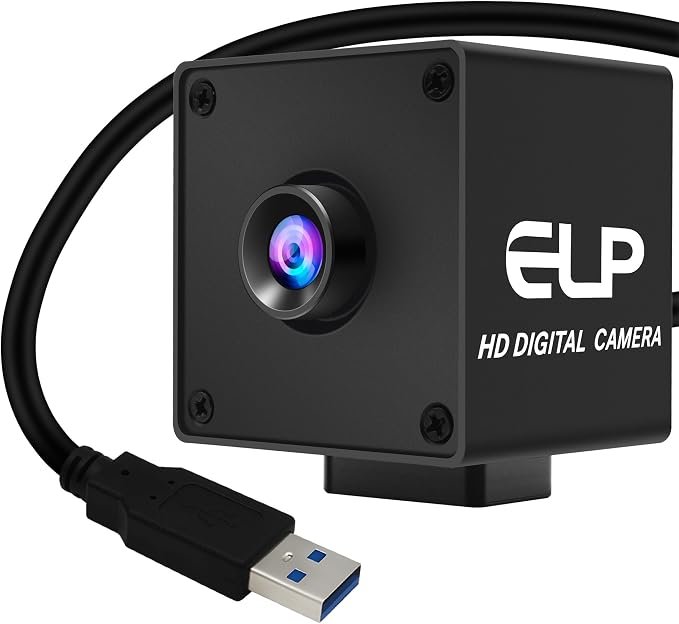
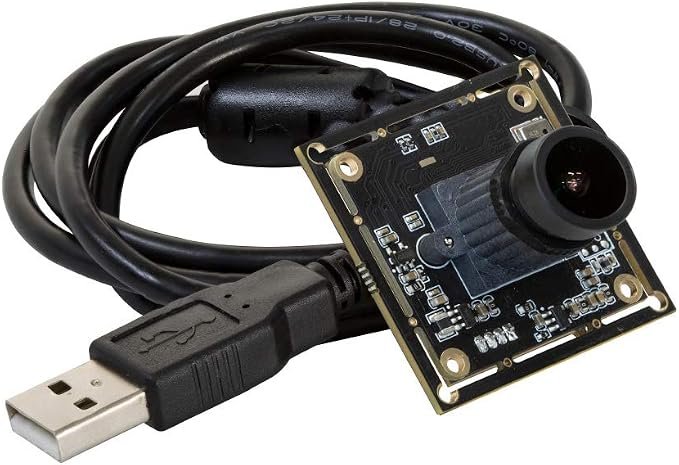
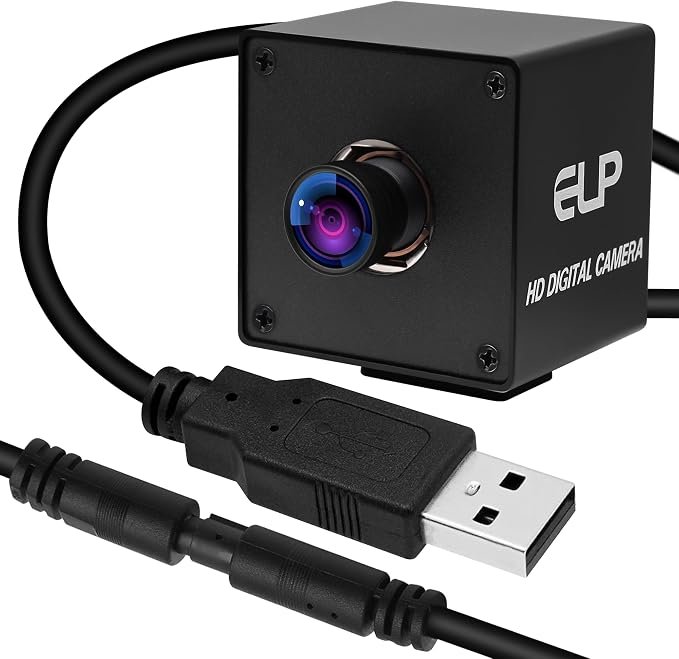
When 90fps isn’t enough, the ELP AR0234 USB 3.0 steps up to a genuine 200fps at 720P and 120fps at full 1920×1200 — over a real USB 3.0 link, so those frames actually reach your software. The 2.3MP AR0234 is the same global-shutter sensor family used in many industrial cameras, and the 83° low-distortion lens keeps geometry honest for measurement and tracking. It’s the pick for ball tracking, propeller/vibration analysis, fast conveyor inspection and any project where motion blur or USB 2.0 bandwidth has become the bottleneck.
✅ Pros- True 200fps high-speed capture
- Global shutter at full 1200P/120fps
- USB 3.0 — no MJPG-only compromise
- Works with Windows, Linux, Pi, Jetson
❌ Cons- Newer listing — few Amazon reviews yet
- Needs a good USB 3.0 controller for full rate
- Costs more than USB 2.0 boards
🎯 Verdict: The best high-speed pick. Industrial-grade 200fps global-shutter capture for a fraction of a machine-vision camera’s price.
👉 Check Price on Amazon →
🔬 BEST MONO RESOLUTION · ⭐ 4.3/53. Arducam OV2311 2MP Global Shutter
1600×1200 · mono · global shutter · 50fps · M12 75° lens
Buy →

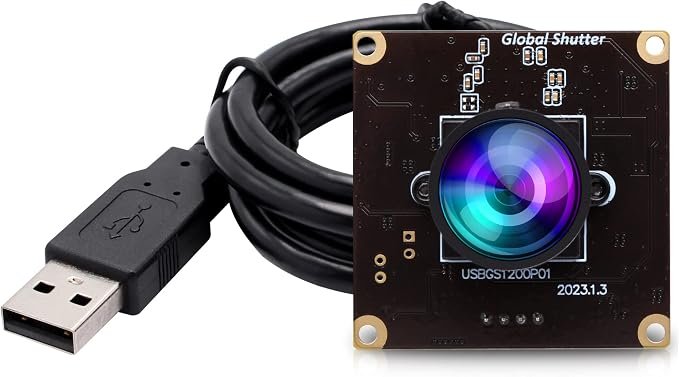
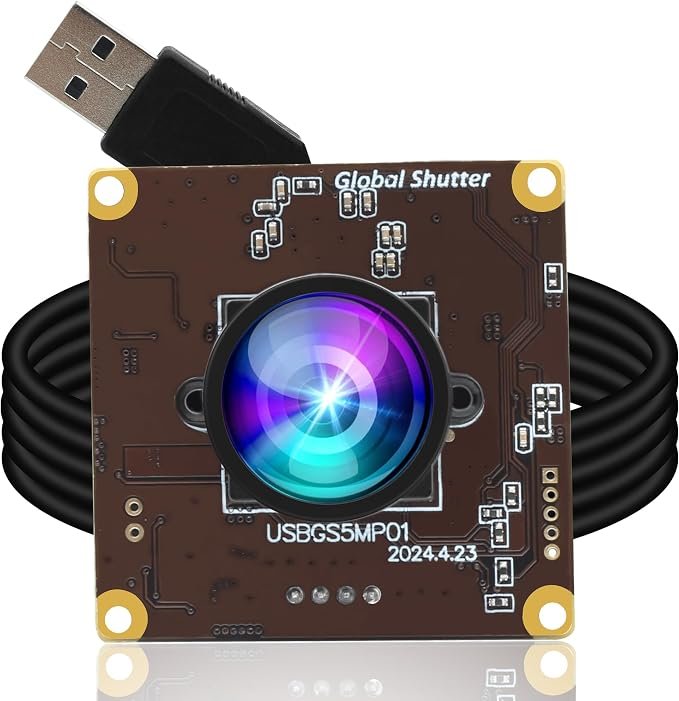
Need more pixels than the OV9281 without giving up the global shutter? The Arducam OV2311 doubles the resolution to 1600×1200 while keeping smear-free capture at up to 50fps. The sensor was designed for eye and gaze tracking, with high near-infrared quantum efficiency that lets you run dimmer IR illumination. It’s the right step up when your features are too small for 1MP — reading small markings, finer motion analysis, or stereo pairs where per-pixel accuracy matters.
✅ Pros: 2MP global shutter; strong NIR sensitivity; external trigger support; low-distortion M12 lens.
❌ Cons: Mono only; 50fps ceiling; small review base with mixed software feedback.
🎯 Verdict: The best monochrome resolution per dollar. Ideal for eye tracking, stereo vision and fine-detail motion work.
🎨 BEST COLOR ALL-ROUNDER · ⭐ 4.3/54. ELP AR0234 USB 2.0 90fps
1920×1200 color · global shutter · 90fps · 120° no-distortion lens
Buy →

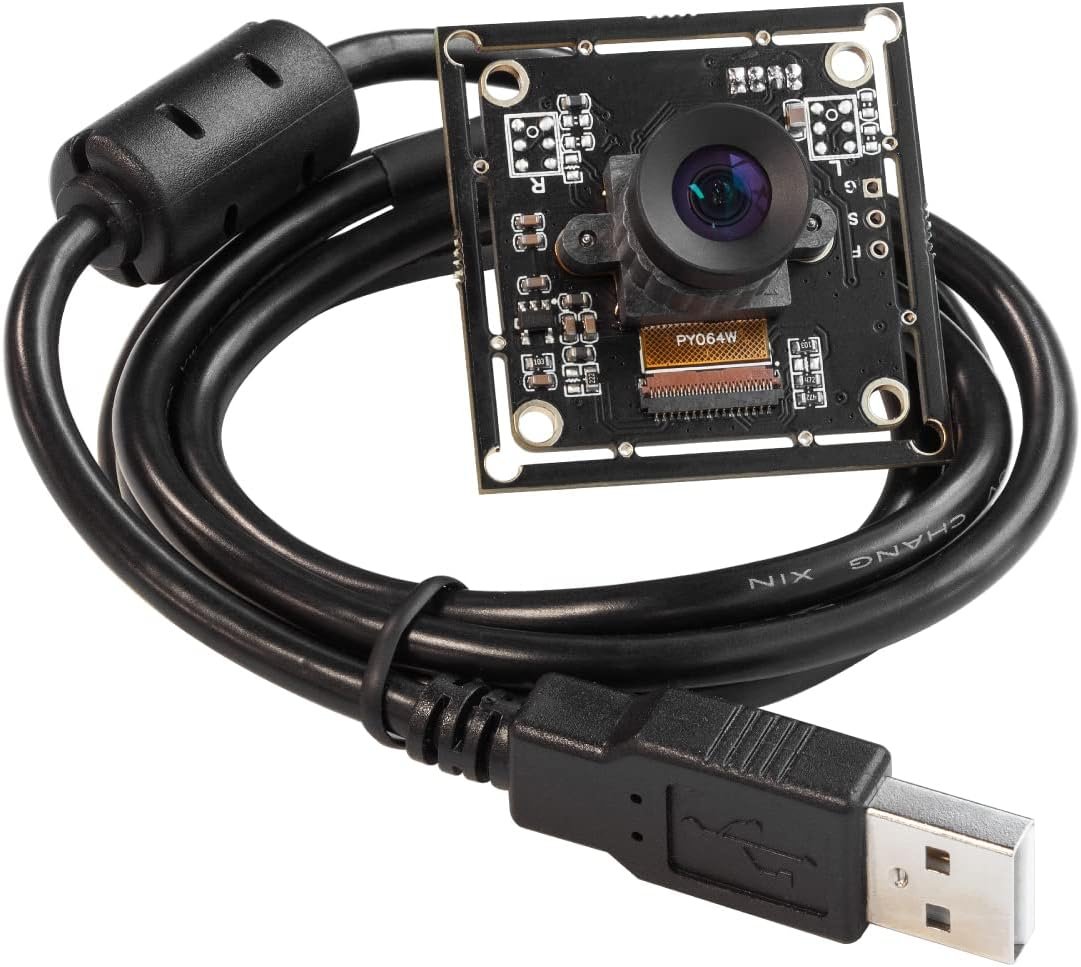
The ELP AR0234 USB 2.0 is the most popular color global-shutter board in this guide (4.3★ across 25 ratings) and the sweet spot if your algorithm needs color features — sorting by color, reading colored markers, or laser-engraver alignment via LightBurn. You get full 1920×1200 at up to 90fps MJPG over plain USB 2.0, a 120° no-distortion lens on a standard 38×38mm board, and true plug-and-play UVC on every OS. No USB 3.0 port or external power needed.
✅ Pros: Color global shutter; 90fps on USB 2.0; wide 120° coverage; best-reviewed GS board here.
❌ Cons: 90fps only with MJPG compression; wide lens needs calibration for measurement; bare board.
🎯 Verdict: The best color global-shutter all-rounder — fast, wide and proven, with no USB 3.0 required.
💵 BEST BUDGET COLOR GS · ⭐ 4.3/55. Arducam OV9782 1MP Color
1280×800 color · global shutter · 100fps · M12 low-distortion lens
Buy →

The Arducam OV9782 is essentially the color twin of our top pick — same 1280×800 resolution, same 100fps MJPG rate, same board format — built on the OV9782 color global-shutter sensor. If your vision task needs color information but your budget stops short of the ELP boards, this is the cheapest way to get smear-free color frames. It pairs naturally with the OV9281 in mixed rigs, sharing mounting holes and workflow.
✅ Pros: Cheapest color global shutter; 100fps; same proven board as the OV9281; UVC plug-and-play.
❌ Cons: 1MP only; color GS sensors are less light-sensitive than mono; no microphones (irrelevant for vision).
🎯 Verdict: The budget pick when color matters. All the OV9281 virtues, in color, for less than the bigger boards.
📸 BEST HIGH-RES GLOBAL SHUTTER · ⭐ 4.6/56. ELP 5MP Global Shutter 50fps
5MP OX05B10 color · global shutter · 50fps · 100° no-distortion lens
Buy →

Most affordable global-shutter boards stop at 1–2MP. The ELP 5MP Global Shutter, built on OmniVision’s OX05B10 sensor, gives you five megapixels of smear-free color imaging at up to 50fps — enough resolution to freeze and measure. Owners rate it highest of all ELP boards here (4.6★), using it for laser-engraver vision, robotics and moving-product inspection where 1080P global-shutter boards can’t resolve enough detail.
✅ Pros: Rare 5MP + global shutter combo; excellent 4.6★ rating; 50fps; low-distortion 100° lens.
❌ Cons: Priciest board camera in this guide; 5MP@50fps demands MJPG and decent CPU; USB 2.0 bandwidth limits raw formats.
🎯 Verdict: The best of both worlds — high resolution and global shutter. Worth it when detail and motion collide.
🔭 BEST ADJUSTABLE LENS · ⭐ 4.5/57. ELP AR0234 Varifocal Zoom
1920×1200 color · global shutter · 90fps · manual-zoom CS-mount lens
Buy →

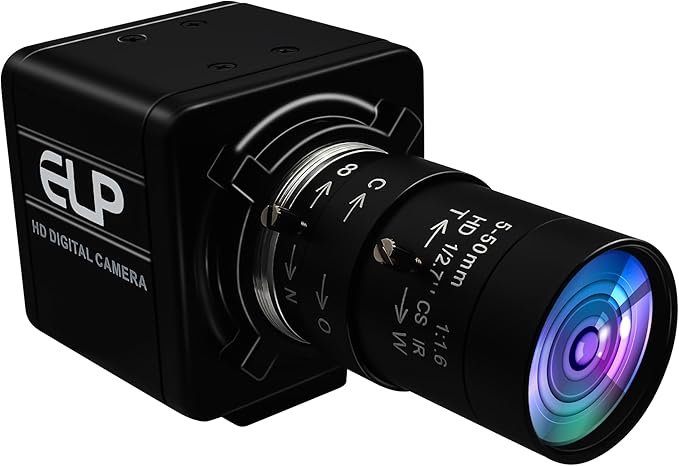
Fixed lenses force you to move the camera; the ELP AR0234 Varifocal lets you move the image instead. The manual-zoom, variable-focus CS-mount lens dials in exactly the field of view and working distance your fixture requires — from wide scene coverage to tight close-ups — while the same trusted AR0234 global-shutter sensor captures 1200P at up to 90fps. At 4.5★ over 32 ratings it’s the best-reviewed camera in this entire guide, popular for CNC/laser alignment and bench inspection.
✅ Pros: Adjustable zoom + focus; global shutter 90fps; best owner rating here (4.5★/32); CS mount takes other lenses.
❌ Cons: Manual adjustment only — no motorized zoom; bulkier than board cameras; zoom changes need refocusing.
🎯 Verdict: The most flexible pick. One camera that adapts to any fixture geometry — perfect when you haven’t finalized your setup.
🌙 BEST LOW-LIGHT · ⭐ 4.0/58. Arducam IMX291 Low Light WDR
1080P color · Sony STARVIS IMX291 · 0.001 lux · WDR · 100° lens
Buy →

When you can’t control the lighting, sensor sensitivity is everything. The Arducam IMX291 uses Sony’s back-illuminated STARVIS sensor — the same family found in security cameras — to capture usable 1080P color down to 0.001 lux, with 80dB wide dynamic range that tames mixed bright/dark scenes like a machine enclosure with a viewing window. It’s a rolling-shutter sensor, so keep it for slow or static scenes: enclosure monitoring, dim warehouse stations, microscopy-style close work with limited light.
✅ Pros: Exceptional 0.001-lux sensitivity; 80dB WDR; H.264/MJPG output; proven Sony STARVIS sensor.
❌ Cons: Rolling shutter — not for fast motion; 30fps ceiling; modest 4.0★ rating on a small review base.
🎯 Verdict: The low-light specialist. When adding lamps isn’t an option, this sensor sees what others can’t.
🔍 BEST 4K INSPECTION · ⭐ 4.3/59. ELP 4K IMX415
3840×2160 color · Sony IMX415 · 30fps · H.265/H.264/MJPG · 100° lens
Buy →

For static inspection — solder joints, PCB assembly verification, print quality, OCR — resolution beats frame rate, and the ELP 4K IMX415 delivers 3840×2160 from a genuine Sony sensor with efficient H.265/H.264 encoding that keeps 4K usable over USB 2.0. The 100° no-distortion lens covers a wide bench area, focus works from 10cm to infinity, and it behaves like any UVC webcam in OpenCV, LightBurn or your inspection software.
✅ Pros: True Sony 4K sensor; H.265 keeps bandwidth manageable; 10cm close focus; wide bench coverage.
❌ Cons: Rolling shutter; 30fps at 4K; few Amazon ratings so far.
🎯 Verdict: The best 4K value for static inspection. Maximum detail per dollar when nothing is moving fast.
🧿 BEST ULTRA-HIGH-RES · ⭐ 4.4/510. ELP 48MP Fast Autofocus
8000×6000 stills · fast autofocus · 70° no-distortion lens · UVC USB 2.0
Buy →

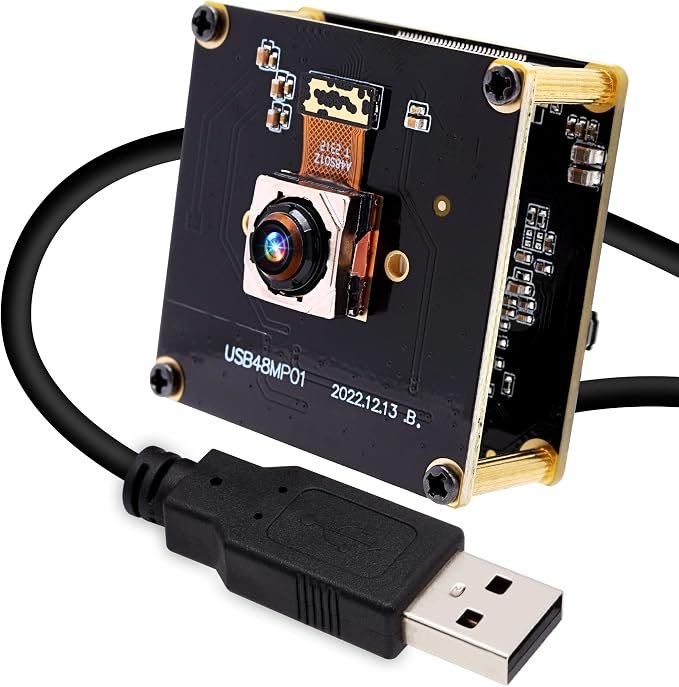
The ELP 48MP Autofocus is a different tool entirely: an 8000×6000 still-capture module for when you need to zoom into an image after the fact — full-board PCB documentation, fine defect archiving, label verification across a whole tray. Fast autofocus handles varying part heights automatically, and video runs at a workable 30fps 1080P for framing. Think of it as a USB microscope-documentation hybrid rather than a motion camera.
✅ Pros: Massive 48MP stills; fast autofocus for varying part heights; industrial 38×38mm board; UVC plug-and-play.
❌ Cons: Rolling shutter; full-res capture is slow over USB 2.0; autofocus can hunt in low light.
🎯 Verdict: The detail king for static work. Unmatched still resolution — just don’t ask it to freeze motion.
🛒 How to Choose the Right Machine Vision Camera
🏆
First machine vision project?
Get the Arducam OV9281 — global shutter, 100fps, external trigger and flawless OpenCV support at entry-level money.
⚡
Tracking really fast motion?
The ELP AR0234 USB 3.0 hits 200fps at 720P and 120fps at 1200P — the only true high-speed option here.
🎨
Algorithm needs color?
The ELP AR0234 USB 2.0 (90fps, 120°) is the proven color global-shutter board; the Arducam OV9782 does it cheaper at 1MP.
📐
Freezing motion AND measuring detail?
The ELP 5MP Global Shutter is the rare board that does both — 5MP resolution with a 50fps global shutter.
🌙
Poor or uncontrollable lighting?
The Arducam IMX291 sees down to 0.001 lux with 80dB WDR — for slow scenes where you can’t add lamps.
🔍
Static inspection & documentation?
Go rolling shutter and max the pixels: ELP 4K IMX415 for live inspection, ELP 48MP for archival stills.
⚙️ Key Specs Compared — Side by Side
| Spec | Arducam OV9281 | ELP AR0234 USB3 | Arducam OV2311 | ELP 5MP GS | ELP 4K IMX415 |
|---|
| Shutter | Global ⭐ | Global ⭐ | Global ⭐ | Global ⭐ | Rolling |
| Resolution | 1280×800 | 1920×1200 | 1600×1200 | 5MP | 3840×2160 ⭐ |
| Max Frame Rate | 100fps | 200fps ⭐ | 50fps | 50fps | 30fps |
| Color / Mono | Mono | Color | Mono | Color | Color |
| Interface | USB 2.0 | USB 3.0 ⭐ | USB 2.0 | USB 2.0 | USB 2.0 |
| External Trigger | Yes ⭐ | No | Yes ⭐ | No | No |
| Best For | Tracking, starter | High-speed | Eye/stereo vision | Detail + motion | Static inspection |
Tap any “View →” or “Buy →” button to check the current price and availability on Amazon.
❓ Frequently Asked Questions
Do I really need a global shutter, or will a normal webcam work?
It depends entirely on motion. A rolling-shutter webcam scans the frame line by line, so anything moving during readout gets skewed, stretched or wobbled — fatal for measuring or tracking fast objects. If your scene is static (PCB inspection, OCR, alignment), rolling shutter is fine and buys you cheaper high-resolution sensors. If parts, balls, drones or conveyors move through the frame, a global shutter like the OV9281, AR0234 or OV2311 exposes every pixel simultaneously and is worth every cent.
Why do machine vision cameras use monochrome sensors?
A color sensor sacrifices resolution and sensitivity to a Bayer filter — each pixel only sees red, green or blue, and the missing values are interpolated. A mono sensor uses every photon at every pixel, giving sharper edges, better low-light performance and stronger near-infrared response. Since most vision algorithms (edge detection, blob tracking, barcode reading) work on grayscale anyway, mono is usually the better tool — buy color only when the color itself is a feature you need to detect.
Will these cameras work with OpenCV, Raspberry Pi and Jetson?
Yes — every camera in this guide is UVC-compliant, meaning it uses the standard webcam drivers built into Windows, Linux, macOS and Android. In OpenCV they open with a plain cv2.VideoCapture(0); on Raspberry Pi and Jetson they appear as /dev/video devices for GStreamer or V4L2. One tip: explicitly request MJPG format and set the resolution/frame rate in code, because most capture libraries default to a slow uncompressed mode.
Why don’t I get the advertised frame rate?
Three usual suspects. First, format: headline rates apply to compressed MJPG — uncompressed YUY2 can be 10fps or less over USB 2.0. Second, software defaults: OpenCV and many apps open cameras at conservative settings, so set FOURCC, resolution and FPS explicitly. Third, exposure: in dim light the auto-exposure lengthens shutter time, capping the frame rate — add light and set exposure manually. Even then, some buyers of budget boards measure ~20–30% below spec, so leave headroom in your design.
How much should lighting factor into my budget?
A lot — experienced vision engineers often say lighting is 80% of the problem. Constant, diffuse, flicker-free illumination lets you run short exposures (sharper motion), low gain (less noise) and fixed settings (repeatable results). Before upgrading to a more expensive camera, try a $20–40 LED panel or ring light with a DC (not mains-flickering) driver; for global-shutter trigger setups, a synchronized strobe freezes motion even better. A modest camera with great light beats a great camera with poor light.
🏁 Final Verdict — Best Pick for Every Use Case
The right machine vision camera for every project and budget:
🥇 Best Overall — Arducam OV9281: global shutter, 100fps, external trigger, proven in tracking rigs
Buy →🏅 Best High-Speed — ELP AR0234 USB 3.0: 200fps @ 720P, 120fps @ 1200P, global shutter
Buy →🎨 Best Color GS — ELP AR0234 USB 2.0: 1200P/90fps color global shutter, no USB 3.0 needed
Buy →💵 Best Budget — Arducam OV9782: the cheapest color global shutter that’s worth buying
Buy →🔍 Best 4K Inspection — ELP 4K IMX415: Sony 4K detail with H.265 efficiency for static work
Buy →🧿 Best Ultra-High-Res — ELP 48MP Autofocus: 8000×6000 stills for documentation-grade detail
Buy →No single camera fits every vision pipeline, but every module here has earned its place. For most makers the Arducam OV9281 is the one to buy first — global shutter, 100fps and an external trigger port make it the most capable starting point by far. Step up to the ELP AR0234 USB 3.0 when speed becomes the bottleneck, the ELP 5MP Global Shutter when detail and motion collide, and the ELP 4K IMX415 or 48MP modules for static inspection. Whichever you choose, budget for good lighting — it will improve your results more than any spec-sheet upgrade. Pair your new camera with our Raspberry Pi, ESP32, Arduino and STM32 tutorials to build the processing side of your vision system.
💬 Building a vision project and not sure which camera fits? Tell us what you’re detecting — motion tracking, inspection, robotics, low light — in the comments below, and we’ll point you to the right pick.
All Amazon links above use our affiliate tag (microlab05-20). Purchasing through them supports microcontrollerslab.com at no extra cost to you. Prices and availability change frequently — always confirm the current price on Amazon before buying.