⚠️ Affiliate Disclosure: This post contains Amazon affiliate links. If you purchase through our links, we may earn a small commission at no extra cost to you. We only recommend products we have thoroughly researched and verified. Prices change frequently, so we don’t list them here — always tap through and confirm the live price on Amazon before buying.
Ultimate Buying Guide 2026
🌈 Best RGB LED Strips for Embedded & Maker Projects
8 RGB LED strips ranked for makers, students and roboticists — from the classic WS2812B/NeoPixel to 12V WS2815, SK6812 RGBW, high-speed APA102 and simple analog tape — with real specs, honest verdicts and direct Amazon links.
✅ 8 Strips Reviewed
✅ Verified Amazon ASINs
✅ Updated July 2026
✅ Honest Pros & Cons
An RGB LED strip is one of the most satisfying add-ons in all of embedded electronics. A single data pin from an Arduino, ESP32, Raspberry Pi Pico or PIC can drive hundreds of full-color pixels — turning a plain project into a glowing status bar, an ambient room light, a reactive audio visualizer, a wearable, or a smart-home fixture running WLED. Learning to control one cleanly is a rite of passage for makers, and the ecosystem of libraries (FastLED, Adafruit NeoPixel, WLED) makes it easier than ever.
The catch is that “RGB LED strip” covers wildly different technologies. Some strips are individually addressable (every pixel is its own controllable color), while others are analog (the whole strip is one color at a time). Addressable strips split further by chip (WS2812B, WS2815, SK6812, APA102/SK9822), by voltage (5V vs 12V), and by how they carry data (single-wire timing vs two-wire data-plus-clock). Pick the wrong type and you’ll fight voltage drop, timing glitches, or a power supply that can’t keep up. This guide ranks 8 RGB LED strips across every budget and use-case on the specs that actually matter for embedded work.
💡 Reality check before you buy: Addressable strips are hungrier than beginners expect — each RGB LED can pull up to ~60 mA at full white, so a 5-meter 300-LED strip at full brightness can draw ~18 A at 5V. Never power more than a few pixels from a board’s 5V pin; use a dedicated supply with a common ground. Long 5V runs also suffer voltage drop (colors fade to red/dim at the far end) — inject power at both ends or step up to a 12V strip like the WS2815. For reliable data, add a ~330 Ω resistor on the data line, keep the wire short, and use a level shifter when driving 5V pixels from a 3.3V board (ESP32/Pico). And remember: an analog RGB strip shows one color for the whole run — if you want per-pixel effects, you need an addressable strip.
🌈 Quick Comparison — All 8 RGB LED Strips
| Strip | Chip / Type | Voltage | Addressable | Best For | Buy |
|---|
| 🥇 BTF WS2812B ECO | WS2812B · Digital | 5V | Per-pixel | Best Overall | Buy → |
| 🏅 BTF WS2815 | WS2815 · Digital | 12V | Per-pixel | Best for Long Runs | Buy → |
| 🏆 Adafruit NeoPixel | WS2812B · Digital | 5V | Per-pixel | Best Genuine / Brand | Buy → |
| 🤍 BTF SK6812 RGBW | SK6812 · Digital | 5V | Per-pixel | Best True White | Buy → |
| ✨ BTF WS2812B Pure Gold | WS2812B · Digital | 5V | Per-pixel | Best Build Quality | Buy → |
| ⚡ BTF APA102 (SK9822) | APA102 · Data+Clock | 5V | Per-pixel | Best High-Speed / POV | Buy → |
| 💵 BTF WS2811 | WS2811 · Digital | 12V | Per 3-LED group | Best Budget 12V | Buy → |
| 🎛️ BTF 5050 RGBW Analog | Analog · Non-addr. | 12V | Whole strip | Best Simple / Cheapest | Buy → |
Specs are approximate and vary by seller, density (30/60/144 LEDs per m) and length. Many strips are sold as bare reels with no power supply or controller. Always confirm details and the live price on the Amazon listing before buying.
🔍 What to Look for in an RGB LED Strip
🎛️
Chip & Protocol
WS2812B (single-wire, 5V) is the default. WS2815 adds 12V and backup data. SK6812 adds a real white LED. APA102/SK9822 use data + clock for rock-solid high-speed refresh. The chip decides your library and wiring.
🔋
Voltage: 5V vs 12V
5V strips (WS2812B/SK6812) are simplest and run from USB power for short runs, but drop voltage over distance. 12V strips (WS2815/WS2811) push color much further with less sag — better for room-length installs.
⚡
Power Budget (Amps)
Budget ~60 mA per RGB LED at full white. A 300-LED 5V strip can want ~18 A; the same length in 12V draws a third of the current. Size your PSU for the worst case, or cap brightness in software.
💡
LED Density
Strips come in 30, 60 or 144 LEDs per meter. Higher density means smoother effects and brighter light, but more pixels to power and more RAM/CPU to drive. 60/m is the sweet spot for most builds.
🛡️
Addressable vs Analog & IP Rating
Addressable = per-pixel effects, needs a data protocol. Analog = one color at a time, driven by simple PWM + MOSFETs. Pick IP30 for indoors, IP65/IP67 (silicone coated/tube) for outdoors and damp spots.
🏆 Detailed Reviews — All 8 RGB LED Strips
🥇 BEST OVERALL
BTF-LIGHTING WS2812B ECO
⭐ 4.8/5 · The Addressable Default
Buy on Amazon →

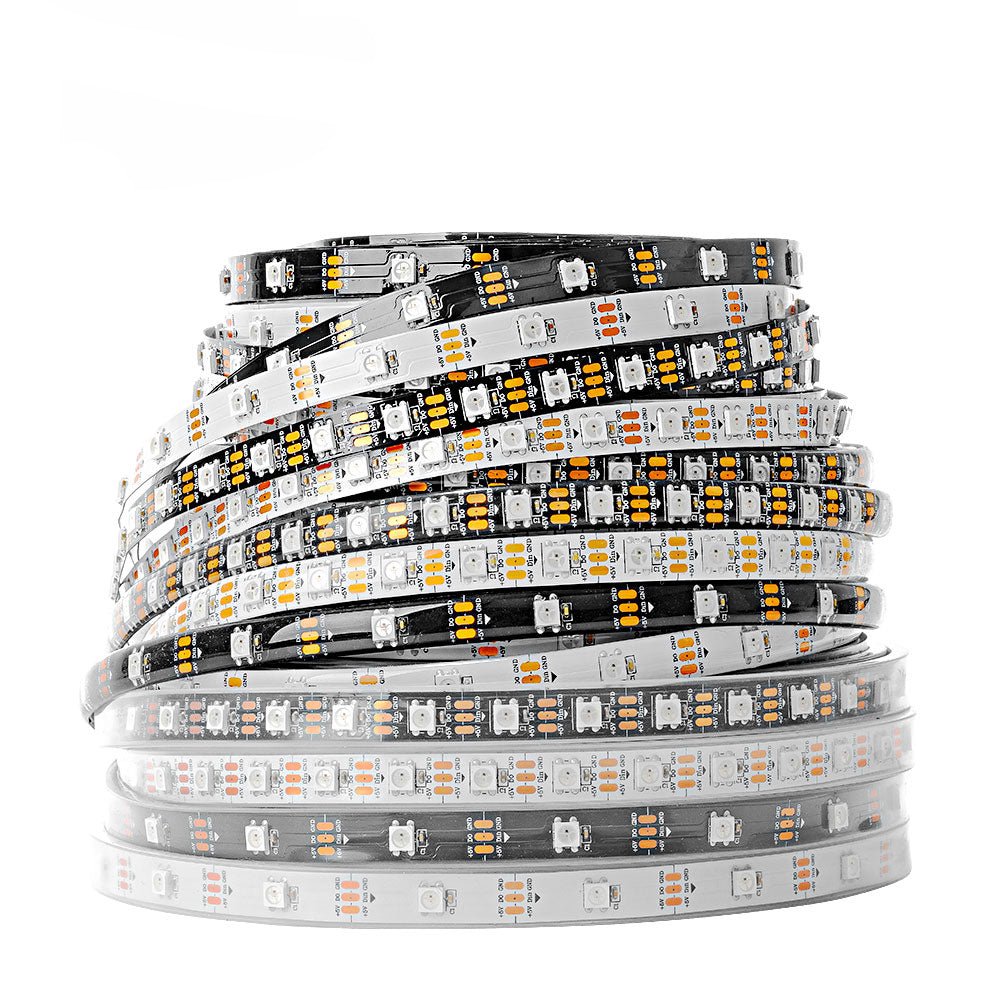
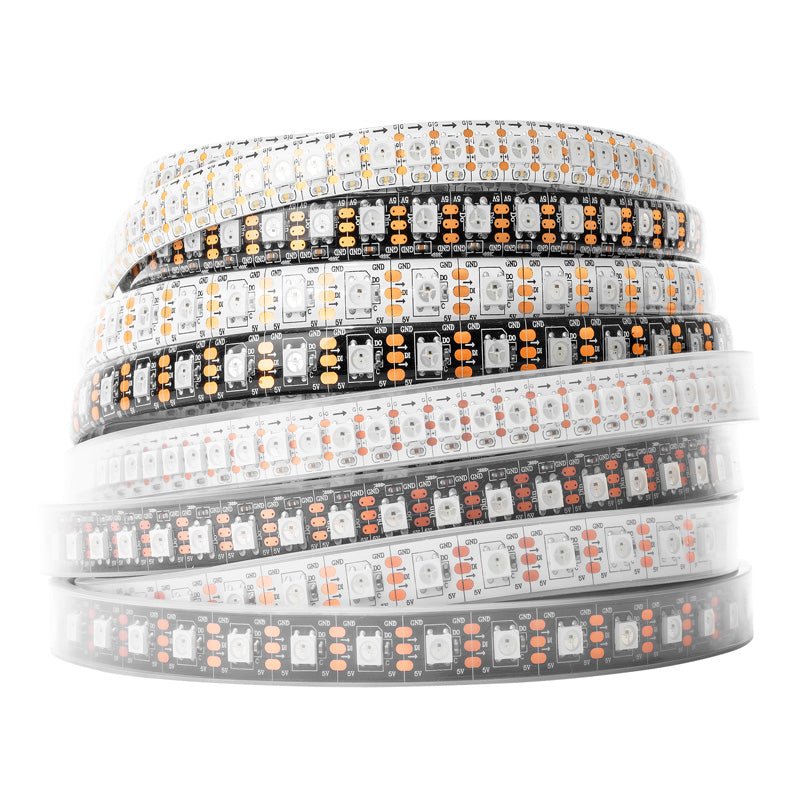
The WS2812B is the chip that launched a million maker projects, and BTF-LIGHTING’s ECO reel is the best-value way to get it. One data pin drives all 300 pixels, each with 24-bit color and 256 brightness levels, and it’s natively supported by FastLED, the Adafruit NeoPixel library and WLED. The “ECO” uses alloy bond wires instead of pure gold to hit a lower price, but for the vast majority of Arduino, ESP32 and Pico builds it looks identical. If you’re starting with addressable LEDs, start here.
✅ Pros- Ubiquitous WS2812B — endless tutorials
- Great price per pixel
- Works with FastLED / NeoPixel / WLED
- Only one data pin needed
❌ Cons- Heavy current at full white
- 5V drops over long runs
- Timing-sensitive; likes a 330Ω + level shifter
🎯 Verdict: The best all-round addressable strip. The default choice for almost every embedded lighting project.
👉 Check Price on Amazon → 🏅 BEST FOR LONG RUNS
BTF-LIGHTING WS2815 (12V)
⭐ 4.7/5 · Addressable, But Tougher
Buy on Amazon →

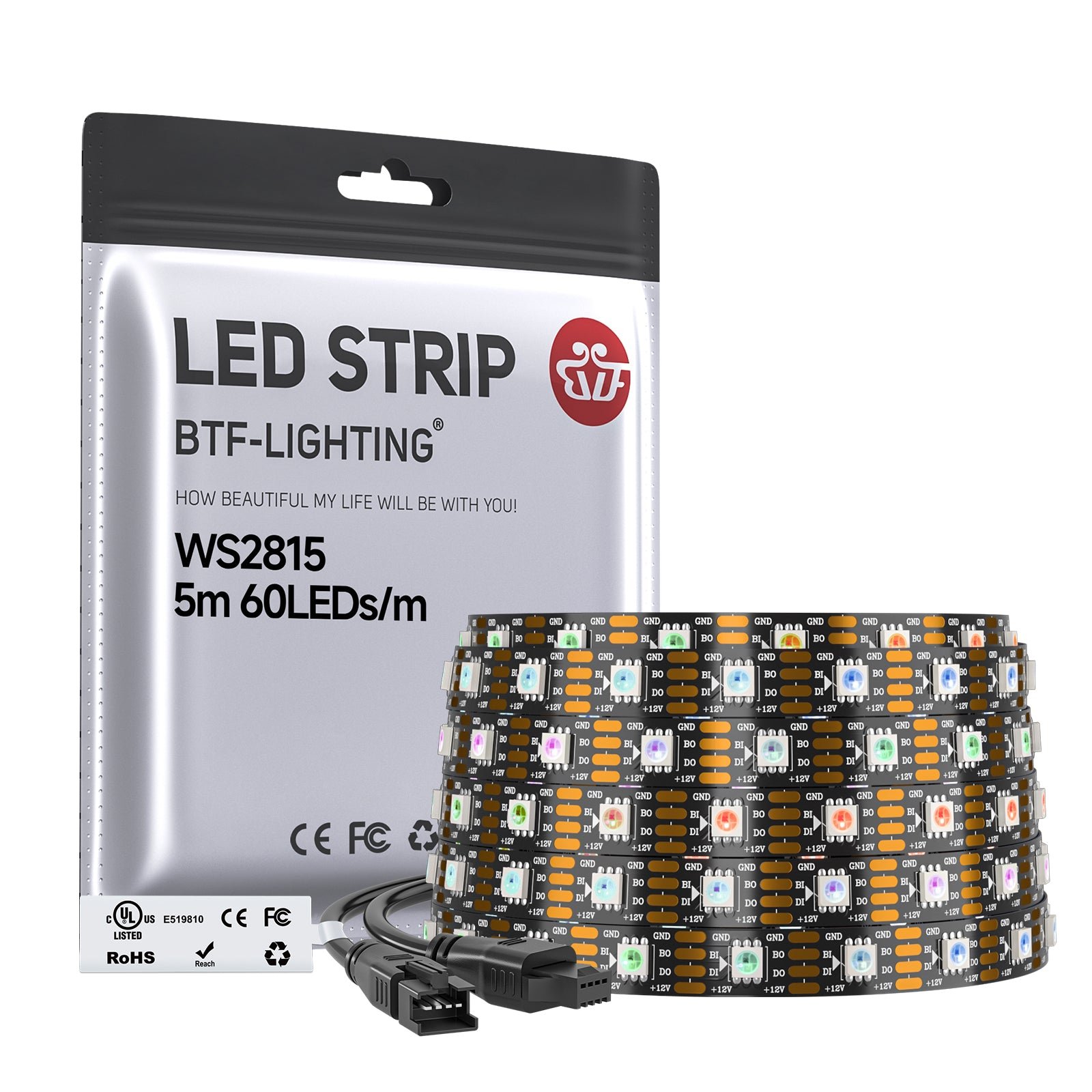
The WS2815 is the grown-up WS2812B. It runs at 12V, so voltage drop over a 5-meter reel is far gentler and colors stay true to the far end. Its killer feature is a backup data line: if one LED dies, the signal jumps the gap and the rest of the strip keeps working — a lifesaver in permanent installs where a single dead pixel would otherwise blank everything downstream. It’s still per-pixel addressable and FastLED/WLED-compatible, just wired for reliability at length.
✅ Pros- 12V — much less voltage drop
- Backup data survives a dead LED
- Lower current than 5V for same length
- Still FastLED / WLED compatible
❌ Cons- Needs a 12V supply (not USB)
- Slightly pricier than WS2812B
- Cut resolution is per-LED, not per-group
🎯 Verdict: The best strip for room-length and permanent installs. Buy this when reliability and distance matter.
👉 Check Price on Amazon → 🏆 BEST GENUINE / NAME-BRAND · ⭐ 4.7/53. Adafruit NeoPixel Digital RGB Strip
WS2812B · 5V · 60 LED/m · black flex PCB · IP65 sheath · genuine Adafruit
Buy →

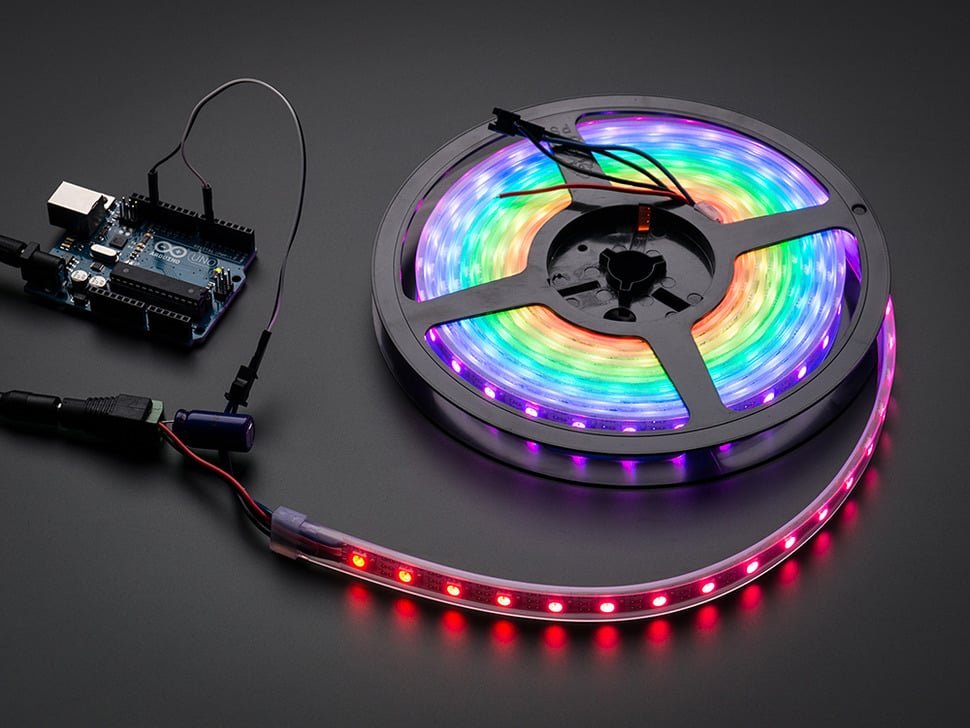
“NeoPixel” is Adafruit’s brand for genuine, quality-controlled WS2812B strips — and it’s the origin of the famous Adafruit NeoPixel library and the superb NeoPixel Überguide. You pay more per meter than a generic reel, but you get consistent binning, a black flex PCB that hides against dark surfaces, a removable IP65 weatherproof sleeve, and documentation that holds your hand through every microcontroller. For teaching, kits and projects where you can’t afford a bad batch, it’s worth the premium.
✅ Pros: Genuine quality & consistency; best-in-class docs & library; black PCB + IP65 sleeve.
❌ Cons: Priciest per meter; sold by the meter; can go out of stock.
🎯 Verdict: The best strip when reliability and support matter more than saving a few dollars.
🤍 BEST TRUE WHITE · ⭐ 4.6/54. BTF-LIGHTING SK6812 RGBW
SK6812 · 5V · dedicated white LED (RGBW) · addressable · 30/60/144 LEDs/m
Buy →
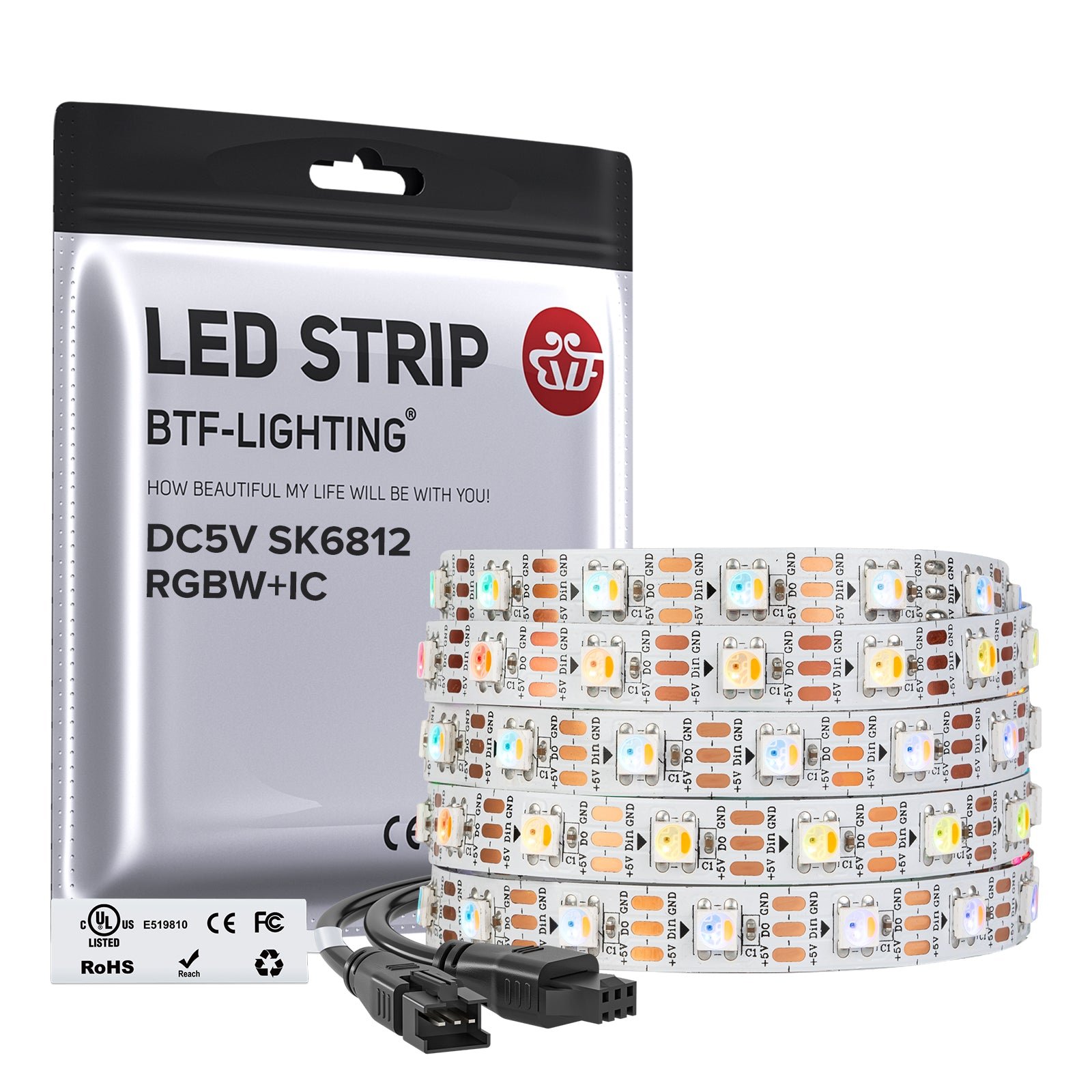
Mixing “white” from red, green and blue always looks slightly off. The SK6812 RGBW solves it by adding a fourth, dedicated white LED (available in warm, natural or cool) to every addressable pixel. That gives you clean, accurate whites for lamps, cabinet lighting and photography, plus full RGB color when you want it — all still driven from a single data pin like a WS2812B. It’s the go-to when your project needs to double as usable room light, not just a rainbow.
✅ Pros: Real, clean white channel; full RGB too; single-wire like WS2812B; FastLED support.
❌ Cons: 4 channels = more data/RAM per pixel; pick the right white temp; costs more than RGB.
🎯 Verdict: The best pick when you need believable white light and color from the same strip.
✨ BEST BUILD QUALITY · ⭐ 4.6/55. BTF-LIGHTING WS2812B Pure Gold
WS2812B · 5V · UL-listed · pure gold bond wires · 300 LED · 5m
Buy →

Same WS2812B chip as the ECO strip, but built to a higher standard: pure gold bond wires inside each LED for better conductivity, less light decay and a longer life, plus UL-listed wiring. If you’re putting a strip somewhere permanent — or you simply want the most reliable version of the world’s most popular pixel — this is the one to spec. It behaves identically in code (FastLED, NeoPixel, WLED); you’re paying for durability, not features.
✅ Pros: Pure gold wires = longer life; UL-listed; identical code to any WS2812B; consistent quality.
❌ Cons: Costs more than ECO; still 5V (voltage drop); no visible difference on short runs.
🎯 Verdict: The best-built WS2812B. Spec it for permanent installs and projects you won’t want to re-solder.
⚡ BEST HIGH-SPEED / POV · ⭐ 4.5/56. BTF-LIGHTING APA102 (SK9822)
APA102 · 5V · Data + Clock (2-wire) · very high refresh · 300 LED
Buy →Where WS2812B relies on strict single-wire timing, the APA102 (and its near-identical clone, the SK9822) adds a separate clock line. That makes it far easier to drive at very high, jitter-free refresh rates over hardware SPI — perfect for persistence-of-vision displays, spinning POV props, high-frame-rate light painting and any project where WS2812B flicker would ruin the effect. It also plays nicely with Raspberry Pi and boards that can’t guarantee nanosecond timing.
✅ Pros: Timing-tolerant (SPI); ultra-high refresh; great for POV & Raspberry Pi; smooth dimming.
❌ Cons: Needs an extra clock wire; pricier than WS2812B; overkill for slow ambient effects.
🎯 Verdict: The best strip for high-speed and POV work where rock-solid timing beats simple wiring.
💵 BEST BUDGET 12V · ⭐ 4.4/57. BTF-LIGHTING WS2811 (12V)
WS2811 · 12V · addressable in 3-LED groups · 300 LED / 100 pixels · 5m
Buy →
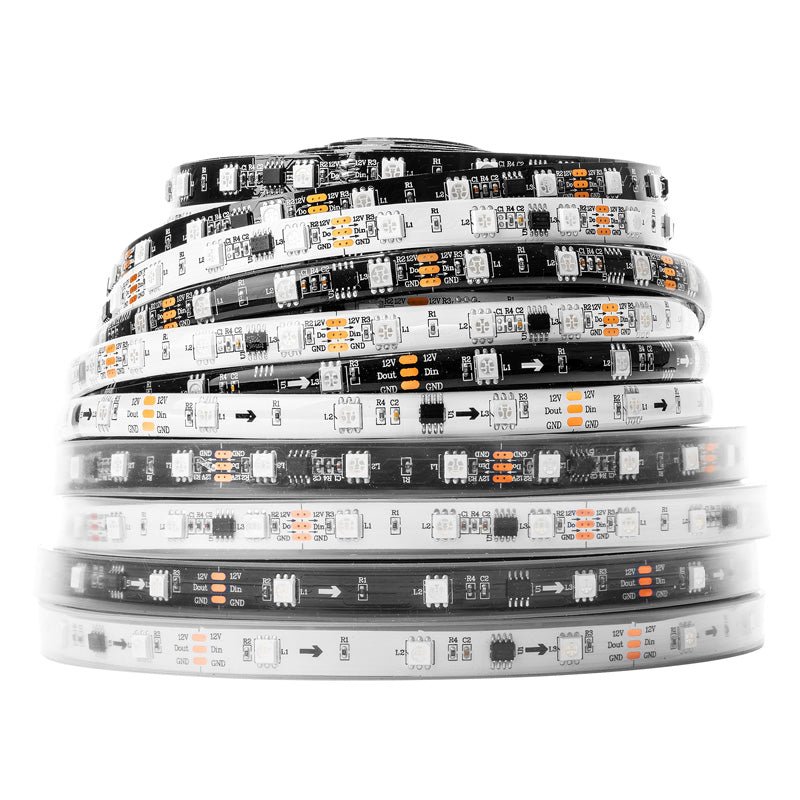
The WS2811 is the budget route to 12V addressable color. Its external-style IC controls LEDs in groups of three, so a 300-LED reel behaves as 100 addressable “pixels.” You lose per-LED resolution, but you gain 12V’s long-run advantage and a lower price — ideal for outlining rooms, signs, eaves and props where big smooth color zones matter more than fine detail. It’s still FastLED/WLED compatible; just set your pixel count to the group count.
✅ Pros: Cheap 12V addressable; long runs; fewer pixels = lighter on RAM/CPU; FastLED/WLED ready.
❌ Cons: Only 1 pixel per 3 LEDs; coarser effects; not for fine per-LED animation.
🎯 Verdict: The best value for long, bold color zones where you don’t need per-LED detail.
🎛️ BEST SIMPLE / CHEAPEST · ⭐ 4.3/58. BTF-LIGHTING 5050 RGBW Analog
Analog (non-addressable) · 12V · RGB + white · PWM + MOSFET control
Buy →
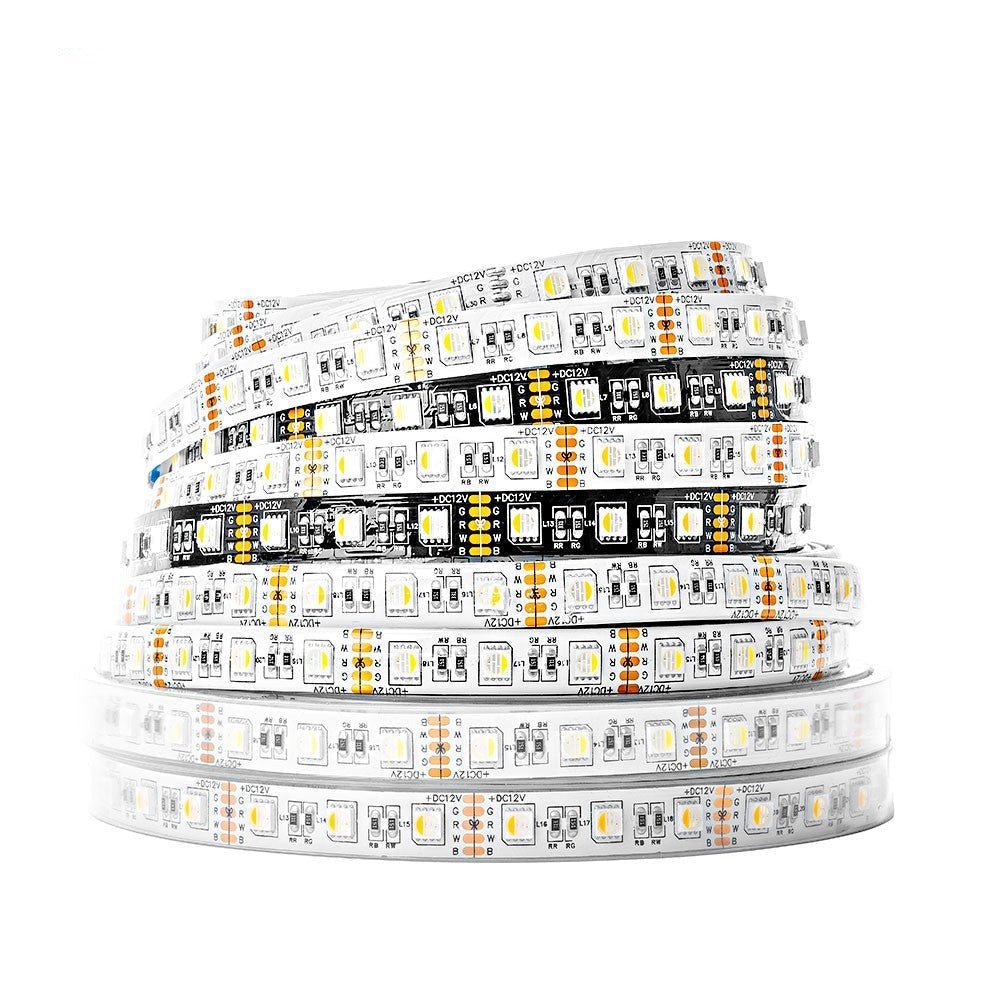
Not every project needs per-pixel control. This classic analog 5050 RGBW strip shows one color across its whole length, set by four simple PWM channels (R, G, B and a warm-white). There’s no timing protocol to fight — you just drive each channel through a logic-level MOSFET from any microcontroller pin. It’s the cheapest, most beginner-proof way to add controllable mood lighting, and a great first lesson in PWM and transistor switching before you graduate to addressable pixels.
✅ Pros: Dead simple PWM control; no timing issues; cheapest per meter; dedicated white channel.
❌ Cons: One color for the whole strip; needs 3–4 MOSFETs; no chasing/rainbow effects.
🎯 Verdict: The best simple, low-cost option for whole-strip mood lighting and learning PWM.
🛒 How to Choose the Right RGB LED Strip
🔰
Just starting with addressable LEDs?
Get the BTF WS2812B ECO — the cheapest way onto the most-supported chip, with endless FastLED/NeoPixel tutorials.
📏
Lighting a whole room?
Choose the 12V WS2815 — less voltage drop over distance and a backup data line so one dead LED won’t kill the run.
🤍
Need believable white light?
Pick the SK6812 RGBW — a dedicated white LED per pixel for clean whites plus full color from one data pin.
⚡
Building a POV or fast display?
Use the APA102 / SK9822 — the extra clock line gives jitter-free, ultra-high refresh over SPI.
💵
On a tight budget, long run?
Grab the 12V WS2811 — addressable in 3-LED groups for cheap, bold color zones over long distances.
🎛️
Just want simple mood lighting?
The analog 5050 RGBW strip needs only PWM + MOSFETs — the easiest, cheapest whole-strip color there is.
⚙️ Key Specs Compared — Side by Side
| Spec | WS2812B ECO | WS2815 | SK6812 RGBW | APA102 | WS2811 |
|---|
| Voltage | 5V | 12V ⭐ | 5V | 5V | 12V ⭐ |
| Data lines | 1 (data) | 1 + backup | 1 (data) | 2 (data+clk) ⭐ | 1 (data) |
| Addressable unit | Per LED ⭐ | Per LED ⭐ | Per LED ⭐ | Per LED ⭐ | Per 3 LEDs |
| White channel | No (mixed) | No (mixed) | Yes, dedicated ⭐ | No (mixed) | No (mixed) |
| Refresh / timing | Strict 1-wire | Strict 1-wire | Strict 1-wire | SPI, very high ⭐ | Strict 1-wire |
| Long-run friendliness | Moderate | Excellent ⭐ | Moderate | Moderate | Excellent ⭐ |
| Best use | General / learning | Room installs | Accurate white | POV / displays | Cheap long runs |
Specs are approximate and vary with density, length and seller. Always confirm details on the live Amazon listing.
❓ Frequently Asked Questions
What’s the difference between WS2812B, WS2815, SK6812 and APA102?
They’re all addressable, but differ in wiring. WS2812B is the 5V, single-data-wire default with the biggest library support. WS2815 is a 12V version with a backup data line for long, reliable runs. SK6812 adds a dedicated white LED (RGBW) for clean whites. APA102/SK9822 use a separate clock wire, so they refresh extremely fast and don’t need strict timing — ideal for POV and Raspberry Pi. Pick based on voltage, whether you need white, and how fast/reliable the data has to be.
How much power does an RGB LED strip need — can I run it from my Arduino/ESP32?
Only a handful of pixels, briefly. Budget about 60 mA per RGB LED at full white, so a 5V 300-LED strip can demand up to ~18 A — far beyond what a board’s regulator or a USB port can supply. Use a dedicated 5V (or 12V) power supply sized for the worst case, connect the strip’s power to that, and tie its ground to your microcontroller’s ground. In practice you can cut current dramatically by limiting brightness in software, since real animations rarely light every pixel white at once.
Do I need a level shifter and a resistor on the data line?
Often, yes. WS2812B-class pixels expect a ~5V data signal, but ESP32, Raspberry Pi Pico and Pi output 3.3V, which can be marginal — a level shifter (like a 74AHCT125) makes it reliable. A series resistor of roughly 330 Ω on the data line right at the first pixel tames ringing, and a large capacitor (1000 µF) across the power input protects against inrush. Keep the data wire short, and if the first pixel misbehaves, you can sacrifice it as a level-shifting buffer.
Addressable or analog — which RGB strip should I buy?
If you want per-pixel effects — rainbows, chases, meters, reactive animations — you need an addressable strip (WS2812B, WS2815, SK6812, APA102). If you just want the whole strip to be one adjustable color for mood or accent lighting, an analog RGB(W) strip is cheaper and far simpler: three or four PWM channels through MOSFETs, no timing protocol to get wrong. Many makers start with an analog strip to learn PWM, then move to addressable pixels for animation.
How long a strip can one microcontroller drive?
Data-wise, a single pin can address hundreds to thousands of pixels — the real limits are RAM and power. Each addressable pixel needs a few bytes of buffer (3 for RGB, 4 for RGBW), so an Arduino UNO’s ~2 KB RAM caps you around 500 RGB pixels; an ESP32 or Pico handles far more. Power is usually the harder limit: long runs need thick wires and power injected at multiple points to fight voltage drop, which is exactly why 12V strips like the WS2815 and WS2811 are favored for big installs.
🏁 Final Verdict — Best RGB LED Strip for Every Project
The right RGB LED strip for every build and budget:
🥇 Best Overall — BTF WS2812B ECO: cheap, ubiquitous 5V addressable, endless library support
Buy →🏅 Best for Long Runs — BTF WS2815: 12V, backup data line, room-length reliability
Buy →🏆 Best Genuine / Brand — Adafruit NeoPixel: quality-controlled WS2812B with the best docs
Buy →🤍 Best True White — BTF SK6812 RGBW: dedicated white LED per pixel plus full color
Buy →⚡ Best High-Speed / POV — BTF APA102 (SK9822): data+clock for jitter-free high refresh
Buy →💵 Best Budget 12V — BTF WS2811: cheap 12V addressable in 3-LED groups for long zones
Buy →🎛️ Best Simple / Cheapest — BTF 5050 RGBW Analog: whole-strip color with just PWM + MOSFETs
Buy →No single strip is right for every build, but every pick here earns its place. For most embedded projects the BTF-LIGHTING WS2812B ECO is the one to buy — the cheapest route onto the world’s most-supported addressable chip. If you’re wiring a whole room, step up to the 12V WS2815; if you want guaranteed quality and the best documentation, pay for genuine Adafruit NeoPixel; for accurate white light choose SK6812 RGBW; for POV and high-speed displays reach for APA102; for cheap long runs use the WS2811; and for the simplest possible mood lighting, the analog 5050 RGBW only needs PWM and a few MOSFETs. Pair your strip with our Arduino, ESP32, STM32 and Raspberry Pi tutorials and start building today.
💬 Not sure which strip fits your project? Tell us what you’re building — an ambient room light, a POV display, a wearable or a WLED setup — in the comments below, and we’ll point you to the right pick.
All Amazon links above use our affiliate tag (microlab05-20). Purchasing through them supports microcontrollerslab.com at no extra cost to you. Prices and availability change frequently — always confirm the current price on Amazon before buying.