⚠️ Affiliate Disclosure: This post contains Amazon affiliate links. If you purchase through our links, we may earn a small commission at no extra cost to you. We only recommend products we have researched and verified against their live Amazon listings. Prices change frequently, so we don’t list them here. Tap through and confirm the current price on Amazon before buying.
Ultimate Buying Guide
⚡ Best Bench Power Supply Under $100
8 variable DC bench power supplies for electronics and embedded work, from linear Tekpower and Korad units to the programmable Riden RD6006 and DPS3005 modules, compared on real specs with honest verdicts.
✅ 8 Supplies Reviewed
✅ Verified Amazon ASINs
✅ Linear, Switching & DIY Picks
✅ Honest Pros & Cons
A USB port or a wall adapter is fine for blinking an LED, but the moment you bring up a new PCB, test a motor driver or debug a power-hungry ESP32 board, you need a variable bench power supply. The feature that matters most is the current limit: set it to a few hundred milliamps, power up an untested board, and a solder bridge or reversed regulator shows up as a current spike instead of smoke. Add an adjustable output, a live voltage/current readout and constant-current mode, and you have the most-used instrument on any electronics bench.
The good news is that you no longer need to spend hundreds of dollars. Under about $100 you can choose between quiet linear supplies, light and powerful switching supplies, and programmable DIY modules such as the Riden RD6006 and DPS3005. This guide ranks 8 bench power supplies on the specs that actually matter for embedded, IoT and hobby electronics work, including the popular Korad KA3005D, so you can pick the right one the first time.
💡 Reality check before you buy: At this price you are trading something away. Linear supplies are quiet but heavy and usually limited to 5A. Switching supplies give you 10A in a lunchbox-sized case, but with more ripple and fan noise. DIY modules (RD6006, DPS3005) are precise and programmable, but you must buy and wire your own AC-DC supply and case, which can push the total past $100. Accuracy figures on budget units are best treated as approximate, so verify critical voltages with a good multimeter. Finally, some picks here (notably the Korad KA3005D) usually sell above the $100 ceiling; we have flagged them clearly.
⚡ Quick Comparison: All 8 Bench Power Supplies
| Power Supply | Type | Output | Key Note | Best For | Buy |
|---|
| 🥇 Tekpower TP3005T | Linear | 0–30V / 0–5A | Display 0.1V / 0.01A | Best Overall Under $100 | Buy Here → |
| 🏅 Wanptek DPS3010U | Switching · encoder | 0–30V / 0–10A | USB-A + USB-C ports | Best Value / Most Power | Buy Here → |
| 📡 Riden RD6006W | DIY module · WiFi/USB | 0–60V / 0–6A | Needs DC input + case | Best Programmable | Buy Here → |
| 🔬 Korad KA3005D | Linear · 4 presets | 0–30V / 0–5A | Usually above $100 | Best Lab-Grade Linear | Buy Here → |
| 🎒 Alientek DP100 | USB-C PD powered | 0–30V / 0–5A (100W) | Pocket-sized, ~95g | Best Portable | Buy Here → |
| 🧰 RD DPS3005 | DIY buck module | 0–32V / 0–5A | Needs DC input + case | Best Budget DIY | Buy Here → |
| 📦 Jesverty SPS-3010 | Switching · V/A/W display | 0–30V / 0–10A | 1,600+ ratings | Most Popular Compact | Buy Here → |
| 💾 NANKADF 30V 5A | Switching · 3 presets | 0–30V / 0–5A | Output ON/OFF button | Best with Memory | Buy Here → |
Specs are taken from the Amazon listings and manufacturer data. Prices change often, so we don’t print them here. Tap “Buy Here” to see the current price on Amazon.
🔍 What to Look for in a Bench Power Supply
🎛️
Linear vs Switching
Linear supplies have very low ripple and noise, ideal for analog, audio, RF and ADC work, but they are heavy and run warm. Switching supplies are light and deliver more current, at the cost of some high-frequency noise.
🔌
Voltage & Current Range
30V / 5A covers nearly all MCU, sensor and 12V/24V work. Go for 10A if you drive motors, LED strips or Peltiers, or 60V (RD6006) for 48V systems, e-bike parts and multi-cell battery packs.
🛡️
Current Limit (CC Mode)
Constant-current mode is what saves boards. Make sure you can set the current limit before switching on, and that the supply drops into CC smoothly with little overshoot.
🔢
Display Resolution
A 4-digit display with 0.01V / 0.001A resolution lets you see a sleeping MCU’s milliamp draw. Cheaper 3-digit units (0.1V / 0.01A) are fine for general work but hide small currents.
💾
Presets, Output Button & PC Control
Memory presets and an output ON/OFF button prevent the classic mistake of hitting a 3.3V board with 12V. USB or WiFi control (RD6006, DP100) adds logging and automated tests.
🏆 Detailed Reviews: All 8 Bench Power Supplies
🥇 BEST OVERALL UNDER $100
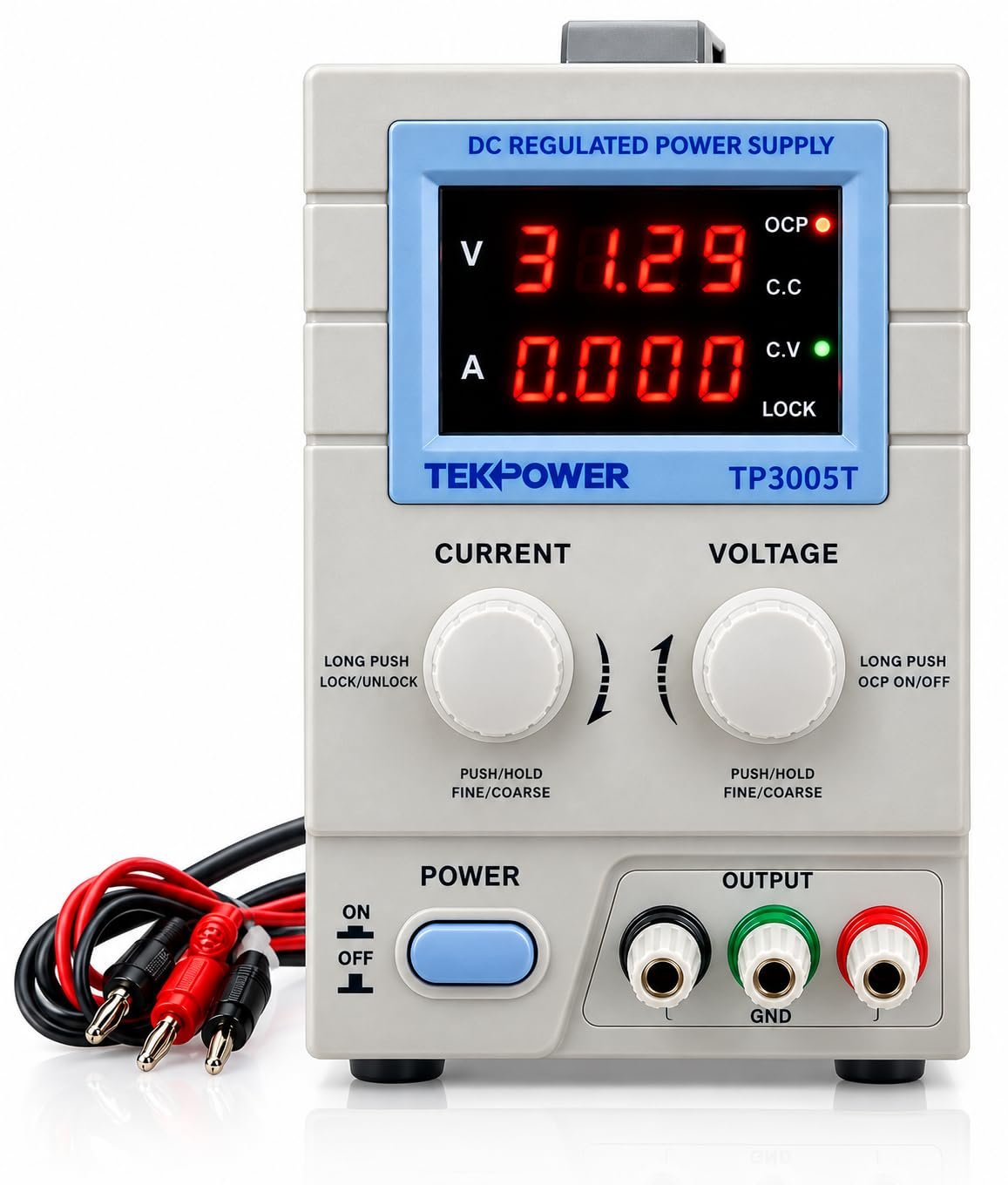
Tekpower TP3005T Linear DC Power Supply (0–30V, 0–5A)
⭐ 4.6/5 · Low-Noise Linear Supply for Everyday Bench Work
Buy on Amazon →

If you want one supply that just works for microcontroller boards, sensors, op-amp circuits and small motors, the Tekpower TP3005T is the safest pick under $100. It is a true linear regulated supply, so its output is far quieter than the switching units that dominate this price range, which matters when you are debugging ADC readings, audio stages or RF modules. It offers 0–30V and 0–5A with automatic constant-voltage and constant-current modes, a back-lit display with 0.1V and 0.01A resolution, and a thermostatically controlled fan that only spins up when the heatsink gets warm. Tekpower backs it with a 1-year warranty, and with over 600 ratings it has a long track record on Amazon.
✅ Pros- Linear design with low output noise
- Proper CV/CC current limiting
- Thermo-controlled fan stays quiet at light loads
- Large review base and 1-year warranty
❌ Cons- Heavy (about 12 lb) and bulky
- Display resolution only 0.1V / 0.01A
- No memory presets or PC control
- Listed for 110V AC input
🎯 Verdict: The best all-round bench supply under $100. If you work with analog, sensor or RF circuits and want clean power with a dependable current limit, buy this one.
👉 Check Price on Amazon →
🏅 BEST VALUE · MOST POWER PER DOLLAR
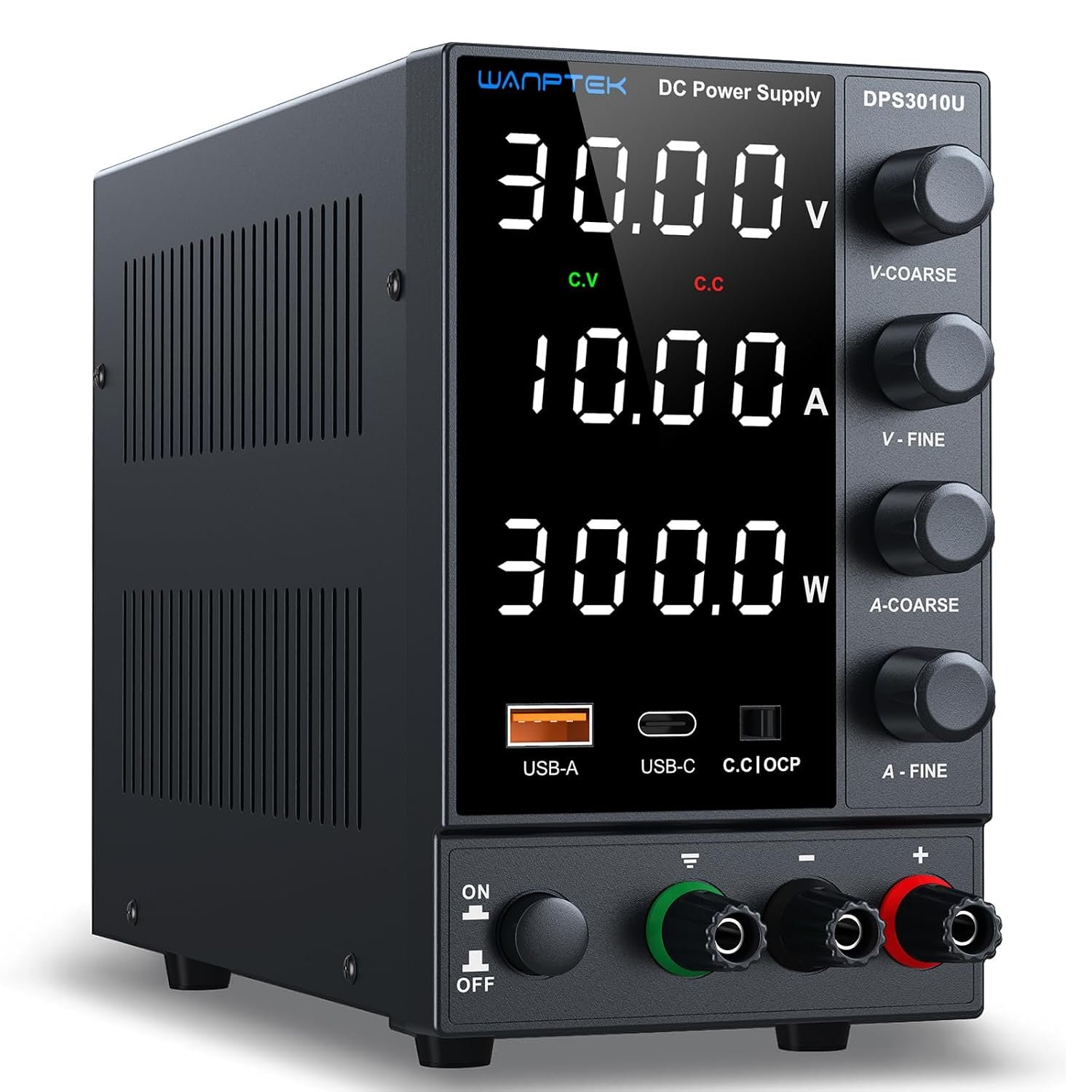
Wanptek DPS3010U Switching Bench Supply (0–30V, 0–10A)
⭐ 4.5/5 · 10A Switching Supply with Encoder Knobs and USB-C
Buy on Amazon →

The Wanptek DPS3010U doubles the current of a typical 30V 5A supply while costing far less than a linear unit. Because it is a switching design it stays light and compact, yet it can push up to 10A for motors, LED strips, 12V fans, Peltier modules and battery-powered builds. Instead of cheap potentiometers it uses digital encoder knobs with separate coarse (whole volts) and fine (decimal) control, so setting exactly 3.30V or 5.00V is quick and repeatable. A 4-digit display, short-circuit (OCP) alarm and both USB-A and USB-C quick-charge ports round it out.
✅ Pros- 10A output for motors and LED loads
- Coarse + fine encoder knobs are easy to set
- USB-A and USB-C charging ports
- Compact and lightweight
❌ Cons- Switching ripple is higher than a linear supply
- Fan noise under heavy load
- No memory presets
🎯 Verdict: The best value if you need current more than ultra-low noise. Perfect for robotics, motor drivers, LED projects and general 12V work.
👉 Check Price on Amazon →
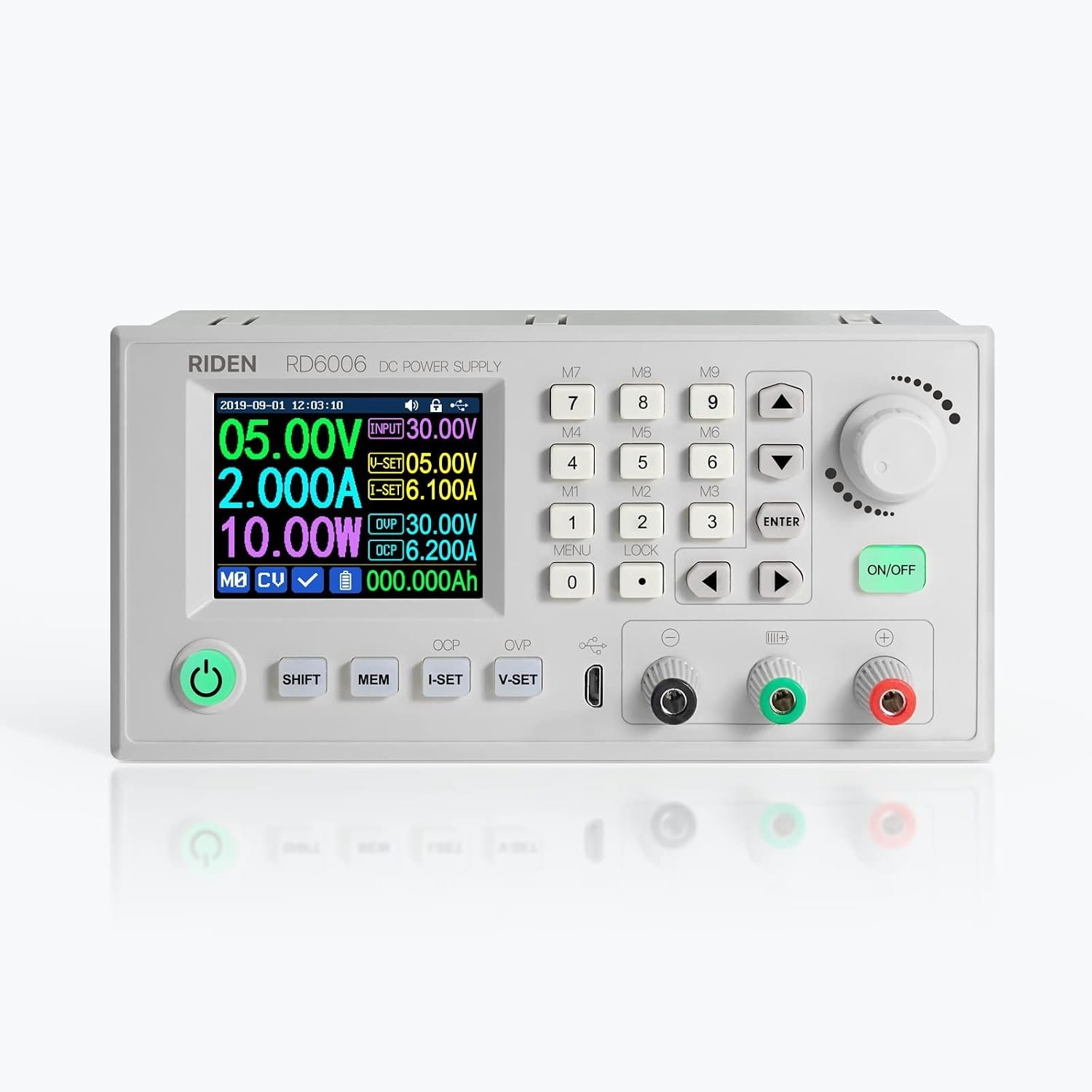
📡 BEST PROGRAMMABLE · 60V · ⭐ 4.4/53. Riden RD6006W 60V 6A Programmable Power Module (WiFi)
0–60V · 0–6A · 0.01V / 0.001A resolution · USB PC software + WiFi app · 6–70V DC input · module only
Buy Here →
The Riden RD6006 is the favourite of makers who want lab-style features on a budget. The RD6006W version on this listing outputs 0–60V at up to 6A with 0.01V and 0.001A resolution, and connects to PC software over USB or to a phone app over WiFi, so you can log data, script voltage sweeps or charge batteries with a controlled profile. Important: this is the control module only. You add your own DC source (6–70V input, at least about 10% above the highest voltage you plan to output) and ideally a case, which can push the total beyond $100.
✅ Pros: Twice the voltage of 30V supplies; fine 1mA current resolution; PC and phone control for logging and automation; huge community support.
❌ Cons: Needs a separate AC-DC supply and case; small, mixed review base on this specific listing; DIY assembly.
🎯 Verdict: The best pick if you want programmability and 60V headroom, and you are happy to assemble it yourself.
👉 Check Price on Amazon →
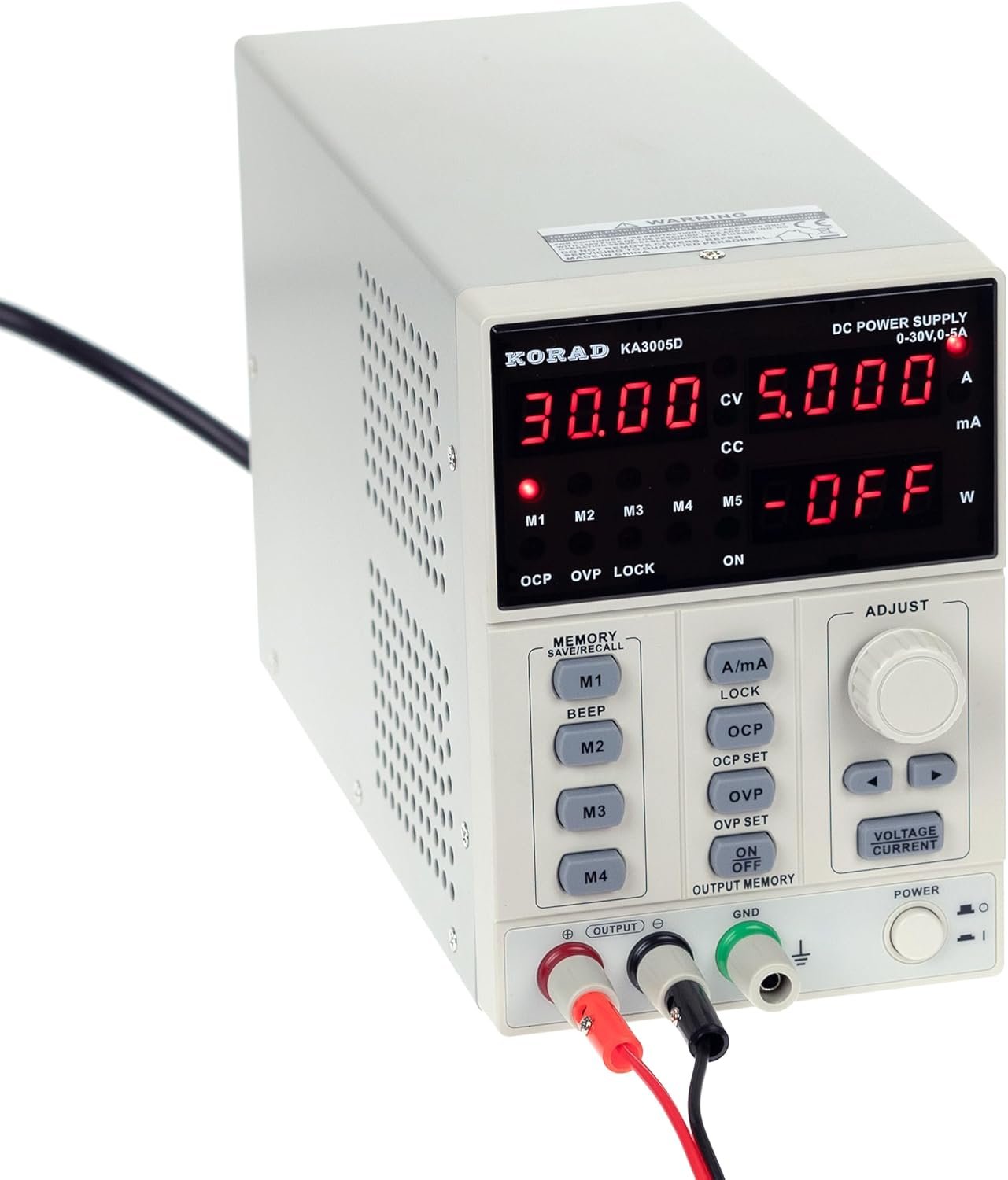
🔬 BEST LAB-GRADE LINEAR · ABOVE $100 · ⭐ 4.5/54. Korad KA3005D Precision Linear DC Power Supply (30V, 5A)
0–30V · 0–5A · Linear · 4-digit display · 4 memory presets · OVP/OCP · 110/220V switchable · ~10 lb
Buy Here →

The Korad KA3005D is the supply many engineers buy as their first serious bench instrument, and it is sold under several other brand names. It is a linear design with a 4-digit back-lit display, a single fast-adjust knob with coarse/fine and V/A selection buttons, and four memory recall buttons for your common rails (3.3V, 5V, 12V and so on). Over-voltage, over-current, thermal and short-circuit protection come standard, and the input is switchable between 110V and 220V. Be aware that it usually sells above the $100 ceiling; check the live price before you decide.
✅ Pros: Linear, low-noise output; 4 memory presets; 4-digit readout; 110/220V switchable input; proven design.
❌ Cons: Typically priced above $100; heavier than switching units; no PC control (that is the KA3005P).
🎯 Verdict: Worth stretching for if you want a precise, quiet linear supply that will stay on your bench for years.
👉 Check Price on Amazon →
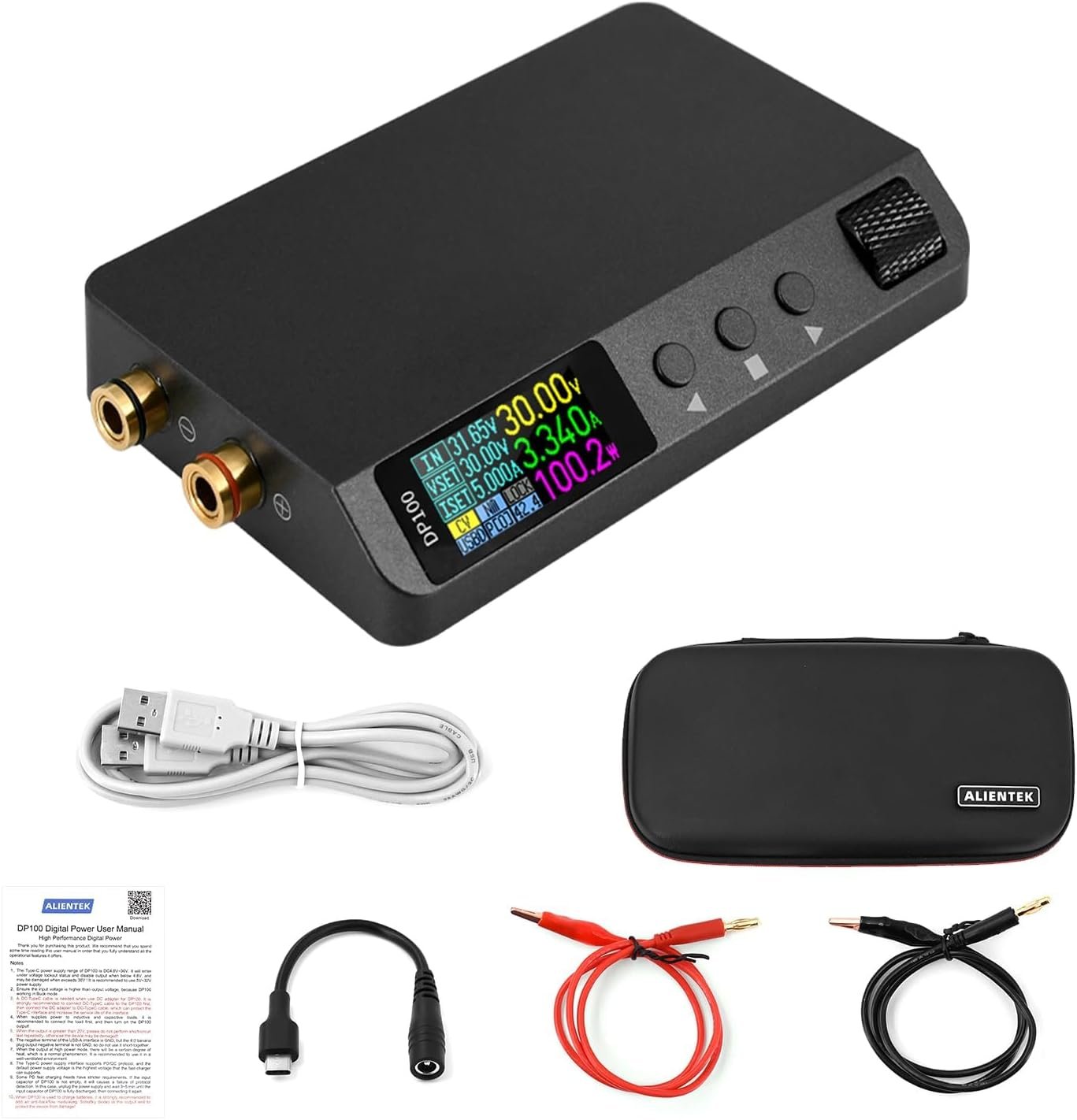
🎒 BEST PORTABLE · USB-C POWERED · ⭐ 4.4/55. Alientek DP100 Portable USB-C Power Supply (30V, 5A, 100W)
0–30V · 0–5A · 100W max · 5–32V input · USB-C PD 2.0/3.0 & QC 3.0 · 0.01V / 0.001A · ~95g
Buy Here →

The Alientek DP100 fits in your palm yet gives you a fully adjustable 0–30V / 0–5A output with 0.01V and 0.001A resolution. It runs from a USB-C PD charger, power bank or laptop adapter (or any 5–32V DC source), which makes it ideal for field service, maker spaces, travel and desks with no room for a full bench supply. Alientek claims under 10mVp-p ripple and no overshoot at switch-on, which is good news for MCUs and sensors. Remember that the output is limited to 100W and by what your charger can deliver, so you cannot draw 30V and 5A at the same time.
✅ Pros: Tiny and light; runs from USB-C PD chargers and power banks; fine resolution; low claimed ripple.
❌ Cons: Output power capped at 100W and by your adapter; small screen; small review base so far.
🎯 Verdict: The best choice if portability matters more than raw power, or as a second supply for your laptop bag.
👉 Check Price on Amazon →
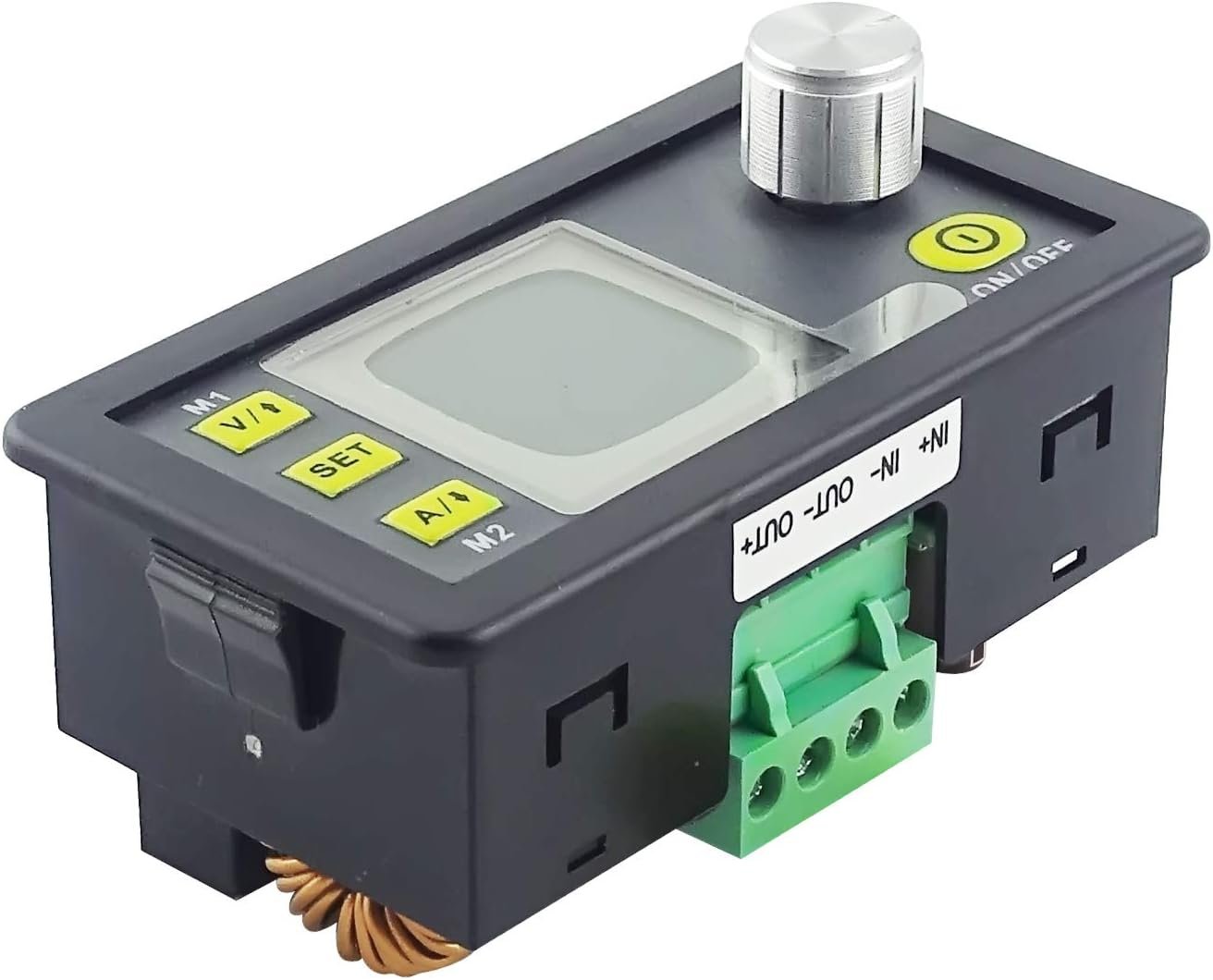
🧰 BEST BUDGET DIY MODULE · ⭐ 4.2/56. RD DPS3005 Programmable Buck Power Module (32V, 5A)
6–40V DC in · 0–32V out (0.01V steps) · 0–5A (0.001A steps) · 160W · 10 memory groups · OVP/OCP
Buy Here →

The DPS3005 is the module that started the DIY digital-supply trend before the RD6006 arrived. Feed it 6–40V DC from a laptop brick or an old 36V supply and you get an adjustable 0–32V, 0–5A constant-voltage/constant-current output, set in 0.01V and 0.001A steps, with 10 memory groups and user-settable over-voltage and over-current limits. This listing is the no-communication version; a USB/Bluetooth version exists if you want PC control. Input voltage must be at least 1.1× your highest output.
✅ Pros: Very low cost; fine digital resolution; 10 memory groups and programmable protection; easy to mount in a project box.
❌ Cons: Needs an external DC supply and enclosure; 160W ceiling; this version has no PC control.
🎯 Verdict: The cheapest route to a precise digital bench supply if you already have a suitable DC adapter.
👉 Check Price on Amazon →
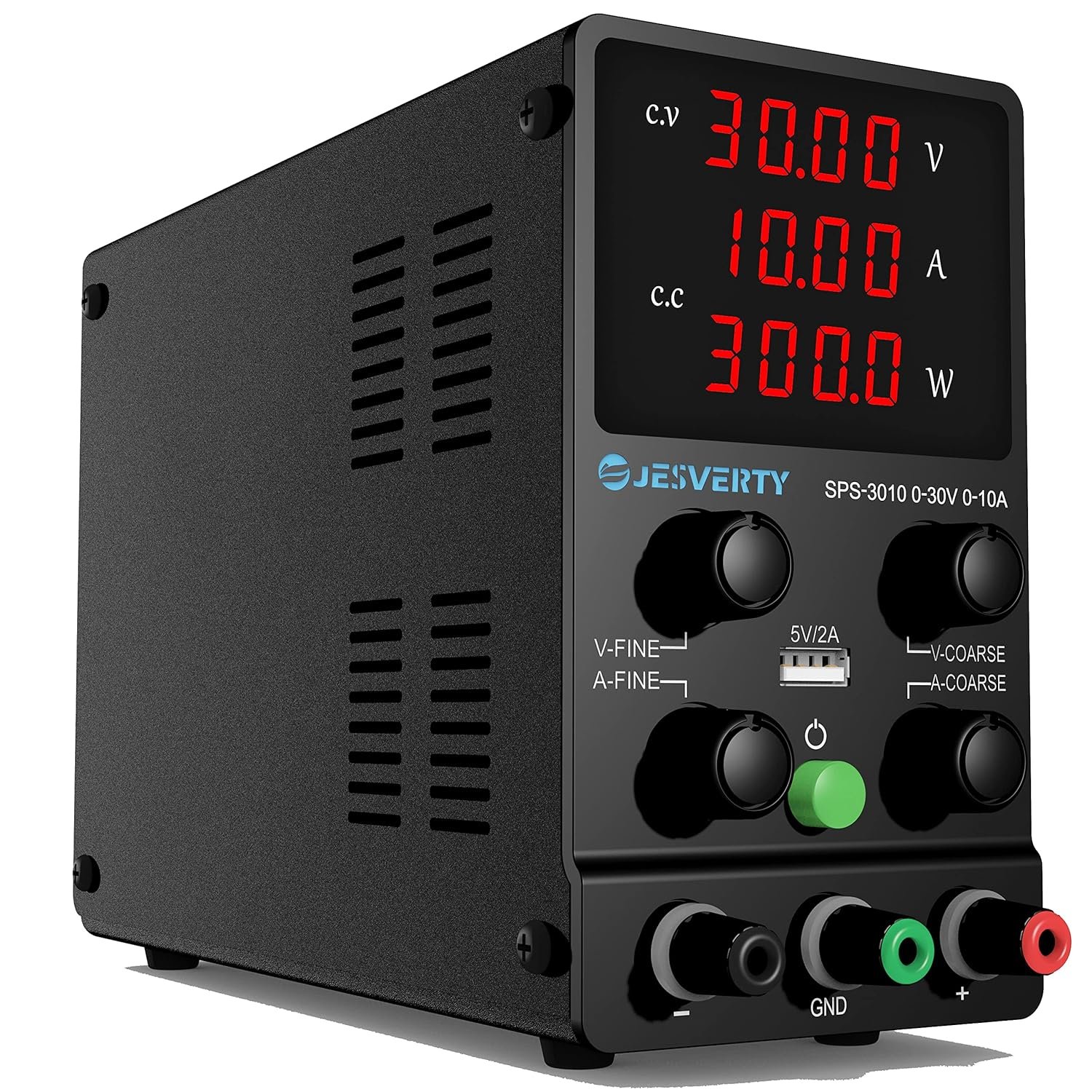
📦 MOST POPULAR · COMPACT 10A · ⭐ 4.4/57. Jesverty SPS-3010 Switching Bench Supply (0–30V, 0–10A)
0–30V · 0–10A · 300W · 4-digit V/A/W display (0.01V / 0.001A / 0.1W) · auto CV/CC · 5V/2A USB · ~2.5 lb
Buy Here →
With well over 1,600 ratings, the Jesverty SPS-3010 is one of the most-bought bench supplies on Amazon. It is a compact switching unit (about 7.1 × 3.35 × 6.1 in, roughly 2.5 lb) that delivers 0–30V at up to 10A. The 4-digit LED display shows voltage, current and live power in watts, the unit switches automatically between CV and CC, and coarse/fine knobs make it easy to dial in a rail. A 5V/2A USB port is handy for charging or powering a dev board.
✅ Pros: Huge review base; small footprint; displays watts as well as V and A; 10A output.
❌ Cons: Uses potentiometers rather than encoders; switching noise; no memory or output-enable button.
🎯 Verdict: A proven, compact 10A workhorse. Choose it over the Wanptek if you prefer a bigger review history to encoder knobs.
👉 Check Price on Amazon →
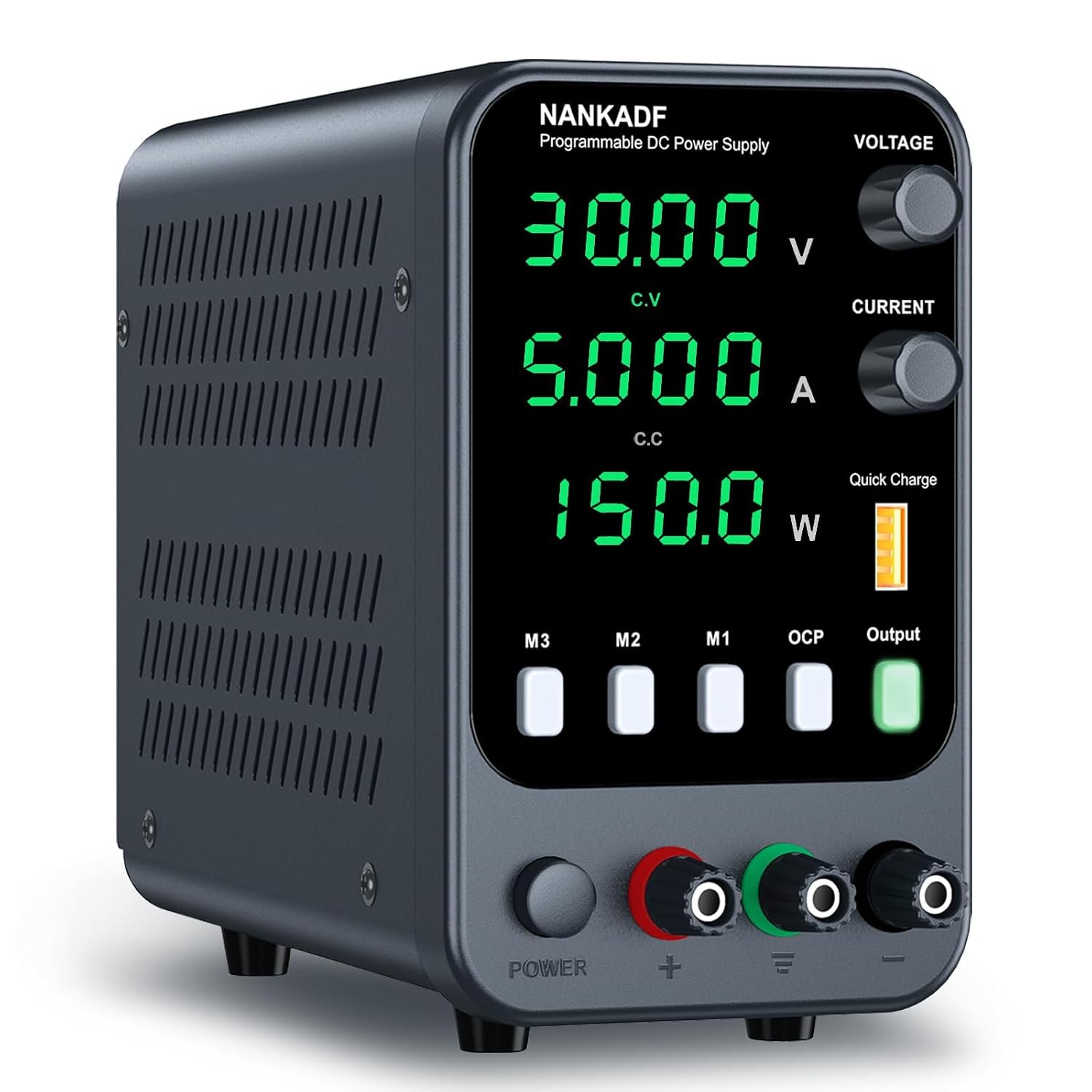
💾 BEST WITH MEMORY PRESETS · ⭐ 4.2/58. NANKADF 30V 5A Bench Supply with Memory & Output Button
0–30V · 0–5A · 150W · encoder knob · M1/M2/M3 memory · output ON/OFF button · V/A/W display · 5V/3.6A USB QC
Buy Here →
Most cheap switching supplies lack the two features that prevent accidents: an output enable button and memory presets. This NANKADF unit has both. You can store three voltage/current pairs (M1/M2/M3) for your usual rails, preview the setting before turning the output on, and watch voltage, current and power at the same time. An encoder knob, a short-circuit (OCP) alarm and a 5V/3.6A quick-charge USB port complete the package.
✅ Pros: Output ON/OFF button; 3 memory presets; encoder knob; shows V, A and W together.
❌ Cons: Only 5A / 150W; switching ripple; lesser-known brand with a smaller review base.
🎯 Verdict: The safest budget switching supply for students and firmware developers who swap between 3.3V, 5V and 12V boards all day.
👉 Check Price on Amazon →
🛒 How to Choose the Right Bench Power Supply
🧪
Debugging analog, sensor or RF circuits?
Pick a linear supply: the Tekpower TP3005T, or the Korad KA3005D if you can stretch past $100.
🤖
Driving motors, LED strips or 12V loads?
Get a 10A switching unit: the Wanptek DPS3010U (encoder knobs) or the Jesverty SPS-3010.
📈
Need logging, scripting or 60V?
The Riden RD6006W gives you PC/app control and 0–60V, as long as you add a DC supply and case.
🎒
Working away from your bench?
The Alientek DP100 runs from any USB-C PD charger or power bank and fits in a pocket.
💸
Tightest budget, have a spare DC adapter?
Build around the RD DPS3005 module for a precise digital CV/CC supply for very little money.
🎓
Switching between 3.3V, 5V and 12V boards all day?
The NANKADF 30V 5A has memory presets and an output button, which prevents costly mistakes.
⚙️ Key Specs Compared: Side by Side
| Spec | Tekpower TP3005T | Wanptek DPS3010U | Riden RD6006W | Korad KA3005D | Alientek DP100 |
|---|
| Topology | Linear | Switching | Buck module (DIY) | Linear ⭐ | Buck-boost (USB-C) |
| Max Voltage | 30V | 30V | 60V ⭐ | 30V | 30V |
| Max Current | 5A | 10A ⭐ | 6A | 5A | 5A |
| Max Power | 150W (30V × 5A) | 300W ⭐ | 360W (with suitable input) | 150W | 100W |
| Display Resolution | 0.1V / 0.01A | 4-digit | 0.01V / 0.001A ⭐ | 4-digit, 10mV / 1mA | 0.01V / 0.001A |
| Memory Presets | None | None | 10 groups ⭐ | 4 (M1–M4) | Not stated on listing |
| PC / App Control | No | No | USB + WiFi ⭐ | No (KA3005P has USB) | USB software |
| Power Input | 110V AC | AC mains | 6–70V DC (not included) | 110/220V AC switchable ⭐ | 5–32V DC / USB-C PD |
Specs are taken from the manufacturer or Amazon listing. ⭐ marks the strongest value in each row. Always confirm details on the live Amazon listing before buying.
❓ Frequently Asked Questions
Should I buy a linear or a switching bench power supply?
Buy linear if you work on analog front-ends, audio, RF or precision ADC circuits, where switching noise can hide or create problems. Buy switching if you mostly power microcontroller boards, motors, LED strips and 12V/24V loads and want more current in a lighter box. Many engineers end up with one of each: a quiet linear supply for sensitive work and a 10A switching supply for heavy loads.
Is a 30V 5A supply enough for Arduino, ESP32 and Raspberry Pi projects?
Yes, for almost all of them. An Arduino or ESP32 board draws well under 1A, and a Raspberry Pi 5 needs about 5V at up to 5A at its peak. 30V covers 12V and 24V rails with headroom. Step up to 10A only for motors, LED strips, Peltiers or several loads at once, and to 60V (RD6006) for 36–48V systems or multi-cell battery packs.
How do I use the current limit to protect a new board?
Before connecting the board, short the output leads (or leave the output off), set the current limit to just above what the board should draw, for example 100–300mA for an MCU board, then set the voltage. Connect the board and switch on. If the supply jumps into CC mode and the voltage collapses, you have a short or a wrongly placed part, and the limit has stopped it from burning. Raise the limit gradually once the board is proven.
What do I need to build a supply around the Riden RD6006 or DPS3005?
A DC source and, ideally, a case. The module’s input must be higher than the highest output you want (Riden recommends roughly 10% headroom), and it must supply enough power. For a DPS3005, a 36V enclosed switching supply or a 19–24V laptop adapter (for lower outputs) works well. For the full 60V / 6A of an RD6006 you need around a 65V supply rated for about 400W. Riden sells matching cases and supplies, but they add to the cost, so budget for the complete build.
Can I charge batteries with a bench power supply?
Yes, with care, because CV/CC is exactly how lithium cells are charged: set the voltage to the cell’s full-charge voltage (for example 4.20V per Li-ion cell) and the current to the recommended charge rate, then stop when the current drops to around 1/10th of the setting. Never leave lithium batteries charging unattended on a bench supply, and use a proper charger or BMS for multi-cell packs. The RD6006 has a dedicated battery-charging mode and app logging that make this easier.
🏁 Final Verdict: Best Bench Power Supply for Every Budget
The right bench supply for every workbench and use case:
🥇 Best Overall Under $100: Tekpower TP3005T, a quiet linear 30V 5A supply with a proven track record
Buy Here →🏅 Best Value / Most Power: Wanptek DPS3010U, 30V 10A switching with encoder knobs and USB-C
Buy Here →📡 Best Programmable: Riden RD6006W, 60V 6A with PC and WiFi app control (DIY build)
Buy Here →🔬 Best Lab-Grade Linear: Korad KA3005D, 4 presets and 4-digit readout (usually above $100)
Buy Here →🎒 Best Portable: Alientek DP100, a pocket 100W supply powered by USB-C PD
Buy Here →🧰 Best Budget DIY: RD DPS3005, a 32V 5A digital module for your own DC adapter
Buy Here →📦 Most Popular Compact: Jesverty SPS-3010, 30V 10A with a live watts readout
Buy Here →💾 Best with Memory: NANKADF 30V 5A, 3 presets and an output ON/OFF button
Buy Here →A bench power supply is the instrument you will use on every single project, so it pays to choose well. For most makers and embedded developers, the Tekpower TP3005T is the one to buy under $100: quiet linear output and a dependable current limit. If you need more current, the Wanptek DPS3010U or Jesverty SPS-3010 give you 10A for the same money. Tinkerers who want programmability should build around the Riden RD6006W or the budget DPS3005, travellers will love the Alientek DP100, and if you can stretch your budget, the Korad KA3005D is a precision linear supply that will last for years. Want to go further? Compare lab-grade models in our programmable DC power supply guide, see our power supplies for microcontroller projects roundup, and explore hundreds of Arduino, ESP32, STM32 and Raspberry Pi tutorials on Microcontrollers Lab.
💬 Not sure which bench supply fits your workbench? Tell us what you build (MCU boards, motor projects, audio circuits or battery packs) in the comments below, and we’ll point you to the right pick.
All Amazon links above use our affiliate tag (microlab05-20). Purchasing through them supports microcontrollerslab.com at no extra cost to you. Prices and availability change frequently, so always confirm the current price on Amazon before buying.