⚠️ Affiliate Disclosure: This post contains Amazon affiliate links. If you purchase through our links, we may earn a small commission at no extra cost to you. We only recommend modules we have researched and whose listings we checked live on Amazon. Prices change constantly, so we deliberately don’t print them here. Always tap through and confirm the current price on Amazon before buying.
Ultimate Buying Guide
⚡ Best Boost Converter Step-Up Modules for Arduino, ESP32 & Battery Projects
8 step-up modules ranked, from the tiny MT3608 and the do-everything XL6009 to the synchronous TPS61023 and a 400W high-power booster, with real specs, honest verdicts and direct Amazon links.
✅ 8 Modules Reviewed
✅ Verified Amazon ASINs
✅ Checked Live on Amazon
✅ Honest Pros & Cons
A boost converter (step-up module) takes a lower DC voltage and raises it to a higher, regulated one. It is how a single 3.7V Li-ion cell runs a 5V Arduino, how two AA batteries power an ESP32 dev board, how a 5V USB port drives a 12V LED strip or fan, and how a 12V car battery charges a 19V laptop. Because it switches an inductor at hundreds of kilohertz instead of burning excess voltage as heat, a good boost module wastes very little energy, which is exactly what battery-powered embedded projects need.
The catch is that boost modules look almost identical but behave very differently. They vary in input range (some start from 0.9V, others need 10V), output range, real usable current, switching frequency and whether they use synchronous rectification for higher efficiency at low voltage. This guide ranks 8 step-up modules across every use case, from micro 5V boosters for coin-sized wearables to 400W units for LED arrays and battery chargers, using the specs that actually matter.
💡 Reality check before you buy: The headline current on most cheap boost modules (MT3608 “2A”, XL6009 “4A”) is the internal switch limit, not the current you can pull from the output. Because input current is roughly output current multiplied by the voltage ratio, boosting 3.7V to 12V at 0.5A already draws around 1.8A from the battery. Expect realistic outputs of roughly a third to half the headline figure for big step-ups. Clone boards also vary in inductor and capacitor quality, so test under your real load before you trust them. Finally, a plain boost converter can only step up: if your input can rise above the output, you need a buck-boost module instead.
⚡ Quick Comparison: All 8 Boost Converter Modules
| Module | Input | Output | Rated Current | Best For | Buy |
|---|
| 🥇 HiLetgo XL6009 | 3–32V | 5–35V adj. | 4A switch | Best Overall | Buy Here → |
| 🏅 Eiechip MT3608 (Micro-USB) | 2–24V | 5–28V adj. | 2A switch | Best Value / Compact | Buy Here → |
| 🔋 TPS61023 5V Module | 0.5–5.5V (1.8V start) | 5V fixed | 1A out | Best for Li-ion to 5V | Buy Here → |
| 🔬 Mini 0.9–5V to 5V Booster | 0.9–5V | 5V fixed | 480mA out | Best for AA / Tiny Builds | Buy Here → |
| 🔌 Adafruit PowerBoost 1000C | 3.7V LiPo | 5.2V USB | 1A+ out | Best Charger + Boost | Buy Here → |
| 🚗 Gowoops 150W Boost | 10–32V | 12–35V adj. | 10A max out | Best 12V/24V Mid-Power | Buy Here → |
| 💥 HiLetgo 400W 15A | 8.5–50V | 10–60V adj. | 15A max, CC/CV | Best High-Power | Buy Here → |
| 📟 DROK LCD Boost 5A | 6–30V | 7–32V adj. | 5A max, CC/CV | Best with Display | Buy Here → |
Current figures are the manufacturer’s rated or switch-limit values; usable output current drops as the step-up ratio rises. Several budget modules are sold in multi-packs, so check the pack size on the listing. Prices change often, so tap through to see the live price on Amazon.
🔍 What to Look for in a Boost Converter Module
🔋
Input Voltage Range
Match the module to your source across its whole discharge curve. A Li-ion cell runs from 4.2V down to about 3.0V, two AAs sag toward 1.8V. Pick a module whose minimum input (and start-up voltage) sits below your battery’s empty voltage.
🎚️
Output: Fixed or Adjustable
Fixed 5V boards (TPS61023, mini boosters) are set-and-forget and can’t be accidentally over-volted. Trimpot boards (MT3608, XL6009) are flexible but must be set with a multimeter before connecting your microcontroller.
⚡
Real Output Current
Ignore the switch-limit headline and do the power math: Pout ≈ Pin × efficiency. The bigger the jump from input to output, the less current you get out. Leave at least 30% headroom for Wi-Fi bursts and motor inrush.
📈
Efficiency & Synchronous Rectification
Classic modules use a Schottky diode that costs about 0.3–0.5V of loss, which hurts most at low voltages. Synchronous chips like the TPS61023 and the PowerBoost’s converter replace it with a MOSFET for longer battery life.
🛡️
Protection & Ripple
Look for current limiting, thermal shutdown and under-voltage lockout. Higher switching frequency means smaller inductors and lower ripple; add a 100–470µF capacitor at the output for noisy loads like ESP32 radios or servos.
🏆 Detailed Reviews: All 8 Step-Up Modules
🥇 BEST OVERALL
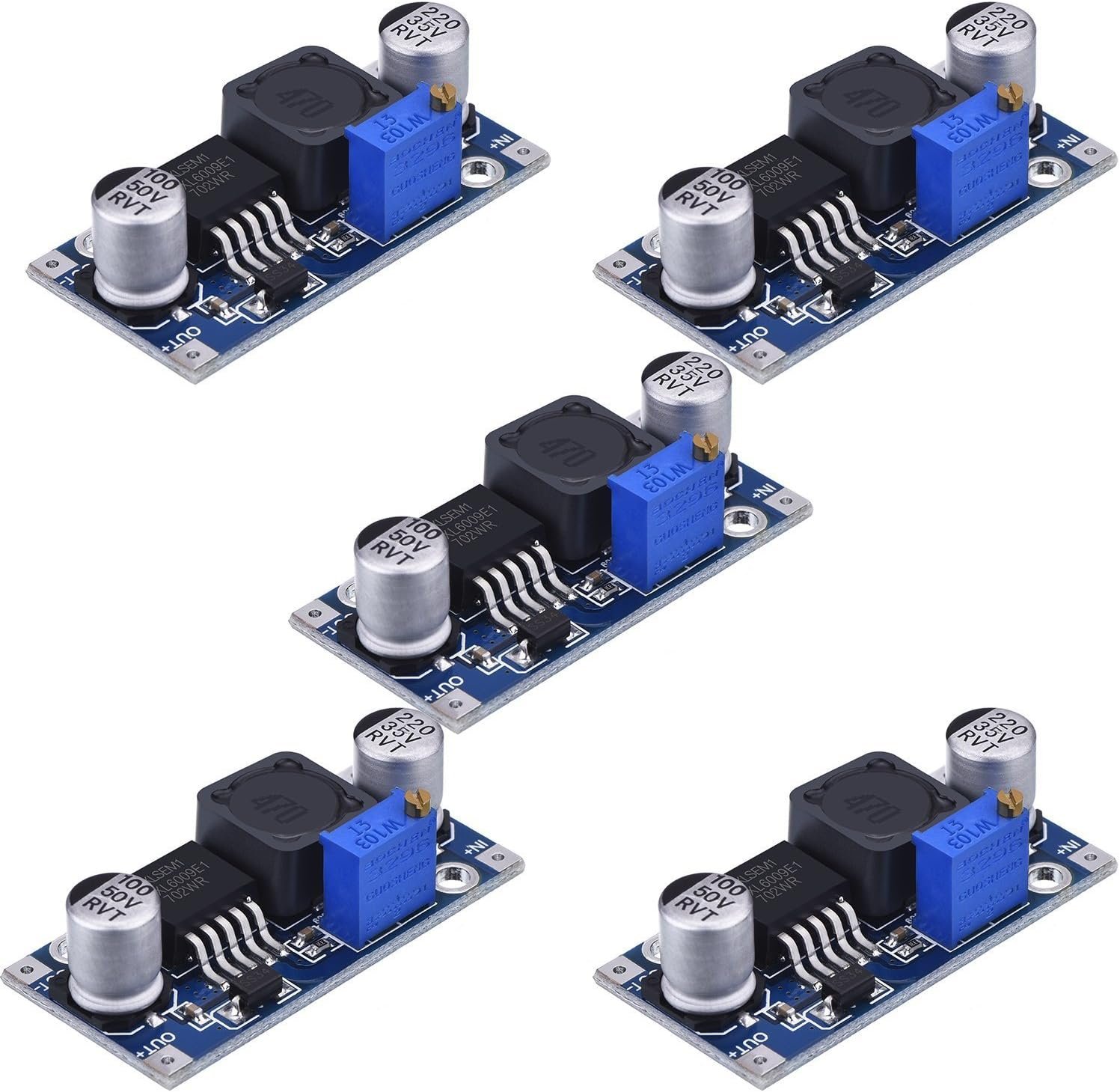
HiLetgo XL6009 Boost Module (5-Pack)
⭐ 4.7/5 · The Do-Everything Adjustable Booster
Buy on Amazon →

If you only stock one boost module in your parts drawer, make it the XL6009. Its wide 3–32V input and 5–35V adjustable output cover almost every hobby job: a 2S/3S Li-ion pack to 12V or 24V, 5V USB to 12V for fans and LED strips, or a solar panel to a charging voltage. The 4A internal MOSFET and 400kHz switching give it far more headroom and lower ripple than the old LM2577 boards it replaced, and the listing quotes efficiency up to 94%. HiLetgo’s five-pack keeps the per-board cost low, and the module has a huge base of tutorials and wiring diagrams.
✅ Pros- Very wide 3–32V in, 5–35V out
- 4A switch gives real headroom
- 400kHz: smaller ripple than LM2577
- Cheap in a 5-pack, huge community
❌ Cons- Usable output is well below 4A on big step-ups
- Diode-based, so weaker at very low input
- Larger than an MT3608
🎯 Verdict: The best all-round adjustable boost converter. Enough range and current for most 5V to 24V jobs, at clone-module prices.
👉 Check Price on Amazon →
🏅 BEST VALUE / MOST COMPACT
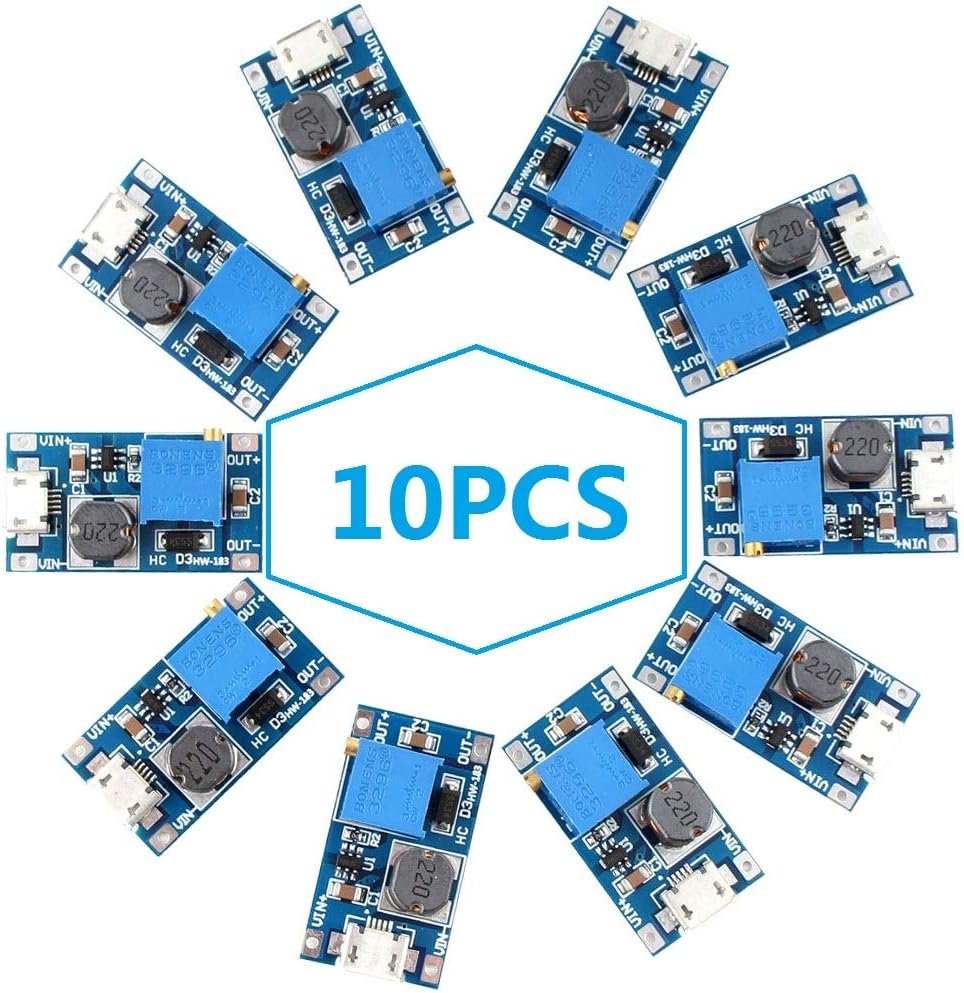
Eiechip MT3608 with Micro-USB (10-Pack)
⭐ 4.6/5 · The Tiny Hobbyist Default
Buy on Amazon →

The MT3608 is the boost chip behind countless breadboard projects, and this Eiechip version adds a handy micro-USB input so you can plug in any phone charger or power bank and dial out 9V, 12V or more. The board measures just 30 × 17 mm, takes 2–24V in and delivers an adjustable 5–28V, with under-voltage lockout, current limiting and thermal protection built into the chip. The “2A” rating is the switch limit, so plan on a few hundred milliamps at 12V from a 5V source. For sensors, small fans, LED strips and op-amp rails, nothing beats it on size and cost, and a 10-pack keeps you stocked for years.
✅ Pros- Tiny 30 × 17 mm footprint
- Micro-USB input, no soldering to test
- Wide 5–28V adjustable output
- Very cheap per board in a 10-pack
❌ Cons- Real current far below the 2A headline
- Gets hot near its limit
- Sensitive trimpot, easy to overshoot
🎯 Verdict: The best value and most compact adjustable booster. Ideal for low-to-medium current loads where space and cost matter.
👉 Check Price on Amazon →
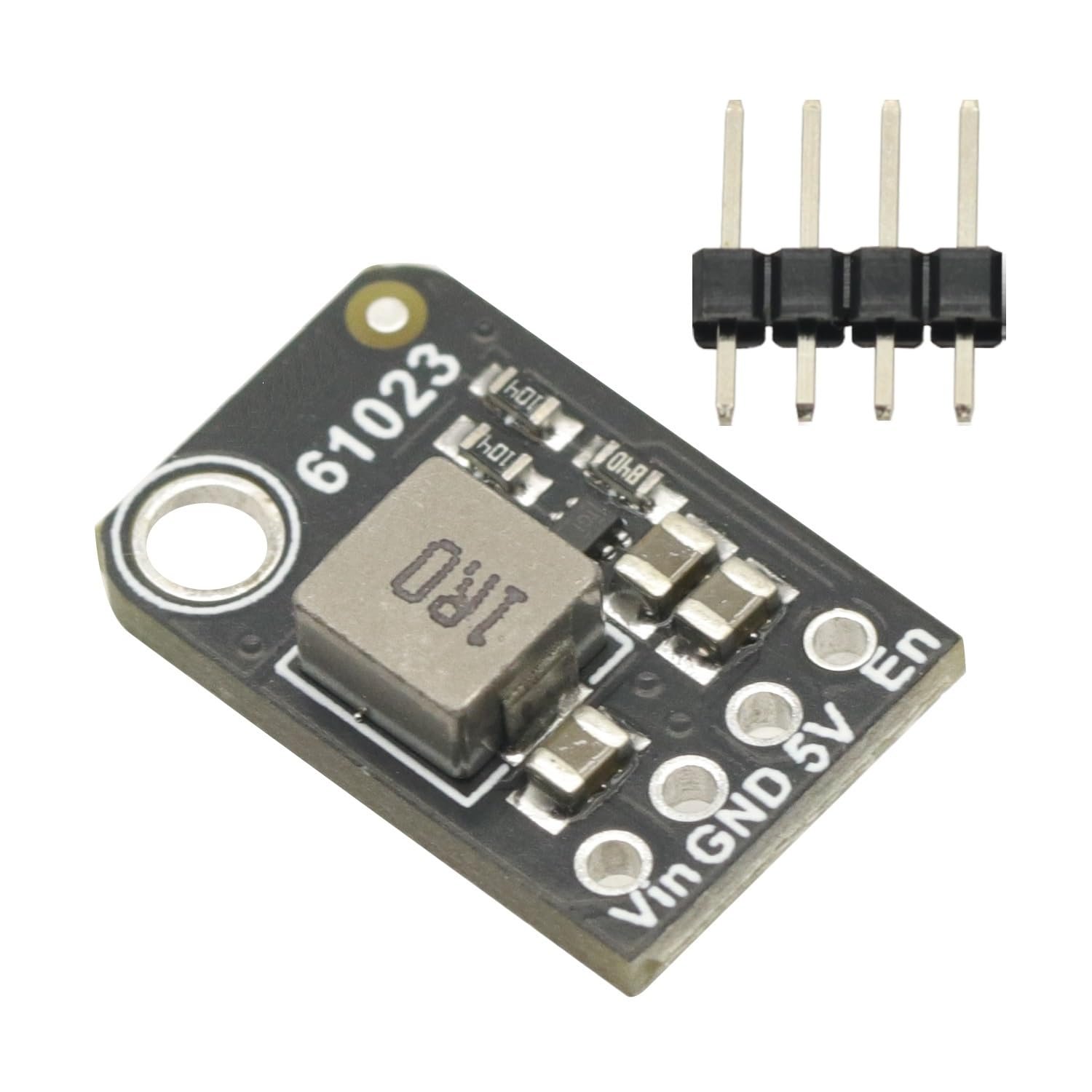
🔋 BEST FOR SINGLE-CELL LI-ION TO 5V · ⭐ 4.5/53. TPS61023 5V 1A Boost Module
0.5–5.5V in (1.8V start-up) · 5V fixed out · 1A · synchronous · 3A valley current limit
Buy →

Texas Instruments’ TPS61023 is a modern synchronous boost converter, and this little board turns it into a set-and-forget 5V, 1A supply. It starts up from 1.8V and, once running, keeps regulating as the input sags all the way to 0.5V, so it squeezes nearly every last drop out of a single 18650/LiPo cell or a pair of AA batteries. With integrated MOSFETs instead of a lossy diode it runs cooler and more efficiently than an MT3608 at these low input voltages, which makes it ideal for powering an Arduino Nano, ESP32-C3 or Raspberry Pi Pico from one cell. Note that this specific listing is new and has only a handful of reviews, so buy a spare.
✅ Pros: Synchronous, efficient at low Vin; runs down to 0.5V; fixed 5V, nothing to mis-adjust; tiny.
❌ Cons: 5V only; 1A ceiling; few reviews on this listing yet.
🎯 Verdict: The best way to get clean 5V from one Li-ion cell or two AAs. Choose it over an MT3608 whenever battery life matters.
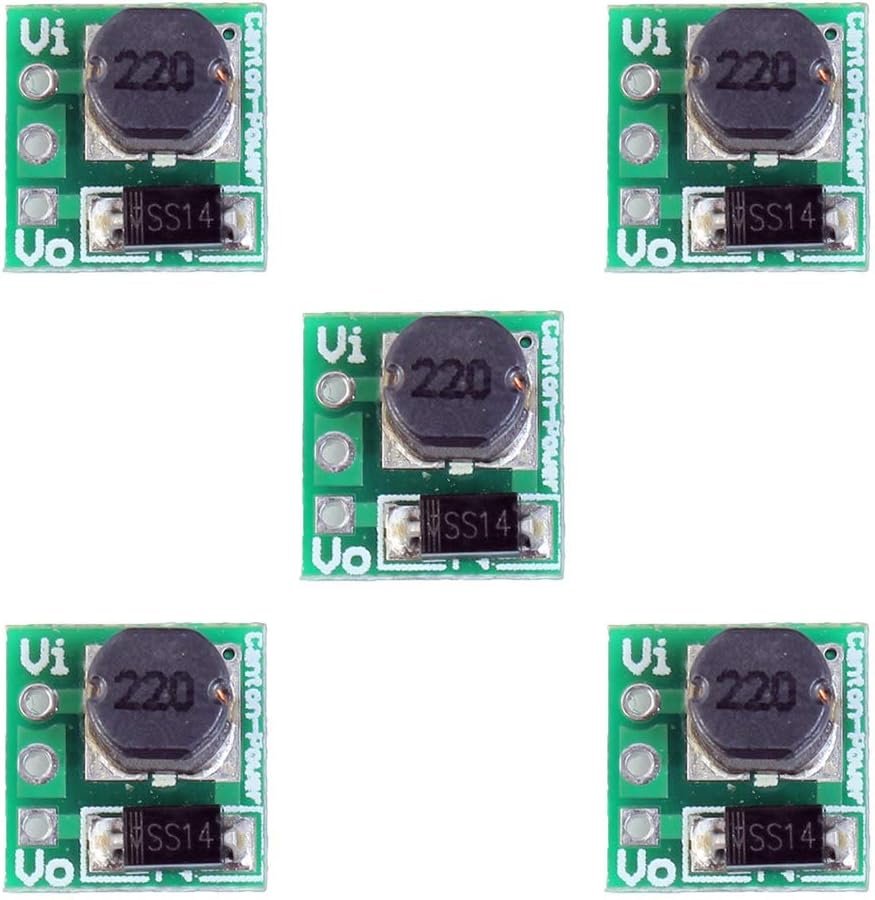
🔬 BEST FOR AA CELLS & TINY BUILDS · ⭐ 4.3/54. Mini 0.9–5V to 5V Boost Converter (5-Pack)
0.9–5V in · 5V fixed out · 480mA max · ~85% typical · 11 × 10.5 mm · ~1 g
Buy →

When space is everything, this 11 × 10.5 mm module weighs about a gram and drops straight onto a breadboard or perfboard with its 2.54 mm pins. It accepts anything from 0.9V to 5V, so a single AA, a NiMH cell, two alkalines or a coin-cell pack can all produce a steady 5V. The 480mA ceiling rules out Wi-Fi boards, but it is perfect for wearables, ATtiny and Arduino Pro Mini sensor nodes, LED badges and anything that sips current.
✅ Pros: Starts from 0.9V; incredibly small and light; breadboard pins; cheap 5-pack.
❌ Cons: 480mA max; too weak for ESP32 Wi-Fi peaks; 150kHz means more ripple.
🎯 Verdict: The best micro booster for low-power builds that run on one or two AA cells.
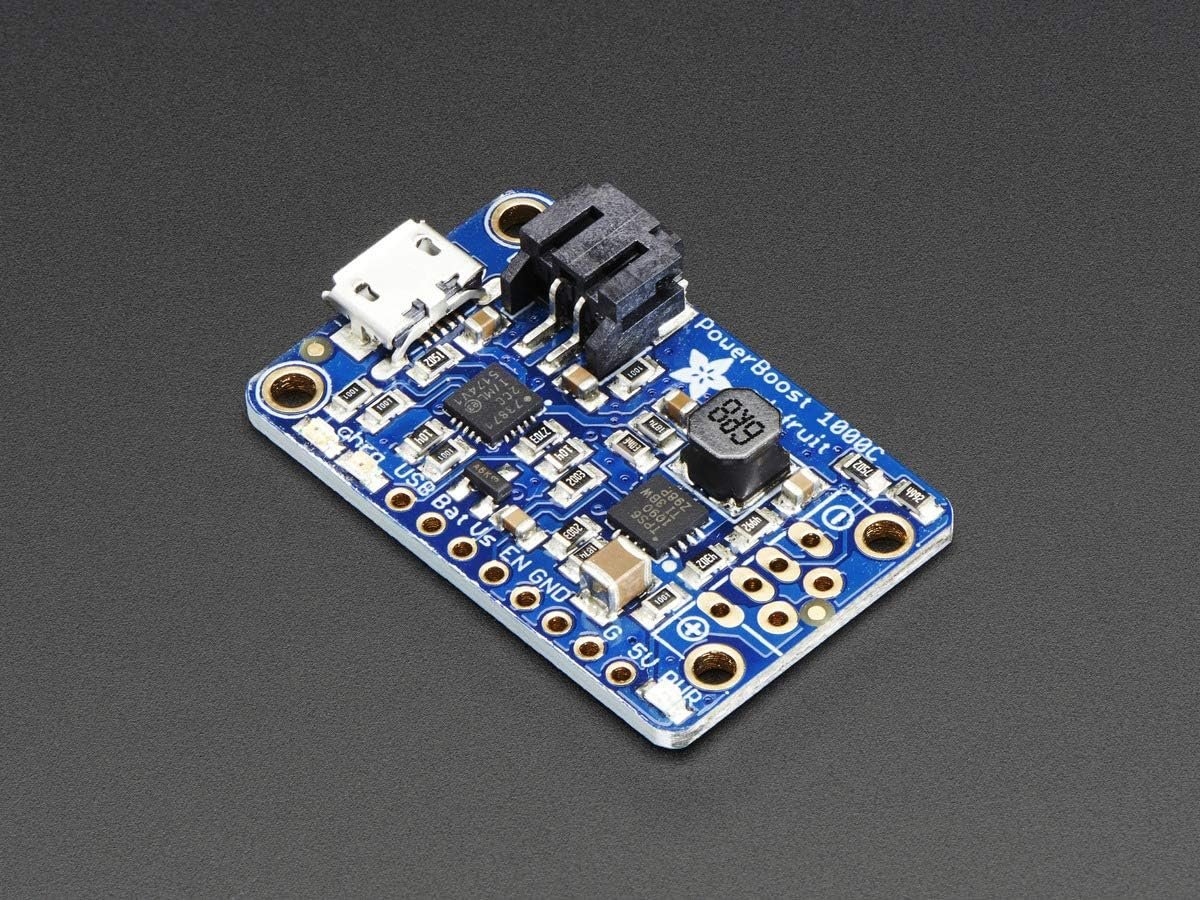
🔌 BEST CHARGER + BOOST COMBO · ⭐ 4.6/55. Adafruit PowerBoost 1000C
3.7V LiPo in · 5.2V USB out · 1A+ · 2A switch · 700kHz synchronous · low-battery LED
Buy →

The PowerBoost 1000C is more than a boost converter: it is a complete portable power system. It boosts a 3.7V LiPo/Li-ion cell to a stiff 5.2V at 1A or more using a 700kHz synchronous converter with a 2A internal switch, and it also charges the battery over USB with load-sharing, so your Raspberry Pi or Arduino keeps running while the pack charges. A low-battery LED lights below 3.2V, there is an enable pin for a power switch, and the board has a USB-A footprint. It costs several times more than a bare module, but it replaces a charger, protection logic and booster with one well-documented board.
✅ Pros: Charge and run at the same time; synchronous 1A+ output; low-battery indicator; excellent docs.
❌ Cons: Much pricier than bare modules; 5V output only; often sold by third-party sellers.
🎯 Verdict: The best all-in-one LiPo charger and 5V booster for portable Pi and Arduino builds.
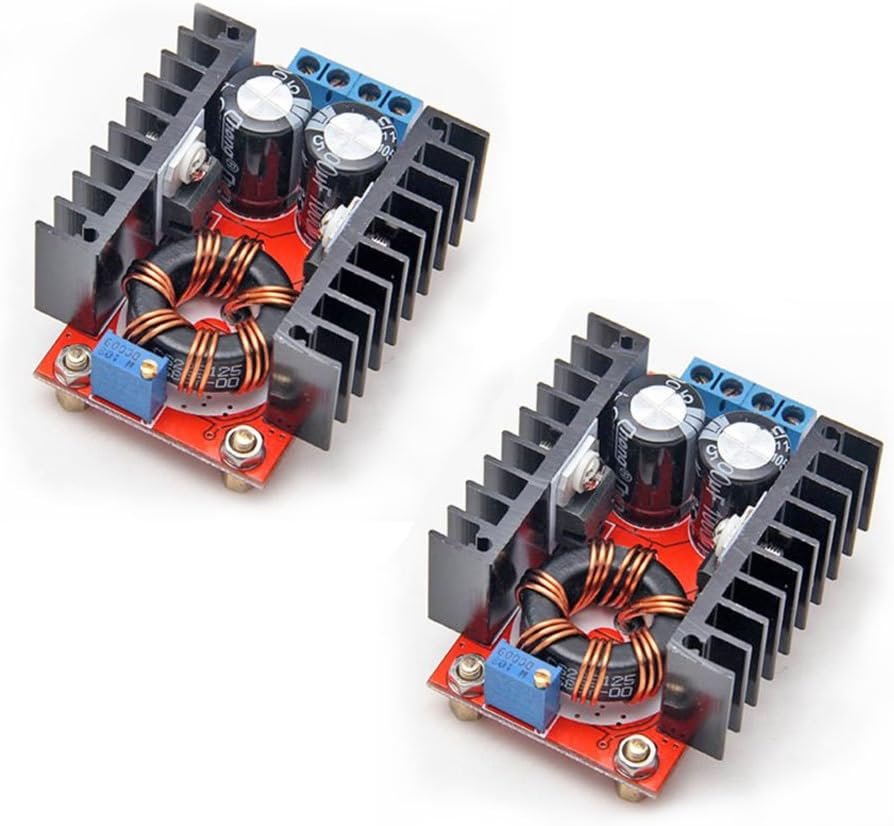
🚗 BEST 12V/24V MID-POWER · ⭐ 4.5/56. Gowoops 150W DC-DC Boost Converter (2-Pack)
10–32V in · 12–35V adj. out · 16A in / 10A out max · up to 94% · -40 to +80°C
Buy →

Once your source is already 12V, the small modules run out of steam. The 150W boost converter is the classic next step: 10–32V in, 12–35V adjustable out, a big toroid inductor and two heatsinks. It is the go-to board for running a 19V laptop or 24V equipment from a car battery, raising a 12V supply for a motor driver, or building an adjustable bench rail. The listing quotes up to 94% efficiency and an industrial -40 to +80°C rating. Treat 150W as a peak: add a fan above roughly 100W of continuous load.
✅ Pros: Real tens-of-watts capability; wide 12–35V output; proven design; affordable 2-pack.
❌ Cons: Needs at least 10V in; large; needs airflow near full load; no reverse-polarity protection.
🎯 Verdict: The best mid-power booster for 12V and 24V systems, cars and laptop-charging projects.
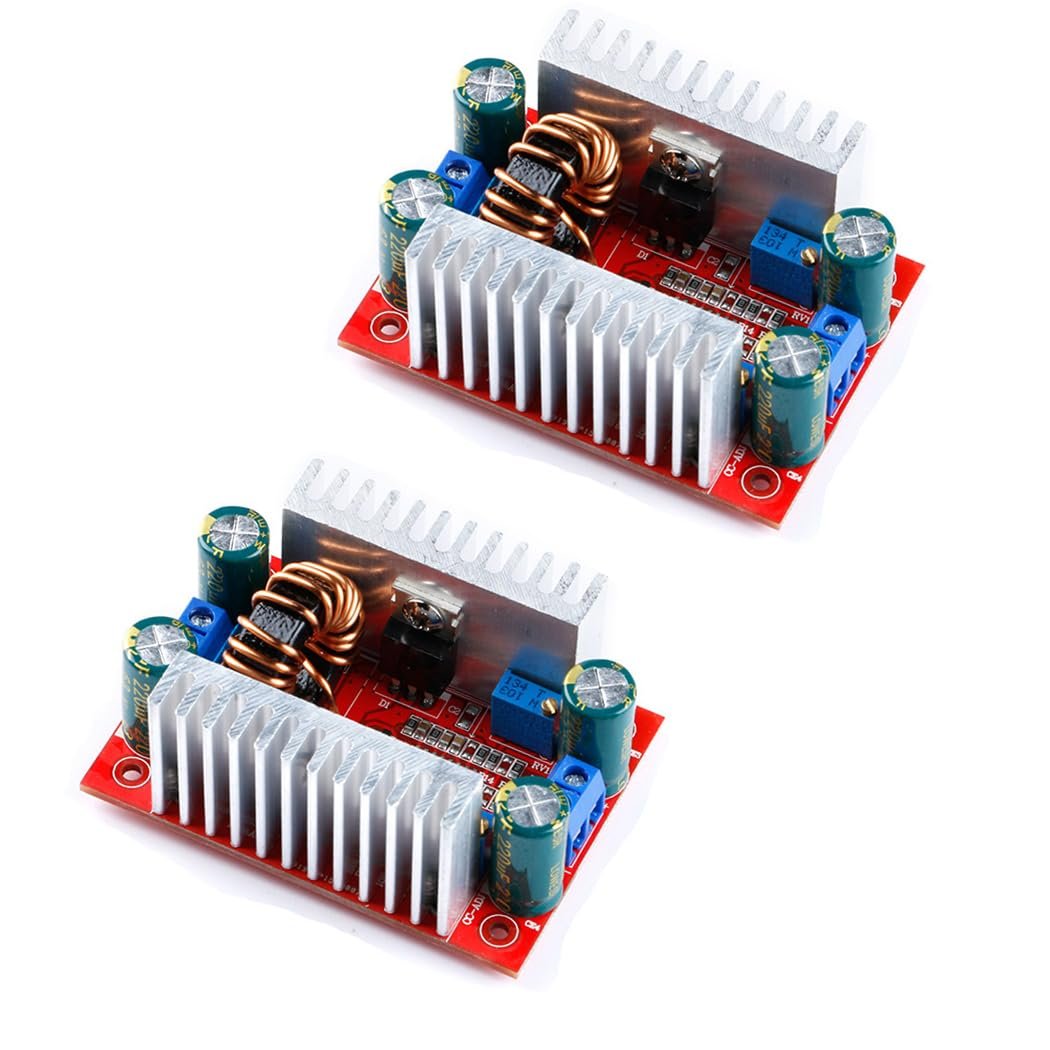
💥 BEST HIGH-POWER · ⭐ 4.3/57. HiLetgo 400W 15A DC Boost Module (2-Pack)
8.5–50V in · 10–60V adj. out · 15A max · constant voltage + constant current · non-isolated
Buy →

For the heavy jobs, the 400W 15A boost module raises 8.5–50V to anything from 10V to 60V, and it adds a separate constant-current trimpot. That CC/CV pair turns it into a high-power LED driver, a lead-acid or lithium pack charger, or a solar voltage stabilizer, not just a fixed rail. It is the board to reach for when you need 36V or 48V from a 12V or 24V battery bank. The ratings are peaks, so plan on active cooling for sustained loads, and be aware this listing has fewer reviews than the smaller modules here.
✅ Pros: Up to 60V out; CC + CV for LEDs and charging; widest input here; 2-pack.
❌ Cons: Needs a fan near rated power; non-isolated; overkill for microcontrollers; fewer reviews.
🎯 Verdict: The best high-power step-up module for LED arrays, battery charging and 36V/48V rails.
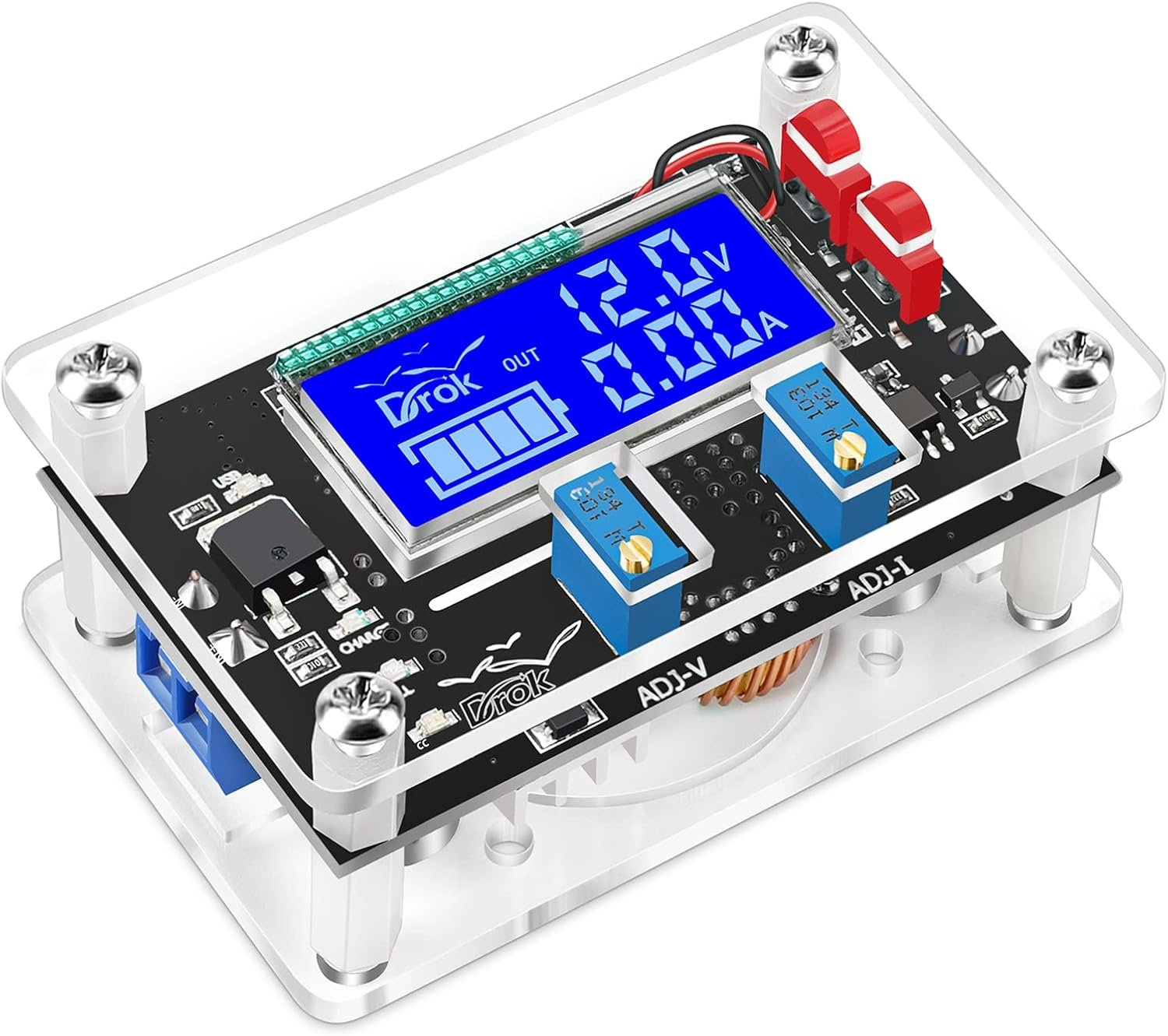
📟 BEST WITH BUILT-IN DISPLAY · ⭐ 4.4/58. DROK LCD Boost Converter 5A
6–30V in · 7–32V adj. out · 5A max · CC/CV · LCD volts + amps · enclosed case
Buy →

Tired of setting trimpots with a multimeter clipped on? The DROK LCD boost converter shows output voltage and current on a clear LCD while you adjust, and it ships in a protective case. It steps 6–30V up to 7–32V with up to 5A, offers both constant-voltage and constant-current modes, and includes voltage calibration. That makes it a handy mini bench supply for testing 12V and 24V gear from a 5–9V source, a solar charge controller, or an LED driver you can actually read. Keep in mind the output must sit at least 1.5V above the input.
✅ Pros: Live V/A display; CC/CV modes; enclosed case; up to 5A.
❌ Cons: Needs 6V+ in; output must be 1.5V above input; mixed reviews on long-term reliability.
🎯 Verdict: The best boost module when you want to see exactly what it is delivering. Great as a compact bench booster.
🛒 How to Choose the Right Boost Converter
🧰
Need one module for everything?
Get the XL6009: 3–32V in, 5–35V out and a 4A switch cover most 5V to 24V jobs.
📦
Short on space or budget?
The MT3608 is tiny, cheap in a 10-pack and takes USB power directly. Perfect for light 9–12V loads.
🔋
Running an MCU from one Li-ion cell?
Use the synchronous TPS61023 5V module for maximum battery life and a fixed, safe output.
🔌
Need charging too?
The Adafruit PowerBoost 1000C charges your LiPo and boosts it to 5V at the same time.
🚗
Boosting 12V to 19V or 24V?
The 150W module handles car batteries, laptops and 24V gear; step up to the 400W for 36–60V or LED arrays.
📟
Want to see volts and amps?
The DROK LCD boost shows live output voltage and current with CC/CV control.
⚙️ Key Specs Compared: Side by Side
| Spec | XL6009 | MT3608 | TPS61023 | PowerBoost 1000C | 150W Module | 400W Module |
|---|
| Input Range | 3–32V | 2–24V | 0.5–5.5V ⭐ | 3.7V LiPo | 10–32V | 8.5–50V |
| Output Range | 5–35V | 5–28V | 5V fixed | 5.2V fixed | 12–35V | 10–60V ⭐ |
| Rated Current | 4A switch | 2A switch | 1A out | 1A+ out | 10A out max | 15A max ⭐ |
| Rectification | Diode | Diode | Synchronous ⭐ | Synchronous ⭐ | Diode | Diode |
| Adjustable Output | Yes (trimpot) | Yes (trimpot) | No | No | Yes (trimpot) | Yes, CV + CC ⭐ |
| Size | Small | 30 × 17 mm ⭐ | Tiny ⭐ | Medium | Large | Large |
| Extras | 400kHz, up to 94% | Micro-USB input | 1.8V start-up | LiPo charger + LBO LED ⭐ | Dual heatsinks | LED driver / charger |
Specs are taken from the live Amazon listings and the chip makers’ data, and can vary between sellers and board revisions. Always confirm details on the listing before buying.
❓ Frequently Asked Questions
How much current can I really get from an MT3608 or XL6009?
Much less than the label. The 2A (MT3608) and 4A (XL6009) figures are internal switch limits, and the switch carries the input current. Use Iout ≈ Iin × (Vin ÷ Vout) × efficiency. Boosting 5V to 12V on an MT3608 typically gives a few hundred milliamps; an XL6009 doing the same job comfortably delivers around 1A. For anything more, move up to a 150W-class module.
Can a boost converter power an ESP32 from a single 18650 cell?
Yes. Boost the cell to 5V and feed the board’s 5V/VIN pin, letting the onboard regulator make 3.3V. A synchronous 5V module like the TPS61023 is the best match because it stays efficient as the cell drops toward 3V. Add a 220–470µF capacitor at the output to absorb the ESP32’s Wi-Fi current spikes, and use a protected cell or a charger board with under-voltage cut-off so the battery isn’t over-discharged.
What is the difference between a boost, buck and buck-boost converter?
A boost converter only raises voltage, a buck converter only lowers it, and a buck-boost converter can do either and holds the output steady even when the input crosses it. Use a boost module when your source is always below the target (one Li-ion cell to 5V, 5V to 12V). If your input can swing above and below the output, for example a 3S pack powering 12V gear, choose a buck-boost module instead.
Why is my boost module’s output equal to the input when there’s no load?
Even when it is not switching, a boost converter passes the input straight through its inductor and diode, so the output can never fall below roughly Vin minus a diode drop. If you see the input voltage at the output, the trimpot is set below the input, the module is in current limit, or the chip has shut down. Turn the trimpot (many need 10 or more turns before the voltage moves), check the input wiring, and make sure the setpoint is above the input.
How do I safely set the output voltage on an adjustable module?
Always set it with nothing connected to the output. Power the module, put a multimeter on the output terminals, and turn the trimpot slowly until you reach the target (counter-clockwise lowers the voltage on most MT3608 and XL6009 boards). Only then connect your circuit, and recheck under load. A drop of hot glue or nail polish on the trimpot stops vibration from drifting the setting, which matters in robots and vehicles.
🏁 Final Verdict: Best Boost Converter for Every Build
The right step-up module for every project and budget:
🥇 Best Overall: HiLetgo XL6009, 3–32V in, 5–35V out, 4A switch, 400kHz
Buy →🏅 Best Value / Compact: Eiechip MT3608, tiny, micro-USB input, cheap 10-pack
Buy →🔋 Best for Li-ion to 5V: TPS61023 module, synchronous, runs down to 0.5V
Buy →🔬 Best for AA / Tiny Builds: Mini 0.9–5V to 5V booster, 11 × 10.5 mm
Buy →🔌 Best Charger + Boost: Adafruit PowerBoost 1000C, charge and run from one LiPo
Buy →🚗 Best 12V/24V Mid-Power: Gowoops 150W, 10–32V to 12–35V
Buy →💥 Best High-Power: HiLetgo 400W 15A, up to 60V with CC/CV
Buy →📟 Best with Display: DROK LCD boost 5A, live volts and amps
Buy →No single boost converter fits every build, but each pick here earns its place. For most projects the XL6009 is the one to keep in your drawer, with the range and headroom to handle almost any 5V to 24V job. If space and cost matter, stock up on MT3608 boards; for battery-powered microcontrollers, the synchronous TPS61023 squeezes the most life out of a single cell; and the PowerBoost 1000C adds charging for truly portable builds. When you graduate to 12V systems and big loads, the 150W and 400W modules take over, and the DROK LCD boost lets you watch every volt. For more on powering your projects, see our guides to the best LiPo battery charger modules, the best power supplies for microcontroller projects and the LTC3780 buck-boost module, then put your new module to work with our Arduino, ESP32, STM32 and Raspberry Pi tutorials.
💬 Not sure which boost converter fits your project? Tell us your input source, target voltage and load current in the comments below, and we’ll point you to the right module.
All Amazon links above use our affiliate tag (microlab05-20). Purchasing through them supports microcontrollerslab.com at no extra cost to you. Prices and availability change frequently, so always confirm the current price on Amazon before buying.