⚠️ Affiliate Disclosure: This post contains Amazon affiliate links. If you purchase through our links, we may earn a small commission at no extra cost to you. We only recommend products we have thoroughly researched and verified. Prices change frequently, so we don’t list them here — always tap through and confirm the live price on Amazon before buying.
Ultimate Buying Guide 2026
🔋 Best LiPo Battery Charger Modules for Makers & Embedded Projects
10 lithium battery charger modules ranked for Arduino, ESP32, Raspberry Pi and robotics — from the classic TP4056 to solar MPPT managers, 2-cell chargers, RC balance chargers and Pi UPS boards — with real specs, honest verdicts and direct Amazon links.
✅ 10 Chargers Reviewed
✅ Verified Amazon Listings
✅ Updated July 2026
✅ Honest Pros & Cons
A LiPo battery charger module is the small but critical board that keeps every portable project alive. Whether you’re building a battery-powered ESP32 sensor node, a wearable, a solar IoT logger, a robot or a DIY power bank, you can’t just wire a USB port to a lithium cell — lithium chemistry needs a proper constant-current/constant-voltage (CC/CV) charge profile, a precise 4.2V-per-cell cutoff, and protection against over-charge, over-discharge and short circuits. Get it wrong and you risk a swollen, dead or dangerous cell. Get it right with the correct module and charging becomes a plug-and-forget affair.
The tricky part is that “LiPo charger” covers a huge range of boards. Some charge a single 3.7V cell at 1A over USB-C; others handle 2-cell (8.4V) packs at 2A; solar managers add MPPT tracking; RC balance chargers juggle 1–6 cells with per-cell balancing; and UPS boards charge and power a Raspberry Pi at the same time. This guide ranks 10 lithium battery charger modules across every use-case and budget — on the specs that actually matter: cell count, charge current, input type, output/boost, and built-in protection.
💡 Reality check before you buy: Cheap TP4056-class boards are fantastic value but vary in quality — the “1A” charge current is a maximum set by an onboard resistor, and clones sometimes ship with weaker protection ICs (or none at all, so buy the “with protection” version for bare cells). A plain charger only charges — it does not boost the cell’s 3.7V up to 5V, so if you need to power a 5V device you also need a boost converter (or buy a charge-plus-boost board). And never charge a multi-cell pack with a single-cell charger: 2S/3S packs need a 2-cell charger or a balance charger, or you’ll overcharge cells and risk a fire. Match the module to your cell count and current first, features second.
🔋 Quick Comparison — All 10 LiPo Charger Modules
| Module | Cells | Charge Current | Input / Output | Best For | Buy |
|---|
| 🥇 TP4056 Type-C | 1S | ~1A | USB-C in | Best Overall | Buy Here → |
| 🏅 Adafruit bq24074 | 1S | up to 1.5A | USB-C / DC / Solar | Best Premium | Buy Here → |
| ⚡ TP5100 | 1S / 2S | up to 2A | 5–18V DC in | Best for 2-Cell Packs | Buy Here → |
| 🔧 SKYRC iMAX B6AC V2 | 1–6S | up to 6A / 50W | AC/DC · balance | Best Balance Charger | Buy Here → |
| 🎛️ SparkFun Adjustable | 1S | 15–500mA (adj.) | micro-USB / PTH | Best Adjustable | Buy Here → |
| 🪶 Adafruit Micro-Lipo | 1S | 100 / 500mA | micro-USB in | Best Ultra-Compact | Buy Here → |
| 🔌 TP4056 + Boost | 1S | ~1A + 5V out | USB in / 5V out | Best Power-Bank Board | Buy Here → |
| ☀️ DFRobot Solar 5V | 1S | up to 900mA | Solar/USB · 5V out | Best Solar / MPPT | Buy Here → |
| 🖥️ Waveshare UPS 3S | 3S | charge + 5V/5A out | USB-C in / 5V out | Best Raspberry Pi UPS | Buy Here → |
| 🔋 Dual 18650 Shield V8 | 2× 1S | charge + 5V/3A out | micro-USB / 5V+3V | Best Dev-Board Shield | Buy Here → |
Specs are approximate and vary by seller/clone. Charge currents are maximums. Always confirm details and the live price on the Amazon listing before buying.
🔍 What to Look for in a LiPo Charger Module
🔢
Cell Count (1S / 2S / 3S)
The single most important match. A 1S charger tops a cell to 4.2V; a 2S charger to 8.4V; 3S to 12.6V. Never charge a multi-cell pack on a single-cell board. For 2+ cells in series, use a 2S charger (TP5100) or a balance charger (iMAX B6).
⚡
Charge Current
Charge a cell at roughly 0.5–1C. A 1000mAh cell likes ~0.5–1A; a tiny 150mAh wearable cell needs a low 100–150mA. Too much current cooks small cells; too little means slow charging. Pick a module whose current suits your battery size.
🛡️
Built-in Protection
Bare cells (18650, pouch) need over-charge, over-discharge, over-current and short-circuit protection. Buy the “with protection” TP4056 (DW01+FS8205), or use a cell that already has a protection PCB. Protected boards are worth every penny.
🔌
Charge Only vs Charge + Boost
A plain charger outputs the raw 3.0–4.2V cell voltage. To run a 5V device (or make a power bank) you need a boost converter. Charge-plus-boost boards and battery shields combine both, giving a stable 5V while charging.
🔗
Input Type & Load Sharing
USB-C is the modern default; solar and DC jacks suit off-grid builds. If your project runs while charging, look for load sharing (like the bq24074) so the input powers the load directly and the battery isn’t constantly cycling.
🏆 Detailed Reviews — All 10 LiPo Charger Modules
🥇 BEST OVERALL

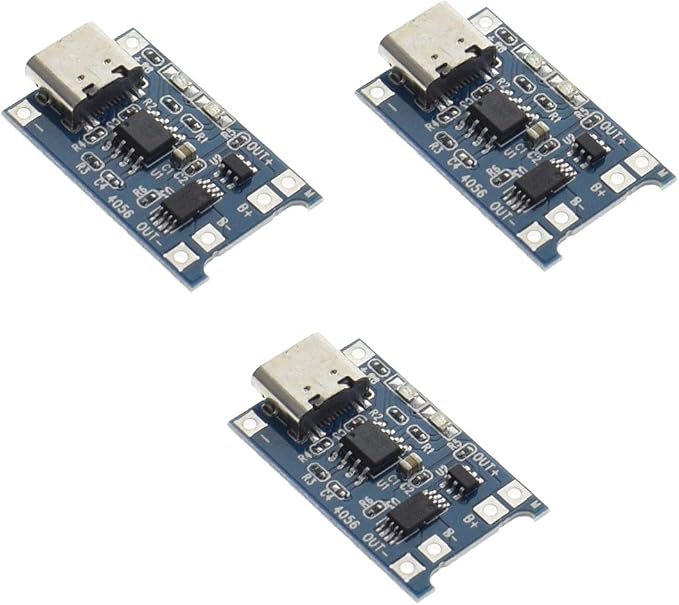
The TP4056 is the module virtually every maker reaches for first — and for good reason. This Type-C version charges a single 3.7V Li-ion/LiPo cell at up to 1A with a clean CC/CV profile and a precise 4.2V cutoff, using red/blue LEDs to show charging and full. Crucially, buy the dual-protection variant (DW01 + FS8205): it adds over-charge, over-discharge, over-current and short-circuit protection so you can safely charge bare 18650s and pouch cells. It’s tiny, sold in cheap multi-packs, and backed by more Arduino/ESP32 tutorials than any other charger. For the vast majority of single-cell projects, this is all you need.
✅ Pros
- Dirt cheap in multi-packs
- Modern USB-C input
- Dual protection for bare cells
- Huge tutorial base
❌ Cons
- Single cell only
- No 5V boost output
- Clone quality varies
🎯 Verdict: The best all-round single-cell charger. Cheap, protected and endlessly documented — start here.
👉 Check Price on Amazon →
🏅 BEST PREMIUM / SOLAR-READY

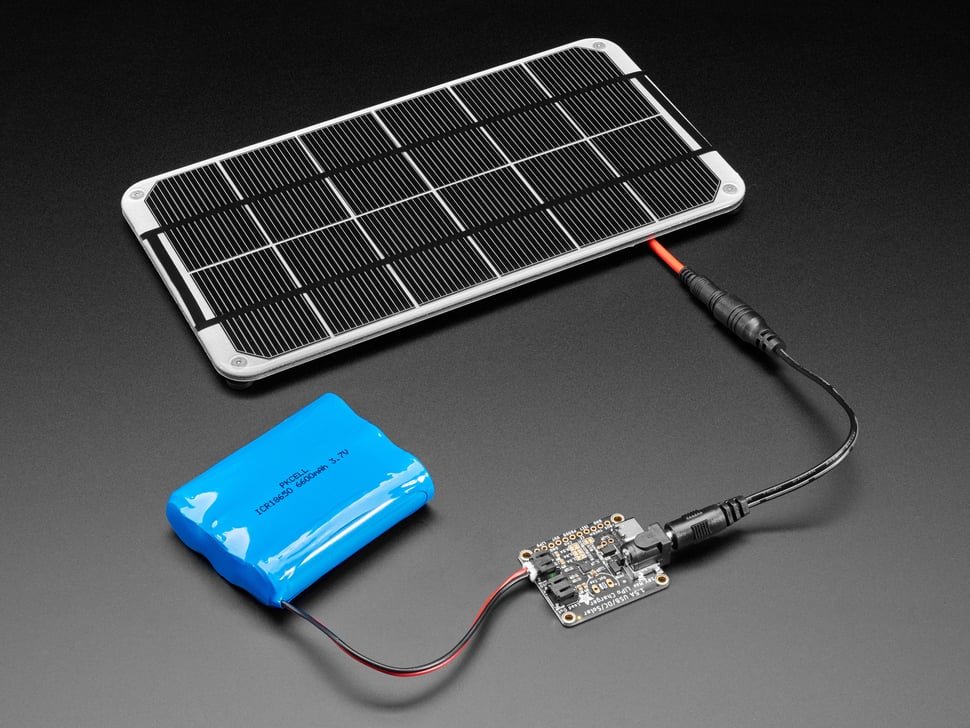
When you need one charger that does everything, the Adafruit bq24074 is the pick. It accepts USB-C, a DC jack or a solar panel across a wide 5–10V input, and its bq24074 chip acts as a near-MPPT tracker — automatically drawing the most current a panel can give in any light. It charges up to 1.5A, and smart load sharing means your project runs off the input when power is present, sparing the battery from needless cycling. The regulated LOAD output never exceeds 4.4V, so it’s safe to feed a 3.3V regulator or 5V boost. It costs more than a TP4056, but for solar and always-on builds it’s in a different league.
✅ Pros
- USB-C, DC & solar input
- Near-MPPT solar tracking
- Load sharing for always-on projects
- Quality build & docs
❌ Cons
- Pricier than clones
- Single cell only
- No onboard 5V boost
🎯 Verdict: The best premium charger for solar and always-on builds. Flexible inputs plus load sharing you won’t outgrow.
👉 Check Price on Amazon →
⚡ BEST FOR 2-CELL PACKS · ⭐ 4.5/53. TP5100 1S/2S Charger
1S/2S · up to 2A · 4.2V/8.4V · 5–18V DC in · buck switch-mode
Buy Here →

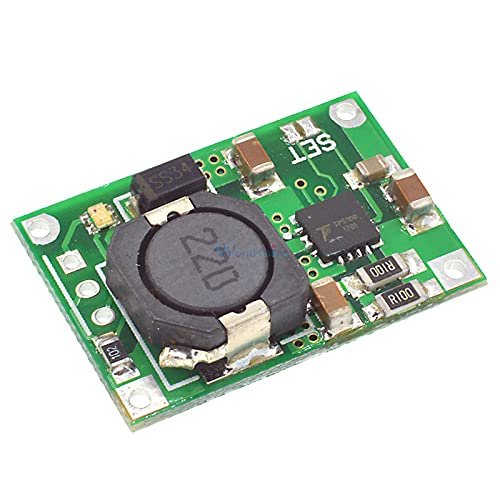
Where the TP4056 stops at one cell, the TP5100 keeps going. This switch-mode buck charger handles both single-cell (4.2V) and 2-cell series (8.4V) packs at up to 2A, taking a wide 5–18V DC input. That makes it the go-to for 2S 18650 packs, small e-bike/tool packs and higher-capacity builds that a 1A linear charger would take all day to fill. Being a buck converter it runs far cooler than a linear charger at 2A, and it includes input over-current/under-voltage, over-temperature, reverse-battery and short-circuit protection.
✅ Pros
- Charges 1S and 2S packs
- Up to 2A, runs cool (buck)
- Wide 5–18V input
❌ Cons
- No USB connector (DC pads)
- Not a per-cell balancer
- No load/boost output
🎯 Verdict: The best low-cost way to fast-charge single or 2-cell packs. Perfect when a TP4056 isn’t enough.
🔧 BEST BALANCE CHARGER · ⭐ 4.7/54. SKYRC iMAX B6AC V2
1–6S LiPo/LiFe/Li-ion · 50W · up to 6A · built-in AC power · cell balancing
Buy Here →

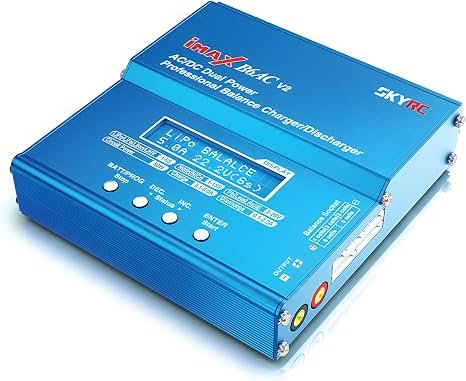
For multi-cell RC packs, a bare charger board won’t cut it — you need balancing, and the SKYRC iMAX B6AC V2 is the classic choice. It charges and balances 1–6S LiPo/LiHV/Li-ion/LiFe packs (plus NiMH/NiCd and Pb) at up to 6A/50W, keeping every cell within millivolts of the others for safety and longevity. The “AC” V2 has the power supply built in, so unlike the DC-only B6 you just plug it into the wall. A backlit LCD walks you through charge, discharge, storage and balance modes with per-cell voltage readouts. It’s overkill for a single 18650, but essential for drone, car and airplane packs.
✅ Pros
- True per-cell balancing 1–6S
- Built-in AC power (V2)
- Storage/discharge modes + LCD
- Handles many chemistries
❌ Cons
- Bulky benchtop unit
- Overkill for single cells
- Watch for counterfeits
🎯 Verdict: The best balance charger for RC and multi-cell packs. If you fly drones or run RC cars, you need one.
🎛️ BEST ADJUSTABLE · ⭐ 4.5/55. SparkFun Adjustable LiPo Charger
1S · MCP73831 · 15–500mA selectable · JST / PTH / coin-cell inputs
Buy Here →

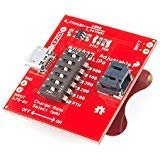
Small cells hate being charged too fast, and that’s exactly where the SparkFun Adjustable LiPo Charger shines. Built around the MCP73831, it lets you dial the charge current from 15mA up to 500mA with onboard switches — so a delicate 100mAh wearable cell gets a gentle 50mA while a bigger cell can take the full 500mA. It accepts a battery via JST, PTH pins or an onboard 2450 coin-cell holder, and powers from micro-USB or input pins. It’s a quality, US-designed board with clear documentation — ideal when you want control rather than a fixed 1A.
✅ Pros
- Selectable 15–500mA current
- JST, PTH & coin-cell inputs
- Quality board + great docs
❌ Cons
- 500mA max (not for big packs)
- Pricier than a TP4056
- Single cell only
🎯 Verdict: The best charger when charge current matters. Perfect for small wearable and coin-cell LiPo builds.
🪶 BEST ULTRA-COMPACT · ⭐ 4.6/56. Adafruit Micro-Lipo Charger
1S · 30×12.5mm · 100mA (switch to 500mA) · micro-USB · JST
Buy Here →
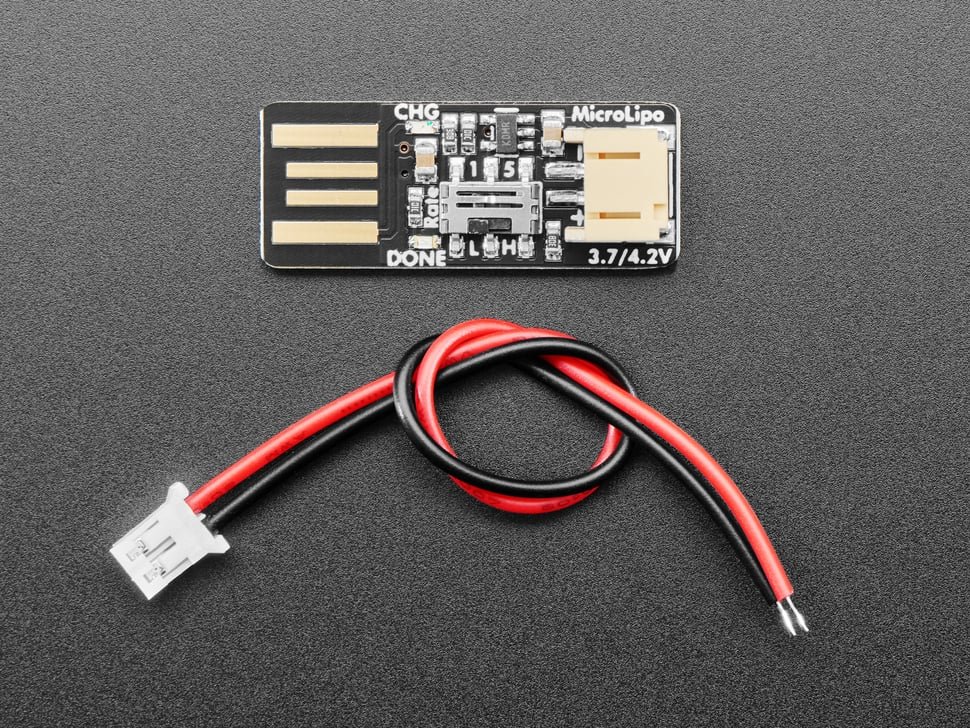
When space is the enemy — think keychains, badges and tiny wearables — the Adafruit Micro-Lipo is the smallest tidy charger around at just 30×12.5mm. It defaults to a safe 100mA (great for the smallest cells) and flips to 500mA with a slide switch when you’re charging a bigger battery. Plug in via micro-USB, connect the cell to the JST port, and the red/green LEDs tell you charging vs. done. It runs a proper three-stage CC/CV charge and comes assembled with a JST cable. It’s single-purpose and low-current, but nothing beats it for slipping a charger into a cramped project.
✅ Pros
- Tiny 30×12.5mm footprint
- Gentle 100mA or 500mA switch
- Assembled with JST cable
❌ Cons
- Older micro-USB input
- 500mA max
- No load/boost output
🎯 Verdict: The best ultra-compact charger. When every millimetre counts, this is the one to embed.
🔌 BEST POWER-BANK BOARD · ⭐ 4.3/57. TP4056 + 5V Boost Module
1S 18650 · ~1A charge + integrated 5V boost output · charge & discharge protection
Buy Here →

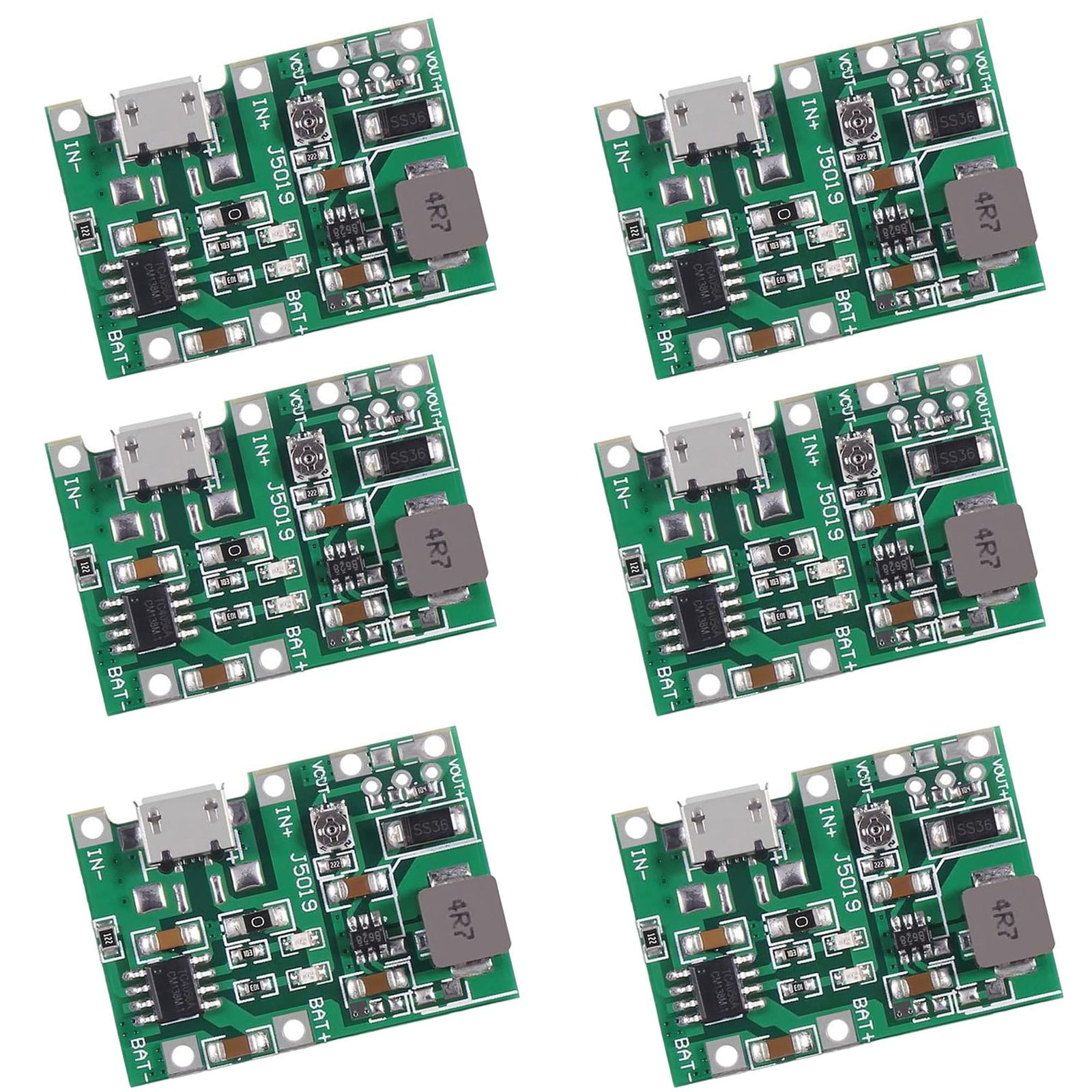
A plain TP4056 charges a cell but can’t power a 5V device — this board fixes that by pairing the TP4056 charger with an integrated DC boost converter that lifts the cell’s 3.7V up to a steady 5V output. That makes it the fastest route to a DIY power bank or a 5V-powered Arduino/ESP project running off a single 18650: charge over USB, draw regulated 5V out, with charge/discharge and reverse-polarity protection built in. LEDs show charging and full. It’s not the highest-current option, but for “charge a cell and get 5V out of one little board,” it’s exactly right.
✅ Pros
- Charge + 5V boost in one
- Ideal for DIY power banks
- Protection built in
❌ Cons
- Boost limited on current
- Single cell only
- Clone quality varies
🎯 Verdict: The best all-in-one for 5V projects. Charge a single cell and get a regulated 5V rail with no extra parts.
☀️ BEST SOLAR / MPPT · ⭐ 4.5/58. DFRobot Solar Power Manager 5V
1S · CN3165 · MPPT · 900mA solar/USB charge · 5V 1A regulated output
Buy Here →

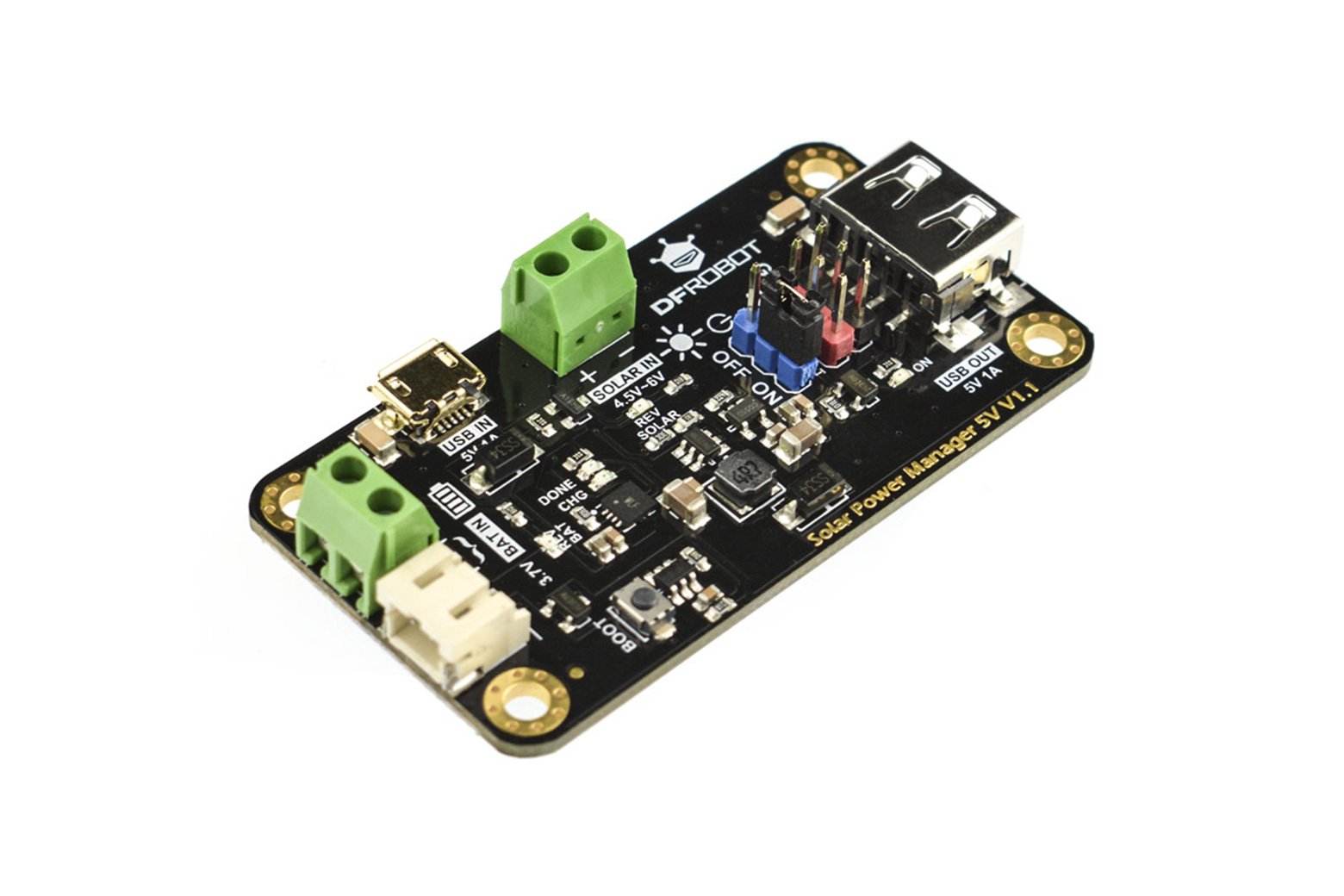
For a self-contained solar node, the DFRobot Solar Power Manager 5V is a tidy, purpose-built board. It uses a CN3165 with a constant-voltage MPPT algorithm to squeeze maximum charge from a 5V panel, topping a 3.7V cell at up to 900mA from solar or USB. Unlike a bare charger, it also provides a switchable, regulated 5V 1A output to run your microcontroller, with full over-charge/over-discharge/over-current, reverse and output protection. It even ships with a heatsink and standoffs. If you’re building a solar-powered weather station or outdoor sensor, this is a cleaner solution than stitching a TP4056 to a boost board.
✅ Pros
- Solar MPPT + USB charging
- Regulated 5V 1A output
- Comprehensive protection
❌ Cons
- Needs a 5V panel (≤10W)
- 900mA charge ceiling
- Larger than a TP4056
🎯 Verdict: The best solar charger for IoT. MPPT charging plus a regulated 5V rail in one outdoor-ready board.
🖥️ BEST RASPBERRY PI UPS · ⭐ 4.4/59. Waveshare UPS Module 3S
3S Li-ion · charge + power simultaneously · 5V 5A output · auto power-fail switchover
Buy Here →

Powering a Raspberry Pi from batteries safely means charging and running the board at the same time — and switching to battery the instant mains drops without rebooting. The Waveshare UPS Module 3S does exactly that: it charges a 3-cell (3S) Li-ion pack while delivering a stiff 5V at up to 5A to your Pi, and seamlessly switches to battery on power loss. It packs multi-cell protection (over-charge/discharge, over-current, short-circuit, reverse) plus balance charging, so a Pi 4/5 stays up through outages. For always-on Pi projects — NAS, cameras, home servers — it’s the reliable choice.
✅ Pros
- Charge + power at once
- Stiff 5V 5A output for Pi
- Auto switchover + balancing
❌ Cons
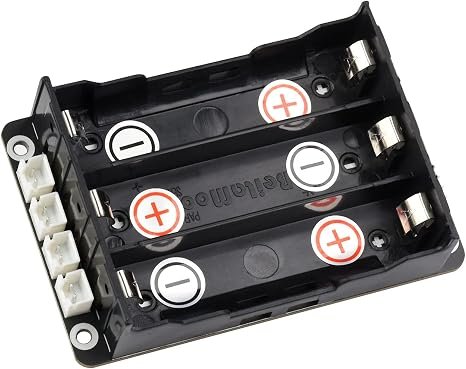
- Needs three 18650 cells (not included)
- Bigger & pricier
- Overkill for simple loads
🎯 Verdict: The best UPS for Raspberry Pi. Uninterrupted 5V power and battery backup in one HAT-friendly board.
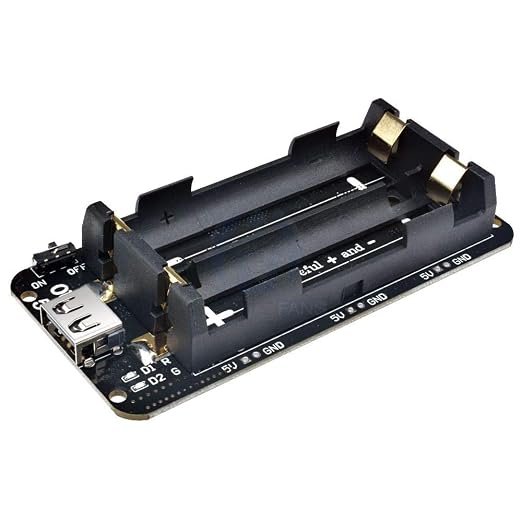
🔋 BEST DEV-BOARD SHIELD · ⭐ 4.3/510. Dual 18650 Battery Shield V8
2× 18650 · charge + 5V/3A & 3V/1A outputs · micro-USB in · USB-A + header pins
Buy Here →

Part charger, part power supply, the Dual 18650 Battery Shield V8 is the easiest way to run an ESP32, ESP8266, Arduino or Pi Zero from cells. Drop two 18650s into the holders, charge them over micro-USB, and draw a regulated 5V (up to 3A) and 3V from the onboard USB-A port and header pins. Two cells in parallel means longer runtime, and the header layout plugs straight into breadboards. It won’t fast-charge (600–800mA input) and it’s a parallel holder, not a balancer, but as a grab-and-go battery base for maker projects it’s superb value.
✅ Pros
- 5V/3A + 3V outputs onboard
- Two cells = long runtime
- Breadboard-friendly pins
❌ Cons
- Slow 600–800mA charging
- Watch cell polarity on insert
- Parallel holder, no balancing
🎯 Verdict: The best plug-and-play battery base for dev boards. Charge two 18650s and power your project at 5V.
🛒 How to Choose the Right LiPo Charger
🔋
Charging one 3.7V cell?
Get the TP4056 Type-C (with protection) — cheap, reliable and endlessly documented. It’s the right answer for 90% of single-cell projects.
☀️
Going solar or always-on?
Choose the Adafruit bq24074 for USB/DC/solar input with load sharing, or the DFRobot Solar Manager 5V for a built-in regulated 5V rail.
⚡
Charging a 2-cell pack?
Use the TP5100 for fast 1S/2S charging at up to 2A. For RC packs of 3–6 cells that need balancing, step up to the iMAX B6AC V2.
🔌
Need 5V out / a power bank?
Pick the TP4056 + Boost board for a single-cell 5V rail, or the Dual 18650 Shield V8 to power dev boards from two cells.
🖥️
Backing up a Raspberry Pi?
The Waveshare UPS Module 3S charges while powering the Pi at 5V/5A and switches to battery instantly on an outage.
🪶
Tiny or wearable build?
The Adafruit Micro-Lipo squeezes into cramped spaces, and the SparkFun Adjustable lets you dial a gentle current for small cells.
⚙️ Key Specs Compared — Side by Side
| Spec | TP4056 Type-C | Adafruit bq24074 | TP5100 | iMAX B6AC V2 | DFRobot Solar 5V |
|---|
| Cells | 1S | 1S | 1S / 2S | 1–6S ⭐ | 1S |
| Max Charge Current | ~1A | 1.5A | 2A ⭐ | 6A (pack) | 900mA |
| Input | USB-C | USB-C/DC/Solar ⭐ | 5–18V DC | AC/DC | Solar/USB |
| 5V Output | No | No (4.4V load) | No | No | 5V 1A ⭐ |
| Cell Balancing | — | — | — | Yes ⭐ | — |
| Solar / MPPT | No | Near-MPPT | No | No | MPPT ⭐ |
| Best For | Everyday single cell | Solar / always-on | 2-cell packs | RC multi-cell | Solar IoT |
Specs are approximate and vary with seller/clone and firmware. Always confirm details on the live Amazon listing.
❓ Frequently Asked Questions
Can I charge a lithium battery directly from an Arduino or USB port?
No — never wire a raw USB 5V or a microcontroller pin straight to a lithium cell. Lithium chemistry needs a controlled constant-current/constant-voltage (CC/CV) charge that ramps current, then holds a precise 4.2V-per-cell cutoff and stops. A dedicated charger IC like the TP4056 or MCP73831 does this for you. Connecting 5V directly will overcharge the cell, causing swelling, venting or fire. Always use a proper charger module, and for bare cells choose one with built-in protection.
Do I need the “with protection” version of the TP4056?
Almost always, yes. The protected TP4056 adds a DW01 + FS8205 circuit that guards against over-discharge, over-current and short circuits on the battery side — critical for bare 18650s and pouch cells that have no internal protection. The only time you can skip it is if your cell already has its own protection PCB built in (many name-brand 18650s do). When in doubt, buy the protected version; the few extra cents can save a cell or prevent a fire.
How do I get 5V for my project from a 3.7V LiPo?
A LiPo cell sits between roughly 3.0V (empty) and 4.2V (full), so you need a boost (step-up) converter to reach a steady 5V. You have two options: pair a plain charger with a separate boost module, or buy an all-in-one board like the TP4056+Boost or the Dual 18650 Shield V8 that charges the cell and outputs a regulated 5V. For projects that run while charging, an integrated board with load sharing (like the bq24074 feeding a boost) avoids constantly cycling the battery.
What’s the difference between a charger and a balance charger?
A single-cell charger tops one cell to 4.2V. A balance charger (like the iMAX B6) is for packs of multiple cells in series (2S–6S), where it monitors and equalises each cell’s voltage through the balance connector during charging. Without balancing, cells in a series pack drift apart, and one can be overcharged while another is undercharged — dangerous and damaging. If you charge RC drone, car or airplane packs, a balance charger isn’t optional; it’s a safety requirement.
What charge current should I use for my battery?
A good default is 0.5C to 1C, where C is the cell’s capacity. A 1000mAh cell can safely take 500mA–1A; a small 150mAh wearable cell wants a gentle 75–150mA. Charging faster than the cell is rated for generates heat and shortens its life, while charging very slowly just takes longer. This is why an adjustable charger like the SparkFun board is handy — you can dial the current to match small cells rather than blasting them with a fixed 1A. Check your cell’s datasheet for its maximum charge rate.
🏁 Final Verdict — Best LiPo Charger for Every Project
The right lithium charger module for every build and budget:
🥇 Best Overall —
TP4056 Type-C1S, ~1A, USB-C, dual protection — the maker default
Buy Here →🏅 Best Premium / Solar —
Adafruit bq24074USB-C/DC/solar, near-MPPT, load sharing, up to 1.5A
Buy Here →⚡ Best for 2-Cell Packs —
TP51001S/2S at up to 2A, cool-running buck charger
Buy Here →🔧 Best Balance Charger —
SKYRC iMAX B6AC V21–6S balancing, 50W, built-in AC — for RC packs
Buy Here →☀️ Best Solar IoT —
DFRobot Solar Manager 5VMPPT charging + regulated 5V 1A output
Buy Here →🖥️ Best Raspberry Pi UPS —
Waveshare UPS Module 3SCharge + power at once, 5V/5A, auto switchover
Buy Here →No single module is right for every build, but every pick here earns its place. For the vast majority of single-cell projects the TP4056 Type-C is the one to buy — cheap, protected and endlessly documented. Reach for the Adafruit bq24074 when you’re going solar or need load sharing; the TP5100 for 2-cell packs; the iMAX B6AC V2 for balancing RC packs; the DFRobot Solar Manager for outdoor IoT; and the Waveshare UPS 3S to keep a Raspberry Pi alive through outages. Pair your charger with our Arduino, ESP32, STM32 and Raspberry Pi tutorials and start building battery-powered projects today.
💬 Not sure which charger fits your project? Tell us what you’re powering — an ESP32 sensor, a wearable, a solar logger, an RC pack or a Raspberry Pi — in the comments below, and we’ll point you to the right module.
All Amazon links above use our affiliate tag (microlab05-20). Purchasing through them supports microcontrollerslab.com at no extra cost to you. Prices and availability change frequently — always confirm the current price on Amazon before buying.