⚠️ Affiliate Disclosure: This post contains Amazon affiliate links. If you purchase through our links, we may earn a small commission at no extra cost to you. We only recommend products we have thoroughly researched and verified.
Ultimate Buying Guide 2026
⚡ Best Power Supplies for Microcontroller Projects
8 power supplies ranked for Arduino, ESP32, STM32 and Raspberry Pi work — from an $8 breadboard module to a programmable triple-output bench unit — with real specs, honest verdicts, and direct Amazon links.
✅ 8 Supplies Reviewed
✅ Verified Amazon ASINs
✅ Updated June 2026
✅ Honest Pros & Cons
A reliable power supply is the quiet workhorse of every microcontroller bench. Your code can be perfect and your wiring flawless, but if the 3.3 V rail sags, the 5 V line is noisy, or a short pulls more current than your supply can deliver, your ESP32 will brown-out and reset, your sensor readings will drift, and you will waste hours chasing a “bug” that is really a power problem. A good adjustable supply with current limiting also protects your boards: dial in a safe current ceiling and a wiring mistake trips the limit instead of frying your project.
The good news is that you do not need a $1,000 lab instrument to power an Arduino. For a few dollars a breadboard module gives you clean 3.3 V and 5 V rails, around $60 buys a real adjustable bench supply with constant-current protection, and a programmable unit for testing and data-logging is now within hobbyist reach. This guide ranks 8 power supplies across every budget and use case — bench supplies, programmable modules, breadboard boards, buck converters, a universal wall adapter and a portable battery — with the specs that actually matter for microcontroller work.
💡 Reality check before you buy: For microcontroller work the headline numbers (60 V! 10 A!) matter less than three things: adjustable current limiting / constant-current mode (so a short trips the limit instead of cooking your board), low ripple and noise (a linear supply like the KORAD reads in the <1 mV range, while cheap switching units sit nearer 30 mV), and the right form factor for how you actually power things. A DC-DC module like the RD6006 is superb value but needs its own input supply, and a breadboard board needs more than 5 V in to give you 5 V out. Match the supply to your bench, not to a spec sheet.
⚡ Quick Comparison — All 8 Power Supplies
| Power Supply | Type | Output | Best For | Price | Buy |
|---|
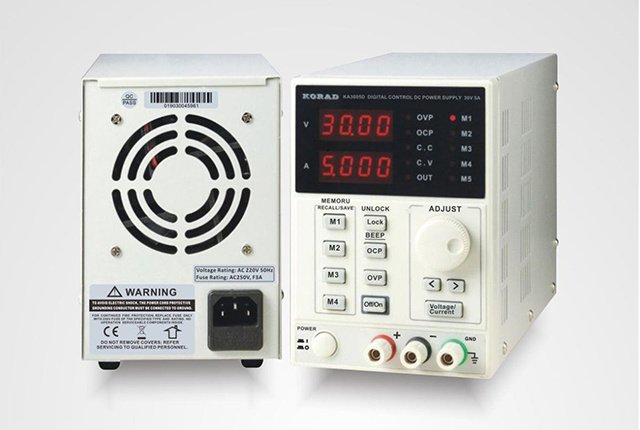
| 🥇 KORAD KA3005D | Linear bench | 0–30V / 0–5A | Best Overall | ~$130 | View → |
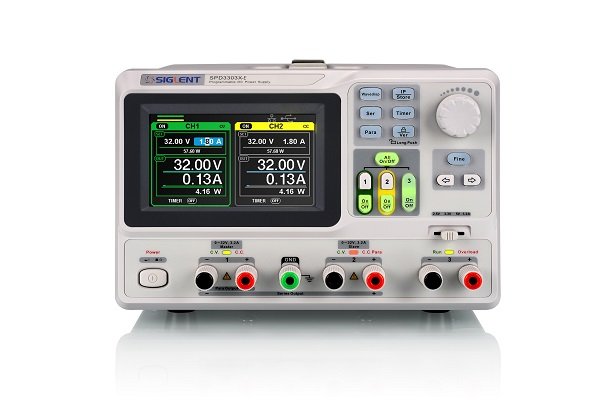
| 🏅 Siglent SPD3303X-E | Programmable, triple | 2×32V/3.2A + 2.5–5V | Best Professional | ~$360 | View → |
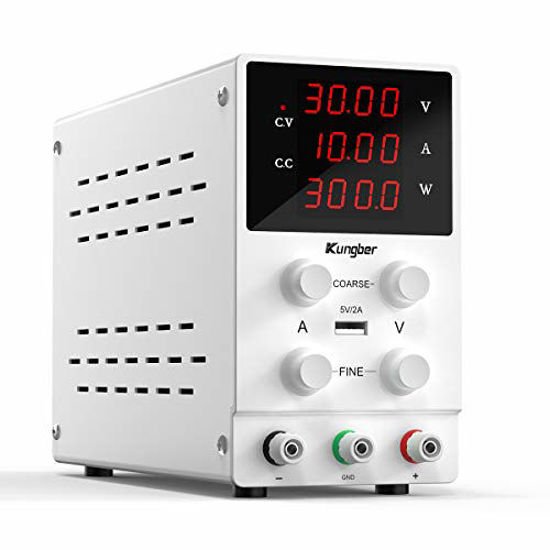
| 💵 Kungber 30V 10A | Switching bench | 0–30V / 0–10A | Best Budget Bench | ~$66 | View → |
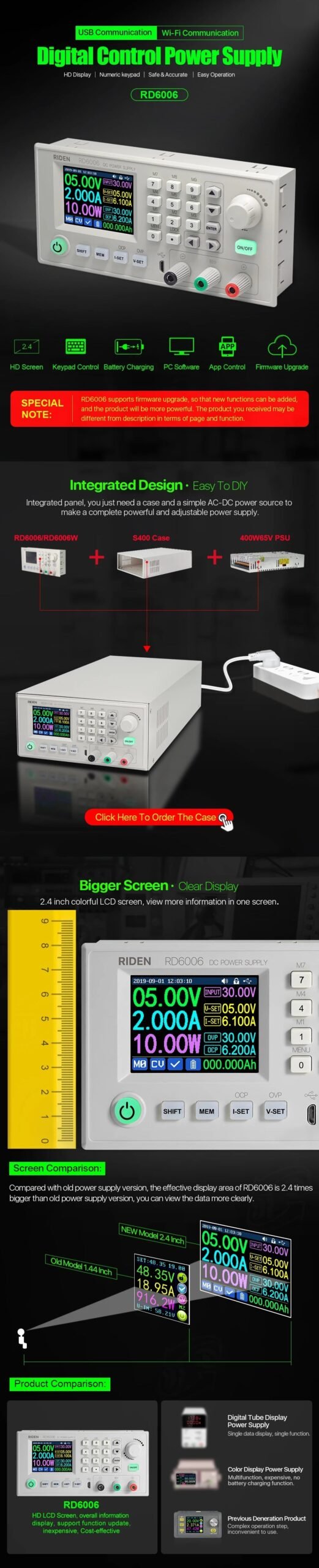
| 🎚️ Riden RD6006 | DC-DC module | 0–60V / 0–6A | Best Programmable Module | ~$58 | View → |
| 🍞 MB102 Breadboard PSU | Breadboard module | 3.3V / 5V | Best for Breadboards | ~$8 | View → |
| 📦 LM2596 Buck Converter | DC-DC step-down | 1.5–35V / ~2A | Best Buck Converter | ~$10 | View → |
| 🔌 SHNITPWR 30W Adapter | AC/DC wall adapter | 3–12V switchable | Best Wall Adapter | ~$17 | View → |
| 🔋 TalentCell 12V 3000mAh | Portable battery | 12V + 5V USB | Best Portable Power | ~$22 | View → |
🔍 What to Look for in a Power Supply for Electronics
🛡️
Current Limiting (CC)
Constant-current mode lets you set a current ceiling. A wiring short then trips the limit instead of frying your MCU — the single most useful safety feature.
〰️
Low Ripple & Noise
Ripple shows up as noise on ADC readings and RF. Linear supplies (≈1 mV) are cleaner than cheap switchers (≈30 mV) for sensitive analog work.
🎛️
Resolution & Readout
10 mV / 1 mA steps and an accurate display let you set rails precisely and read tiny currents — handy for measuring a board’s real draw.
🔢
Voltage & Current Range
0–30 V covers virtually all MCU work; a few amps is plenty unless you drive motors or LED strips. More headroom rarely hurts, but you pay for it.
🔌
Programmability & Presets
Memory presets save your common rails; PC/SCPI control and data-logging matter for repeatable testing and battery-life measurements.
🏆 Detailed Reviews — All 8 Power Supplies

The KORAD KA3005D is the sweet spot for a serious microcontroller bench. It is a fully digital, linear 0–30 V / 0–5 A supply with 10 mV / 1 mA setting resolution and genuinely low ripple (<1 mVRMS), so your ADC readings stay clean. You get true constant-voltage / constant-current operation with adjustable OVP/OCP, five memory presets, output on/off, power-off memory and a panel lock. For anyone debugging Arduino, ESP32 or STM32 boards, the rock-solid CC limiting alone is worth the price — set 100 mA and a short trips the limit instead of cooking your board.
✅ Pros- Clean linear output, <1 mV ripple
- Precise 10 mV / 1 mA control
- Solid CC limiting + adjustable OVP/OCP
- 5 presets, memory, panel lock
❌ Cons- Single output only
- 5 A ceiling — not for big motor banks
- USB/programmable needs the KA3005P
🎯 Verdict: The best all-round bench supply for makers. Clean, precise and protective — the one to buy if you want a do-everything lab supply at ~$130.
👉 Check Price on Amazon: amazon.com/dp/B0084JFWNY
🏅 Best Professional
Siglent SPD3303X-E
⭐⭐⭐⭐⭐ 4.8/5 · The Lab Standard
Buy on Amazon →

The Siglent SPD3303X-E is the step up for anyone who designs mixed-signal hardware. Its three isolated outputs — two adjustable 0–32 V / 3.2 A channels plus a selectable 2.5/3.3/5 V rail — let you power an analog supply, a digital rail and a logic level at the same time, and the channels can run independent, series or parallel. A 4.3″ TFT shows live readouts, you get five memory presets, a timing-output function, and full PC control via Easypower/SCPI with LabVIEW drivers for automated testing. It is overkill for a single Arduino, but for dual-rail op-amp boards, programmable test rigs and serious development it is a joy.
✅ Pros- Triple isolated output (dual-rail + logic)
- Independent / series / parallel modes
- SCPI + LabVIEW programmable
- Big TFT, presets, quiet smart fan
❌ Cons- ~$360 — the priciest pick here
- Heavy (≈20 lb) and large
- Overkill for simple 5 V projects
🎯 Verdict: The professional’s choice. If you design dual-rail or mixed-signal hardware, or need programmable, repeatable testing, the SPD3303X-E earns its premium.
👉 Check Price on Amazon: amazon.com/dp/B0B59DV77W
💵 Best Budget Bench · ⭐ 4.5/5
3. Kungber 30V 10A
Switching · 0–30V / 0–10A · 0.01V/0.01A · 5V/2A USB · ~$66

If you want a real adjustable bench supply for the least money, the Kungber 30V 10A is the internet’s default budget pick. You get 0–30 V and a generous 0–10 A, 0.01 V / 0.01 A resolution on a backlit 4-digit display, automatic CV/CC switching, coarse-and-fine knobs and a 5 V/2 A USB port, plus the usual short-circuit and thermal protections. The honest trade-off: it is a switching supply, so ripple (~30 mV) is higher than a linear KORAD — fine for powering boards, motors and LED strips, less ideal for ultra-low-noise analog.
✅ Pros: Up to 10 A; CV/CC; fine+coarse knobs; 5V USB; very cheap.
❌ Cons: Switching ripple ~30 mV; basic build; no presets/PC control.
🎯 Verdict: The most current per dollar. A brilliant first bench supply if you need high output cheaply and can live with switching noise.
👉 amazon.com/dp/B08DJ1FDXV
🎚️ Best Programmable Module · ⭐ 4.6/5
4. Riden RD6006
DC-DC buck · in 6–70V · out 0–60V / 0–6A / 360W · PC app · ~$58

The Riden RD6006 packs astonishing capability into a tiny module: 0–60 V / 0–6 A (360 W), a 2.4″ color display, a full keypad and rotary encoder, capacity/energy logging, adjustable cut-off current/temperature, and USB PC software for remote control and graphing. Voltage accuracy is a tight ±0.3%. The one big caveat for newcomers: it is a DC-DC buck module, not a complete supply — you must feed it 6–70 V from your own brick or supply, and it can only step that input down. Pair it with a 24 V laptop-style adapter and you have a programmable lab supply for a fraction of the usual cost.
✅ Pros: Programmable + data logging; color screen; keypad+encoder; huge 60V/6A range; superb value.
❌ Cons: Needs a separate input supply; buck-only (can’t boost); ~100 mV ripple; some assembly.
🎯 Verdict: The smartest budget upgrade. Add your own input brick and you get programmable, logging-capable lab power for ~$58.
👉 amazon.com/dp/B08N62ZTYF
🍞 Best for Breadboards · ⭐ 4.6/5
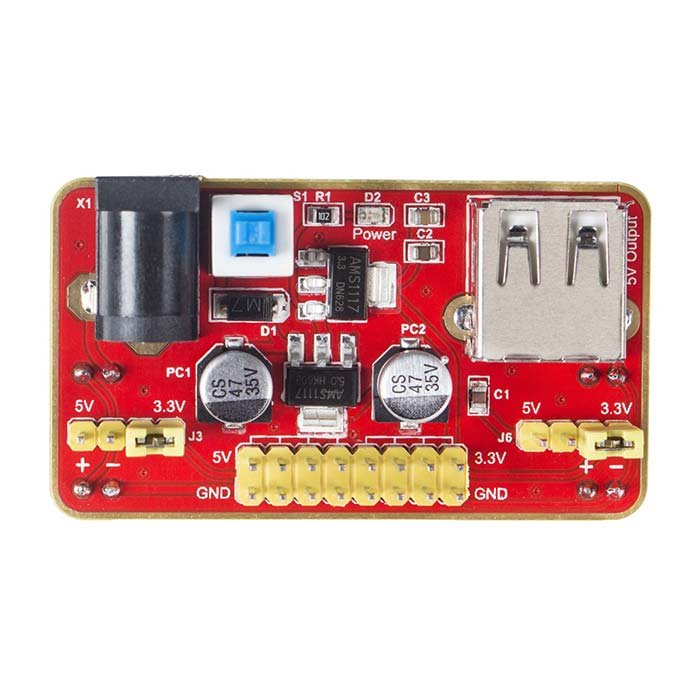
5. MB102 Breadboard Power Supply (3-pack)
In 6.5–12V or USB · dual rails 3.3V/5V · 700mA · ~$8

For breadboard prototyping nothing beats the humble MB102. It clips straight onto the power rails of a standard breadboard and delivers selectable 3.3 V or 5 V on each side (each rail switchable to 0 V/3.3 V/5 V independently), with a USB-A 5 V output to power a dev board and an on-board switch and LED. Feed it 6.5–12 V via the barrel jack or USB. Output is a modest 700 mA, so it is for logic and sensors, not motors — and note it needs more than 5 V in to give a clean 5 V out. At a few dollars for a 3-pack, every maker should own a handful.
✅ Pros: Plugs into the breadboard; dual 3.3/5V rails; USB out; switch+LED; dirt cheap multipack.
❌ Cons: Only 700 mA; needs >6.5V input for 5V out; no current limiting; basic regulators.
🎯 Verdict: The instant breadboard rail. Indispensable for prototyping 3.3 V and 5 V logic — buy a multipack and never be without one.
👉 amazon.com/dp/B07S4G1YVY
📦 Best Buck Converter · ⭐ 4.5/5
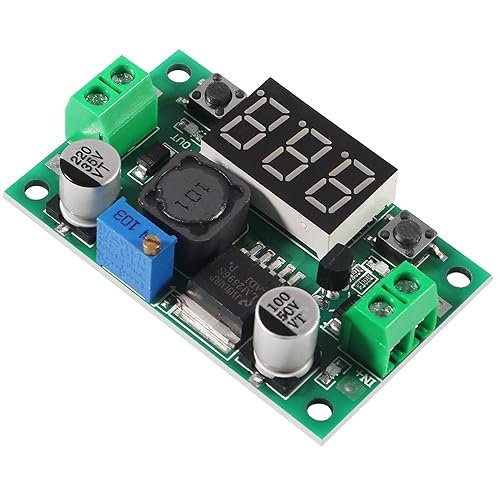
6. LM2596 Buck Converter (5-pack)
In 3–40V · out 1.5–35V adj · ~2A cont. · ~92% eff · ~$10

When you need a fixed rail inside a project — say 5 V from a 12 V battery, or 3.3 V for a sensor — the classic LM2596 buck converter is the answer. Input 3–40 V, output adjustable 1.5–35 V via the on-board trimmer, around 92% efficient. The chip is rated 3 A but realistically you want a heatsink above ~2 A and to keep continuous draw nearer 2 A. There is no current limiting and you set the output by turning a tiny pot with a meter attached, so it is a build-it-in part rather than a bench tool — but at ~$2 each in a 5-pack, it is the cheapest way to get a custom rail anywhere in your design.
✅ Pros: Tiny & cheap; wide 3–40V input; ~92% efficient; perfect for embedding a rail in a project.
❌ Cons: No current limiting; trimmer set by hand; needs heatsink near 3 A; buck-only.
🎯 Verdict: The build-it-in workhorse. Not a bench supply, but the go-to module for creating custom rails inside battery and embedded projects.
👉 amazon.com/dp/B0D4HQ48H3
🔌 Best Wall Adapter · ⭐ 4.4/5
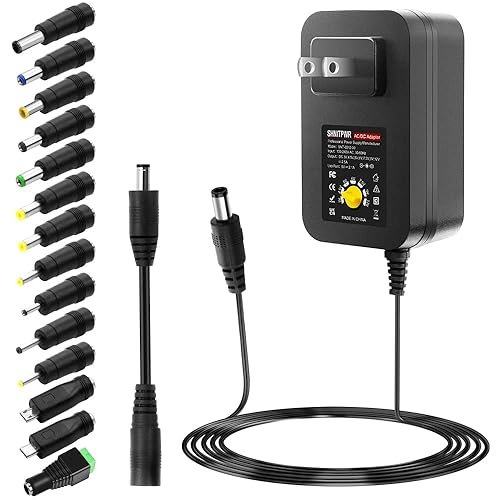
7. SHNITPWR 30W Universal Adapter
AC→3/4.5/5/6/7.5/9/12V · 2.5A/30W · 5V/2.1A USB · 14 tips · ~$17
Once a project leaves the bench it needs a tidy way to run off mains — and the SHNITPWR 30W universal adapter is perfect for that. A switch selects 3, 4.5, 5, 6, 7.5, 9 or 12 V at up to 2.5 A (30 W), there is a separate 5 V/2.1 A USB port, and it ships with 14 interchangeable barrel tips plus a screw-terminal connector so you can wire it to almost anything without soldering. It is regulated with overload, over-voltage, thermal and short-circuit cut-offs. It is not a precision lab supply and has no current limiting, but as a “power my finished MCU board from the wall” adapter it is unbeatable value.
✅ Pros: 7 switchable voltages; 5V USB; 14 tips + screw connector; regulated & protected; cheap.
❌ Cons: Not adjustable beyond fixed steps; no current limiting; not for precision/analog work.
🎯 Verdict: The deploy-it adapter. The simplest, cheapest way to power a finished single-board project from mains at the right voltage.
👉 amazon.com/dp/B08BL5Y9ZM
🔋 Best Portable Power · ⭐ 4.5/5
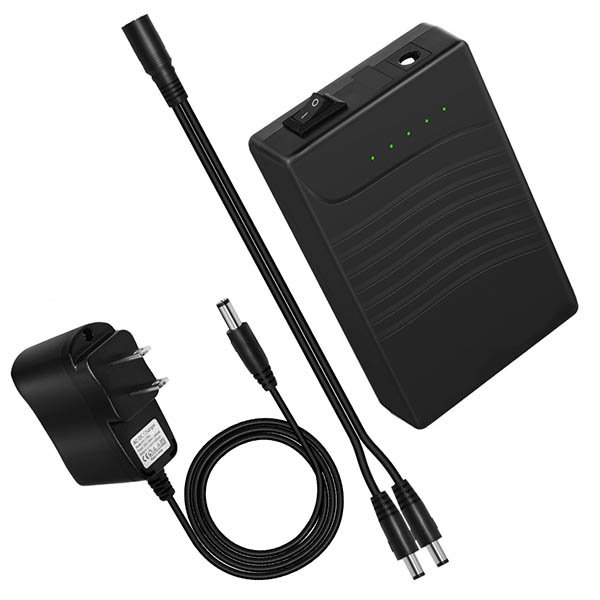
8. TalentCell 12V 3000mAh
12V (9–12.6V)/3A + 5V USB · charger included · ~190g · ~$22

For field projects, robots and remote sensor nodes you need power without a wall socket, and the TalentCell 12V 3000mAh is the maker favourite. It offers a 12 V barrel output (a real 9–12.6 V as it discharges) at up to 3 A and a separate 5 V USB output, a 5-LED fuel gauge, and over-charge/discharge/short-circuit protection — and the AC charger plus a 1-to-2 splitter cable are included. At ~190 g it tucks into any enclosure. Pair it with a buck converter or the MB102 and you have clean portable rails for an ESP32 or Arduino anywhere.
✅ Pros: 12V + 5V USB dual output; charger & splitter included; LED gauge; protected; light & compact.
❌ Cons: 12V rail droops to 9V as it drains; 3000 mAh is modest; pair with a regulator for fixed rails.
🎯 Verdict: The go-anywhere battery. The simplest way to take a 12 V or 5 V microcontroller project off-grid for hours.
👉 amazon.com/dp/B01M7Z9Z1N
🛒 How to Choose the Right Power Supply
🏆
Want the Best All-Rounder?
Get the KORAD KA3005D. Clean linear 0–30V/5A, precise control and solid current limiting — the complete maker bench supply at ~$130.
💎
Designing Mixed-Signal?
The Siglent SPD3303X-E gives you three isolated outputs and full SCPI programmability — ideal for dual-rail and automated testing.
💵
On a Tight Budget?
The Kungber 30V 10A (~$66) is a real adjustable bench supply for the price of a cable, or add an input brick to the RD6006 for programmable power.
🍞
Just Prototyping?
Clip an MB102 onto your breadboard for instant 3.3V/5V rails, and keep a strip of LM2596 modules for custom in-project rails.
🔌
Deploying a Finished Board?
The SHNITPWR universal adapter (~$17) powers it from mains at the exact voltage, with the right tip for any jack.
🌲
Going Portable?
The TalentCell 12V 3000mAh battery powers field projects with 12V and 5V outputs and a charger in the box.
⚡ Key Specs Compared — Side by Side
| Spec | KA3005D | SPD3303X-E | Kungber | RD6006 | MB102 | TalentCell |
|---|
| Type | Linear bench | Programmable | Switching | DC-DC module | Breadboard | Battery |
| Voltage | 0–30V | 0–32V ×2 ⭐ | 0–30V | 0–60V ⭐ | 3.3/5V | 12V |
| Max Current | 5A | 3.2A ×3 | 10A ⭐ | 6A | 700mA | 3A |
| Ripple | <1mV ⭐ | Low (linear) | ~30mV | ~100mV | n/a | n/a |
| CC Limiting | ✅ | ✅ | ✅ | ✅ | ❌ | ❌ |
| Programmable | ❌ | ✅ SCPI ⭐ | ❌ | ✅ (USB) | ❌ | ❌ |
| Self-contained | ✅ | ✅ | ✅ | ❌ needs input | needs 6.5–12V | ✅ ⭐ |
| Price | ~$130 | ~$360 | ~$66 | ~$58 | ~$8 ⭐ | ~$22 |
❓ Frequently Asked Questions
Do I really need a bench power supply, or can I just use USB?
USB from your PC is fine for many 5 V projects, but it can’t change voltage, has no current limiting, and a short can damage your USB port. A bench supply lets you set any voltage, cap the current so a mistake trips the limit instead of frying your board, and read exactly how much your project draws. If you build regularly, the KORAD KA3005D or the budget Kungber pays for itself the first time it saves a board.
What does “constant current” (CC) mode actually do?
You set a maximum current; while the load draws less, the supply holds your voltage (CV mode). If the load tries to draw more — a short, a reversed part, an over-driven motor — the supply caps the current and drops the voltage instead, protecting both your project and itself. Setting a sensible CC limit (e.g. 100–200 mA when first powering a new board) is the single best habit for protecting microcontrollers.
Linear or switching — which is better for microcontrollers?
For digital logic, either works. Linear supplies like the KORAD have far lower ripple/noise (<1 mV vs ~30 mV) and run cooler electrically, which matters for sensitive analog, ADC and RF work. Switching supplies like the Kungber are cheaper, lighter and deliver more current. If you do precision analog, choose linear; if you just need lots of cheap amps for motors and strips, switching is fine.
The RD6006 looks amazing and cheap — what’s the catch?
It is a DC-DC module, not a complete supply: you must provide a 6–70 V input (a laptop-style 24 V brick is popular) and it can only step that voltage down, never up. Factor in an input supply and a case and you still get programmable, logging-capable lab power for well under $100 — just know it isn’t plug-and-play out of the box like the KORAD or Siglent.
How many volts and amps do I need for Arduino/ESP32 projects?
Most MCU work lives between 3.3 V and 12 V and draws well under 1 A — an ESP32 peaks around 0.5 A on Wi-Fi transmit. A 0–30 V, 3–5 A supply covers essentially everything, with headroom for sensors, small motors and LED strips. You only need 10 A (Kungber) if you drive motor banks or long LED strips; for pure logic, even a breadboard MB102 at 700 mA is plenty.
🏁 Final Verdict — Our Top Picks
🎯 Best Pick for Every Budget
🥇 Best Overall — KORAD KA3005D: clean linear 0–30V/5A with precise CC limiting, ~$130Buy → 💎 Best Professional — Siglent SPD3303X-E: triple output + SCPI programmableBuy → 💵 Best Budget Bench — Kungber 30V 10A: a real adjustable supply for ~$66Buy → 🎚️ Best Programmable Module — Riden RD6006: lab features for ~$58 (add input)Buy → 🍞 Best for Breadboards — MB102: instant 3.3V/5V rails, ~$8 for a 3-packBuy → 🔋 Best Portable Power — TalentCell 12V 3000mAh: 12V + 5V off-grid, ~$22Buy → No single power supply does everything, but every pick here will make your microcontroller work safer and less frustrating. For most makers the KORAD KA3005D is the supply to buy — clean linear power, precise control and the current limiting that saves boards. If money is tight, the Kungber 30V 10A or an RD6006 module gives you real adjustable power for a fraction of the cost, while an MB102 and a strip of LM2596 modules handle everyday prototyping for pocket change. Pair your new supply with our embedded and electronics tutorials and put it to work right away.
💬 Not sure which power supply fits your projects? Tell us what you’re building in the comments below — we read and reply to every question.
All Amazon links above use our affiliate tag. Purchasing through them supports microcontrollerslab.com at no extra cost to you. Prices and availability change frequently — always confirm the current price on Amazon before buying.