⚠️ Affiliate Disclosure: This post contains Amazon affiliate links. If you purchase through our links, we may earn a small commission at no extra cost to you. We only recommend products we have thoroughly researched and verified. Prices shown are approximate and change frequently — always confirm the live price on Amazon before buying.
Ultimate Buying Guide 2026
〰️ Best Function & Signal Generators for Electronics Labs
8 function/arbitrary waveform generators ranked for hobbyists, students and pro benches — from a ~$106 dual-channel DDS to a 16-bit TrueArb lab generator — with real specs, honest verdicts, and direct Amazon links.
✅ 8 Generators Reviewed
✅ Verified Amazon ASINs
✅ Updated June 2026
✅ Honest Pros & Cons
A function generator (or signal generator) is one of the three instruments — alongside a power supply and an oscilloscope — that turn a hobby bench into a real electronics lab. It lets you inject a clean, precisely controlled sine, square, triangle, pulse or arbitrary waveform into a circuit so you can test amplifiers, filters, sensors, ADCs, microcontroller inputs and RF stages, then watch exactly how they respond on your scope. Nothing teaches signal-chain debugging faster than being able to drive a circuit and see what comes out.
The tricky part is matching the instrument to your work. A true benchtop arbitrary waveform generator (Rigol, Siglent) gives you low jitter, deep memory and remote control, while an affordable DDS signal generator (Koolertron, OWON, Seesii) covers everyday audio, MCU and hobby RF testing for a fraction of the price. This guide ranks 8 function and signal generators across every budget — beginner to professional — on the specs that actually matter: bandwidth, channels, sample rate, vertical resolution and waveform quality.
💡 Reality check before you buy: The headline “60MHz” almost always refers to the sine wave only — square, pulse and arbitrary waveforms usually top out far lower (often 10–25MHz), so don’t buy on the big number alone. Budget DDS units skimp on shielding and bundled software (the included PC apps are frequently clunky), and most do not ship with BNC test leads. If you need clean pulses, low jitter and trustworthy remote control, step up to a real benchtop generator. Match the bandwidth to your actual signals — for audio, sensors and MCU work, even a 15MHz unit is plenty.
〰️ Quick Comparison — All 8 Function/Signal Generators
| Generator | Type | Bandwidth / Ch | Sample Rate | Best For | Price* | Buy |
|---|
| 🥇 Rigol DG1022Z | Benchtop AWG | 25MHz · 2-ch | 200 MSa/s | Best Overall | ~$311 | View → |
| 🏅 UNI-T UTG962E | Portable AWG | 60MHz · 2-ch | 200 MSa/s | Best 60MHz Portable | ~$175–219 | View → |
| 💵 OWON DGE2070 | Desktop AWG | 70MHz · 2-ch | 300 MSa/s | Best Dual-Channel Value | ~$169 | View → |
| 📻 OWON DGE1060 | Desktop AWG | 60MHz · 1-ch | 300 MSa/s | Best for Radio / RF | ~$118 | View → |
| 🎓 Koolertron 15MHz | DDS | 15MHz · 2-ch | 200 MSa/s | Best for Beginners | ~$119 | View → |
| 🧰 Koolertron 30MHz | DDS | 30MHz · 2-ch | 200 MSa/s | Best Mid-Range DDS | ~$107 | View → |
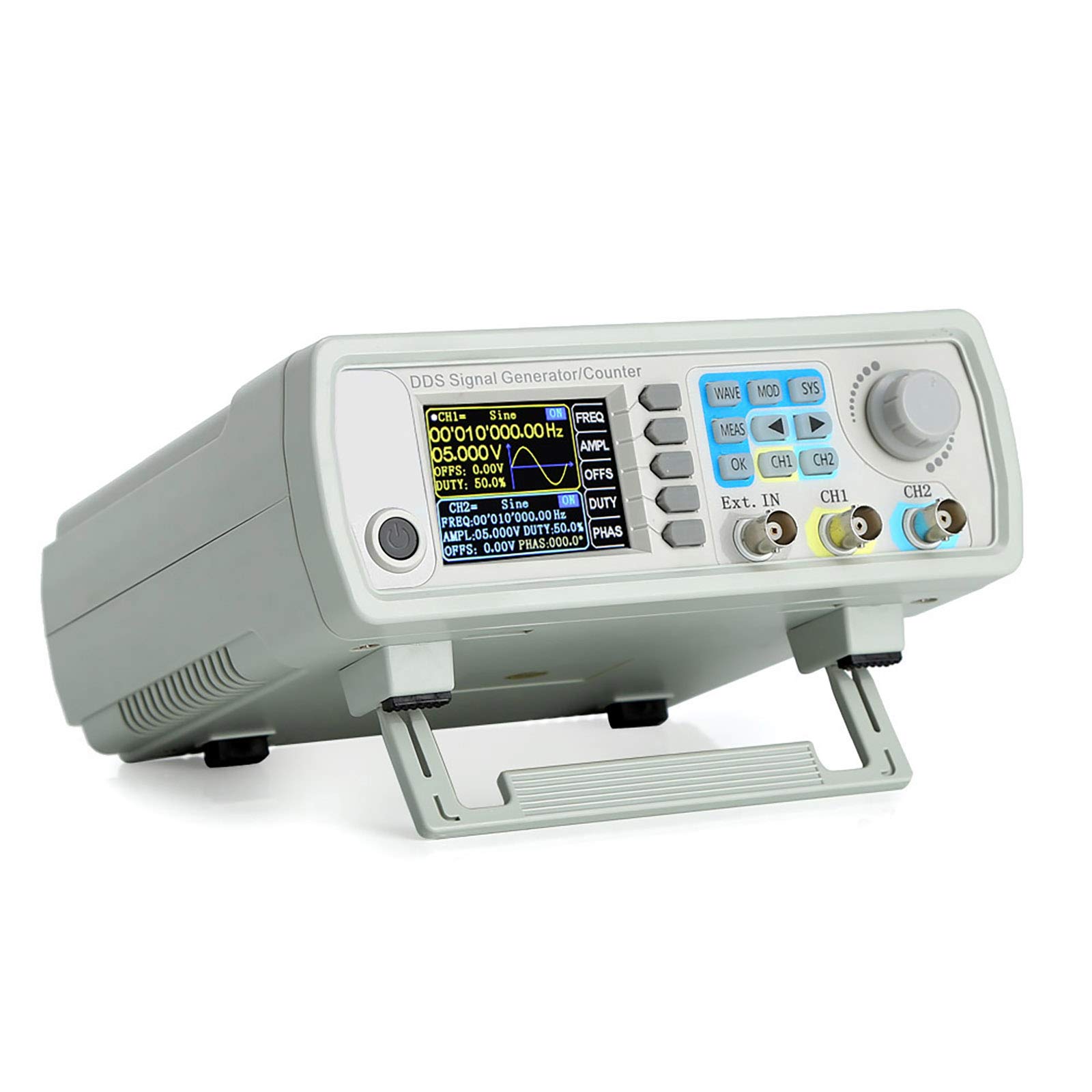
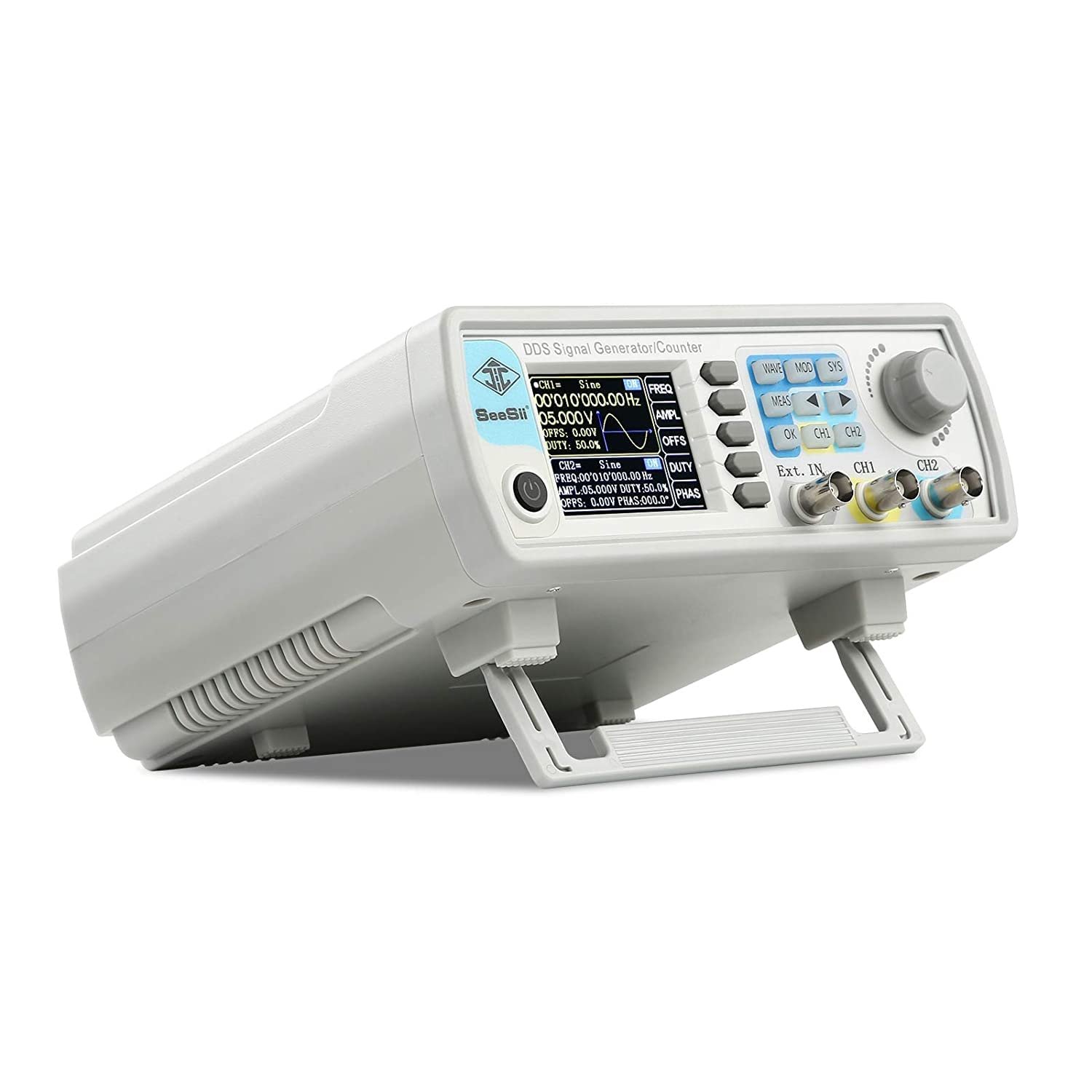
| 💲 Seesii FG-615 | DDS | 15MHz · 2-ch | 200 MSa/s | Best Ultra-Budget | ~$106 | View → |
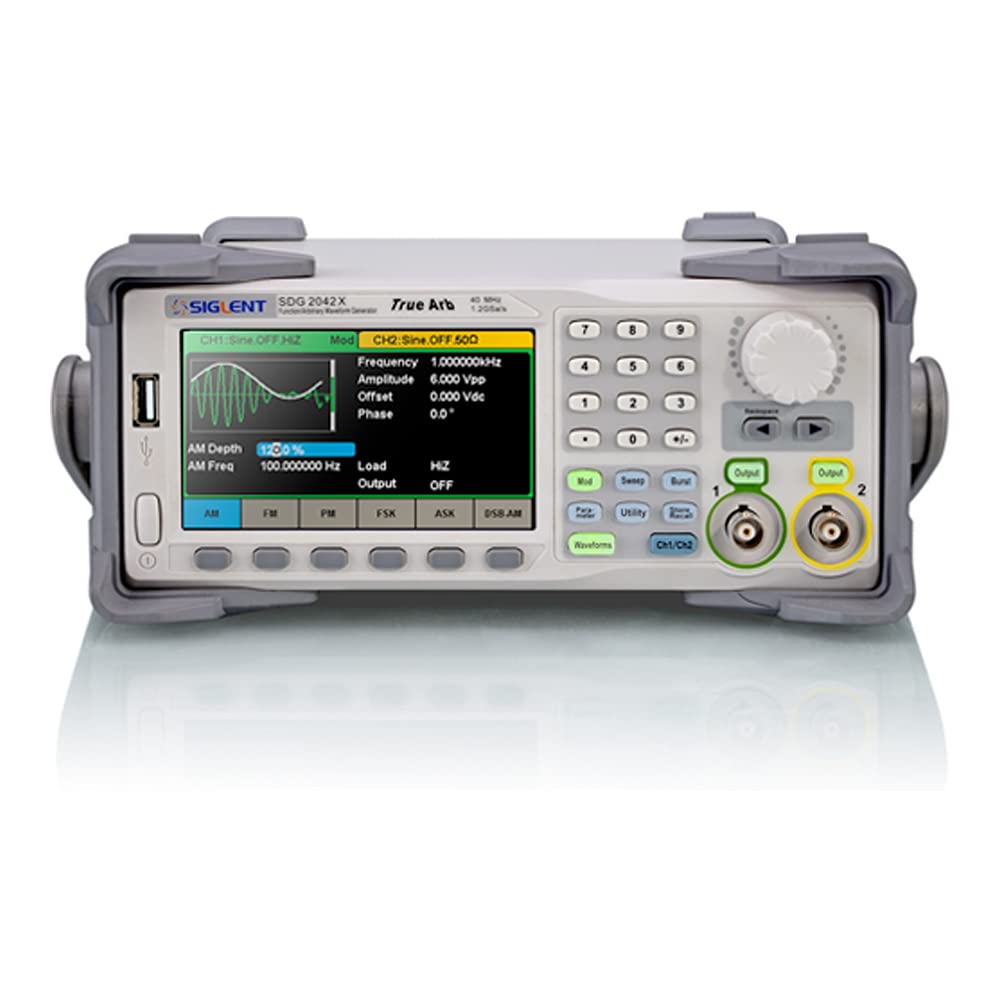
| 🏆 Siglent SDG2042X | Pro AWG | 40MHz · 2-ch | 1.2 GSa/s | Best Professional | ~$574 | View → |
*Approximate Amazon prices at time of writing. Prices and availability change frequently — always confirm the current price on Amazon before buying.
🔍 What to Look for in a Function/Signal Generator
📶
Bandwidth (per waveform)
The “MHz” rating is the max sine frequency. Square, pulse and arbitrary waveforms are usually limited much lower. Check the spec table for the waveform you actually use.
🔀
Channels & Phase
Two channels let you create phase-shifted, I/Q or quadrature signals and simulate encoders. Independent dual outputs are standard now — single-channel units cost less.
⚡
Sample Rate & Resolution
Higher sample rate (MSa/s–GSa/s) and 14–16-bit vertical resolution mean cleaner, lower-distortion arbitrary waveforms and finer amplitude steps.
🎛️
Modulation & Sweep
AM/FM/PM/FSK, sweep and burst turn a basic generator into a real test tool for RF, comms and frequency-response work. Almost every pick here covers the basics.
🔌
Remote Control (SCPI)
USB/LAN with SCPI and LabVIEW support lets you automate tests and build a Bode plotter with a matching scope. A must for repeatable, scripted measurements.
🏆 Detailed Reviews — All 8 Function/Signal Generators
🥇 BEST OVERALL

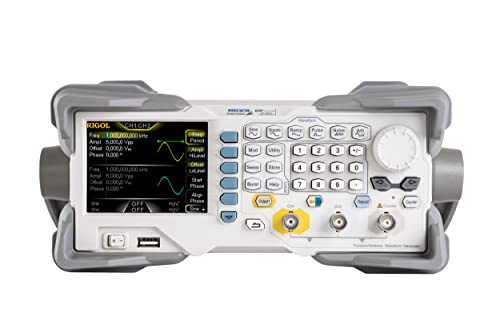
The Rigol DG1022Z is the generator we recommend to anyone who wants a real instrument rather than a hobby box. Rigol’s SiFi (Signal Fidelity) architecture builds each waveform point-by-point for low jitter and clean edges, and you get two fully independent channels, a built-in 8-order harmonics generator, a 200MHz frequency counter and a deep 8 Mpts arbitrary memory. It’s the most “lab-grade” experience you can get near $300, with the reliability and documentation Rigol is known for.
✅ Pros- SiFi engine — low jitter, clean signals
- Deep 8 Mpts arb memory
- Harmonics generator + 200MHz counter
- Trusted brand, great docs & support
❌ Cons- Pricier than DDS clones
- 25MHz ceiling (sine)
- No test leads included
🎯 Verdict: The best all-round generator. If you want one instrument that will still satisfy you in five years, buy the DG1022Z.
👉 Check Price on Amazon →
🏅 BEST 60MHz PORTABLE

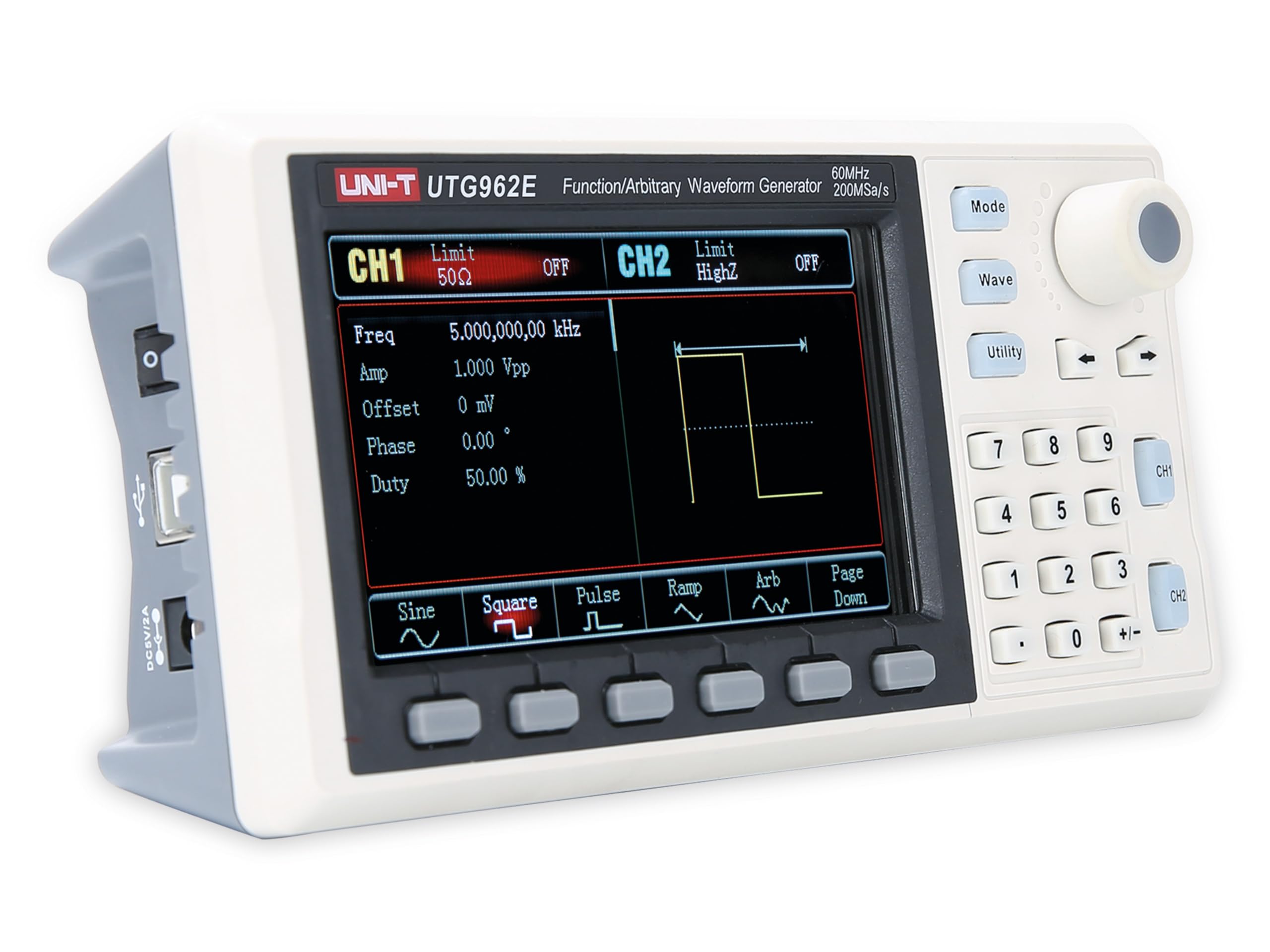
The UNI-T UTG962E packs a genuine 60MHz dual-channel arbitrary waveform generator into a palm-sized case with a gorgeous 4.3-inch TFT display — easier to read than most units twice its size. You get 200 MSa/s, 14-bit resolution, 1 µHz frequency resolution, AM/FM/PM/FSK modulation and sweep, all for well under the price of a benchtop Rigol. It’s the pick if you want serious bandwidth and a great screen without giving up bench space.
✅ Pros- True 60MHz, dual channel
- Large, crisp 4.3″ display
- Compact & light — moves easily
- Ships with BNC cables & adapter
❌ Cons- PC software is clunky
- Only 24 arb waveform slots
- No frequency counter
🎯 Verdict: The best high-bandwidth generator you can put almost anywhere. Ideal for RF and amplifier work on a crowded bench.
👉 Check Price on Amazon →
💵 BEST DUAL-CHANNEL VALUE · ⭐ 4.5/53. OWON DGE2070
70MHz · 2-ch · 300 MSa/s · 14-bit · SCPI + LabVIEW · ~$169
Buy →

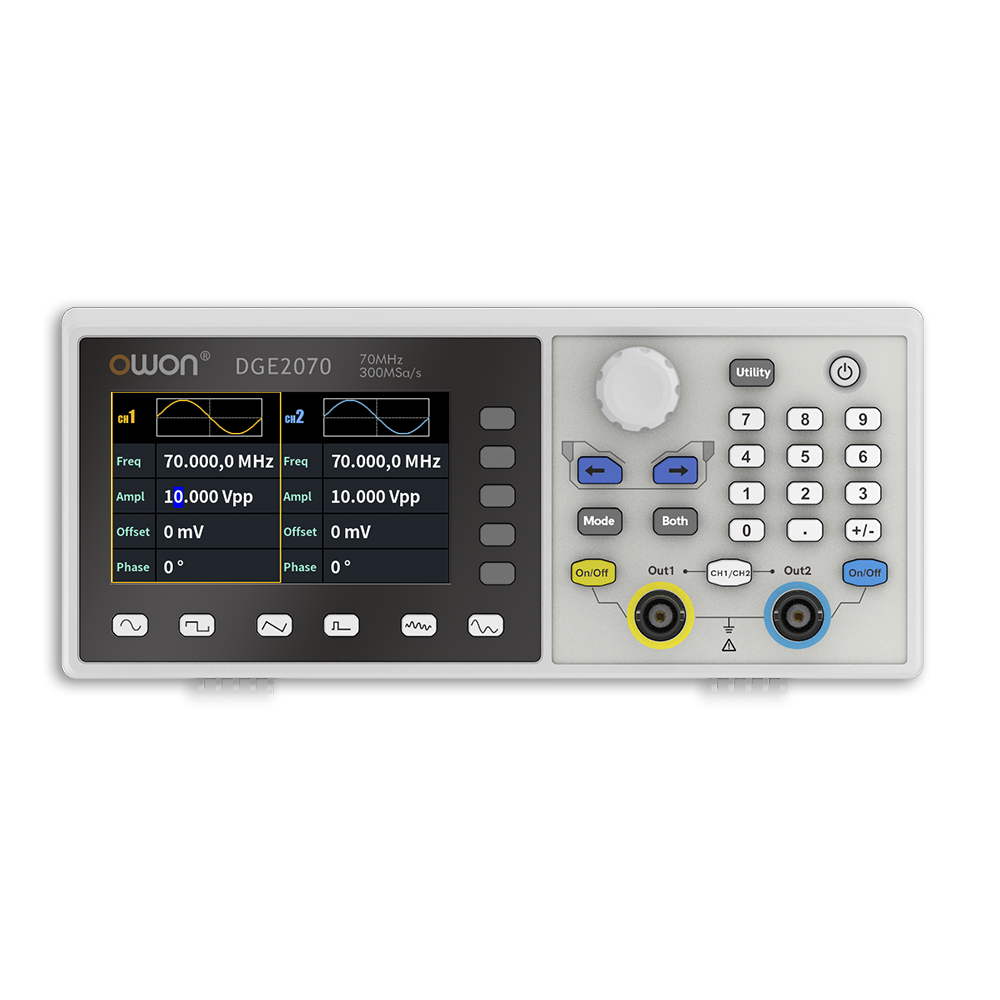
The OWON DGE2070 is the sweet spot for makers who want maximum capability per dollar: two channels, the highest sine bandwidth in this guide at 70MHz, 300 MSa/s, 14-bit resolution and 8K arbitrary memory — plus full SCPI and LabVIEW remote control for automated testing. At around $169 it undercuts every benchtop here while keeping the features that matter for sweep, burst and frequency-response work.
✅ Pros: Highest 70MHz bandwidth here; 300 MSa/s + 14-bit; SCPI/LabVIEW automation; great price.
❌ Cons: Square only to 20MHz; no built-in counter; basic 3.6″ LCD.
🎯 Verdict: The best dual-channel value. If you want bench-class specs and PC automation without the bench-class price, this is the one.
📻 BEST FOR RADIO / RF · ⭐ 4.4/54. OWON DGE1060
60MHz · 1-ch · 300 MSa/s · 14-bit · 160 arb waveforms · ~$118
Buy →

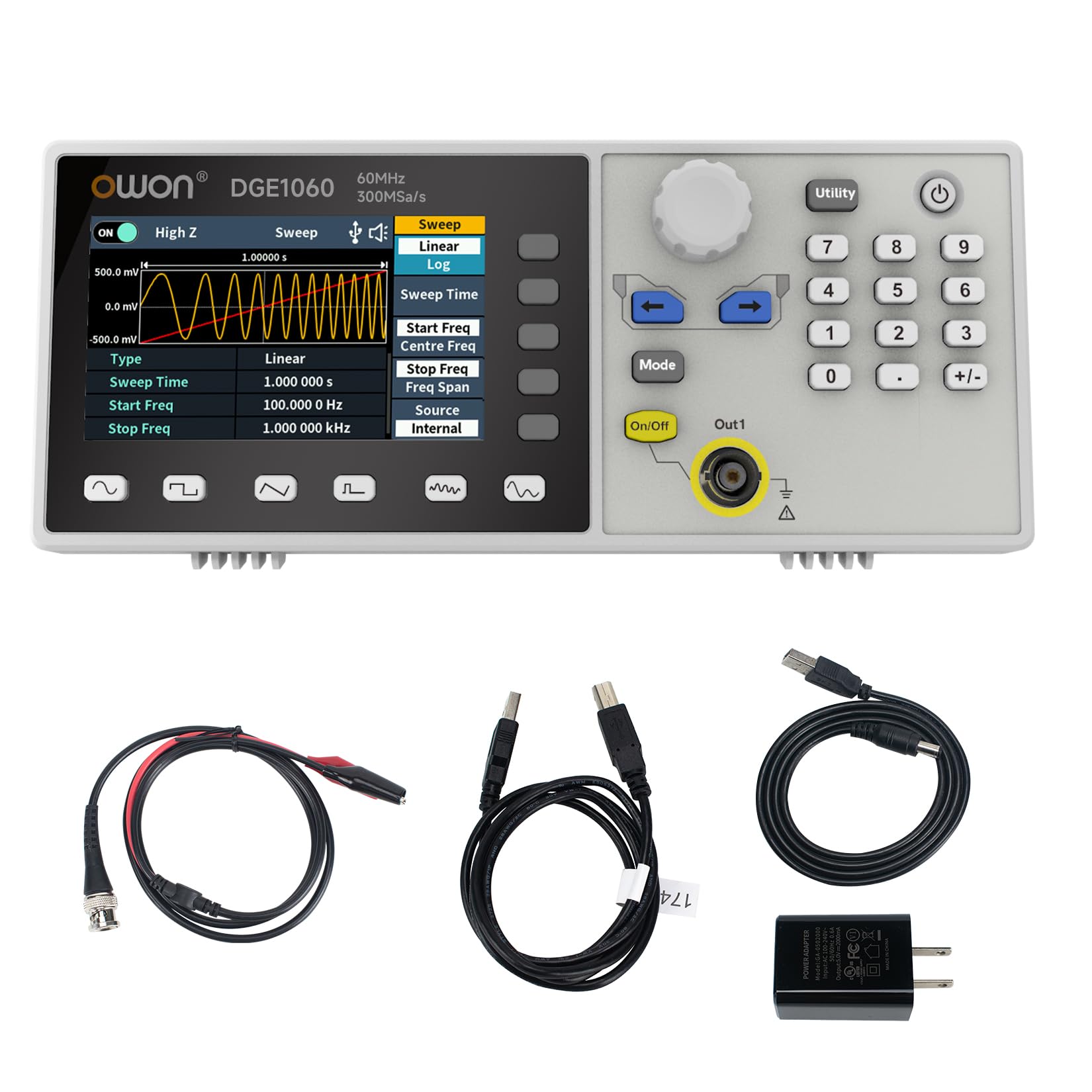
If you mostly need one clean, accurate output — for radio alignment, HF signal injection or oscilloscope calibration — the single-channel OWON DGE1060 delivers 60MHz, 300 MSa/s and 14-bit resolution for around $118. Ham operators love that its frequency accuracy measures far better than the rated spec (users report ~0.4 ppm against WWV), and it includes 160 arbitrary waveforms plus AM/FM/PM/FSK modulation. Skip it if you need two channels or low-millivolt outputs.
✅ Pros: Excellent frequency accuracy; 300 MSa/s + 14-bit; SCPI control; great for HF/radio work.
❌ Cons: Single channel; no sync output; some RF noise from electronics/adapter.
🎯 Verdict: The best single-channel value for radio and RF hobbyists who prize accuracy over a second output.
🎓 BEST FOR BEGINNERS · ⭐ 4.4/55. Koolertron 15MHz DDS
15MHz · 2-ch · 200 MSa/s · 14-bit · 60 arb slots · ~$119
Buy →

The Koolertron 15MHz DDS is the most-reviewed budget signal generator on Amazon for a reason: it’s the easy, affordable on-ramp to bench testing. Two independent channels, a built-in frequency counter, sweep, 60 user waveform slots and 200 MSa/s cover everything a student or new maker needs for audio, sensor and microcontroller work. 15MHz is more than enough for the vast majority of hobby signals, and the huge owner base means plenty of tutorials and help.
✅ Pros: Massive review base & community; dual channel + counter; great value; accurate frequency.
❌ Cons: 15MHz ceiling; non-intuitive menus; some report knob/button wear.
🎯 Verdict: The best first signal generator. Cheap, capable and everywhere — the safe beginner pick.
🧰 BEST MID-RANGE DDS · ⭐ 4.3/56. Koolertron 30MHz DDS
30MHz · 2-ch · 200 MSa/s · 14-bit · sweep + counter · ~$107
Buy →

Want a little more headroom than the 15MHz model for almost the same money? The Koolertron 30MHz DDS doubles the sine bandwidth while keeping the same friendly dual-channel layout, frequency counter, sweep and 14-bit output. It’s the value mid-point of the range — comfortable for audio, MCU, IF and entry-level RF experiments — and often sells for around $107, making it one of the best dollar-for-MHz deals on Amazon.
✅ Pros: 30MHz for budget money; dual channel + counter; sweep & arb storage; proven design.
❌ Cons: Square/pulse limited well below 30MHz; small 2.4″ screen; fiddly UI.
🎯 Verdict: The best mid-range DDS. Extra bandwidth for barely more than the beginner unit.
💲 BEST ULTRA-BUDGET · ⭐ 4.2/57. Seesii FG-615
15MHz · 2-ch · 200 MSa/s · 2.4″ LCD · ~$106
Buy →

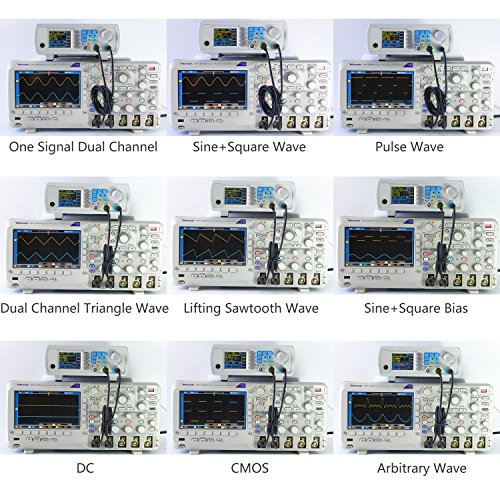
The Seesii FG-615 is the cheapest dual-channel arbitrary generator we’re comfortable recommending. For around $106 you still get two independent outputs, 15MHz sine, 200 MSa/s, a frequency counter and sweep on a compact 2.4-inch LCD. It’s a no-frills DDS clone, but it does the core job — driving test signals into your circuits — reliably, making it a smart pick for a second bench, a classroom set, or a tight first build.
✅ Pros: Lowest price for dual channel; counter + sweep; compact; fine for audio/MCU work.
❌ Cons: 15MHz ceiling; budget build quality; minimal documentation.
🎯 Verdict: The best ultra-budget pick. The most generator you can get for around a hundred dollars.
🏆 BEST PROFESSIONAL · ⭐ 4.7/58. Siglent SDG2042X
40MHz · 2-ch · 1.2 GSa/s · 16-bit · TrueArb · ~$574
Buy →
When “good enough” isn’t, the Siglent SDG2042X is the upgrade. Its standout numbers — a blistering 1.2 GSa/s sample rate, 16-bit vertical resolution and 8 Mpts memory — combine with Siglent’s TrueArb and EasyPulse engines to produce arbitrary and pulse waveforms with jitter and distortion that budget DDS units simply can’t touch. With deep modulation, harmonics and rock-solid software, it’s a genuine professional instrument for R&D, calibration and serious audio work.
✅ Pros: 1.2 GSa/s + 16-bit; TrueArb/EasyPulse; superb signal quality; excellent software & support.
❌ Cons: Most expensive here; overkill for casual hobby use; stock can be limited.
🎯 Verdict: The best professional generator. If signal fidelity is non-negotiable, the SDG2042X is worth every dollar.
🛒 How to Choose the Right Generator
🏆
Want one instrument for years?
Get the Rigol DG1022Z — real benchtop fidelity, deep memory and a trusted brand at ~$311.
📡
Need high bandwidth, small size?
The UNI-T UTG962E gives 60MHz, dual channel and a big 4.3″ screen in a palm-sized case.
💵
Best value with automation?
The OWON DGE2070 packs 70MHz, dual channel and SCPI/LabVIEW control for ~$169.
🎓
New to the bench?
Start with the Koolertron 15MHz (or ultra-cheap Seesii FG-615) — dual channel for ~$106–119.
📻
Radio / RF alignment?
The single-channel OWON DGE1060 nails frequency accuracy for HF and scope calibration.
🔬
Professional / R&D work?
The Siglent SDG2042X brings 1.2 GSa/s, 16-bit and TrueArb fidelity for demanding labs.
⚙️ Key Specs Compared — Side by Side
| Spec | Rigol DG1022Z | UNI-T UTG962E | OWON DGE2070 | Koolertron 30M | Siglent SDG2042X |
|---|
| Sine Bandwidth | 25MHz | 60MHz | 70MHz ⭐ | 30MHz | 40MHz |
| Channels | 2 | 2 | 2 | 2 | 2 |
| Sample Rate | 200 MSa/s | 200 MSa/s | 300 MSa/s | 200 MSa/s | 1.2 GSa/s ⭐ |
| Resolution | 14-bit | 14-bit | 14-bit | 14-bit | 16-bit ⭐ |
| Arb Memory | 8 Mpts ⭐ | 24 slots | 8K | 60 slots | 8 Mpts ⭐ |
| Counter | Yes ⭐ | No | No | Yes ⭐ | Yes ⭐ |
| Remote (SCPI) | USB/LAN ⭐ | USB | USB + LabVIEW | USB | USB/LAN ⭐ |
| Price* | ~$311 | ~$190 | ~$169 ⭐ | ~$107 ⭐ | ~$574 |
*Approximate Amazon prices — always verify the live price before purchasing.
❓ Frequently Asked Questions
What’s the difference between a function generator and an arbitrary waveform generator?
A pure function generator outputs a fixed set of standard shapes — sine, square, triangle, pulse. An arbitrary waveform generator (AWG) adds the ability to play back any waveform you define point-by-point, from a custom pulse train to a digitized real-world signal. Almost every modern unit, including all eight here, is technically an AWG, so the terms are now used interchangeably. If you want to replay captured or hand-drawn waveforms, just confirm it has a usable arbitrary mode and PC editor.
How much bandwidth do I actually need?
Far less than the marketing suggests. Audio work needs only ~100kHz; microcontroller, sensor and most analog projects are happy under 1–5MHz; and the headline “MHz” usually applies to the sine wave only — squares and pulses top out much lower. A 15MHz unit (Koolertron, Seesii) covers the vast majority of hobby tasks. Reach for 40–70MHz (OWON, UNI-T, Siglent) only if you’re doing IF/RF, fast digital edges, or high-frequency clock work.
Are cheap DDS generators good enough, or should I buy benchtop?
For learning, audio, sensors and general MCU work, a budget DDS unit like the Koolertron or OWON is genuinely good enough and accurate. The benchtop Rigol and Siglent earn their price with lower jitter, cleaner pulses, deeper memory and reliable SCPI automation — things that matter for precise pulse timing, low-distortion audio and scripted, repeatable measurements. Buy budget to learn; upgrade when you hit a real limitation.
Do these generators come with test leads?
Most budget units include one or two BNC-to-BNC and BNC-to-alligator cables, but benchtop models (Rigol, Siglent) often ship with none. Always plan to buy a couple of quality 50 Ω BNC leads and a BNC-to-minigrabber set — they’re inexpensive and make a big difference in signal integrity, especially above a few MHz.
Can I build a Bode plotter with one of these?
Yes — pair a generator that supports SCPI remote control (the OWON DGE2070, Rigol DG1022Z or Siglent SDG2042X) with a compatible oscilloscope or multimeter and you can sweep frequency and automatically plot a circuit’s frequency response. Siglent and Rigol have especially mature software ecosystems for this kind of automated, same-brand measurement.
🏁 Final Verdict — Best Pick for Every Budget
The right function generator for every bench and wallet:
🥇 Best Overall — Rigol DG1022Z: benchtop fidelity, 8 Mpts memory, trusted brand (~$311)
Buy →🏅 Best 60MHz Portable — UNI-T UTG962E: big screen, dual channel, compact (~$190)
Buy →💵 Best Value — OWON DGE2070: 70MHz, dual channel, SCPI/LabVIEW (~$169)
Buy →🎓 Best for Beginners — Koolertron 15MHz: most-reviewed, easy, dual channel (~$119)
Buy →💲 Best Ultra-Budget — Seesii FG-615: cheapest dual-channel that’s worth buying (~$106)
Buy →🏆 Best Professional — Siglent SDG2042X: 1.2 GSa/s, 16-bit, TrueArb fidelity (~$574)
Buy →No single generator is perfect for everyone, but every pick here will turn abstract circuit theory into signals you can actually drive and measure. For most makers the Rigol DG1022Z is the one to buy — true benchtop fidelity that you won’t outgrow. If you want the most features per dollar, the OWON DGE2070 is unbeatable; beginners should start with the Koolertron 15MHz or ultra-cheap Seesii FG-615; and if signal quality is non-negotiable, the Siglent SDG2042X is worth the stretch. Pair your new generator with our Arduino, ESP32, STM32 and Raspberry Pi tutorials and start testing your circuits today.
💬 Not sure which generator fits your work? Tell us what you’re testing — audio, MCU, RF, or precision lab measurements — in the comments below, and we’ll point you to the right pick.
All Amazon links above use our affiliate tag (microlab05-20). Purchasing through them supports microcontrollerslab.com at no extra cost to you. Prices and availability change frequently — always confirm the current price on Amazon before buying.