⚠️ Affiliate Disclosure: This post contains Amazon affiliate links. If you purchase through our links, we may earn a small commission at no extra cost to you. We only recommend modules we have researched and whose listings we checked live on Amazon. Prices change constantly, so we deliberately do not print them here. Tap through and confirm the current price on Amazon before buying.
Ultimate Buying Guide
🔌 Best RS485 Modules for Arduino, ESP32 & Raspberry Pi
8 RS485 boards ranked for Modbus, long-distance sensors and industrial links: from the classic MAX485 module to auto-direction, 3.3V, galvanically isolated, USB and Raspberry Pi HAT picks, with real specs, honest verdicts and direct Amazon links.
✅ 8 Modules Reviewed
✅ Verified Amazon ASINs
✅ Checked Live on Amazon
✅ Honest Pros & Cons
RS485 is the quiet workhorse of industrial electronics. It turns your microcontroller’s plain UART into a differential A/B pair that can run up to about 1,200 m (4,000 ft) of twisted-pair cable, shrug off motor and relay noise, and share a single bus with dozens of devices. That is why energy meters, VFDs, PLCs, soil and weather sensors and solar inverters almost all speak Modbus RTU over RS485. If your Arduino, ESP32, STM32 or Raspberry Pi needs to talk to any of them, you need an RS485 transceiver module.
The catch is that these boards are not all the same. Some need you to toggle DE/RE direction pins in code, others switch direction automatically. Some only work with 5V logic, others are happy at 3.3V. Cheap modules have no surge protection at all, while industrial converters add galvanic isolation, TVS diodes and fuses. This guide ranks 8 RS485 modules across hobby, lab and field use on the specs that actually matter.
💡 Reality check before you buy: Budget MAX485 boards are 5V parts with no isolation and little or no surge protection. They are perfect on the bench but can die on a long outdoor cable after a lightning-induced surge or a ground-potential difference between buildings. Their receiver output also swings to 5V, which is outside an ESP32’s absolute maximum rating unless you level-shift it. The “up to 1,200 m” and “up to 128 nodes” headline figures assume low baud rates, proper twisted pair, 120 Ω termination at both ends and a shared ground reference. Plan for those, and even a cheap module will run reliably; skip them, and even a premium converter will drop packets.
🔌 Quick Comparison: All 8 RS485 Modules
| Module | Type | Logic / Power | Direction Control | Best For | Buy |
|---|
| 🥇 HiLetgo TTL to RS485 (Auto Flow) | TTL module · 5-pack | 3.3V / 5V | Automatic | Best Overall | Buy Here → |
| 🏅 MAX485 Module | TTL module · 5-pack | 5V | Manual (DE/RE) | Best Value / Classic | Buy Here → |
| 🛡️ DSD TECH SH-U12 | TTL board · MAX13487 | 5V | Automatic | Best Protected TTL Board | Buy Here → |
| 🔋 SparkFun RS-485 Breakout | Breakout · SP3485 | 3.3V (5V-tolerant in) | Manual (RTS pin) | Best 3.3V Breakout | Buy Here → |
| ⚡ Waveshare TTL to RS485 (B) | Isolated · DIN rail | 3.3V / 5V TTL | Automatic | Best Isolated / Industrial | Buy Here → |
| 💻 Waveshare USB to RS485 | USB adapter · FT232R | USB powered | Automatic | Best USB for PC / Modbus | Buy Here → |
| 🔁 DSD TECH SH-U11 | USB adapter · RS485/RS422 | USB powered | Automatic | Best USB with RS422 | Buy Here → |
| 🍓 Waveshare RS485 CAN HAT | Pi HAT · RS485 + CAN | 3.3V (Pi GPIO) | Automatic (default) | Best for Raspberry Pi | Buy Here → |
Prices are intentionally not listed because they change daily. Many budget modules ship as multi-packs, so check the pack size on the listing and confirm the live price on Amazon before buying.
🔍 What to Look for in an RS485 Module
🔋
Logic Voltage (3.3V vs 5V)
MAX485 boards are 5V parts and their RO pin outputs 5V. For ESP32, STM32, Pico and Raspberry Pi, pick a 3.3V-capable module (SP3485, MAX3485 or an auto-flow board rated for 3.3V) or add a level shifter.
🔀
Direction Control
RS485 is half-duplex, so something must switch the transceiver between talk and listen. Manual boards expose DE/RE pins you drive from a GPIO; auto-direction boards do it in hardware, so they wire up like a plain UART with just TX and RX.
🛡️
Isolation & Protection
Long cables pick up surges and ground offsets. TVS diodes, ESD-rated chips and resettable fuses help; galvanic isolation (separate power and signal domains) is the real fix for field wiring between buildings or around VFDs.
📡
Speed, Distance & Nodes
Check the max data rate and unit load. Classic MAX485 allows 32 standard loads; 1/4-unit-load chips like the MAX13487 allow up to 128. Most Modbus devices run at 9600 or 19200 baud, where 1 km runs are realistic.
🧩
Form Factor & Termination
Choose between breadboard modules, USB dongles, Pi HATs and DIN-rail converters. Check for screw terminals and whether a 120 Ω termination resistor is fitted, removable or selectable, since only the two bus ends should terminate.
🏆 Detailed Reviews: All 8 RS485 Modules
🥇 BEST OVERALL
HiLetgo TTL to RS485 Converter (Automatic Flow Control)
⭐ 4.7/5 · Plug-and-Play UART to RS485
Buy on Amazon →

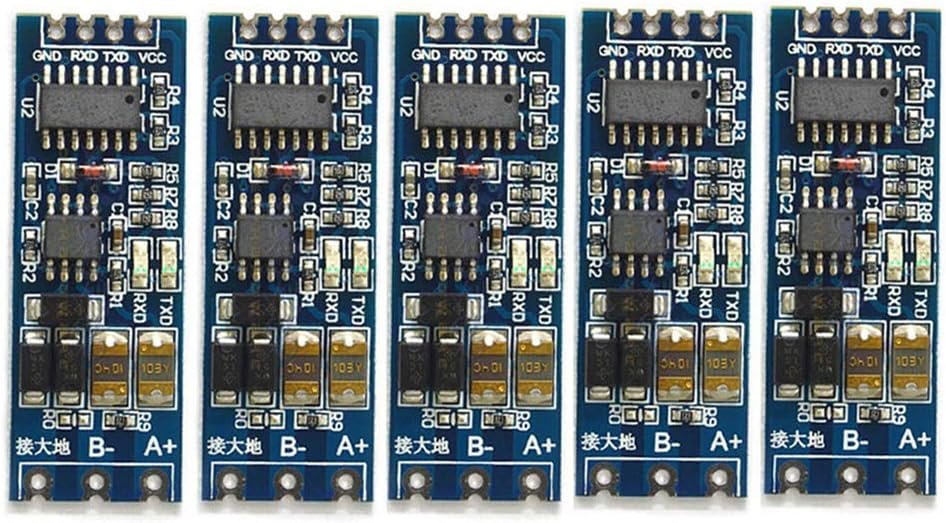
For most makers this is the RS485 module to buy. The HiLetgo TTL to RS485 converter switches between transmit and receive automatically in hardware, so there are no DE/RE pins to juggle: wire VCC, GND, TXD and RXD to any UART and it behaves like a normal serial port. It runs from 3.3V or 5V, which makes it a clean match for ESP32, ESP8266, STM32 and Raspberry Pi Pico as well as 5V Arduinos. RXD/TXD indicator LEDs help you see traffic while debugging Modbus, the bus supports up to 128 devices, and HiLetgo states the board is hot-swappable. You get five in a pack, enough for a master plus several slave nodes.
✅ Pros- Automatic direction, no DE/RE code
- Works at 3.3V and 5V
- TX/RX activity LEDs
- Five boards per pack
❌ Cons- No galvanic isolation
- No screw terminal on the A/B side
- Auto-switching can struggle at very high baud rates
🎯 Verdict: The easiest way to put any 3.3V or 5V microcontroller on an RS485 or Modbus bus. Buy this unless you specifically need isolation or USB.
👉 Check Price on Amazon →
🏅 BEST VALUE / CLASSIC
MAX485 TTL to RS485 Transceiver Module
⭐ 4.5/5 · The Module Every Tutorial Uses
Buy on Amazon →

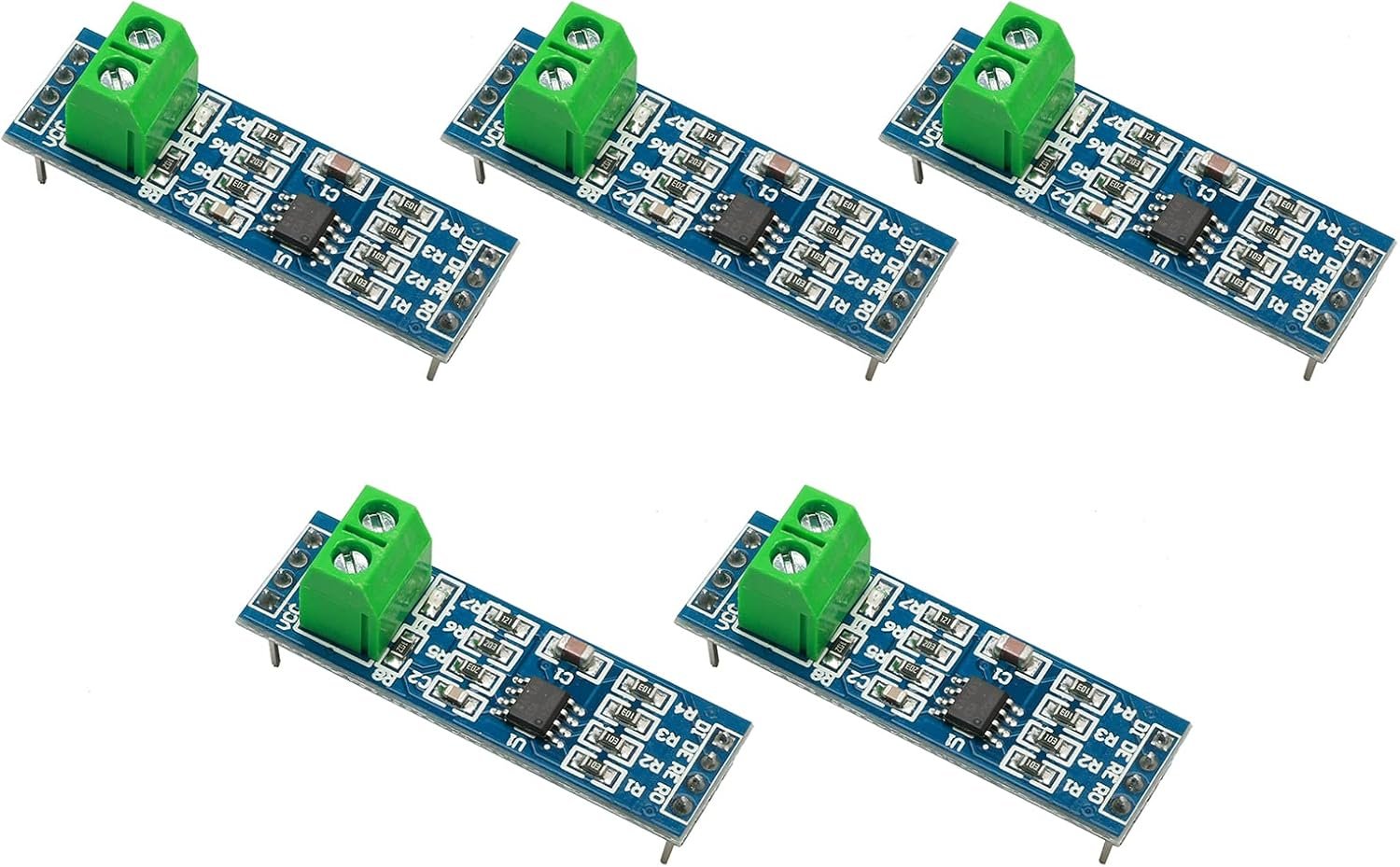
The little blue MAX485 module is the board used in almost every RS485 tutorial, including our own. It breaks the MAX485 transceiver out to RO, RE, DE and DI pins on one side and a 5.08 mm two-pole screw terminal for A and B on the other. You tie RE and DE together to a GPIO and drive it HIGH to transmit and LOW to receive, which teaches you exactly how half-duplex RS485 works. It is a 5V part, ideal with Arduino Uno, Nano and Mega. With a 3.3V ESP32 or Pi, level-shift the RO line (or pick our top pick) because it outputs 5V. At multi-pack pricing it is the cheapest way to build a multi-node test bus.
✅ Pros- Cheapest RS485 option by far
- Screw terminal for A/B wiring
- Matches countless tutorials
- Full control of DE/RE timing
❌ Cons- 5V only, RO needs level shift for 3.3V MCUs
- Extra GPIO and code for direction
- Minimal surge protection, no isolation
🎯 Verdict: The best value RS485 module and the best one to learn on. Perfect for 5V Arduino projects and bench Modbus experiments.
👉 Check Price on Amazon →
🛡️ BEST PROTECTED TTL BOARD · ⭐ 4.5/53. DSD TECH SH-U12 RS485 to TTL Board
MAX13487 · auto direction · 15 kV ESD + TVS · up to 500 kbps · 128 nodes · 5V
Buy →

The DSD TECH SH-U12 is what the generic modules want to be when they grow up. It is built around Maxim’s MAX13487, a transceiver with genuine hardware AutoDirection, plus 15 kV ESD protection and TVS over-voltage clamps on the bus. It supports rates up to 500 kbps and up to 128 slaves, has power/TX/RX LEDs and a proper three-way screw terminal for A, B and ground. It comes from a brand that offers support and a one-year replacement, which matters when you are deploying rather than tinkering. Note it is specified as a 5V board, so it suits Arduino and 5V systems best.
✅ Pros: Branded MAX13487 auto-direction; ESD + TVS protection; A/B/GND screw terminal; brand support.
❌ Cons: 5V board; single unit, not a multi-pack; still not isolated.
🎯 Verdict: The best protected TTL-level RS485 board for 5V builds that will live outside the lab.
🔋 BEST 3.3V BREAKOUT · ⭐ 4.4/54. SparkFun Transceiver Breakout RS-485 (SP3485)
SP3485 · single 3.3V supply · 5V-tolerant inputs · half-duplex · RTS drives DE/RE · RJ-45 / terminal / header footprints
Buy →

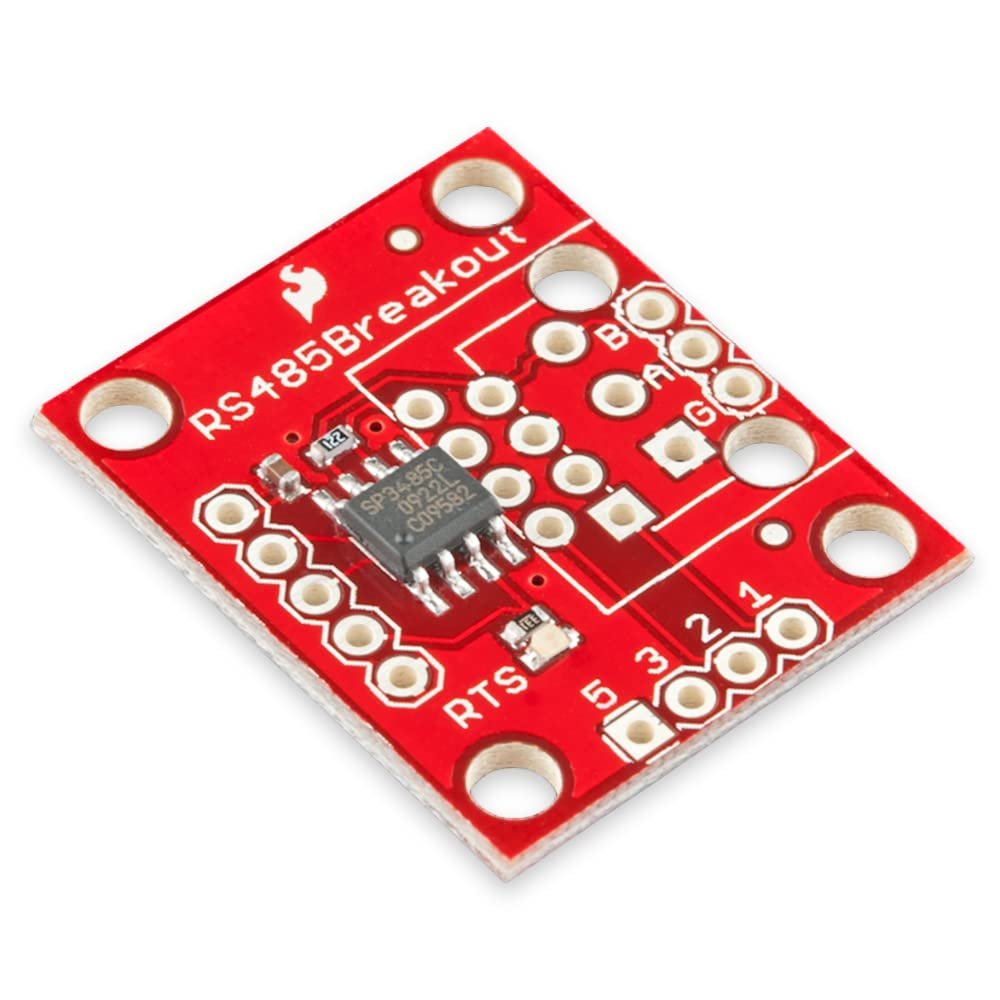
If your project runs on 3.3V, a native 3.3V transceiver is cleaner than level-shifting a MAX485. SparkFun’s RS-485 breakout carries the SP3485, which runs from a single 3.3V supply and still accepts 5V logic inputs. The bus side is broken out to footprints for an RJ-45 jack, a 3.5 mm screw terminal and a 0.1″ header, so you choose the connector that suits your cable. Driver and receiver enable are tied to a single RTS pin that you toggle from a GPIO. It is well documented, open hardware from a name you can trust, which makes it a favourite for ESP32, STM32, nRF and Pico builds.
✅ Pros: True 3.3V operation; 5V-tolerant logic; flexible RJ-45/terminal/header layout; excellent docs.
❌ Cons: Manual direction via RTS pin; connectors may need soldering; single board, few Amazon reviews.
🎯 Verdict: The best 3.3V RS485 breakout for ESP32, STM32 and Pico builds that want a trusted, documented board.
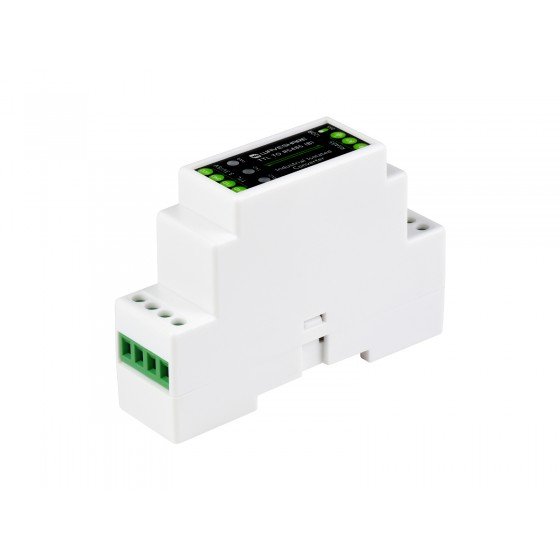
⚡ BEST ISOLATED / INDUSTRIAL · ⭐ 4.7/55. Waveshare TTL to RS485 (B) Galvanic Isolated Converter
Power + signal isolation · 600W lightning/surge protection · TVS · resettable fuse · DIN rail · ~1.2 km
Buy →

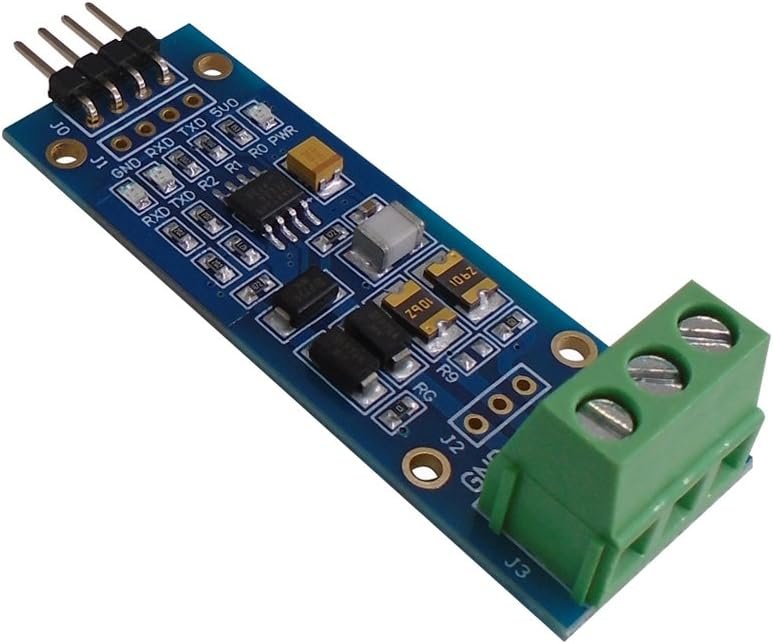
When your RS485 cable leaves the enclosure, crosses a factory floor or runs between buildings, isolation is what keeps a surge or ground offset from travelling back into your microcontroller. Waveshare’s TTL to RS485 (B) provides isolated power and isolated signals, 600W lightning and anti-surge protection, TVS diodes and a resettable fuse, all in a DIN-rail enclosure with screw terminals. It accepts 3.3V or 5V TTL, handles direction automatically and is rated for roughly 1.2 km runs. It costs more than a bare module, but it is the kind of part you install once and forget.
✅ Pros: Galvanic isolation; heavy surge protection; DIN-rail case; 3.3V/5V TTL; auto direction.
❌ Cons: Pricier and bulkier than modules; overkill for short bench links.
🎯 Verdict: The best isolated RS485 converter for field wiring, control panels and anything near motors or VFDs.
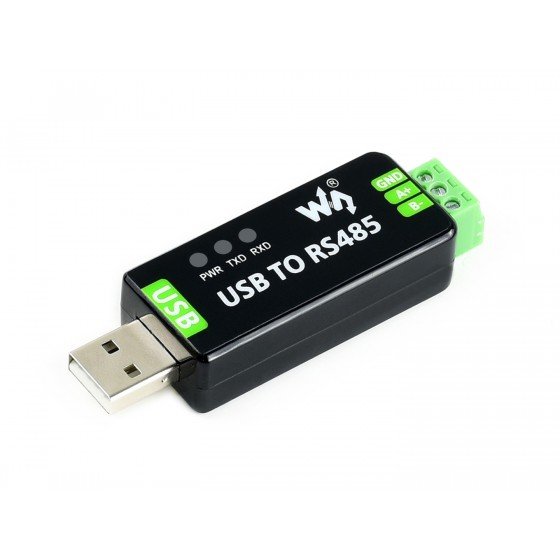
💻 BEST USB FOR PC / MODBUS · ⭐ 4.7/56. Waveshare Industrial USB to RS485 Converter
FTDI FT232R-series + SP485EEN · 300 to 921,600 bps · TVS + resettable fuse · Windows / Linux / Android
Buy →
Every RS485 developer eventually needs a USB to RS485 adapter on the PC side, to sniff the bus, poll a Modbus meter from a tool like Modbus Poll or QModMaster, or talk to a board from Python. Waveshare’s industrial version pairs a genuine FTDI FT232R-series USB bridge with an SP485EEN transceiver, adds TVS surge suppression, a resettable fuse and protection diodes, and supports 300 to 921,600 bps. It shows up as a standard COM or ttyUSB port with standard FTDI drivers, and it is also a great way to give a Raspberry Pi or Linux gateway an RS485 port with zero wiring.
✅ Pros: Genuine FTDI; strong protection; wide baud range; ideal for Modbus testing and Pi gateways.
❌ Cons: Not isolated; RS485 only (no RS422); needs a host USB port.
🎯 Verdict: The best USB to RS485 adapter for PC debugging, Modbus polling and Linux gateways.
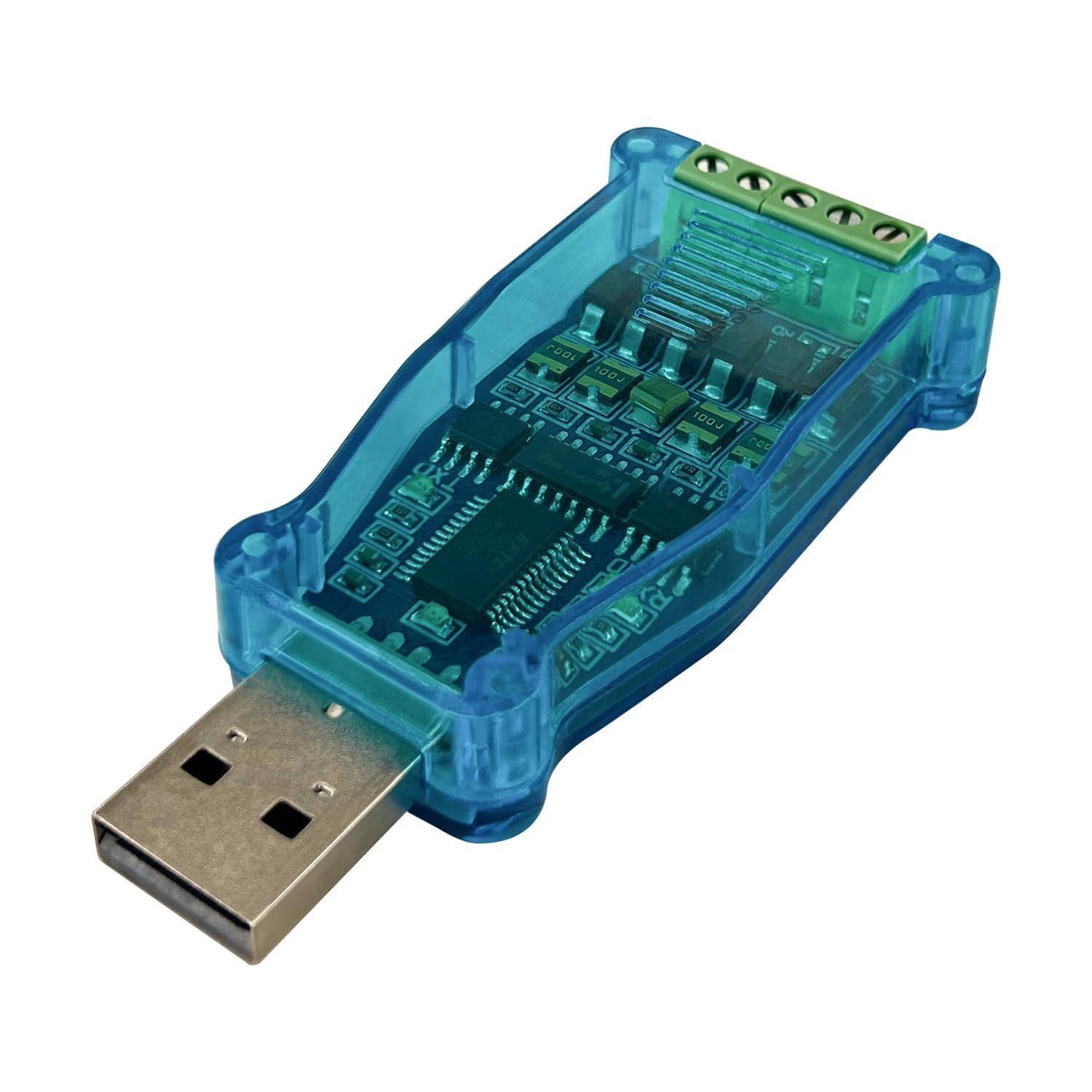
🔁 BEST USB WITH RS422 · ⭐ 4.5/57. DSD TECH SH-U11 USB to RS485 / RS422 Converter
FTDI FT232R · RS485 half-duplex + RS422 full-duplex · power & TX/RX LEDs · Windows / Linux / macOS
Buy →

The DSD TECH SH-U11 is one of the most-reviewed USB serial adapters on Amazon for a reason. It uses an FTDI FT232R chip for painless drivers on Windows 11, Linux and macOS, and unlike most RS485 dongles it also speaks RS422, the four-wire full-duplex cousin used by some encoders, displays and older industrial gear. Screw terminals handle the wiring, and power and transceiver LEDs show what is happening at a glance. If you service mixed equipment, one SH-U11 in the toolbag covers both standards.
✅ Pros: RS485 and RS422 in one; FTDI chip; status LEDs; huge review base and brand support.
❌ Cons: Not isolated; translucent plastic case is less rugged than a metal enclosure.
🎯 Verdict: The best USB adapter when you need both RS485 and RS422 from one dongle.
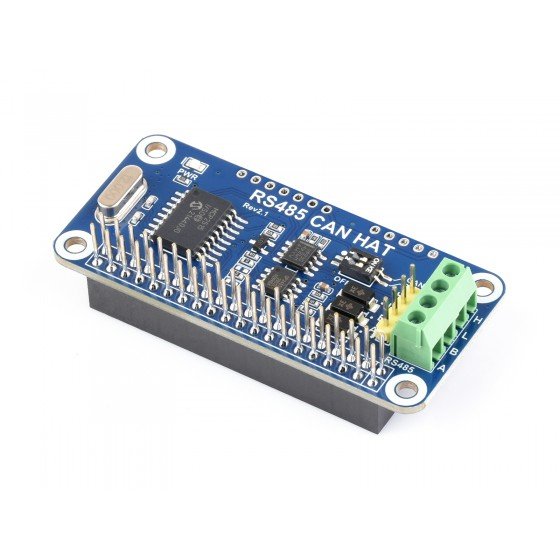
🍓 BEST FOR RASPBERRY PI · ⭐ 4.6/58. Waveshare RS485 CAN HAT
RS485 via UART (SP3485) · CAN via SPI (MCP2515 + SN65HVD230) · Pi 40-pin header · half-duplex
Buy →
For a tidy Raspberry Pi gateway, the Waveshare RS485 CAN HAT stacks straight onto the 40-pin header and gives you two industrial buses in one board: RS485 through the Pi’s UART with an SP3485 transceiver, and CAN through an MCP2515 controller over SPI with an SN65HVD230 transceiver. Screw terminals and reserved control pins keep wiring neat, and Waveshare’s wiki has ready examples for both buses. It is a natural base for Modbus-to-MQTT bridges, Home Assistant integrations and data loggers where the Pi sits in the same cabinet as the field devices.
✅ Pros: RS485 plus CAN on one HAT; native 3.3V Pi logic; clean stacking; good wiki examples.
❌ Cons: Not isolated; UART setup needed on the Pi; Pi-only form factor.
🎯 Verdict: The best RS485 add-on for Raspberry Pi, with CAN thrown in for automotive and robotics work.
🛒 How to Choose the Right RS485 Module
📶
Using an ESP32, ESP8266 or Pico?
Get the HiLetgo auto flow control module. It runs at 3.3V and needs only TX and RX, so your Modbus code stays simple.
🎓
Learning RS485 on an Arduino Uno?
Grab a pack of MAX485 modules. Toggling DE/RE yourself teaches half-duplex properly, and they match most tutorials.
🏭
Wiring to VFDs, PLCs or another building?
Pay for isolation: the Waveshare TTL to RS485 (B) adds isolated power and signals plus 600W surge protection on a DIN rail.
💻
Debugging Modbus from a laptop?
Use the Waveshare USB to RS485, or the DSD TECH SH-U11 if you also need RS422 for older equipment.
🍓
Building a Raspberry Pi gateway?
The Waveshare RS485 CAN HAT stacks on the header and adds CAN too, ideal for Modbus-to-MQTT bridges.
🛡️
Need a sturdier 5V board?
The DSD TECH SH-U12 brings MAX13487 auto-direction, 15 kV ESD and TVS protection. For native 3.3V with manual control, choose the SparkFun SP3485.
⚙️ Key Specs Compared: Side by Side
| Spec | HiLetgo Auto Flow | MAX485 Module | DSD TECH SH-U12 | SparkFun SP3485 | Waveshare TTL-RS485 (B) |
|---|
| Logic / Supply | 3.3V or 5V ⭐ | 5V | 5V | 3.3V (5V-tolerant in) | 3.3V or 5V ⭐ |
| Direction Control | Automatic ⭐ | DE/RE pins | Automatic ⭐ | RTS pin | Automatic ⭐ |
| Max Nodes | 128 ⭐ | 32 | 128 ⭐ | 32 | Multi-point (see listing) |
| Isolation | No | No | No | No | Galvanic ⭐ |
| Protection | Basic | Basic | 15 kV ESD + TVS | Basic | 600W surge, TVS, fuse ⭐ |
| Bus Connector | Pins / pads | 2-pin screw terminal | 3-pin screw terminal | RJ-45 / terminal / header footprints | Terminals + DIN rail ⭐ |
| Pack Size | 5 boards ⭐ | 5 boards ⭐ | 1 board | 1 board | 1 unit |
Node counts follow the transceiver’s unit-load rating (32 for standard MAX485 and SP3485, 128 for 1/4-unit-load parts). Specs can vary by seller batch, so confirm the details on the live Amazon listing.
❓ Frequently Asked Questions
Can I use a 5V MAX485 module with an ESP32 or Raspberry Pi?
Transmitting usually works because the MAX485 reads a 3.3V DI signal as HIGH. The problem is the receiver: RO swings to 5V, which exceeds the ESP32’s and Pi’s 3.6V absolute maximum. Many people get away with it for a while, but it is not a safe design. Either add a resistor divider or level shifter on RO, or simply use a 3.3V-capable module such as the HiLetgo auto flow board, the SparkFun SP3485 breakout or a MAX3485-based module.
What is the difference between manual DE/RE and automatic flow control?
RS485 uses one pair of wires for both directions, so the transceiver’s driver must be enabled only while you transmit. On MAX485 boards you tie DE and RE together to a GPIO, set it HIGH, send your bytes, wait until the UART has fully shifted out the last bit (Serial.flush() on Arduino), then set it LOW to listen. Auto flow boards detect activity on TX and switch the driver themselves. That saves a pin and avoids timing bugs, though at very high baud rates a manually controlled or native auto-direction chip like the MAX13487 is more predictable.
Do I need a 120 Ω termination resistor?
On long or fast links, yes, but only at the two physical ends of the bus. Termination matches the cable’s impedance and stops reflections that corrupt data. Many cheap modules have a 120 Ω resistor fitted by default, so if you connect several of them in the middle of a bus you can end up with too many terminations and a weak signal. For short bench tests at 9600 baud it rarely matters; for runs of tens of metres or more, terminate both ends and remove it from the middle nodes.
How far can RS485 really go, and how many devices can share a bus?
The standard figure is about 1,200 m at up to roughly 100 kbps on good twisted-pair cable; higher speeds mean shorter distances. The number of devices depends on the transceiver’s unit load: standard parts such as the MAX485 allow 32 nodes, while 1/4-unit-load parts such as the MAX13487 allow 128. Use a daisy-chain topology rather than a star, keep stubs short and run a ground reference wire alongside A and B.
Which module should I use to read a Modbus RTU energy meter or sensor?
For a microcontroller, any of the TTL modules here works with a Modbus library such as ModbusMaster on Arduino and ESP32. The auto flow HiLetgo board is the easiest because the library does not need a DE/RE callback. First, confirm the meter’s settings (baud rate, parity, slave ID and register map) with a USB to RS485 adapter and a PC tool; that one step removes most “no response” headaches. If the meter is in a distribution board or near motors, use the isolated Waveshare converter.
🏁 Final Verdict: Best RS485 Module for Every Build
The right RS485 board for every project and budget:
🥇 Best Overall: HiLetgo TTL to RS485 auto flow control, 3.3V/5V, no DE/RE pins
Buy →🏅 Best Value / Classic: MAX485 module 5-pack for Arduino and learning
Buy →🛡️ Best Protected TTL Board: DSD TECH SH-U12 with MAX13487, ESD and TVS
Buy →🔋 Best 3.3V Breakout: SparkFun RS-485 Transceiver Breakout (SP3485)
Buy →⚡ Best Isolated / Industrial: Waveshare TTL to RS485 (B), galvanic isolation on a DIN rail
Buy →💻 Best USB for PC / Modbus: Waveshare USB to RS485 with FTDI and SP485EEN
Buy →🔁 Best USB with RS422: DSD TECH SH-U11, RS485 and RS422 in one dongle
Buy →🍓 Best for Raspberry Pi: Waveshare RS485 CAN HAT, RS485 plus CAN
Buy →There is no single RS485 module that fits every job, but each pick here earns its place. For most microcontroller projects the HiLetgo auto flow control board is the one to buy: 3.3V and 5V friendly and wired like a plain UART. Learners and 5V Arduino users should grab a pack of classic MAX485 modules; builds that leave the lab deserve the DSD TECH SH-U12 or, for real field wiring, the isolated Waveshare TTL to RS485 (B). Keep a USB to RS485 adapter on your desk for Modbus debugging, and use the RS485 CAN HAT when a Raspberry Pi is your gateway. To get started, follow our RS485 communication between two Arduino boards and RS485 between ESP32 and ESP8266 tutorials, or browse all our Arduino, ESP32, STM32 and Raspberry Pi tutorials.
💬 Not sure which RS485 module fits your project? Tell us what you are connecting (an energy meter, a VFD, a soil sensor network or a PLC) and which board you are using in the comments below, and we will point you to the right pick.
All Amazon links above use our affiliate tag (microlab05-20). Purchasing through them supports microcontrollerslab.com at no extra cost to you. Prices and availability change frequently, so always confirm the current price on Amazon before buying.
| Arduino Components | Amazon Links |
|---|
| Arduino Starter Kit | Buy Now |
| Arduino Development Kit | Buy Now |
| Arduino Smart Robot Car Kit V4 | Buy Now |
| Arduino Sensors Kit | Buy Now |