⚠️ Affiliate Disclosure: This post contains Amazon affiliate links. If you purchase through our links, we may earn a small commission at no extra cost to you. Every product below was checked against its live Amazon listing before publishing. Prices change often, so we don’t list them here. Tap any Buy Here button to see the current price on Amazon.
Ultimate Buying Guide
🔋 Best LiFePO4 Batteries and Chargers for IoT and Solar
13 picks compared for ESP32, Raspberry Pi, LoRa and solar sensor nodes: small 12V LiFePO4 packs, a 5V USB power bank, 3.2V cells and proper 14.6V chargers.
✅ 13 Picks Reviewed
✅ 12V Packs and 3.2V Cells
✅ Matching 14.6V Chargers
✅ Honest Pros & Cons
LiFePO4 (lithium iron phosphate) has become the default chemistry for off-grid IoT. A 12V LiFePO4 pack weighs roughly half as much as the lead-acid battery it replaces, the listings below quote 2,000 or more full cycles instead of a few hundred, and the chemistry is far more tolerant of heat and abuse than the Li-ion cells in a phone. A single 3.2V LiFePO4 cell also sits right at the voltage an ESP32 likes, which makes it a neat match for small solar nodes.
This guide compares 13 batteries and chargers that were checked against live Amazon listings: compact 5 to 7Ah 12V packs for camera, router and LoRa gateway backup, a LiFePO4 power bank with a 5V USB port, 3.2V cells, and four chargers that actually terminate at the 14.6V LiFePO4 needs. Pair them with our guides to solar charging modules for IoT and solar charge controllers to finish the power system.
💡 Reality check before you buy: A LiFePO4 battery needs a LiFePO4 charge profile. A 12V pack wants about 14.4 to 14.6V and no lead-acid desulfation pulses, so use a LiFePO4 charger or a solar controller with a lithium setting. Most packs here have a built-in BMS that protects against over-charge and over-discharge, but check each listing for its maximum continuous current (several are limited to 5 to 10A) and never charge LiFePO4 below freezing. Series and parallel limits differ by brand (for example, WOXABHSL allows max 2 in series and 4 in parallel). This guide focuses on small 5 to 7Ah packs that suit IoT nodes, not large RV and marine batteries. Finally, LiFePO4 still stores a lot of energy: fuse the positive lead close to the battery and never short the terminals.
Table of Contents
- Quick Comparison: All 13 LiFePO4 Picks
- How to Choose
- Detailed Reviews: All 13 Picks
- Which One for Which Job
- LiFePO4 vs Li-ion vs Lead-Acid for IoT
- Frequently Asked Questions
- Final Verdict: Best LiFePO4 Batteries and Chargers
🔋 Quick Comparison: All 13 LiFePO4 Picks
| Product | Capacity / Output | Key Spec | Notes (from listing) | Best For | Buy |
|---|
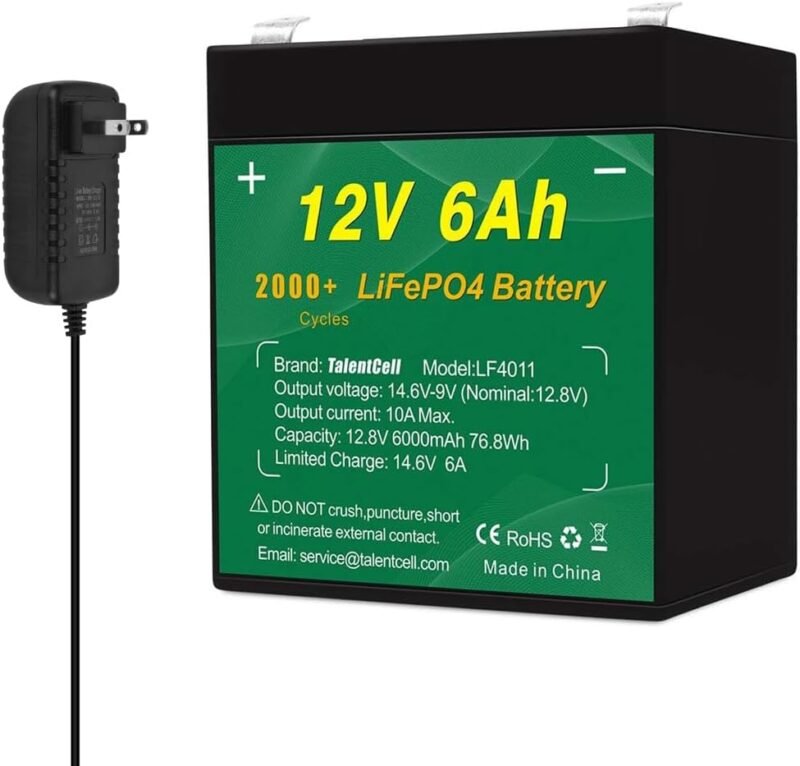
| 🥇 Talentcell LF4011 12V 6Ah | 12.8V 6Ah, 76.8Wh | 10A max output | 14.6V 1.5A charger included | Best Overall | Buy Here → |
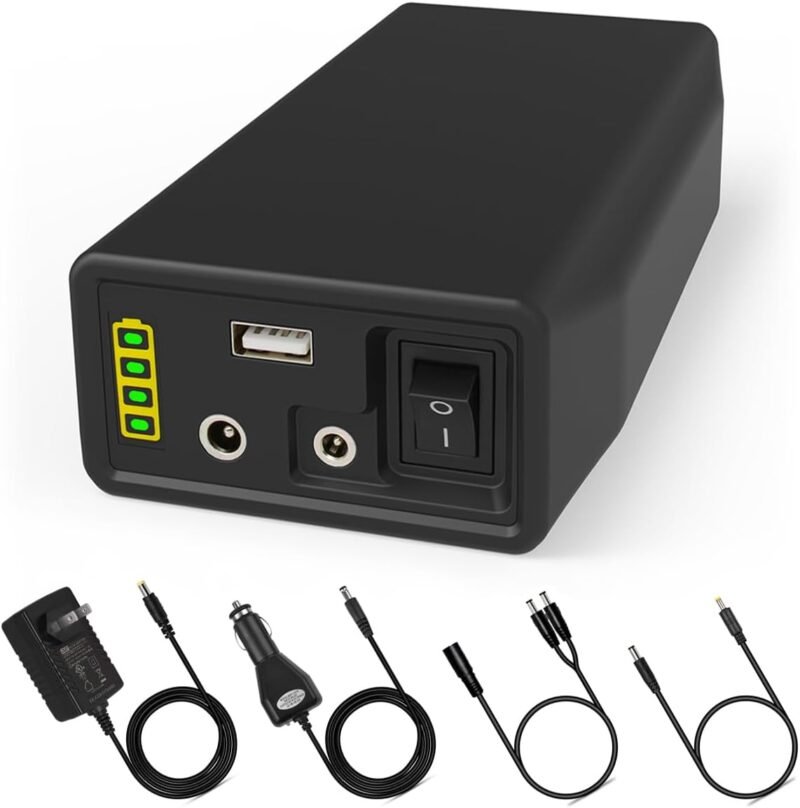
| 🔌 Talentcell LF4100 Power Bank | 12.8V 6Ah, 76.8Wh | DC5521 5A, 9V 2A, USB 5V 2A | Multiple protections | Best With 5V USB | Buy Here → |
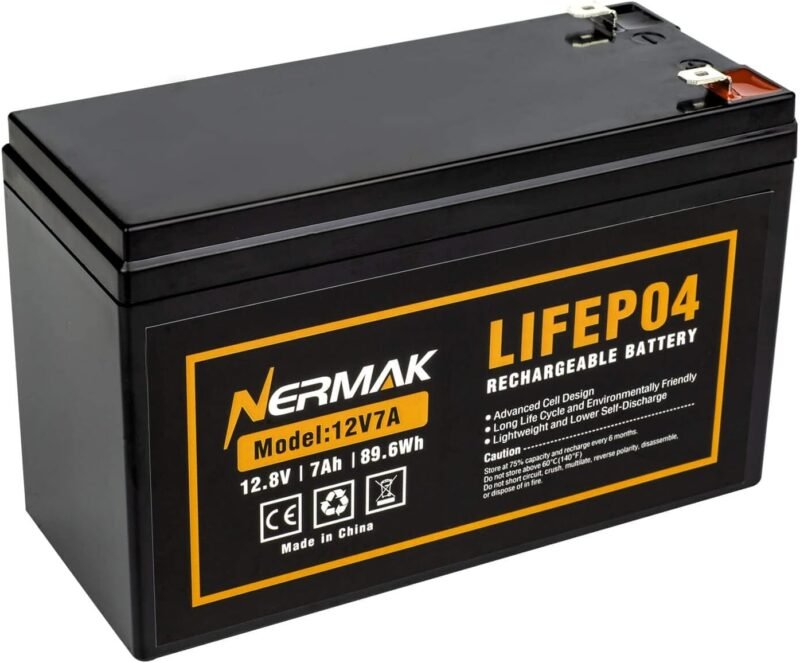
| ☀️ NERMAK 12V 7.2Ah | 12V 7.2Ah | SLA size | Series up to 4 | Best Value Solar Pack | Buy Here → |
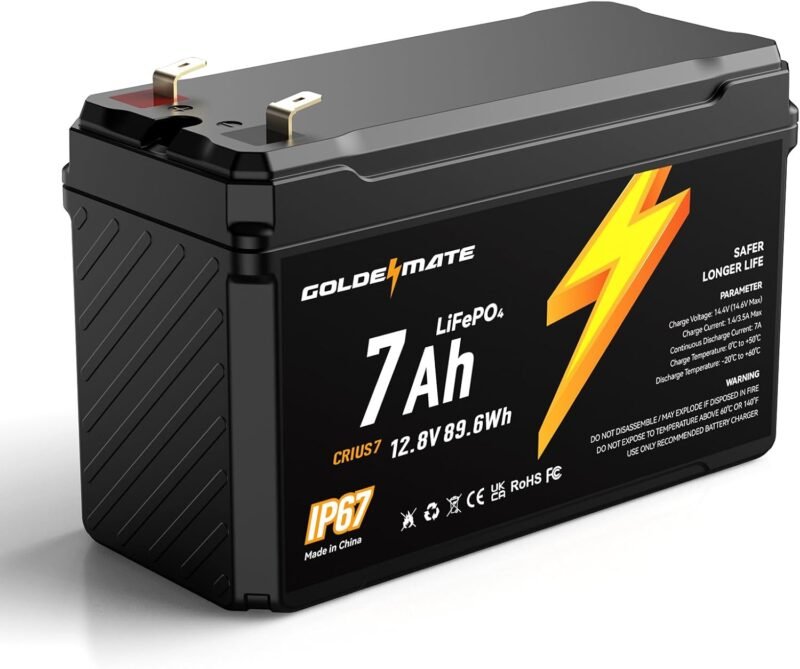
| 💧 GOLDENMATE 12V 7Ah IP67 | 12V 7Ah | IP67, 15A BMS | 4S4P expansion | Best Weatherproof | Buy Here → |
| 🔄 WOXABHSL 12.8V 7Ah | 12.8V 7Ah | 10A max discharge | Max 2S / 4P | Best SLA Drop-In | Buy Here → |
| ♻️ TalentCell 12V 6Ah (3000+) | 12.8V 6Ah | DC5521, 5A max | 3000+ cycles claim | Most Cycles Claimed | Buy Here → |
| 🪶 SENTORISE 12V 6Ah | 12.8V 6Ah | About 0.8 kg | BMS incl. high temp | Lightest 12V Pack | Buy Here → |
| 📦 ECI Power 12V 5Ah | 12V 5Ah | UL1642 listed cells | Built-in BMS | Smallest 12V Pack | Buy Here → |
| 🔋 HyperPS 14430 3.2V (20-pack) | 3.2V 400mAh each | 14430 (4/5 AA) | Bare cells, 20 pack | Best 3.2V Cells | Buy Here → |
| ⚡ LiTime 12V 20A Charger | 14.6V 20A | 0V activation | Not waterproof | Best Fast Charger | Buy Here → |
| 🔧 LiTime 12V 10A Charger | 14.6V 10A | FCC, CE, RoHS, PSE | Not waterproof | Best Mid-Size Charger | Buy Here → |
| 🔌 BROODAY 14.6V 10A Charger | 14.6V 10A | Alligator clips | LiFePO4 only | Budget Charger | Buy Here → |
| 🔀 ECO-WORTHY 12V 10A Charger | 12V 10A | SLA and LiFePO4 modes | Clips, ring terminals, SAE | Best Dual-Mode Charger | Buy Here → |
Specs and ratings are taken from each Amazon listing at the time of writing. Ratings change over time, so check the listing before buying.
🔍 How to Choose
🧮
Size capacity from your load
Multiply average current by hours of autonomy. An ESP32 node averaging 80 mA at 5V needs about 0.4W, so a 76.8Wh pack covers several days even after converter losses.
🔌
Match the voltage to your board
12V packs need a buck converter for 5V or 3.3V boards. A single 3.2V cell can feed a 3.3V MCU almost directly. The LF4100 adds a ready 5V USB port.
🛡️
Read the BMS limits
The BMS sets maximum current and protections. Check continuous current (10A, 15A) and series or parallel limits before building a bank.
⚡
Use a LiFePO4 charger
Look for 14.4 to 14.6V termination and no desulfation pulses. A 0V activation feature helps when a BMS has tripped.
❄️
Plan for temperature
LiFePO4 must not be charged below freezing. Keep outdoor packs insulated, shaded and away from hot electronics.
🏆 Detailed Reviews: All 13 Picks
🥇 BEST OVERALL
1. Talentcell LF4011 12V 6Ah LiFePO4 Pack
⭐ 4.5/5 · Comes with its own charger
Buy on Amazon →

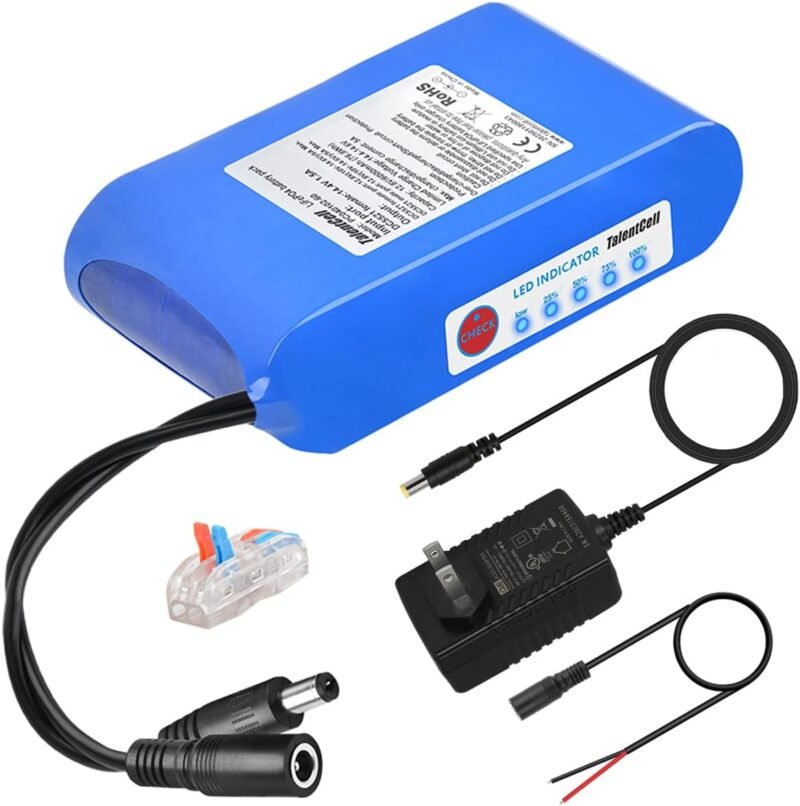
The Talentcell LF4011 is the easiest way into LiFePO4 for an IoT project because the box contains both the 12.8V 6Ah (76.8Wh) battery and a 14.6V 1.5A LiFePO4 charger, so there is no guessing about charge voltage. The listing quotes 2,000+ cycles, an output range of 14.6V down to 9V and up to 10A, and a shape similar to a traditional lead-acid battery so it drops into existing mounts. It holds 4.5 stars from 215 ratings. Behind a 12V to 5V buck converter it will run an ESP32 or a LoRa gateway for days.
✅ Pros- Charger included
- Fits SLA battery spaces
- Strong rating
❌ Cons- 1.5A charger is slow
- No USB output on this model
🎯 Verdict: The safest first LiFePO4 pack for a 12V camera, router or gateway backup.
👉 Check Price on Amazon →
🔌 BEST WITH 5V USB
2. Talentcell LF4100 LiFePO4 Power Bank
⭐ 4.4/5 · 12V, 9V and 5V USB in one box
Buy on Amazon →

The Talentcell LF4100 takes the same 12.8V 6Ah LiFePO4 capacity and adds the outputs makers actually need: a DC5521 port (14.6 to 9V, 5A max), a 9V DC4017 port (2A max) and a 5V 2A USB port. That USB port can power a Raspberry Pi Zero, an ESP32 dev board or a USB modem directly, while the 12V jack runs a camera or LED strip. The listing quotes 2,000+ cycles and multiple protections, with 4.4 stars from 230 ratings. It is the most flexible portable pack here for field tests and temporary sensor deployments.
✅ Pros- USB 5V and 12V outputs
- Portable enclosure
- Strong review base
❌ Cons- Not weatherproof
- USB output limited to 2A
🎯 Verdict: Best for bench and field work where you power both 12V gear and 5V boards.
👉 Check Price on Amazon →
☀️ BEST VALUE SOLAR PACK · ⭐ 4.2/53. NERMAK 12V 7Ah (7.2Ah) LiFePO4 Battery
12V 7.2Ah · 2000+ cycles · up to 4 in series · 4A quick charge · 379 ratings
Buy Here →

NERMAK has the largest review base of the 12V packs here, 4.2 stars from 379 ratings. The listing names solar power, emergency LED lighting, 12V routers, fish finders and ham radio as uses, quotes 2,000+ cycles against 300 to 500 for lead-acid, and says up to 4 identical batteries can be connected in series with 4A quick charging. It is a sensible bank for a small solar-powered weather station or LoRa repeater.
✅ Pros: Biggest review base; solar uses named in the listing.
❌ Cons: No charger in the box; 12 month warranty only.
🎯 Verdict: A budget building block for small 12V solar nodes.
💧 BEST WEATHERPROOF · ⭐ 4.4/54. GOLDENMATE 12V 7Ah IP67 LiFePO4 Battery
12V 7Ah · IP67 waterproof · 15A smart BMS · 2.07 lb · 194 ratings
Buy Here →

The GOLDENMATE 12V 7Ah stands out with an IP67 waterproof rating and an integrated 15A smart BMS, the highest BMS current among the small packs here. The listing gives the weight as 2.07 lb and allows up to 4 units in series and 4 in parallel. It scores 4.4 stars from 194 ratings. For an outdoor node, IP67 on the battery is a useful second line of defence if water gets into the enclosure.
✅ Pros: IP67 case; 15A BMS; clear expansion rules.
❌ Cons: You still need a sealed enclosure for the electronics.
🎯 Verdict: Pick this for battery boxes in sheds, boats and garden poles.
🔄 BEST SLA DROP-IN · ⭐ 4.2/55. WOXABHSL 12.8V 7Ah LiFePO4 (6FM7 Replacement)
12.8V 7Ah · replaces 6FM7 SLA · 10A max discharge · 1.76 lb · 265 ratings
Buy Here →

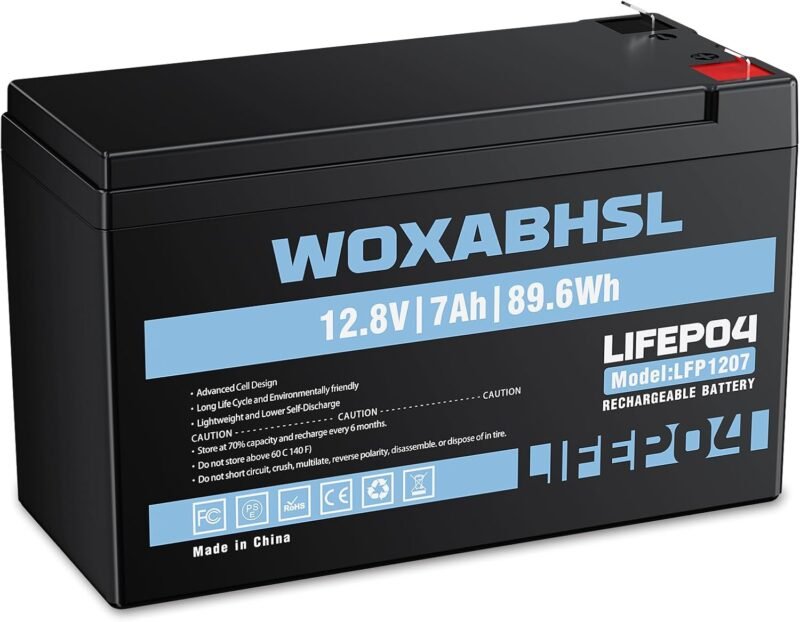
WOXABHSL sells this pack as a direct replacement for 6FM7 12V 7Ah lead-acid batteries, sized 5.94 x 2.56 x 3.71 inch and weighing 1.76 lb. The listing is unusually specific: 10A maximum discharge, max 2 in series and 4 in parallel, a 14.4V LiFePO4 charger at 1A to 5A, and named uses such as mini solar storage, garage door opener backup and security alarms. It has 4.2 stars from 265 ratings.
✅ Pros: Exact SLA footprint; honest current and wiring limits.
❌ Cons: 10A limit rules out inverters and motors.
🎯 Verdict: Swap it into alarm panels and UPS-style backups that used a 7Ah SLA.
♻️ MOST CYCLES CLAIMED · ⭐ 4.5/56. TalentCell 12V 6Ah LiFePO4 Pack (3000+ Cycles)
12.8V 6Ah · 76.8Wh · DC5521 5A max · 3000+ cycles per listing · 127 ratings
Buy Here →

This newer TalentCell 12V 6Ah pack quotes 3,000+ cycles on its listing and uses a DC5521 barrel output (inner positive) rated at 5A maximum, with over-charge and other protections. It suits CCTV cameras, modems, LED panels and 12V pumps, and has 4.5 stars from 127 ratings. The barrel jack makes it plug-and-play with most 12V camera and router power leads.
✅ Pros: Barrel-jack output; high cycle claim.
❌ Cons: 5A output cap; fewer ratings than the LF4011.
🎯 Verdict: A tidy plug-in backup for a 12V camera or modem.
🪶 LIGHTEST 12V PACK · ⭐ 4.3/57. SENTORISE 12V 6Ah Mini LiFePO4 Battery
12.8V 6Ah · 76.8Wh · about 0.8 kg · smart BMS with high-temp protection · 135 ratings
Buy Here →

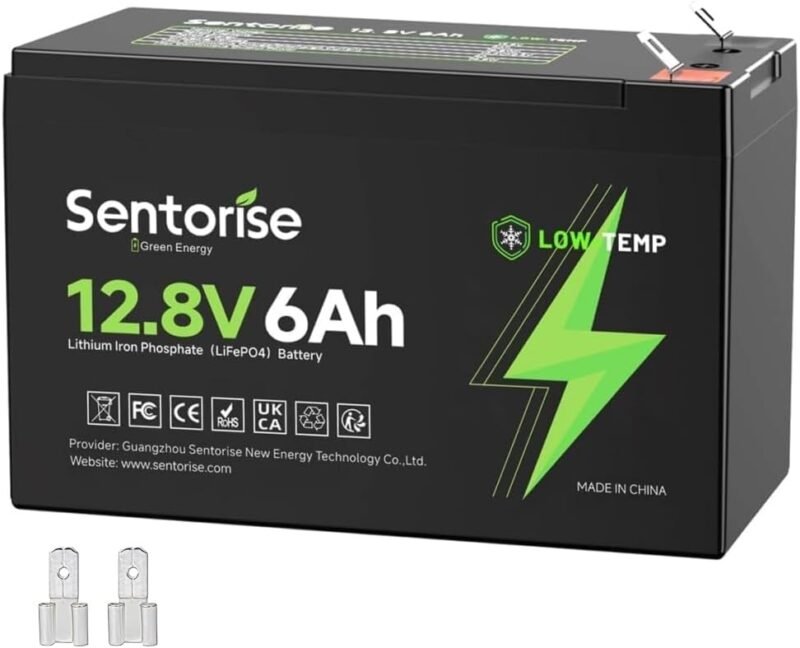
The SENTORISE 12V 6Ah is pitched as a mini drop-in battery for tight spaces, at about 0.8 kg (1.76 lb). Its listing mentions Grade A LiFePO4 cells, 76.8Wh, 2,000+ cycles at 100% depth of discharge and a smart BMS with over-charge, over-discharge, over-current, short-circuit and high-temperature protection. It has 4.3 stars from 135 ratings.
✅ Pros: Light and compact; high-temperature protection listed.
❌ Cons: Brand has a shorter track record.
🎯 Verdict: Good for pole-mounted nodes where weight matters.
📦 SMALLEST 12V PACK · ⭐ 4.3/58. ECI Power 12V 5Ah LiFePO4 Battery
12V 5Ah · UL1642 listed cells · 2000+ cycles at 80% DOD · built-in BMS · 159 ratings
Buy Here →

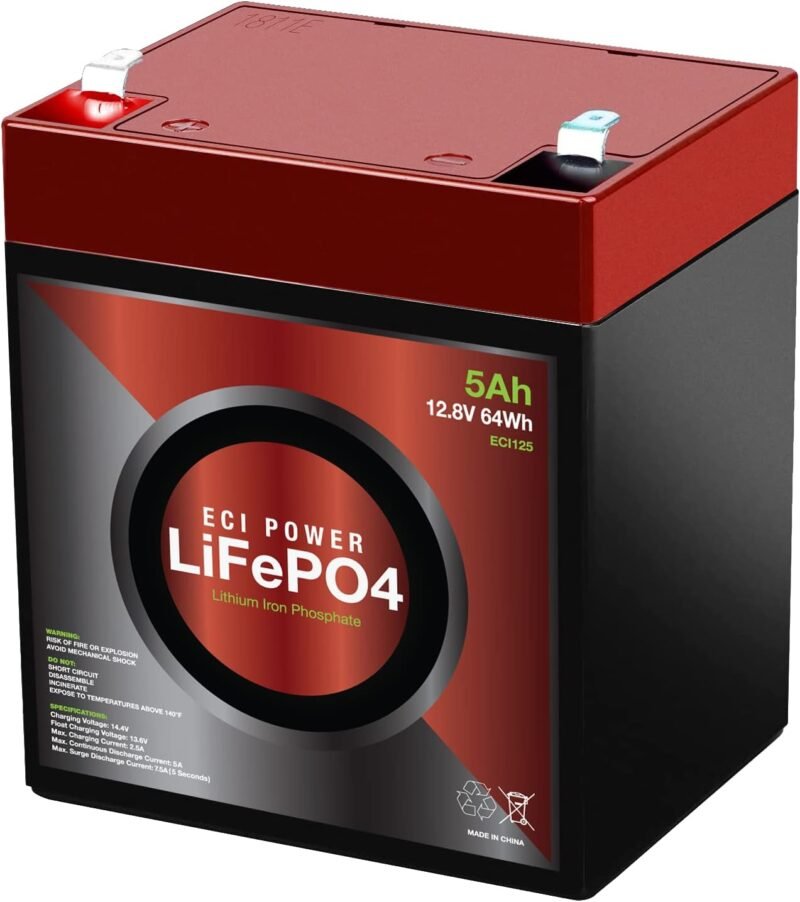
ECI Power makes the smallest 12V pack in this guide at 5Ah. The listing states it uses UL1642 listed LiFePO4 Grade-A cells, guarantees a minimum of 2,000 cycles at 80% depth of discharge, and has a BMS that protects against over-charge, deep discharge, overloading and overheating. With 4.3 stars from 159 ratings, it is a good fit when a 12V node only draws a few hundred milliamps.
✅ Pros: Cell certification stated; compact.
❌ Cons: Less capacity than the 6 to 7Ah packs.
🎯 Verdict: Right-sized for a low-power 12V sensor or router backup.
🔋 BEST 3.2V CELLS · ⭐ 4.3/59. HyperPS 3.2V LiFePO4 14430 Cells, 20-Pack
3.2V nominal · 400mAh each · 14 x 43 mm (4/5 AA) · 2,360 ratings
Buy Here →

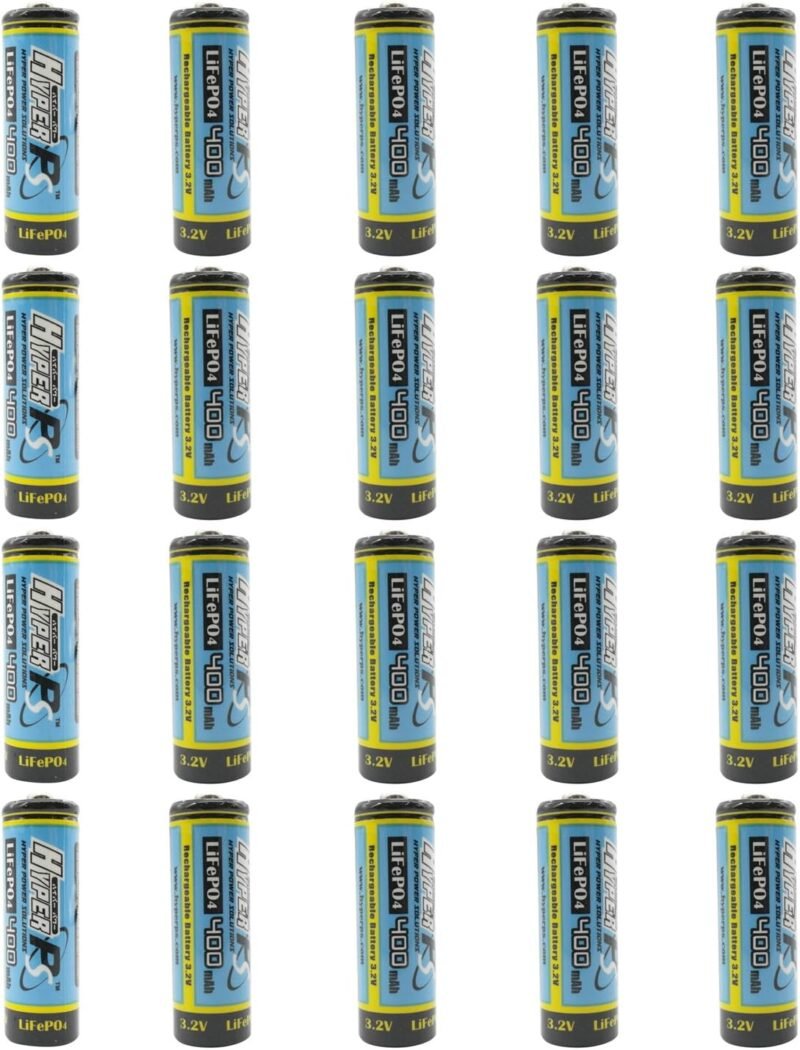
Single LiFePO4 cells are the hidden gem for tiny solar nodes: a 3.2V nominal cell can feed an ESP32 or nRF52 directly or through a low-dropout regulator. The HyperPS 14430 20-pack has by far the most ratings in this guide, 4.3 stars from 2,360. The listing gives 400mAh capacity, 14.9 g per cell and 43 x 14 mm size, and clearly warns that these are 4/5 AA, shorter than AA, so they suit solar garden-light style holders.
✅ Pros: Huge review base; correct voltage for 3.3V MCUs.
❌ Cons: Bare cells with no protection; small capacity.
🎯 Verdict: Ideal for experimenting with small solar ESP32 or BLE nodes.
⚡ BEST FAST CHARGER · ⭐ 4.7/510. LiTime 12V 20A LiFePO4 Charger
14.6V 20A · 0V activation · CC, CV and float/cut-off · cooling fan · 1,005 ratings
Buy Here →

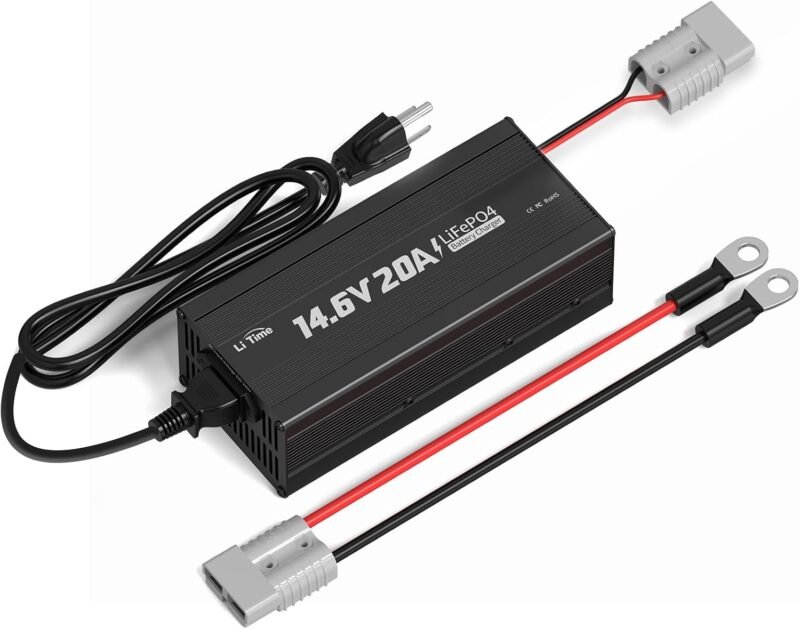
The LiTime 20A is the highest-rated product in this guide, 4.7 stars from 1,005 ratings. It outputs 14.6V at up to 20A for 12V LiFePO4 batteries, with 0V activation to wake a battery whose BMS has shut down, automatic CC, CV and float or cut-off stages, an aluminium housing with a cooling fan and LED status. The listing warns it is not waterproof. 20A is overkill for a 6Ah pack, so use it for larger banks.
✅ Pros: Top rating; 0V wake-up for tripped BMS.
❌ Cons: Too fast for small packs; indoor use only.
🎯 Verdict: The charger to own if you also run a larger 12V LiFePO4 bank.
🔧 BEST MID-SIZE CHARGER · ⭐ 4.5/511. LiTime 12V 10A LiFePO4 Charger
14.6V 10A · built-in fan · FCC, CE, RoHS, PSE per listing · -4 to 104°F · 300 ratings
Buy Here →

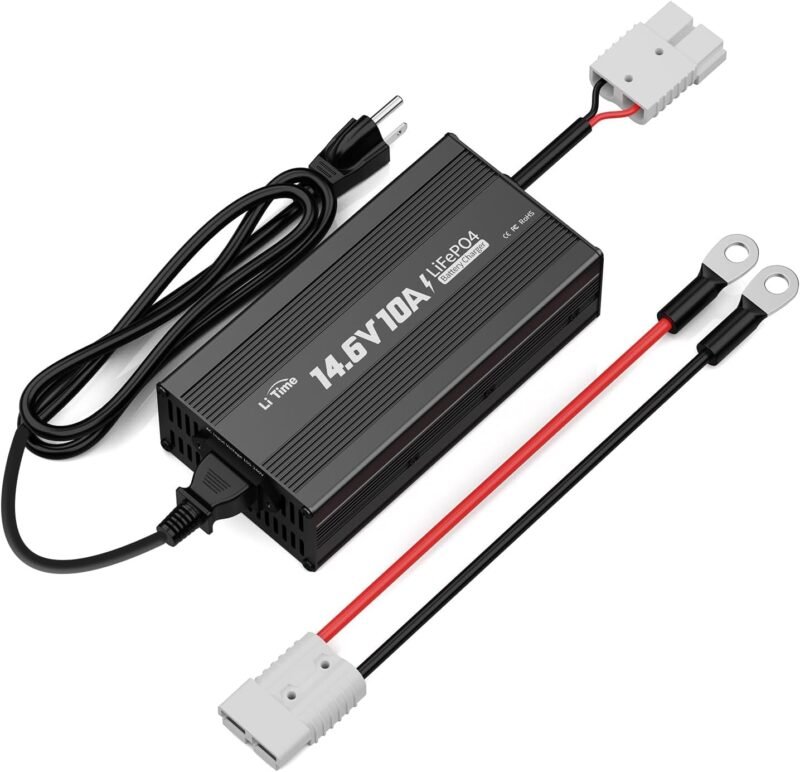
The LiTime 10A uses the same CC, CV and float or cut-off logic at half the current. Its listing names FCC, CE, RoHS and PSE certification, a built-in cooling fan and an operating range of -4°F to 104°F. With 4.5 stars from 300 ratings, it is a better match than the 20A model for 7Ah to 50Ah batteries.
✅ Pros: Certifications listed; gentler current.
❌ Cons: Still too strong for the smallest 5Ah packs; indoor only.
🎯 Verdict: A balanced charger for mid-size 12V LiFePO4 packs.
🔌 BUDGET CHARGER · ⭐ 4.4/512. BROODAY 14.6V 10A LiFePO4 Charger
14.6V 10A · alligator clips · LED indicator · LiFePO4 only · 923 ratings
Buy Here →

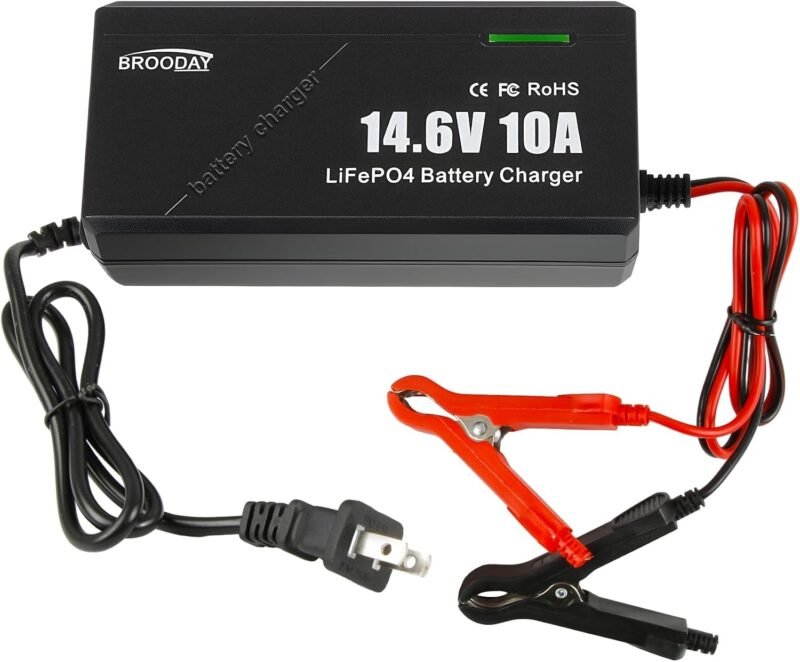
The BROODAY charger is designed exclusively for 12V (12.8V) LiFePO4 batteries and the listing states it is not compatible with lead-acid. It outputs 14.6V at 10A through alligator clips, has an LED indicator, a cooling fan and overheat protection, and claims a 50Ah battery reaches 50% in about 2.5 hours. It has 4.4 stars from 923 ratings.
✅ Pros: Large review base; simple clip-on use.
❌ Cons: No 0V wake-up listed; generic brand.
🎯 Verdict: A cost-conscious charger for occasional top-ups.
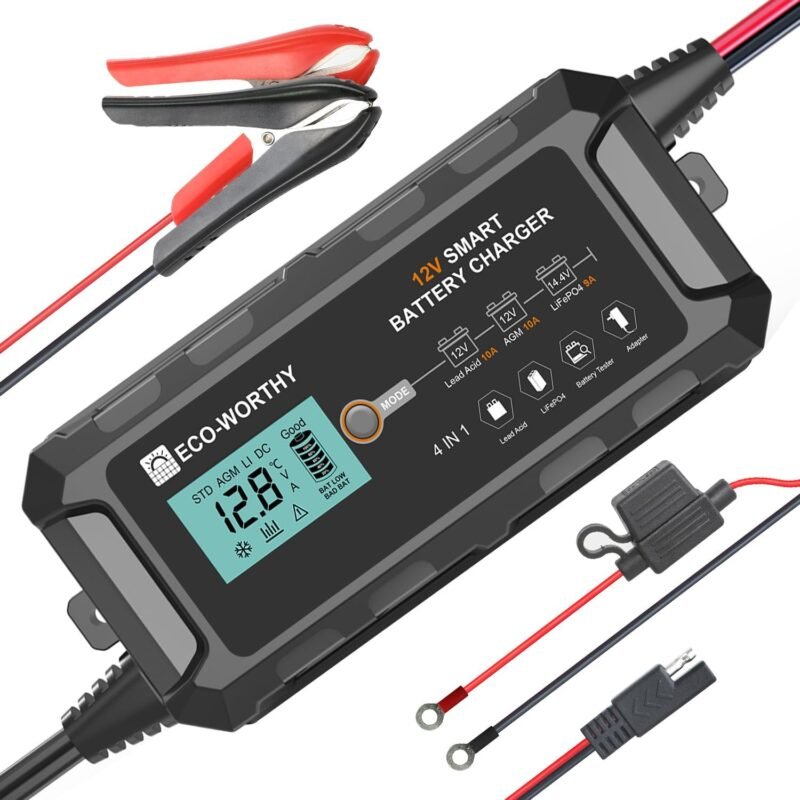
🔀 BEST DUAL-MODE CHARGER · ⭐ 4.6/513. ECO-WORTHY 12V 10A Lead-Acid and LiFePO4 Charger
12V 10A · lead-acid and LiFePO4 modes · battery maintainer · SAE connector · 306 ratings
Buy Here →

If your workshop still has lead-acid batteries, the ECO-WORTHY 10A offers two battery-type options, 12V lead-acid and 12V lithium (LiFePO4), from a 100 to 110V AC input. It comes with battery clips and an O-ring terminal cable with a 10A fuse and an SAE connector. It rates 4.6 stars from 306 ratings. Make sure the LiFePO4 mode is selected; its maintainer and desulfation features are aimed at lead-acid.
✅ Pros: Charges both chemistries; fused ring-terminal lead.
❌ Cons: Easy to leave in the wrong mode.
🎯 Verdict: Best for mixed workshops moving from SLA to LiFePO4.
🛒 Which One for Which Job
📡
LoRa gateway or Meshtastic repeater
Talentcell LF4011 or NERMAK 7.2Ah with a small solar controller and a 12V to 5V buck.
📷
12V camera or router backup
TalentCell 12V 6Ah (DC5521) plugs straight into barrel-jack gear; add the LiTime 10A for recharging.
🍓
Raspberry Pi or ESP32 field test
Talentcell LF4100: its 5V USB port powers boards with no extra converter.
🌧️
Outdoor battery box
GOLDENMATE IP67 inside a sealed enclosure for garden and pole installs.
🚨
Alarm panel or garage door backup
WOXABHSL 7Ah drops into 6FM7 SLA spaces with clear current limits.
🌱
Tiny solar BLE or ESP32 node
HyperPS 14430 3.2V cells with a small solar panel and a LiFePO4-aware charge circuit.
⚗️ LiFePO4 vs Li-ion vs Lead-Acid for IoT
| Aspect | LiFePO4 | Li-ion (18650, LiPo) | Sealed Lead-Acid |
|---|
| Nominal cell voltage | 3.2V ⭐ | 3.6 to 3.7V | 2.0V |
| Cycle life (typical claims) | 2,000+ cycles ⭐ | 300 to 1,000 | 300 to 500 |
| Thermal stability | Very stable ⭐ | Needs careful protection | Stable, vents gas |
| Weight for same energy | Light | Lightest ⭐ | Heaviest |
| Energy density | Medium | Highest ⭐ | Low |
| Charging below 0°C | Not allowed | Not allowed | Possible ⭐ |
| 12V pack charge voltage | 14.4 to 14.6V | 16.8V (4S) | 14.4 to 14.7V |
| Direct 3.3V MCU power | Single cell fits ⭐ | Needs regulator | Not practical |
Cycle figures for LiFePO4 and SLA reflect the claims in the listings above; Li-ion figures are typical values. Highlighted cells show the strongest option for each row.
❓ Frequently Asked Questions
Can I charge a LiFePO4 battery with a lead-acid charger?
Not reliably. Some lead-acid chargers stop short of a full charge, and many apply desulfation or equalisation pulses that LiFePO4 does not need. The WOXABHSL listing specifically warns that lead-acid chargers cause incomplete charging. Use a dedicated 14.6V LiFePO4 charger or a dual-mode unit like the ECO-WORTHY set to lithium.
How do I power an ESP32 from a 12V LiFePO4 battery?
Use a buck converter rather than a linear regulator, since a linear regulator wastes most of the energy as heat. Our step-down voltage regulator guide covers LM2596 and MP1584 modules, and the ESP32 deep sleep modes stretch runtime further.
Can a single 3.2V LiFePO4 cell power a 3.3V microcontroller?
Often yes. A charged cell rests near 3.3 to 3.4V and spends most of its discharge around 3.2V, which is inside the operating range of many 3.3V MCUs. Check your board’s minimum voltage and use a low-dropout regulator or protection circuit, and charge with a LiFePO4 profile (3.6V max per cell), not a Li-ion TP4056 set to 4.2V.
What size solar panel do I need for a LiFePO4 IoT node?
Work out daily energy use in watt-hours, then size the panel to replace it in your worst-month sun hours with margin. A small node using 10Wh a day might need a 10 to 20W panel in a cloudy climate. See our solar charging modules guide for the charge electronics.
Is LiFePO4 safe to use outdoors?
It is one of the most thermally stable lithium chemistries, but it still needs care. Keep it out of direct sun, inside a sealed and vented enclosure, and avoid charging below freezing. Fuse the battery lead and use the BMS limits stated in each listing.
🏁 Final Verdict: Best LiFePO4 Batteries and Chargers
Our picks for each kind of build:
🥇 Best Overall: Talentcell LF4011 12V 6Ah with charger
Buy Here →🔌 Best With 5V USB: Talentcell LF4100 LiFePO4 Power Bank
Buy Here →☀️ Best Value Solar Pack: NERMAK 12V 7.2Ah
Buy Here →💧 Best Weatherproof: GOLDENMATE 12V 7Ah IP67
Buy Here →🔋 Best 3.2V Cells: HyperPS 14430 3.2V 20-Pack
Buy Here →⚡ Best Charger: LiTime 12V 20A LiFePO4 Charger
Buy Here →For most IoT and solar builds, the Talentcell LF4011 is the simplest start because its charger is in the box, the LF4100 adds a handy 5V USB port, and the NERMAK and GOLDENMATE packs scale up a small solar node. Complete the power chain with our guides to solar charge controllers, solar charging modules, buck converter modules, boost converters, 18650 batteries and holders, LiPo charger modules and electronics project enclosures.
💬 What battery is powering your outdoor node, and how long does it last between charges? Share your runtime numbers in the comments below.
All Amazon links above use our affiliate tag (microlab05-20). Purchasing through them supports microcontrollerslab.com at no extra cost to you. Prices and availability change frequently, so always confirm the current price on Amazon before buying.