⚠️ Affiliate Disclosure: This post contains Amazon affiliate links. If you purchase through our links, we may earn a small commission at no extra cost to you. We only recommend modules we have researched and whose listings we checked live on Amazon. Prices and stock change constantly, so we deliberately don’t print them here. Tap any “Buy Here” button to see the current price on Amazon before buying.
Ultimate Buying Guide
🔌 Best Step-Down Voltage Regulator Modules: LM2596, MP1584, XL4016 & More
8 DC-DC buck converter modules ranked, from the classic LM2596 and the tiny MP1584EN to 8A XL4016 boards and DROK LCD converters, with real listing specs, honest verdicts and direct Amazon links.
✅ 8 Modules Reviewed
✅ Verified Amazon ASINs
✅ Listings Checked Live
✅ Honest Pros & Cons
Almost every embedded project has the same power problem: the battery, solar panel or wall adapter gives you 7.4V, 12V or 24V, but your ESP32, Arduino, Raspberry Pi or sensors want a clean 5V or 3.3V. A linear regulator like the 7805 or AMS1117 burns the difference off as heat, which is fine at a few milliamps and terrible at an amp. A step-down (buck) voltage regulator module switches instead of burning, so it converts 12V to 5V at 85–95% efficiency and stays cool doing it.
The market is flooded with cheap buck boards, and most of them are built around a handful of chips: the classic LM2596, the thumbnail-sized MP1584EN and Mini-360 (MP2307), and the high-current XL4015 and XL4016. On top of that, brands like DROK sell finished converters with LCD readouts, constant-current mode and sealed enclosures. This guide ranks 8 step-down modules by what actually matters in real builds: usable current, input range, size, noise and protection.
💡 Reality check before you buy: The current ratings printed on cheap buck modules are peak numbers measured on a good day. A “3A” LM2596 or MP1584 board is comfortable at roughly 1.5–2A continuous, and an “8A” XL4016 board needs a fan or generous airflow to go much past 5A. Clone boards also vary: capacitor quality, trimmer pots and even the regulator chip itself can differ from batch to batch. Every buck converter needs input headroom (typically 1.5–3V above the output), adds some switching ripple you may need to filter for ADCs or RF, and none of these modules is isolated. Always set the voltage with a multimeter before you connect your board.
🔌 Quick Comparison: All 8 Step-Down Modules
| Module | Chip / Type | Input | Output | Rated Current | Best For | Buy |
|---|
| 🥇 Valefod LM2596 (Display) | LM2596 | 4–40V | 1.5–35V | 3A max | Best Overall | Buy Here → |
| 🏅 EBOOT MP1584EN | MP1584EN | 4.5–28V | 0.8–20V | 3A max | Best Compact & Value | Buy Here → |
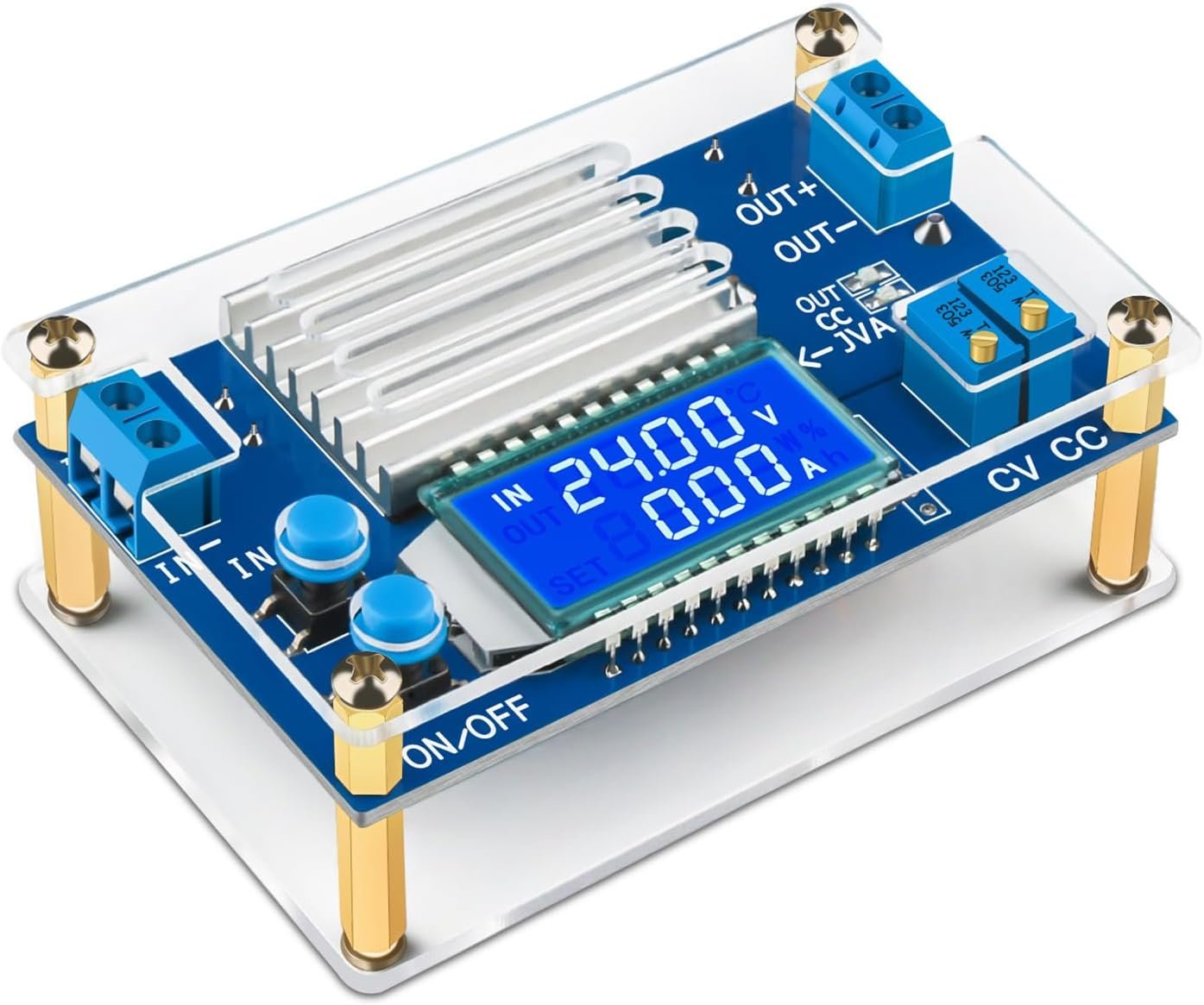
| 🖥️ DROK 5A LCD + USB | CC/CV module | 6–32V | 1.5–32V | 5A max (4.5A rec.) | Best for Bench Use | Buy Here → |
| 🔥 HiLetgo XL4016 | XL4016E1 | 4–40V | 1.25–36V | 8A / 200W | Best Budget High-Current | Buy Here → |
| ⚡ DROK 12A CC/CV LCD | CC/CV module | 5.3–32V | 1.2–32V | 8A cont. / 120W | Best High-Power | Buy Here → |
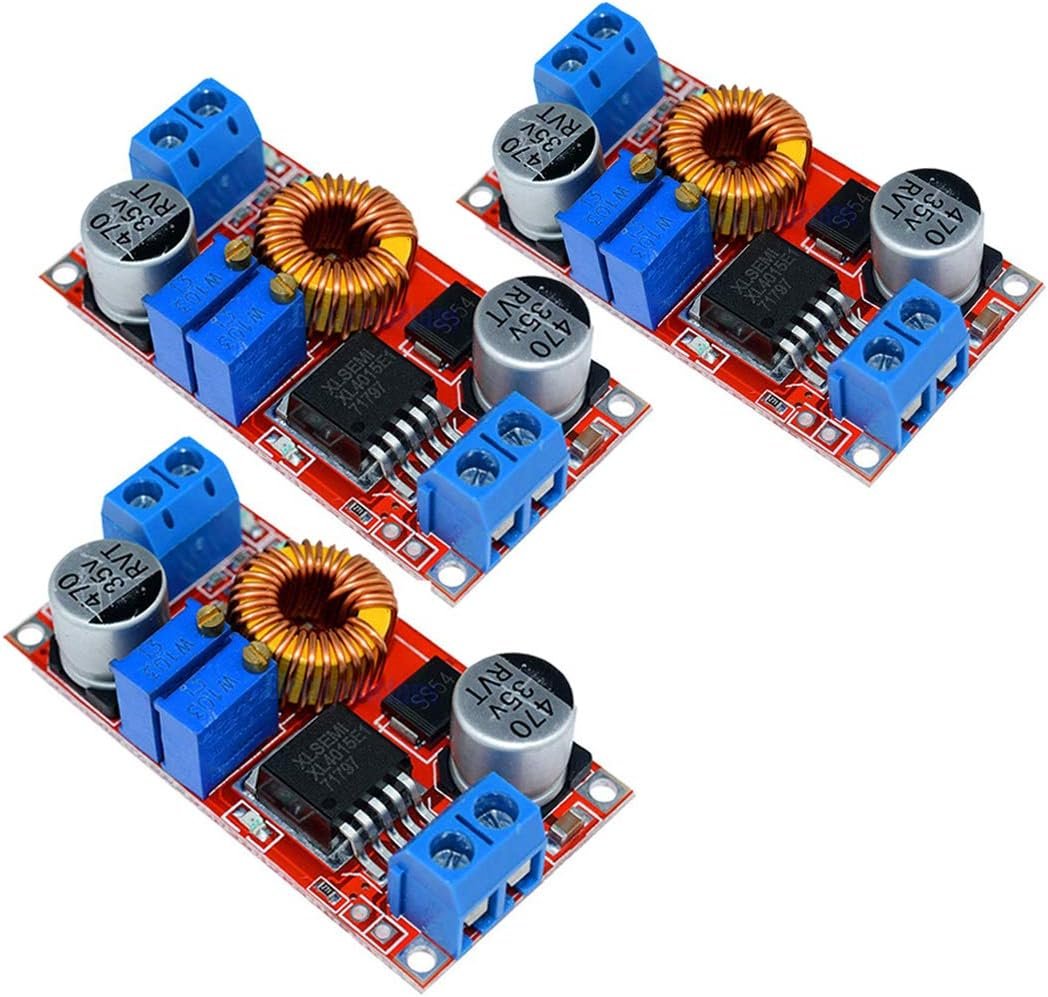
| 🔋 HiLetgo XL4015 CC/CV | XL4015 | 5–32V | 0.8–30V | 5A (adjustable CC) | Best for LEDs & Charging | Buy Here → |
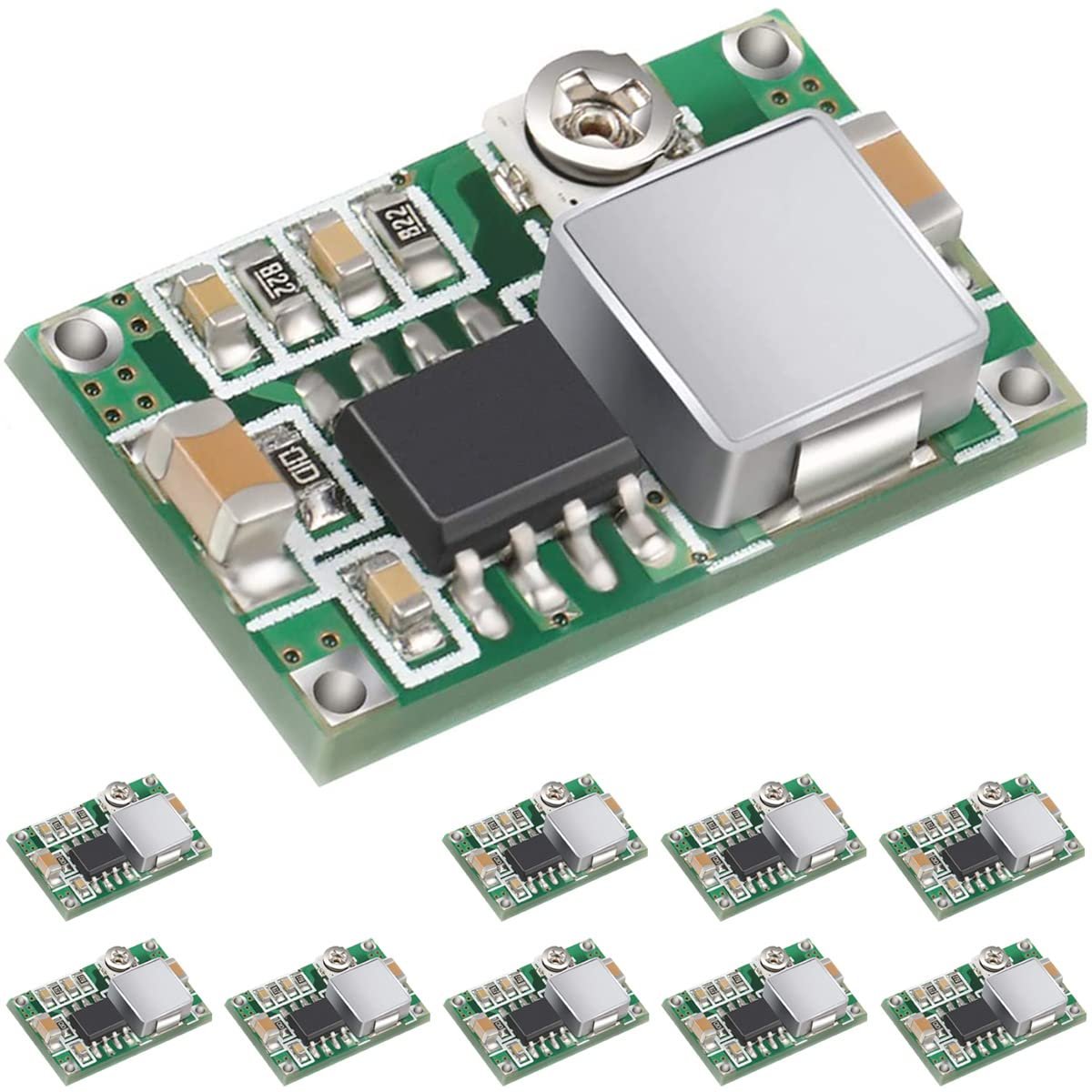
| 🐜 DAOKAI Mini-360 | MP2307 | 4.75–23V | 1.0–17V | 3A peak | Smallest Module | Buy Here → |
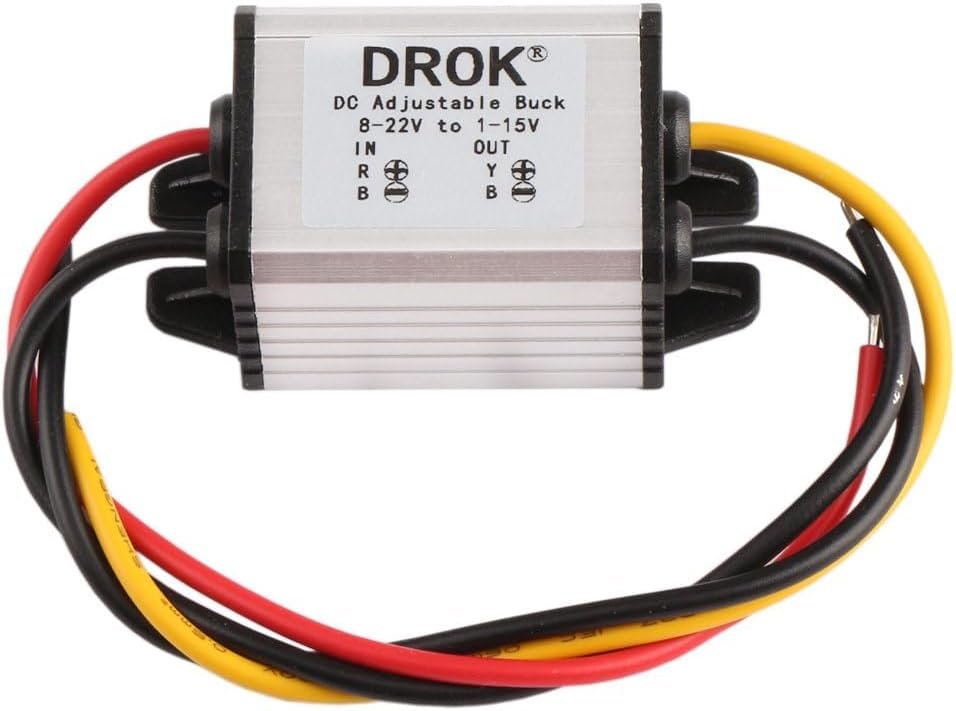
| 🚗 DROK Waterproof Buck | Sealed sync buck | 8–22V | 3–15V | 3A | Best for Cars & Outdoors | Buy Here → |
We don’t list prices because they change daily. Most picks ship as multi-packs, so check the quantity on the listing. Tap “Buy Here” to see the current price and stock on Amazon.
🔍 What to Look for in a Step-Down Module
🔋
Input Range & Headroom
Match the module to your source: a 3S LiPo peaks at 12.6V, a 24V system can spike above 28V. Leave margin below the max input, and remember most bucks need the input 1.5–3V above the output to regulate.
⚡
Real Continuous Current
Ignore the headline number and plan for about 60–70% of it continuously. Add your peak loads (an ESP32 Wi-Fi burst, a servo stall, a Pi under load) and choose a module with headroom.
📏
Size & Mounting
MP1584EN and Mini-360 boards fit inside wearables and drones; LM2596 boards suit breadboards and enclosures; XL4016 and DROK units need space and airflow for their heatsinks.
🎚️
CV vs CC/CV Control
Plain modules regulate voltage only. CC/CV boards (XL4015, DROK) also limit current, which is what you need for driving high-power LEDs or charging lithium and lead-acid batteries.
🛡️
Protection & Display
Budget boards usually have no reverse-polarity or short-circuit protection. LCD and LED readouts make setup faster, and finished DROK units add reverse, over-current and over-temperature protection.
🏆 Detailed Reviews: All 8 Step-Down Modules
🥇 BEST OVERALL
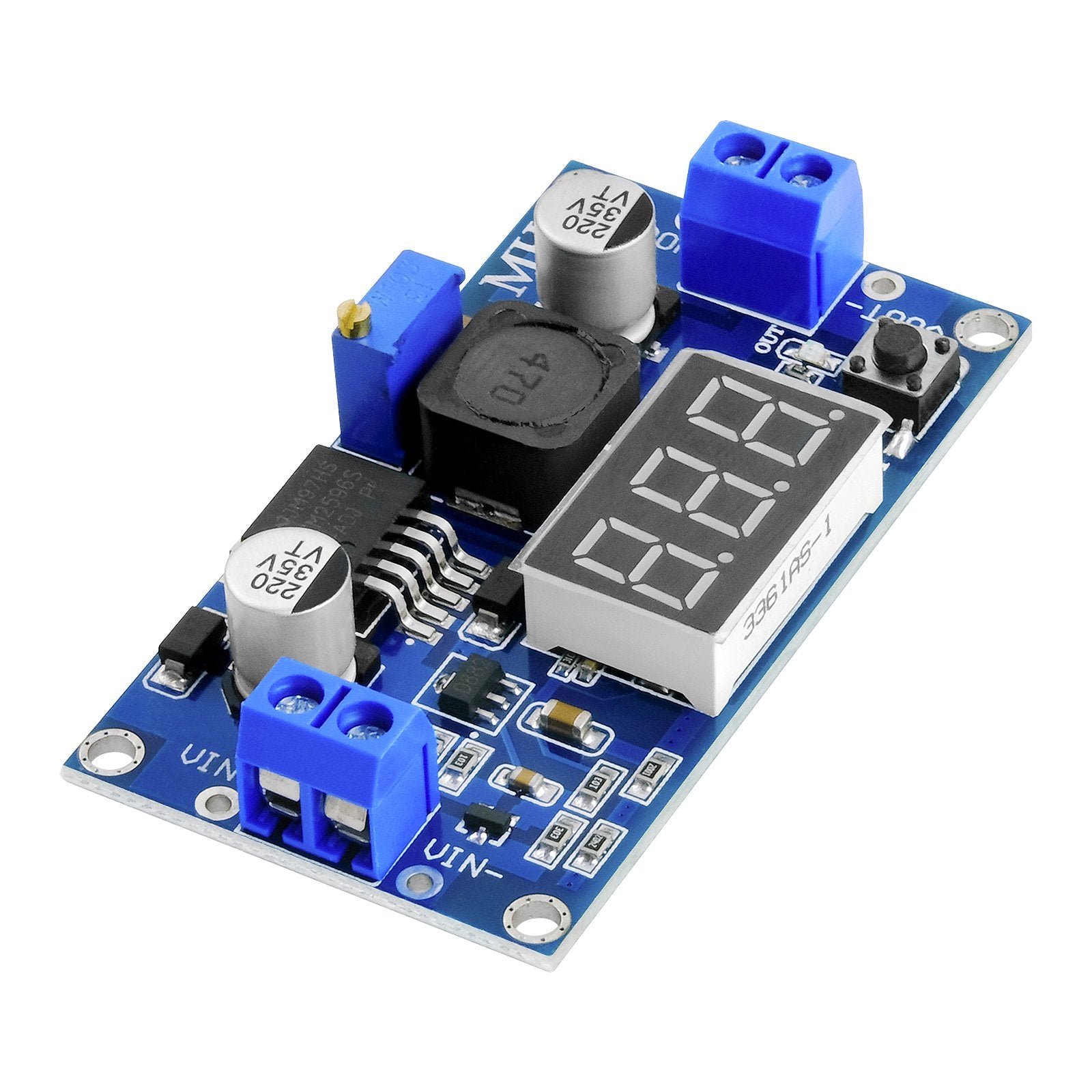
Valefod LM2596 with LED Display (3-Pack)
⭐ 4.6/5 · The Classic LM2596, With a Built-In Voltmeter
Buy on Amazon →

The LM2596 is the buck converter most makers learn on, and this Valefod three-pack is the version we’d actually buy. Each board adds a 3-digit LED voltmeter with a push button to switch between input and output readings, so you can dial in 5V or 3.3V with the blue multi-turn trimmer without reaching for a multimeter every time. The listing specifies 4–40V in, 1.5–35V out and 3A max, with screw terminals on both sides, so there’s no soldering for quick tests. The LM2596 runs at a modest 150 kHz, which makes it forgiving of layout and wiring, and its huge community means every forum fix and tutorial applies. It’s the default choice for powering an Arduino, ESP32 or sensor rig from a 12V or 24V supply.
✅ Pros- Built-in voltmeter for easy setup
- Very wide 4–40V input
- Screw terminals, no soldering
- Huge community and support
❌ Cons- Comfortable at ~2A, not 3A continuous
- Larger than MP1584-class boards
- No reverse-polarity protection
🎯 Verdict: The best step-down module for most projects. Wide input, a readout that saves time, and the most battle-tested buck chip in the hobby world.
👉 Check Price on Amazon →
🏅 BEST COMPACT & VALUE
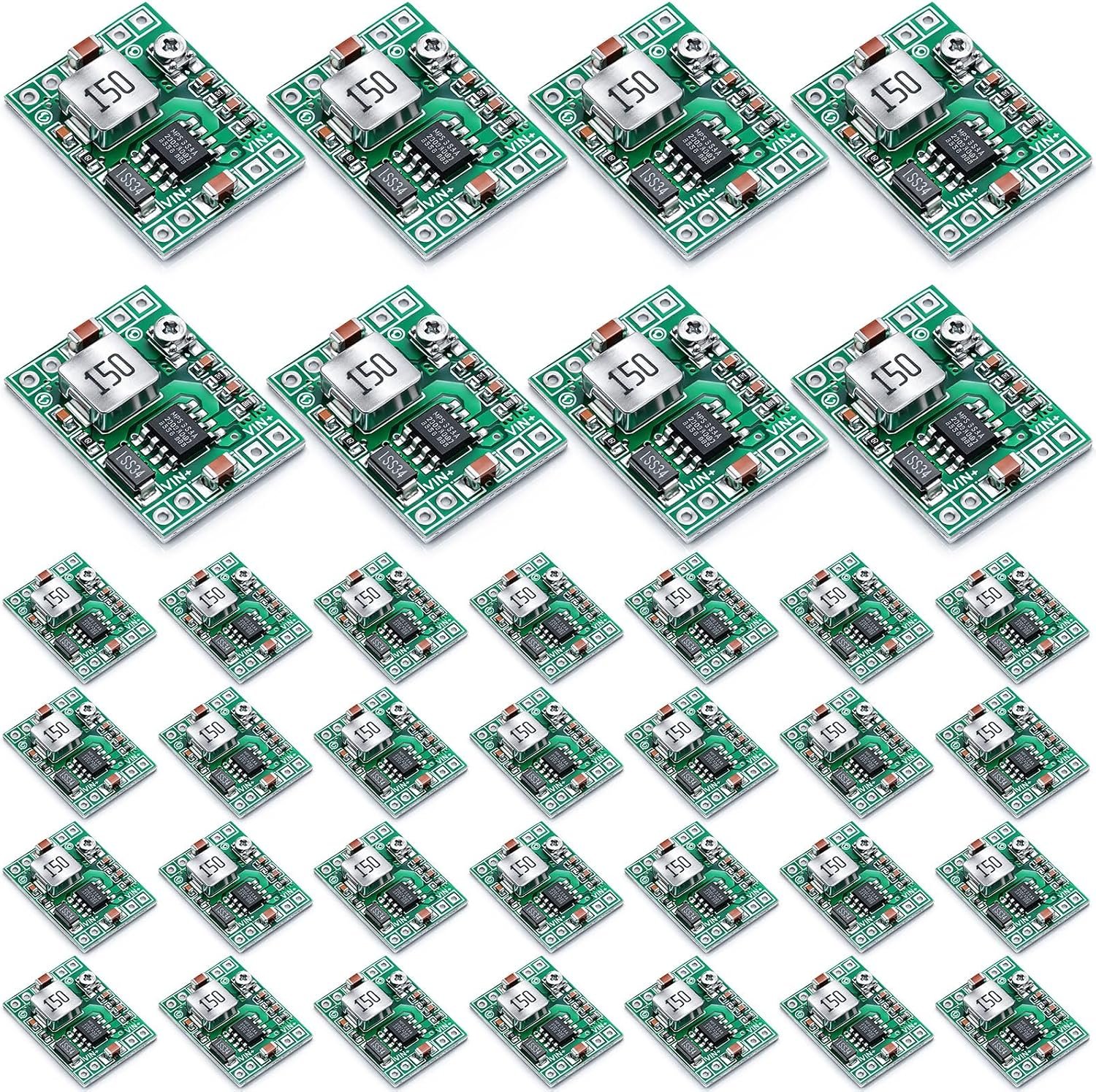
EBOOT MP1584EN Mini Buck (6-Pack)
⭐ 4.5/5 · Six Tiny 3A Bucks for the Price of One Big Board
Buy on Amazon →

The MP1584EN is what you reach for when space matters. This EBOOT six-pack puts the Monolithic Power chip on a board just 22 × 17 × 4 mm, small enough to hide inside a sensor node, a robot chassis or a 3D-printed enclosure. The listing quotes 4.5–28V in, 0.8–20V out, 3A max, up to 92% efficiency and under 30 mV of output ripple, and the high switching frequency (around 1 MHz) is why the inductor can be so small. Its 0.8V minimum output also covers low-voltage rails that an LM2596 can’t reach. With six boards in the pack, you can drop one into every project instead of sharing one module across the bench.
✅ Pros- Tiny 22 × 17 mm footprint
- Six boards per pack
- Low ripple, high efficiency
- Output down to 0.8V
❌ Cons- Solder pads, no terminals
- Tiny trimmer is easy to over-turn
- Gets hot above ~2A continuous
🎯 Verdict: The best compact and best value buck module. Perfect for embedding a clean 5V or 3.3V rail anywhere in your build.
👉 Check Price on Amazon →
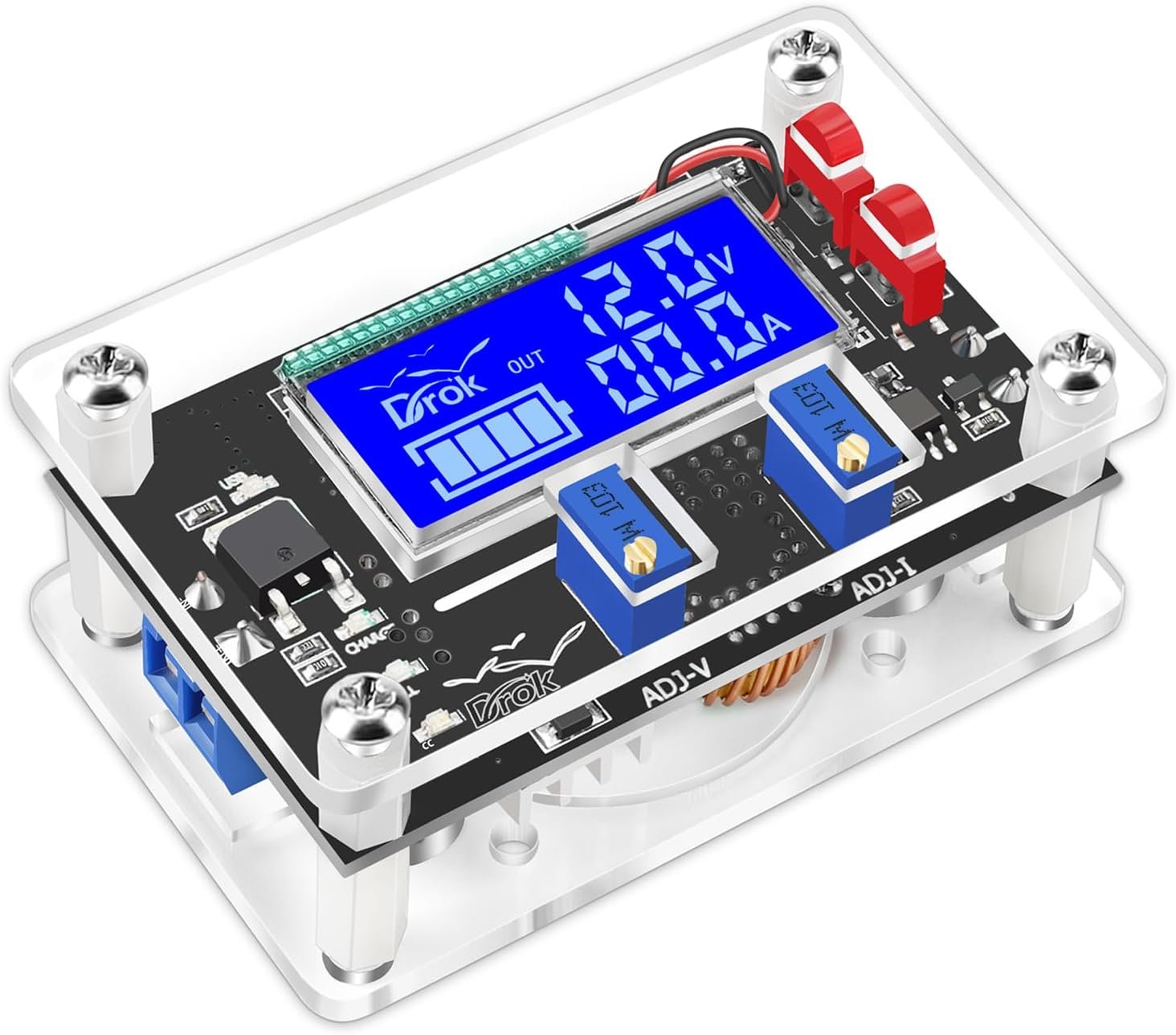
🖥️ BEST FOR BENCH USE · ⭐ 4.5/53. DROK 5A LCD Buck Converter with USB
6–32V in · 1.5–32V out · 5A max (4.5A recommended) · 75W · CC/CV · LCD V/A · USB port · case
Buy Here →

The DROK 5A LCD buck converter is closer to a tiny bench supply than a bare module. A large LCD shows output voltage and current at the same time, two trimmers set constant-voltage and constant-current limits, and a USB port lets you charge or power USB gadgets directly. It ships in a protective acrylic case and the listing adds short-circuit, over-temperature and input reverse-connection protection. DROK recommends staying within 4.5A and 50W for long runs. Note that the output ships set to around 20V, so adjust it before connecting anything sensitive.
✅ Pros: Live V and A readout; CC/CV mode; USB output; case and protections included.
❌ Cons: Larger than bare modules; 50W recommended continuous; default 20V output needs adjusting first.
🎯 Verdict: The best buck converter for bench work and prototyping. You see exactly what your circuit draws, and the current limit protects it.
👉 Check Price on Amazon →
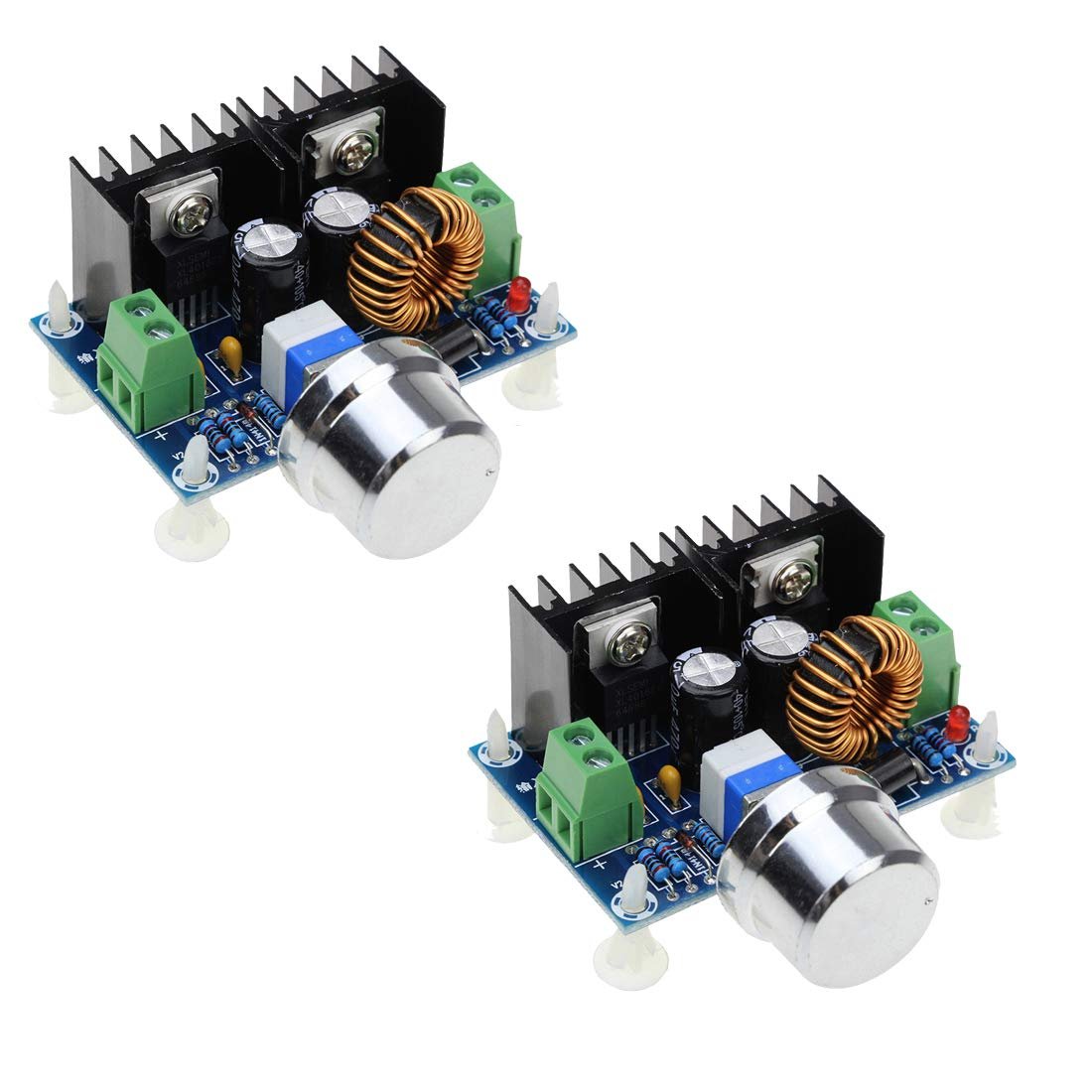
🔥 BEST BUDGET HIGH-CURRENT · ⭐ 4.2/54. HiLetgo XL4016 8A (2-Pack)
XL4016E1 · 4–40V in · 1.25–36V out · 8A / 200W rated · 180 kHz · 94% listed efficiency · 2 boards
Buy Here →

When an LM2596 isn’t enough, the XL4016 is the next step up. This HiLetgo two-pack uses the XL4016E1 regulator and a separate Schottky diode, each on its own heatsink, and replaces the fiddly trimmer with a full-size potentiometer knob, so adjusting the output is quick. The listing rates it at 8A and 200W with 4–40V in and 1.25–36V out, which covers 12V LED strips, motor drivers and a Raspberry Pi 5 with headroom. Realistically, plan on about 5A continuous without a fan. Reviews are more mixed than our top picks, so test each board under load before relying on it.
✅ Pros: Handles several amps; easy knob adjustment; very wide input and output range; two boards per pack.
❌ Cons: 8A needs active cooling; mixed QC in reviews; no display or protection.
🎯 Verdict: The best budget pick for high-current loads. Derate it sensibly and it powers jobs that would cook an LM2596.
👉 Check Price on Amazon →
⚡ BEST HIGH-POWER · ⭐ 4.6/55. DROK 12A CC/CV LCD Buck Converter
5.3–32V in · 1.2–32V out · 8A / 120W continuous (12A peak) · CC/CV · LCD V-in/V-out/A/W · 0.05V precision
Buy Here →

The DROK 12A CC/CV converter is the most capable unit in this roundup. The listing is refreshingly honest: 8A and 120W for long-term operation, with the 12A figure as a peak. A backlit LCD shows input voltage, output voltage, output current and output power, voltage precision is 0.05V, and a button switches the output on and off (you can even choose the default power-on state). It comes with an acrylic case and heatsink, plus reverse-connection and short-circuit protection. It’s ideal for RV and solar systems, 24V to 12V conversion, and high-power LED or battery charging jobs.
✅ Pros: Honest 8A continuous rating; full V/A/W display; CC/CV with output on/off; case and heatsink included.
❌ Cons: Bulky for embedded builds; costs more than bare modules; 32V max input rules out 36V+ systems.
🎯 Verdict: The best high-power step-down converter. Buy this when you need real amps with a display and protection built in.
👉 Check Price on Amazon →
🔋 BEST FOR LEDS & CHARGING · ⭐ 4.3/56. HiLetgo XL4015 5A CC/CV (3-Pack)
XL4015 · 5–32V in · 0.8–30V out · adjustable up to 5A constant current · CC/CV · 3 boards
Buy Here →

The HiLetgo XL4015 CC/CV module has two trimmers instead of one: one sets the output voltage and the other sets a current limit up to 5A. That constant-current mode is exactly what you need to drive high-power LEDs without a resistor, or to charge lithium and lead-acid batteries with a CC/CV profile. Indicator LEDs show charging and charge-complete states. The listing quotes 5–32V in and 0.8–30V out, and you get three boards per pack. It uses non-synchronous rectification, so expect it to run warm near its limit.
✅ Pros: True CC/CV control; good for LEDs and battery charging; three boards per pack; charge status LEDs.
❌ Cons: No display, so you need a multimeter; runs warm near 5A; no input protection.
🎯 Verdict: The best budget CC/CV module. If you’re driving LEDs or charging batteries, the current limit is worth having.
👉 Check Price on Amazon →
🐜 SMALLEST MODULE · ⭐ 4.2/57. DAOKAI Mini-360 (10-Pack)
MP2307 · 4.75–23V in · 1.0–17V out · 3A peak · up to 96% efficiency · 17 × 12 × 3.8 mm · 10 boards
Buy Here →

The Mini-360 is the smallest adjustable buck you can buy, at just 17 × 12 × 3.8 mm. This DAOKAI ten-pack uses the synchronous MP2307 chip with an integrated shielded inductor, and the listing quotes 4.75–23V in, 1.0–17V out, up to 96% efficiency and an automatic thermal shutdown around 85 °C. It’s the go-to module for RC aircraft, drones, wearables and tight PCB retrofits. Keep it under roughly 1.5A continuous, since a board this small has very little copper to shed heat.
✅ Pros: Tiny footprint; synchronous and efficient; ten boards per pack; integrated shielded inductor.
❌ Cons: Low real-world continuous current; 23V max input; tiny pads and trimmer are fiddly.
🎯 Verdict: The best choice when every millimetre counts. Ideal for light 5V and 3.3V loads in very tight spaces.
👉 Check Price on Amazon →
🚗 BEST FOR CARS & OUTDOORS · ⭐ 4.4/58. DROK Waterproof Buck Converter
8–22V in · 3–15V out · 3A · synchronous rectification · sealed aluminium case · reverse, OC, OT & OV protection
Buy Here →

The DROK waterproof buck converter is built for the places bare PCBs fail: cars, boats, garden sensors and anything that sees vibration or moisture. The electronics are fully sealed in an aluminium enclosure that doubles as the heatsink, with pre-attached wire leads instead of screw terminals. The listing quotes 8–22V in, 3–15V out at 3A, synchronous rectification, and reverse-connection, over-current, over-heating and over-voltage protection. The adjustment pot sits underneath, so it won’t drift once mounted. Keep the input at least 3V above the output.
✅ Pros: Sealed and vibration-resistant; full protection set; enclosure acts as heatsink; set-and-forget pot.
❌ Cons: 22V max input; 3A only; no display, so set it with a multimeter.
🎯 Verdict: The best rugged step-down module for 12V vehicle and outdoor projects.
👉 Check Price on Amazon →
🛒 How to Choose the Right Step-Down Module
🧪
Powering an Arduino or ESP32 from 12V?
Get the Valefod LM2596 with display: wide input, easy setup and plenty of current for MCU projects.
📦
Need a 5V or 3.3V rail inside a small enclosure?
The EBOOT MP1584EN fits almost anywhere, and you get six boards per pack.
🍓
Running a Raspberry Pi 5 or LED strip?
Use the HiLetgo XL4016 or, for a display and protection, the DROK 12A CC/CV.
🖥️
Want a mini bench supply?
The DROK 5A LCD with USB shows live voltage and current and limits current to protect prototypes.
🔋
Charging batteries or driving power LEDs?
Pick the HiLetgo XL4015 CC/CV module and set the current limit first.
🚗
Building for a car, boat or outdoors?
The sealed DROK waterproof buck handles vibration, moisture and 12V automotive rails.
⚙️ Key Specs Compared: Side by Side
| Spec | Valefod LM2596 | EBOOT MP1584EN | HiLetgo XL4016 | HiLetgo XL4015 | DROK 12A CC/CV |
|---|
| Input Voltage | 4–40V ⭐ | 4.5–28V | 4–40V ⭐ | 5–32V | 5.3–32V |
| Output Voltage | 1.5–35V | 0.8–20V ⭐ | 1.25–36V | 0.8–30V ⭐ | 1.2–32V |
| Rated Current | 3A max | 3A max | 8A / 200W | 5A (CC adj.) | 8A cont. / 12A peak ⭐ |
| Board Size | 57 × 36 × 13 mm | 22 × 17 × 4 mm ⭐ | Large, 2 heatsinks | Medium | Cased, largest |
| Display | 3-digit LED (V) | None | None | None | LCD V/A/W ⭐ |
| Constant Current | No | No | No | Yes ⭐ | Yes ⭐ |
| Units per Pack | 3 | 6 ⭐ | 2 | 3 | 1 |
Specs are taken from the live Amazon listings and can vary by batch or revision. Rated currents are listing figures; plan for less in continuous use. Always confirm details on the listing before buying.
❓ Frequently Asked Questions
Should I use a buck converter or a linear regulator like the 7805 or AMS1117?
Use a buck converter whenever the voltage drop or the current is significant. A linear regulator wastes the voltage difference as heat: dropping 12V to 5V at 1A burns 7W in a 7805, which needs a big heatsink. A buck module does the same job at around 85–95% efficiency and stays cool. Linear regulators still win for very low currents, ultra-low-noise analog rails, or as a quiet post-regulator after a buck.
How do I set the output voltage safely?
Power the module with no load attached, put a multimeter on the output, and turn the trimmer until you read the target voltage. Most modules use a multi-turn trimmer, so it can take 10 to 20 turns before the output starts to move; on LM2596 boards, turning counter-clockwise usually lowers the voltage. Only connect your Arduino, ESP32 or Pi after the reading is stable, and re-check it under load.
Can these modules power a Raspberry Pi or ESP32?
An ESP32 or Arduino is easy: any module here can supply 5V or 3.3V at a few hundred milliamps, with headroom for Wi-Fi bursts. A Raspberry Pi 4 needs a solid 5V at up to 3A, which is beyond a cheap LM2596 or MP1584 in continuous use. A Raspberry Pi 5 wants 5V at up to 5A for full USB power. For a Pi, use the XL4016 or DROK 12A, set the output to about 5.1V, and use short, thick wires to avoid voltage drop.
Are the current ratings on cheap buck modules real?
They are best-case peak figures. Heat limits these boards long before the chip’s theoretical maximum. As a rule of thumb, run LM2596, MP1584EN and Mini-360 boards at roughly 1.5–2A continuous, an XL4015 at about 3–4A, and an XL4016 at around 5A unless you add a fan. Branded units like the DROK 12A quote a separate long-term rating (8A, 120W), which is the number to design around.
Why does my buck converter output the same voltage as the input, or not regulate at all?
The most common causes are an input that is too close to the target output (bucks need 1.5–3V of headroom), a trimmer that has been turned to its end stop, or a board damaged by reverse polarity or a short. Counterfeit or failed regulator chips can also pass the input straight through, which is why you should always measure the output before connecting your circuit. If a module outputs full input voltage, retire it rather than trusting it.
🏁 Final Verdict: Best Step-Down Module for Every Build
The right buck converter for every load, size and budget:
🥇 Best Overall: Valefod LM2596 with LED display, the classic 4–40V buck with a built-in voltmeter
Buy Here →🏅 Best Compact & Value: EBOOT MP1584EN six-pack, 3A bucks at 22 × 17 mm
Buy Here →🖥️ Best for Bench Use: DROK 5A LCD with USB, live V/A readout and CC/CV
Buy Here →🔥 Best Budget High-Current: HiLetgo XL4016 two-pack, 8A rated with an easy adjustment knob
Buy Here →⚡ Best High-Power: DROK 12A CC/CV, 8A continuous with a full LCD and protection
Buy Here →🔋 Best for LEDs & Charging: HiLetgo XL4015 CC/CV, adjustable current limit up to 5A
Buy Here →🐜 Smallest Module: DAOKAI Mini-360 ten-pack, 17 × 12 mm synchronous buck
Buy Here →🚗 Best for Cars & Outdoors: DROK waterproof buck, sealed and fully protected
Buy Here →For most microcontroller projects the Valefod LM2596 with display is the step-down module to buy: wide input, a built-in voltmeter and the most proven buck chip around. When space is tight, the EBOOT MP1584EN or the even smaller Mini-360 will hide anywhere. For serious current, choose the HiLetgo XL4016 on a budget or the DROK 12A CC/CV for a display and protection, grab the XL4015 for LEDs and battery charging, and the sealed DROK waterproof buck for vehicles. Building out your power setup? See our best power supplies for microcontroller projects, our programmable DC power supply picks, the best LiPo battery charger modules, and our guide to the LTC3780 DC-DC step-up module when you need to boost instead of buck. Then dive into our Arduino, ESP32, STM32 and Raspberry Pi tutorials and start building.
💬 Not sure which module fits your build? Tell us your input voltage, the voltage you need and how much current your load draws in the comments below, and we’ll point you to the right step-down converter.
All Amazon links above use our affiliate tag (microlab05-20). Purchasing through them supports microcontrollerslab.com at no extra cost to you. Prices and availability change frequently, so always confirm the current price on Amazon before buying.