⚠️ Affiliate Disclosure: This post contains Amazon affiliate links. If you purchase through our links, we may earn a small commission at no extra cost to you. We only recommend products we have thoroughly researched and verified.
Ultimate Buying Guide 2026
📡 Best LoRa Modules for Long Range IoT
9 LoRa & LoRaWAN modules ranked for long-range IoT — from a $6 UART transceiver to a Meshtastic-ready GPS node — with real specs, honest verdicts and direct Amazon links.
✅ 9 Modules Reviewed
✅ Verified Amazon ASINs
✅ Updated June 2026
✅ Honest Pros & Cons
A LoRa module is the cheapest, simplest way to send small amounts of data over remarkable distances — kilometres, not metres — while sipping so little power that a node can run for years on a coin cell. Where Wi-Fi and Bluetooth top out at a room or a building, LoRa’s spread-spectrum modulation trades raw speed for range and robustness, which is exactly what most IoT sensors actually need: a soil-moisture probe, a gate sensor, a water-tank float or a GPS tracker doesn’t need megabits, it needs to be heard from across a farm, a city or a valley.
The hard part is choosing the right module, because “LoRa module” covers everything from a bare $6 transceiver you wire yourself to a complete ESP32 board with an OLED, Wi-Fi and GPS. Some speak raw SPI to a microcontroller, some take simple AT commands over a serial port, and some run a full LoRaWAN stack that talks to The Things Network. This guide ranks 9 LoRa modules across every use case and budget — point-to-point links, LoRaWAN nodes, Raspberry Pi HATs and Meshtastic trackers — with the specs that actually matter so you can match the radio to your project.
💡 Reality check before you buy: Those headline ranges — “10 km!”, “15 km!” — are line-of-sight, ideal-antenna, slowest-data-rate numbers. In a real town with buildings and trees, expect a few hundred metres to a couple of kilometres unless you raise the antenna and slow the data rate. Frequency is legal, not optional: use 915 MHz in North America, 868 MHz in Europe and 433 MHz where permitted — a mismatched band can be illegal and won’t talk to your gateway. Most bare modules run on 3.3 V logic and will be damaged by a 5 V Arduino without level shifting, and almost none include an antenna worth keeping. Finally, two radios must match: same chip family, same frequency, same settings.
📡 Quick Comparison — All 9 LoRa Modules
| LoRa Module | Chip / Type | Interface | Best For | Price* | Buy |
|---|
| 🥇 Heltec WiFi LoRa 32 V3 | ESP32-S3 + SX1262 | All-in-one board | Best Overall | ~$22 | View → |
| 🛰️ LILYGO T-Beam V1.2 | ESP32 + SX1276 + GPS | All-in-one board | Best for GPS / Meshtastic | ~$40 | View → |
| 🍓 Waveshare SX1262 LoRa HAT | SX1262 | Raspberry Pi HAT (UART) | Best for Raspberry Pi | ~$25 | View → |
| 🧰 Adafruit RFM95W Breakout | SX1276 | SPI breakout | Best for Makers | ~$20 | View → |
| 🔌 REYAX RYLR998 | SX1262 | UART (AT commands) | Best Plug-and-Play | ~$22 | View → |
| 📶 EBYTE E32-900T20D | SX1276 | UART (transparent) | Best Point-to-Point | ~$11 | View → |
| ⚙️ HopeRF RFM95W | SX1276 | SPI (bare module) | Best Bare Transceiver | ~$13 | View → |
| 💵 Ai-Thinker Ra-02 | SX1278 (433 MHz) | SPI (bare module) | Best Budget 433 MHz | ~$8 | View → |
| 🌐 SX1262 LoRaWAN/GNSS HAT | SX1262 + GNSS | Raspberry Pi HAT | Best for LoRaWAN + GPS | ~$48 | View → |
*Approximate Amazon prices at time of writing. Frequency variants (433/868/915 MHz) and multi-packs change the price. Always confirm the current price and your local band on Amazon.
🔍 What to Look for in a LoRa Module
📻
Chip & Frequency
SX1276/77/78/79 are the classic LoRa chips; the newer SX1262 adds lower power and better sensitivity. Match the band to your region: 915 MHz (US), 868 MHz (EU), 433 MHz where allowed.
🔌
Interface
Bare modules speak SPI (most control, most wiring). UART “AT command” or transparent modules are far easier — send bytes in, they come out the other radio. All-in-one boards bundle the MCU too.
📈
Output Power & Sensitivity
Look for +20–22 dBm TX power and sensitivity around -148 dBm. Together they set your link budget — the real driver of range, more than any marketing distance figure.
🌐
LoRa vs. LoRaWAN
Raw LoRa P2P is two radios talking directly — simplest. LoRaWAN adds a network layer, gateways and servers like The Things Network. Pick modules with a real LoRaWAN stack if you need that.
🔋
Power & Antenna
Most modules are 3.3 V logic — protect them from 5 V boards. Battery projects want low sleep current (SX1262 shines). And a good antenna matched to your band matters more than another few dBm.
🏆 Detailed Reviews — All 9 LoRa Modules
🥇 BEST OVERALL
Heltec WiFi LoRa 32 V3
⭐⭐⭐⭐⭐ 4.7/5 · Editor’s Choice
Buy on Amazon →

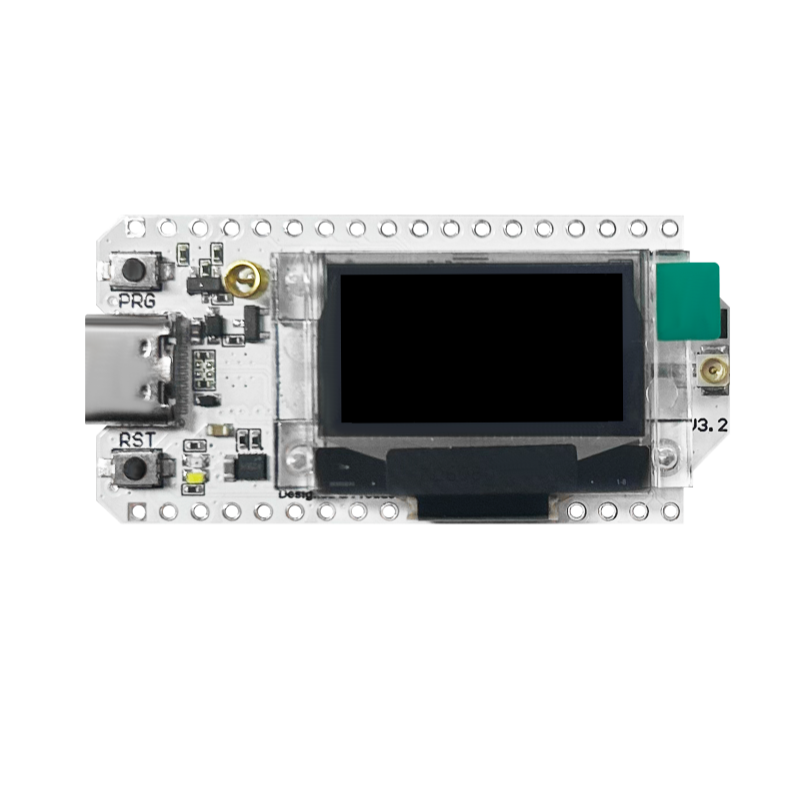
The Heltec WiFi LoRa 32 V3 is the module we hand to almost everyone, because it isn’t just a radio — it’s a complete IoT node. An ESP32-S3 brain, an SX1262 LoRa radio, Wi-Fi, Bluetooth LE and a tiny OLED all live on a board the size of two postage stamps, powered and flashed over USB-C with onboard battery management. It runs Arduino, PlatformIO, ESP-IDF and MicroPython, and it’s the de-facto standard for Meshtastic and MeshCore mesh networking, so the community, code and tutorials are vast.
✅ Pros- Radio + MCU + OLED + Wi-Fi in one
- Low-power SX1262, USB-C, battery mgmt
- Best-in-class Meshtastic support
- Huge community & code base
❌ Cons- No 5 V tolerance (it’s a 3.3 V board)
- Tiny stock antenna; upgrade it
- Overkill if you only need a bare radio
🎯 Verdict: The best all-round LoRa platform. If you want one board that does long-range radio plus Wi-Fi, OLED and Meshtastic out of the box, buy this.
👉 Check Price on Amazon: amazon.com/dp/B0DHGZKCL1 🛰️ BEST FOR GPS & MESHTASTIC
LILYGO T-Beam V1.2
⭐⭐⭐⭐⭐ 4.5/5 · The Tracker
Buy on Amazon →

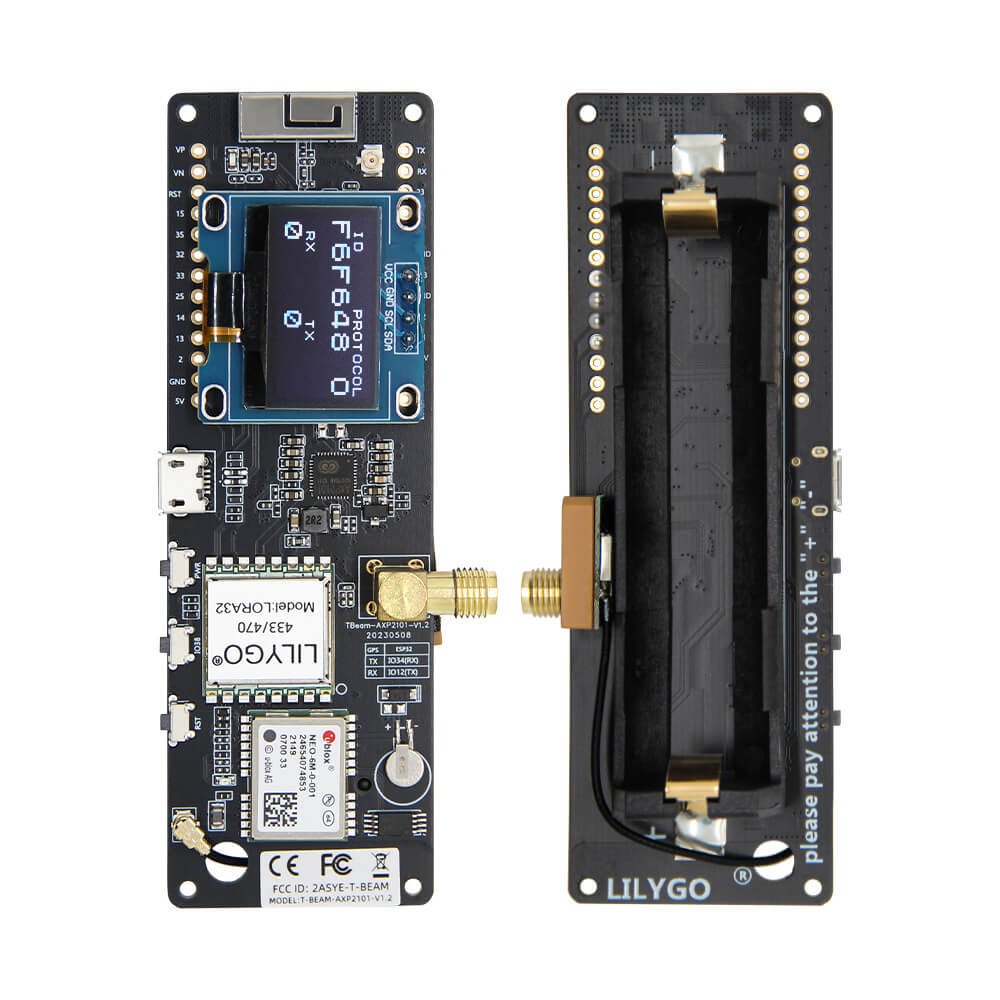
When your nodes move, the LILYGO T-Beam is the one to get. It bolts a NEO-6M GPS, an ESP32, an SX1276 LoRa radio, an AXP power-management chip and an 18650 battery holder onto a single board — everything a portable asset tracker or a Meshtastic node needs in the field. Flash the Meshtastic or SoftRF firmware and you have a pocket GPS mesh device in minutes; or write your own Arduino sketch. Pick the 915 MHz variant for the US (433/868/923 MHz options exist for other regions).
✅ Pros- Onboard GPS + LoRa + ESP32 + battery
- Perfect for Meshtastic / SoftRF trackers
- 18650 holder = truly portable
- OLED & multiple frequency options
❌ Cons- Stock GPS & LoRa antennas are weak
- Power-hungry vs. an SX1262 node
- Battery not included
🎯 Verdict: The best LoRa module for anything that moves. Onboard GPS plus a battery holder make it the default Meshtastic and asset-tracking board — just upgrade the antennas.
👉 Check Price on Amazon: amazon.com/dp/B0CZ6PDXW4 🍓 BEST FOR RASPBERRY PI · ⭐ 4.5/53. Waveshare SX1262 LoRa HAT
SX1262 · 915 MHz · UART · ~5 km · Pi 40-pin HAT · ~$25
Buy →

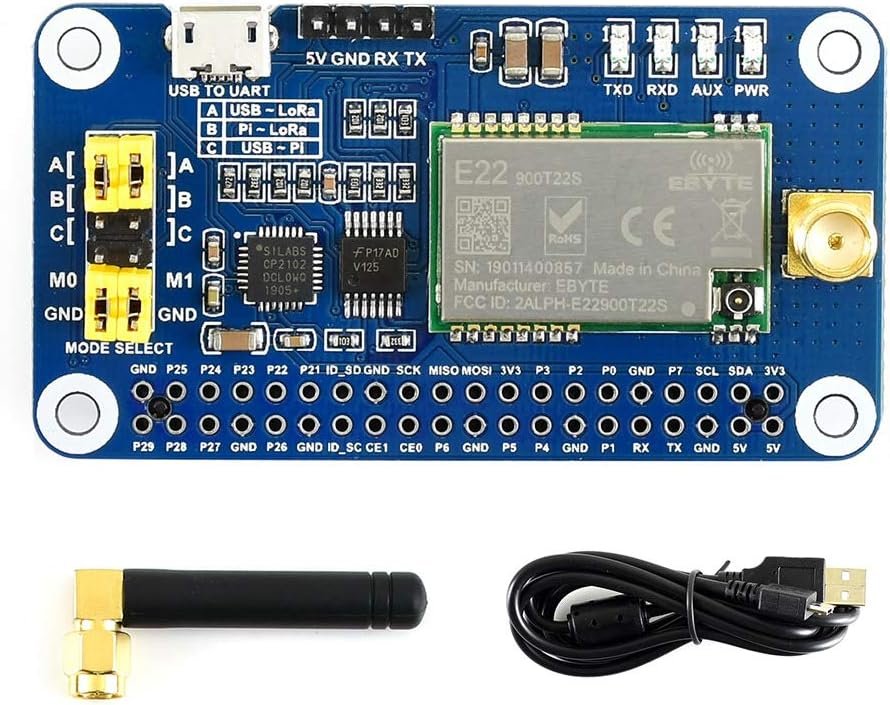
Drop the Waveshare SX1262 LoRa HAT onto a Raspberry Pi’s 40-pin header and you have long-range radio without any soldering. It talks over UART (with an onboard CP2102 USB-UART for debugging), supports the full 915 MHz band, and adds genuinely useful features like wake-on-radio, carrier-sense and a built-in transparent-transmission mode for up to ~5 km. It also works with Arduino and STM32, making it a flexible bridge between a Pi gateway and field nodes.
✅ Pros: Plug-on Pi HAT, no soldering; SX1262 low power; wake-on-radio & carrier sense; works with Pi/Arduino/STM32.
❌ Cons: Raw LoRa, not a turnkey LoRaWAN stack; one node per Pi; buy the correct band for your region.
🎯 Verdict: The easiest way to add long-range LoRa to a Raspberry Pi project or a single-channel test gateway.
🧰 BEST FOR MAKERS · ⭐ 4.6/54. Adafruit RFM95W LoRa Breakout
SX1276 · 868/915 MHz · +20 dBm · SPI · great libraries · ~$20
Buy →

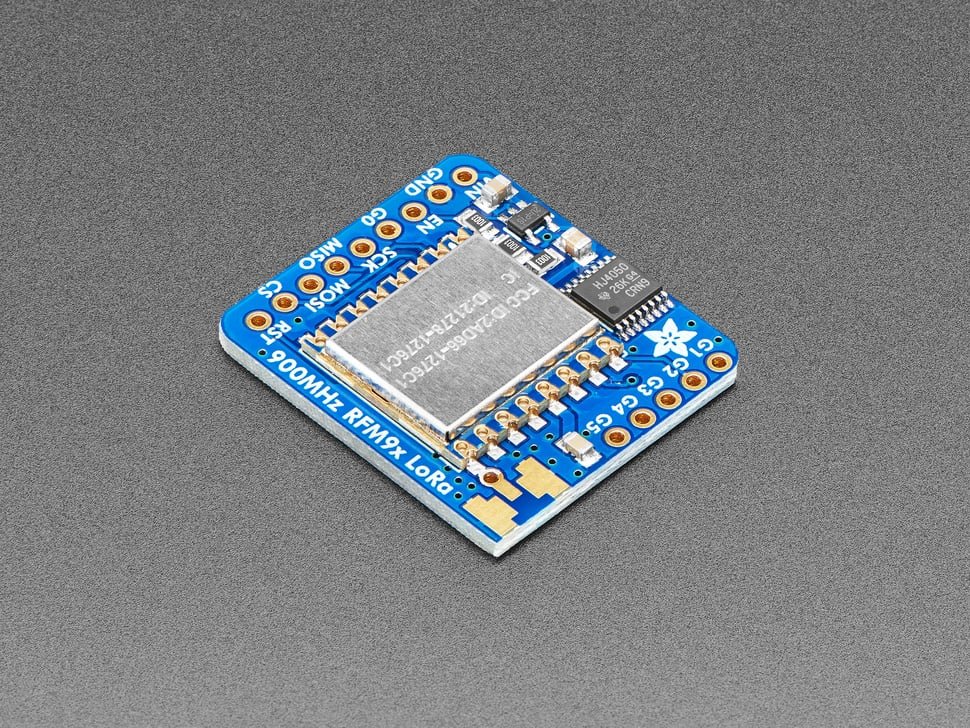
The Adafruit RFM95W RadioFruit breakout is the maker’s favourite for a reason: it takes the raw SX1276 and adds a 3.3 V regulator and logic level-shifting so it works safely with 3 V or 5 V microcontrollers, plus Adafruit’s superb Arduino and CircuitPython libraries and learn guides. It’s +20 dBm, reaches roughly 2 km on a simple wire antenna (much more with a directional one) and is the smoothest on-ramp to LoRa and even LoRaWAN/The Things Network for hobbyists.
✅ Pros: Onboard regulator + level shifting (3–5 V safe); excellent libraries & tutorials; uFL/SMA/wire antenna options; reliable.
❌ Cons: Pricier than generic RFM95 modules; header soldering required; no MCU (you supply it).
🎯 Verdict: The most beginner-friendly bare LoRa radio. Pay a little extra for the safety net of great docs and level shifting.
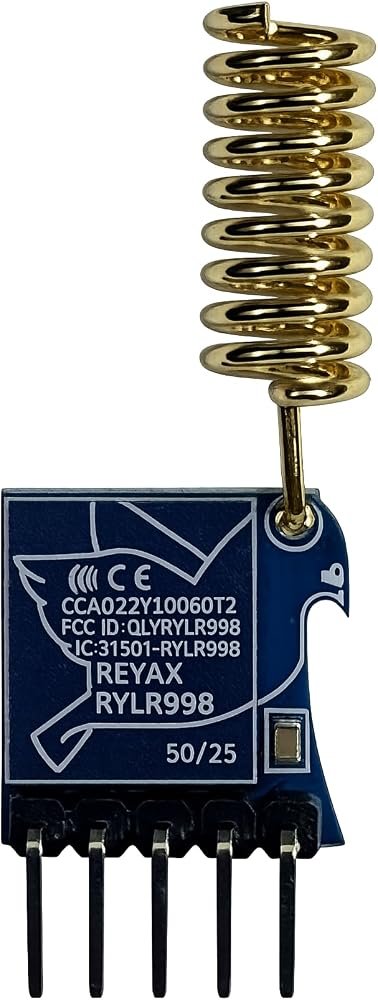
🔌 BEST PLUG-AND-PLAY · ⭐ 4.6/55. REYAX RYLR998
SX1262 · 868/915 MHz · UART AT commands · FCC/CE/IC · ~$22
Buy →

If wiring SPI and learning a radio library sounds like a chore, the REYAX RYLR998 is the antidote. It hides an SX1262 behind dead-simple AT commands over UART — type AT+SEND, the data appears at the other module. It’s FCC/CE/IC certified (important if you ever sell a product), ships with an antenna, and works with any Arduino, ESP32, STM32 or Raspberry Pi using just TX/RX pins. For point-to-point links it’s the fastest path from box to working radio.
✅ Pros: Trivial AT-command interface; SX1262 + antenna included; certified for product use; works with any UART host.
❌ Cons: Less low-level control than raw SPI; not a LoRaWAN stack; 3.3 V logic only.
🎯 Verdict: The easiest LoRa module to get talking. Ideal for beginners and quick, reliable point-to-point telemetry.
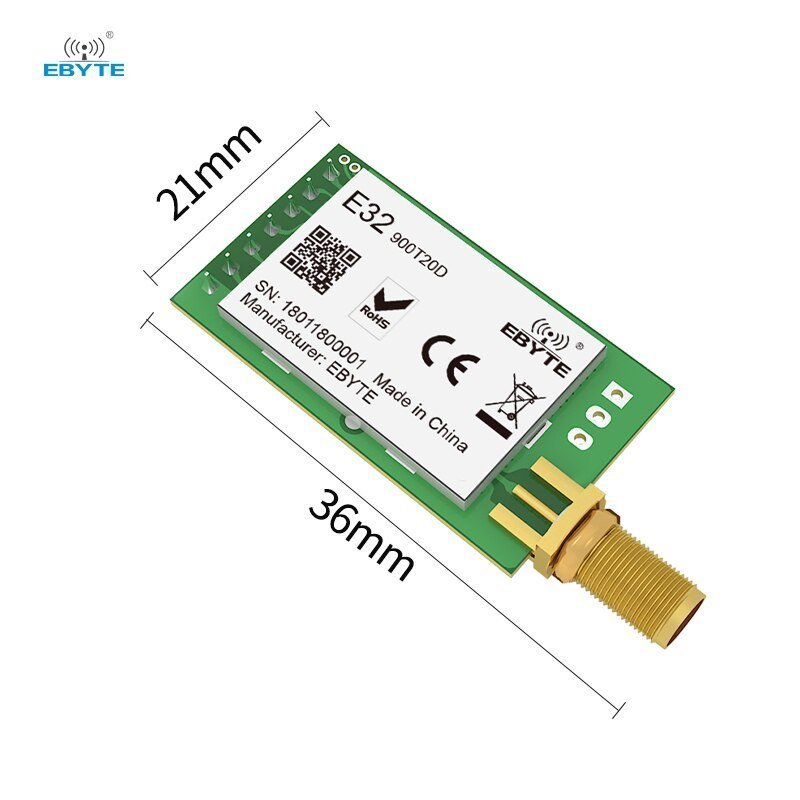
📶 BEST POINT-TO-POINT · ⭐ 4.4/56. EBYTE E32-900T20D
SX1276 · 862–931 MHz · 20 dBm/100 mW · 5.5 km · UART · ~$11
Buy →
The EBYTE E32-900T20D is a workhorse “transparent transmission” module: feed bytes into its UART on one end and they pop out the radio on the other, no protocol to learn. It pushes 20 dBm (100 mW) for a rated 5.5 km, buffers and auto-splits long packets, and runs on 2.3–5.5 V (with 3.3 V TTL signalling). At around $11 with an SMA antenna it’s the value pick for a simple, reliable long-range link between two microcontrollers.
✅ Pros: Transparent UART — zero protocol; 20 dBm/5.5 km rated; auto sub-packeting; cheap, includes antenna.
❌ Cons: TX/RX strictly 3.3 V — 5 V can fry it; config via mode pins is fiddly; not LoRaWAN.
🎯 Verdict: The best cheap point-to-point link. Two of these plus two Arduinos is the fastest long-range serial cable replacement there is.
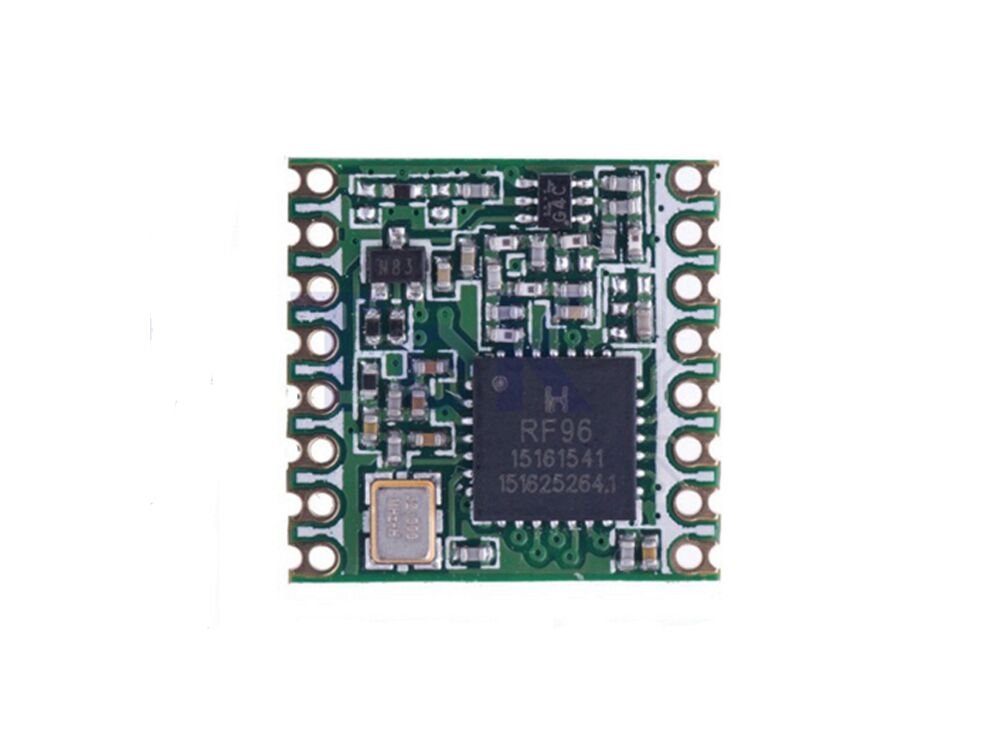
⚙️ BEST BARE TRANSCEIVER · ⭐ 4.3/57. HopeRF RFM95W
SX1276 · 915 MHz · +20 dBm · -148 dBm · SPI · ~$13
Buy →

The HopeRF RFM95W is the actual radio inside most of the breakouts above — the bare SX1276-based module, sold here by a US seller for fast shipping. With +20 dBm output and -148 dBm sensitivity it has an excellent link budget, and it’s the right choice when you’re designing your own PCB or integrating LoRa into a product and don’t want to pay for a breakout. The trade-off: it’s a raw 2 mm-pitch module, so you handle level shifting, antenna and soldering yourself.
✅ Pros: Genuine HopeRF radio; superb -148 dBm sensitivity; cheap per unit; ideal for custom PCBs/products; US shipping.
❌ Cons: Bare module — you add level shifting + antenna; 2 mm pitch is fiddly to solder; no libraries bundled.
🎯 Verdict: The best bare transceiver for integrators. Buy it when you’re building your own hardware, not prototyping on a breadboard.
💵 BEST BUDGET 433 MHz · ⭐ 4.3/58. Ai-Thinker Ra-02
SX1278 · 433 MHz · +20 dBm · -148 dBm · SPI · IPEX · ~$8
Buy →

The Ai-Thinker Ra-02 is the budget classroom and hobby favourite. Built on the SX1278 at 433 MHz, it offers +20 dBm output, -148 dBm sensitivity and an IPEX antenna connector for around $8 — making it the cheapest way to get two microcontrollers talking over a kilometre or more. The lower 433 MHz band penetrates obstacles slightly better than 915 MHz, though check that it’s licence-free in your country. It speaks SPI and works with the popular RadioHead/LoRa Arduino libraries.
✅ Pros: Dirt cheap (~$8); +20 dBm / -148 dBm; IPEX connector for a proper antenna; well-supported in Arduino libraries.
❌ Cons: 433 MHz only (band legality varies); 3.3 V logic; no onboard antenna; solder a 1.27 mm header.
🎯 Verdict: The best budget entry into LoRa. Grab two for under $20 and learn point-to-point radio on the 433 MHz band.
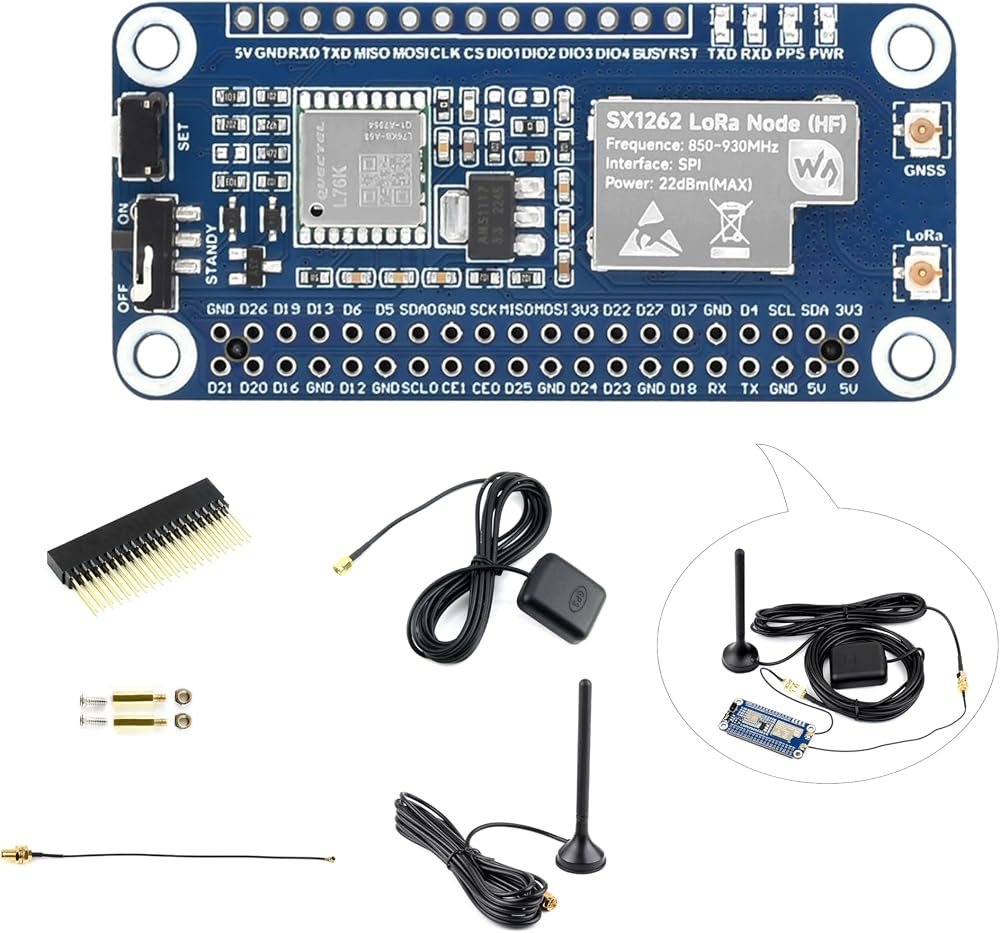
🌐 BEST FOR LoRaWAN + GPS · ⭐ 4.4/59. SX1262 LoRaWAN/GNSS HAT
SX1262 + GNSS · 915 MHz · TTN/ChirpStack-ready · Pi HAT · ~$48
Buy →

For a proper LoRaWAN node with geolocation, this SX1262 + GNSS HAT is the most capable pick here. It pairs an SX1262 LoRa radio with a multi-constellation GNSS receiver on a Raspberry Pi HAT, and ships with example code for The Things Network and ChirpStack — so you’re sending uplinks to a real LoRaWAN server, with GPS position, rather than just doing raw P2P. A magnetic CB antenna and GNSS antenna are included. It’s the priciest module on the list, but it’s also the only true LoRaWAN-plus-GPS solution.
✅ Pros: Real LoRaWAN stack (TTN/ChirpStack); onboard GNSS for geolocation; Pi HAT form factor; antennas included.
❌ Cons: Most expensive pick (~$48); needs a LoRaWAN gateway in range; steeper setup than raw P2P modules.
🎯 Verdict: The best module for building a real LoRaWAN sensor or tracker that reports to The Things Network with GPS.
🛒 How to Choose the Right LoRa Module
🥇
Just Starting Out?
Get the Heltec WiFi LoRa 32 V3 — radio, MCU, Wi-Fi and OLED in one, with the biggest community behind it (~$22).
🛰️
Tracking Something That Moves?
The LILYGO T-Beam adds GPS and a battery holder — the default for Meshtastic and asset trackers.
🍓
Building on Raspberry Pi?
The Waveshare SX1262 LoRa HAT plugs straight onto the GPIO header — no soldering, instant long-range radio.
🔌
Want the Easiest Link?
The REYAX RYLR998 (AT commands) or EBYTE E32 (transparent UART) get two boards talking with almost no code.
🌐
Need LoRaWAN / The Things Network?
The SX1262 LoRaWAN/GNSS HAT runs a real LoRaWAN stack with GPS — for production-style sensor nodes.
💵
On a Tight Budget?
The Ai-Thinker Ra-02 (~$8) or HopeRF RFM95W (~$13) deliver real LoRa range for the price of lunch.
⚙️ Key Specs Compared — Side by Side
| Spec | Heltec V3 | T-Beam | Waveshare HAT | Adafruit RFM95W | REYAX 998 | EBYTE E32 |
|---|
| Radio chip | SX1262 ⭐ | SX1276 | SX1262 ⭐ | SX1276 | SX1262 ⭐ | SX1276 |
| Onboard MCU | ESP32-S3 ⭐ | ESP32 ⭐ | No | No | No | No |
| Interface | Built-in | Built-in | UART | SPI | UART/AT ⭐ | UART |
| GPS | No | Yes ⭐ | No | No | No | No |
| Max TX power | 21 dBm | 20 dBm | 22 dBm | 20 dBm | 22 dBm ⭐ | 20 dBm |
| Ease of use | Medium | Medium | Easy ⭐ | Medium | Easiest ⭐ | Easy |
| Price | ~$22 | ~$40 | ~$25 | ~$20 | ~$22 | ~$11 ⭐ |
❓ Frequently Asked Questions
What’s the difference between LoRa and LoRaWAN?
LoRa is the physical radio modulation — the way bits travel through the air over long distances. LoRaWAN is a networking protocol built on top of LoRa, adding gateways, addressing, encryption and cloud servers like The Things Network. For two devices talking directly (point-to-point), you only need raw LoRa, which is simpler and what most of the modules here do by default. Choose a LoRaWAN-capable module (like the SX1262 LoRaWAN/GNSS HAT) only when you need many nodes reporting to a managed network through a gateway.
Which frequency should I buy — 433, 868 or 915 MHz?
It’s set by your region’s regulations, not preference. Use 915 MHz in North America, 868 MHz in Europe/UK, and 433 MHz only where it’s licence-free for your use. Both radios in a link must be on the same band, and a node must match its LoRaWAN gateway. Buying the wrong band is the single most common LoRa mistake — always pick the variant for your country before checkout.
How far will a LoRa module really reach?
Realistically, a few hundred metres to a couple of kilometres in a typical town, and 5–15 km only with clear line of sight, raised antennas and the slowest data rate (highest spreading factor). The headline “10 km / 15 km” figures are best-case lab numbers. Range depends far more on antenna quality, height and obstructions than on the module itself — a $40 board with a stock antenna at desk height will lose to an $8 module with a good antenna up high.
Can I connect a LoRa module directly to a 5 V Arduino?
Usually not safely. Most LoRa modules (RFM95W, Ra-02, EBYTE E32, REYAX) use 3.3 V logic, and feeding 5 V into their data pins can damage them. Either use a 3.3 V board (ESP32, many STM32s), add a logic level shifter, or pick a module with onboard level shifting like the Adafruit RFM95W breakout, which is explicitly rated for 3–5 V logic. The all-in-one boards (Heltec, T-Beam) already handle this internally.
What’s the easiest LoRa module for a complete beginner?
For two devices talking to each other with minimal code, the REYAX RYLR998 (simple AT commands) or the EBYTE E32 (transparent serial) are the gentlest start. If you want a single board that’s also a microcontroller with a screen, the Heltec WiFi LoRa 32 V3 plus the Meshtastic firmware lets you build a working long-range messenger without writing any code at all.
🏁 Final Verdict — Our Top Picks
The right LoRa module for every use case and budget:
🥇 Best Overall — Heltec WiFi LoRa 32 V3: radio + ESP32 + Wi-Fi + OLED + Meshtastic (~$22)
Buy →🛰️ Best for GPS / Meshtastic — LILYGO T-Beam: onboard GPS + battery holder (~$40)
Buy →🍓 Best for Raspberry Pi — Waveshare SX1262 LoRa HAT: plug-on, no soldering (~$25)
Buy →🔌 Easiest to Use — REYAX RYLR998: AT-command point-to-point in minutes (~$22)
Buy →📶 Best Point-to-Point Value — EBYTE E32-900T20D: 20 dBm transparent UART (~$11)
Buy →💵 Best Budget — Ai-Thinker Ra-02: real LoRa range for ~$8 (433 MHz)
Buy →No single LoRa module is right for every project, but each pick here matches a clear need. For most people building their first long-range IoT node, the Heltec WiFi LoRa 32 V3 is the one to buy — it bundles the radio, microcontroller, Wi-Fi and a screen into one cheap, beautifully supported board. If your sensor moves, step up to the LILYGO T-Beam for onboard GPS; if you’re on a Raspberry Pi, the Waveshare SX1262 HAT plugs straight on; and if you just want two devices talking with almost no code, the REYAX RYLR998 or EBYTE E32 get you there fastest. Pair your new radio with our Arduino, ESP32 and Raspberry Pi tutorials and start building your long-range network today.
💬 Not sure which LoRa module fits your project? Tell us what you’re building — a sensor network, a GPS tracker, a Meshtastic node or a LoRaWAN deployment — in the comments below, and we’ll point you to the right pick.
All Amazon links above use our affiliate tag (microlab05-20). Purchasing through them supports microcontrollerslab.com at no extra cost to you. Prices, frequency variants and availability change frequently — always confirm the current price and your local band on Amazon before buying.