⚠️ Affiliate Disclosure: This post contains Amazon affiliate links. If you purchase through our links, we may earn a small commission at no extra cost to you. We only recommend products we have thoroughly researched and verified.
Ultimate Buying Guide 2026
📡 Best Frequency Counters for Electronics, Ham Radio & RF Work
10 frequency counters ranked — from a 0.01 Hz–2.4 GHz benchtop instrument to a pocket RF counter and solder-it-yourself modules — with real specs, honest verdicts, and direct Amazon links.
✅ 10 Counters Reviewed
✅ Verified Amazon ASINs
✅ Updated June 2026
✅ Honest Pros & Cons
A frequency counter is one of the most useful instruments on an electronics bench. Whether you are checking the output of a crystal oscillator, tuning a homebrew VFO, verifying a microcontroller clock, or reading the transmit frequency of a two-way radio, a counter gives you a precise digital number that an oscilloscope can only estimate. The right one turns “is this oscillator close enough?” into an exact answer measured to a few parts per million.
The tricky part is that “frequency counter” covers wildly different tools. A benchtop counter reaches into the gigahertz with a stable timebase; a handheld RF counter sniffs a nearby transmitter’s carrier in the field; a tiny panel module just displays a radio’s frequency for a few dollars. This guide ranks 10 frequency counters across all of those categories — bench, handheld and module — and explains the specs that actually matter, so you can match the instrument to the job instead of overpaying or buying something that can’t reach your signal.
💡 Reality check before you buy: Affordable counters live and die by their timebase. Cheap units use a plain crystal that drifts with temperature; better ones use a TCXO (±2–3 ppm) and lab gear uses an oven-controlled OCXO. That last digit is only as trustworthy as the reference behind it. Also note that handheld “RF counters” only read a strong nearby carrier — they will not measure a logic clock or a low-level bench signal. And bare modules ship as boards: you supply power and an enclosure. Decide whether you need bench range, field portability, or just a cheap frequency display before you spend.
📡 Quick Comparison — All 10 Frequency Counters
| Frequency Counter | Type | Range | Best For | Buy |
|---|
| 🥇 VICTOR VC3165 | Benchtop | 0.01 Hz–2.4 GHz | Best Overall | View → |
| 🏅 Surecom SF401 Plus | Handheld RF | 27 MHz–3 GHz | Best for Ham Radio | View → |
| 🇺🇸 TekPower TP3165 | Benchtop | 0.01 Hz–2.4 GHz | Best US Support | View → |
| 📟 Surecom SF-103 | Handheld RF | 2 MHz–2.8 GHz | Best Color Screen | View → |
| 🔁 FY6900 (100M) | Generator + Counter | 0.01 Hz–100 MHz | Best 2-in-1 | View → |
| 🧳 VQP TFC2700L | Portable bench | 10 Hz–2.7 GHz | Best Wide-Range Value | View → |
| 🔧 PLJ-6LED-H Module | Panel module | 1 MHz–1 GHz | Best Build-In Module | View → |
| 🎓 1Hz–50MHz DIY Kit | Solder kit | 1 Hz–50 MHz | Best Learning Kit | View → |
| 💵 Jiayouy 1Hz–50MHz | Assembled module | 1 Hz–50 MHz | Best Budget Assembled | View → |
| 📻 PLJ-6LED-A Module | Panel module | 0.1–65 MHz | Best HF / VFO Display | View → |
Prices change often, so we have left them out of this table on purpose — tap any View → button to see the live Amazon price for that exact model.
🔍 What to Look for in a Frequency Counter
📶
Frequency Range
HF audio/clock work needs only tens of MHz; VHF/UHF radio and RF needs hundreds of MHz to multiple GHz. Buy a range that comfortably exceeds your highest signal.
⏱️
Timebase Accuracy
A TCXO (±2–3 ppm) holds the reading steady as the room warms up; a plain crystal drifts. The timebase, not the digit count, sets real accuracy.
🔢
Resolution & Gate Time
More display digits and a longer gate time give finer resolution — but a longer gate means slower updates. Bench units let you trade one for the other.
🔌
Input & Sensitivity
Bench counters take a BNC probe (1 MΩ / 50 Ω); handhelds sniff a nearby antenna; modules tap a circuit directly. Check sensitivity if your signal is weak.
🧰
Form Factor
Mains-powered bench box for the lab, pocket unit for the field, or a bare module to embed in a project. Match it to where you will actually use it.
🏆 Detailed Reviews — All 10 Frequency Counters
🥇 BEST OVERALL
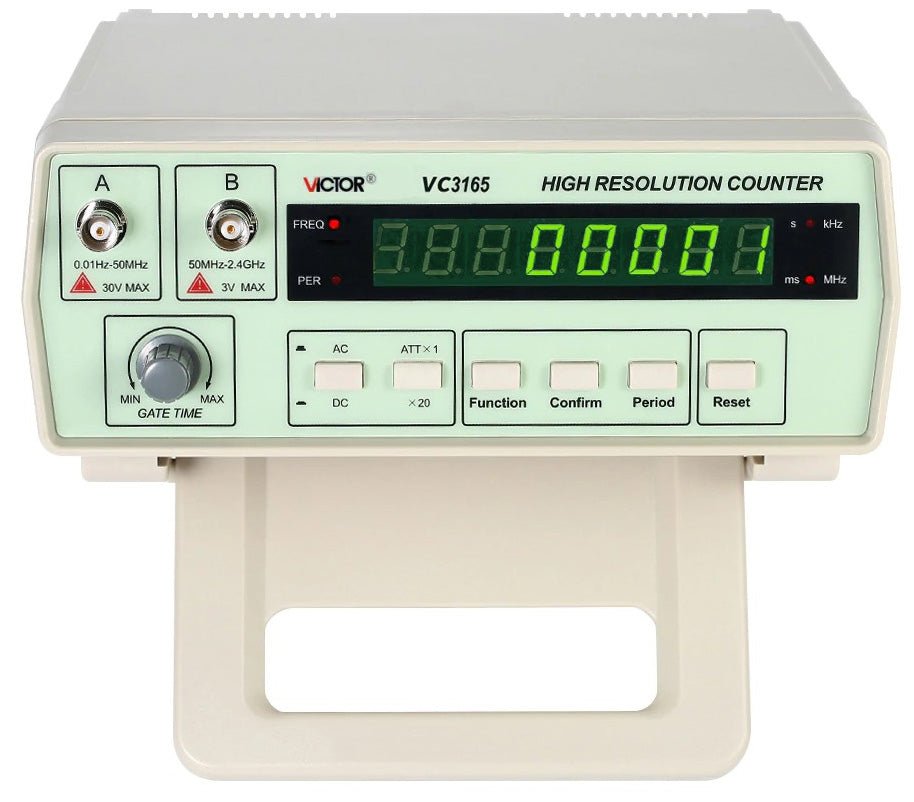
VICTOR VC3165 Frequency Counter
⭐⭐⭐⭐⭐ 4.5/5 · Editor’s Choice
Buy on Amazon →

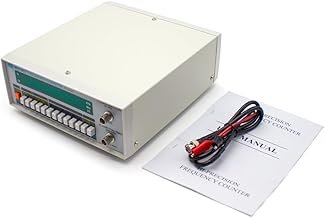
The VICTOR VC3165 is the counter we recommend to most hobby and small-lab benches. It covers an enormous 0.01 Hz to 2.4 GHz across two input channels — Channel A handles 0.01 Hz–50 MHz, Channel B prescales 50 MHz–2.4 GHz — and shows results on a bright 8-digit LED display. A crystal-controlled, temperature-compensated timebase keeps readings steady, while a continuously variable gate (100 ms–10 s) lets you trade speed for resolution. It is a no-nonsense mains-powered instrument that does frequency, period and equal-precision measurement and just works.
✅ Pros- Huge 0.01 Hz–2.4 GHz span
- 8-digit resolution, stable TCXO-class timebase
- Frequency, period & equal-precision modes
- Real mains-powered bench instrument
❌ Cons- Dated 1990s-style interface
- Manual range/attenuator switching
- No USB / data logging
🎯 Verdict: The best all-round bench counter for the money. Massive range, a trustworthy timebase and dead-simple operation make it the default pick for a hobby lab.
👉 Check Price on Amazon: amazon.com/dp/B00CW8Q2Z0 🏅 BEST FOR HAM RADIO
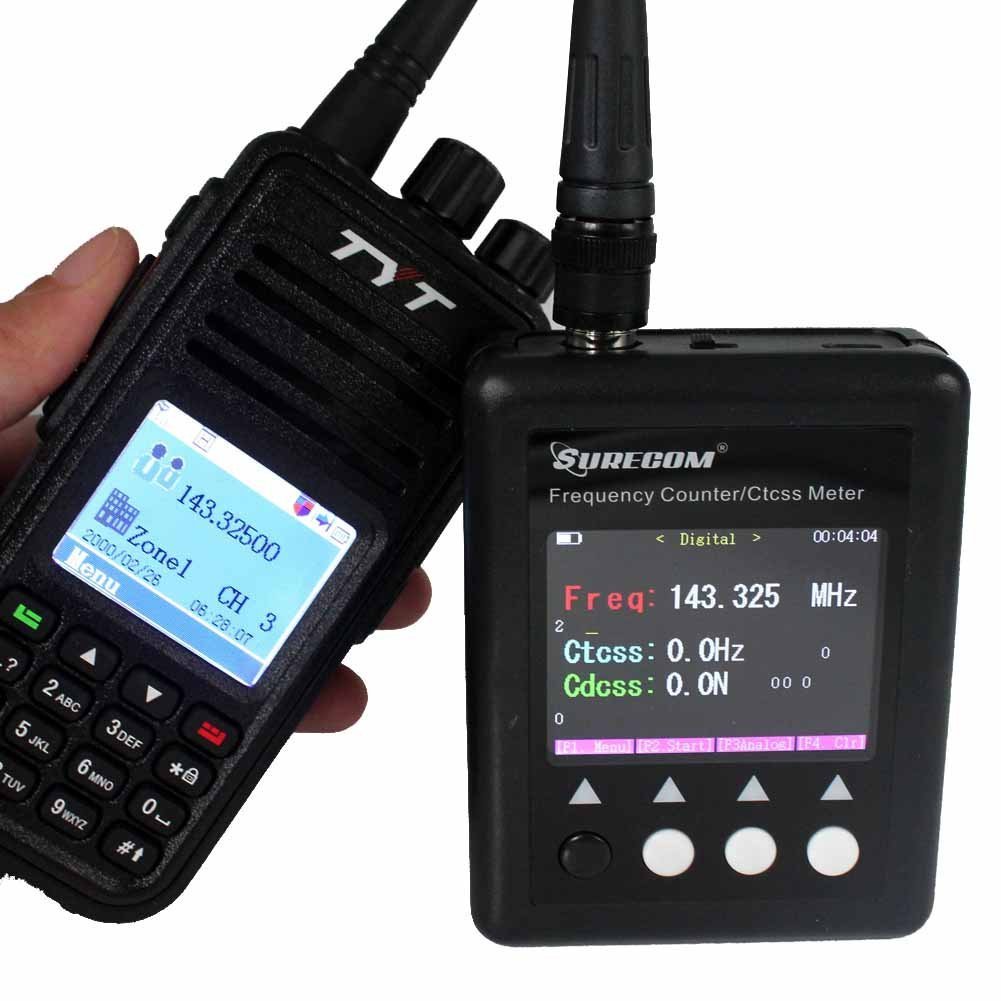
Surecom SF401 Plus
⭐⭐⭐⭐⭐ 4.5/5 · The Field Tool
Buy on Amazon →

When the signal you need to measure is a live transmitter, the Surecom SF401 Plus is the tool to reach for. This pocket counter reads the carrier frequency of any nearby walkie-talkie or transceiver from 27 MHz to 3 GHz and decodes its CTCSS/DCS sub-tone at the same time — invaluable for radio techs, ham operators and anyone setting up repeaters. A TCXO holds it to ±2–4 ppm, it runs off an internal rechargeable battery, and it ships with antennas and a charger. It is the field counterpart to a bench instrument.
✅ Pros- Grabs a transmitter’s freq in seconds
- Decodes CTCSS / DCS tones too
- Truly pocketable, rechargeable
- Antennas + charger included
❌ Cons- Needs a strong nearby RF signal
- Not for logic clocks / bench signals
- Reads carriers only, no period mode
🎯 Verdict: The best field frequency counter for two-way radio and ham work. If you measure transmitters more than bench circuits, this is the one to own.
👉 Check Price on Amazon: amazon.com/dp/B01NA0957P 🇺🇸 BEST US SUPPORT · ⭐ 4.4/53. TekPower TP3165
Benchtop · 0.01 Hz–2.4 GHz · 8-digit LED · OEM Victor VC3165
Buy →
The TekPower TP3165 is the same proven VC3165 hardware — 0.01 Hz–2.4 GHz, two channels, 8-digit LED — but sold and backed by a US distributor. If you want the VC3165 experience with English documentation and a domestic seller to handle returns or warranty questions, this badge-engineered version is the safer buy. Performance and controls are identical to our top pick.
✅ Pros: Identical VC3165 capability; US-based seller support; English manual; same wide range and resolution.
❌ Cons: Same dated UI and no PC link; often priced a little higher than the plain VC3165.
🎯 Verdict: Buy this version of the VC3165 if US support and an English manual matter more than saving a few dollars.
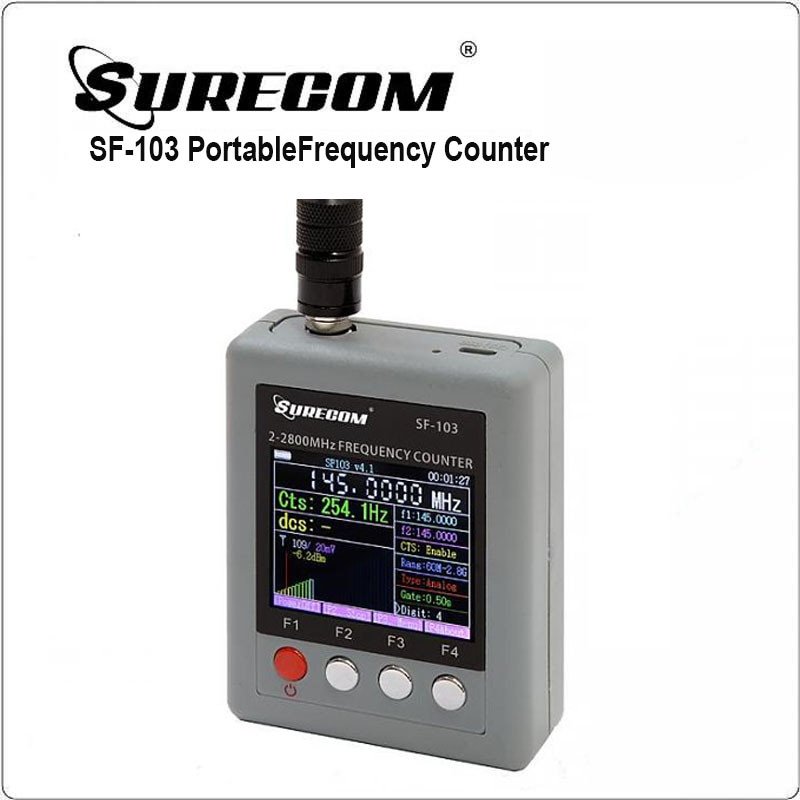
📟 BEST COLOR SCREEN · ⭐ 4.4/54. Surecom SF-103
Handheld RF · 2 MHz–2.8 GHz · color TFT · CTCSS/DCS · DMR-aware
Buy →

The Surecom SF-103 is the nicer-screen evolution of the SF401 Plus. It adds a 240×320 color TFT, a signal-strength bar, a digital (DMR) mode and two selectable ranges — 2 MHz–200 MHz or 27 MHz–2.8 GHz — in a 113 g pocket body with a built-in Li-ion battery. As an RF carrier counter it works just like the SF401 Plus (point it near a transmitter), but the bright display and field-strength readout make it more pleasant to use in the field.
✅ Pros: Bright color TFT; signal-strength indicator; DMR digital mode; CTCSS/DCS decode; very pocketable.
❌ Cons: Still near-field RF only; two fixed range bands; import lead times vary.
🎯 Verdict: The upgraded handheld pick — choose it over the SF401 Plus if you want a color screen and a field-strength meter.
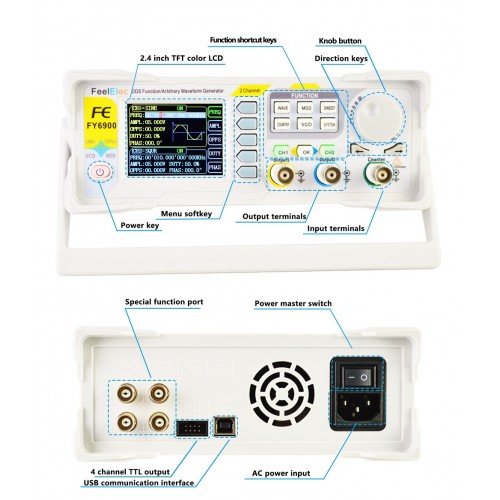
🔁 BEST 2-IN-1 · ⭐ 4.4/55. FY6900 DDS Generator + Counter
Signal generator + counter · 0.01 Hz–100 MHz counter · 2.4" TFT
Buy →

The FY6900 is a dual-channel DDS function/arbitrary-waveform generator that also includes a frequency counter, so one box both produces and measures signals. Its built-in counter reads 0.01 Hz to 100 MHz and uniquely reports frequency, period, pulse width and duty cycle with selectable AC/DC coupling. For a hobby bench that doesn’t yet own a signal source, getting a capable generator and a usable counter together is excellent value — just remember the counter tops out at 100 MHz, so it is not for RF/GHz work.
✅ Pros: Generator AND counter in one; measures period, pulse width & duty; AC/DC coupling; PC software; great value.
❌ Cons: Counter limited to 100 MHz; not a dedicated precision instrument; choose the 100M model if you want the full counter range.
🎯 Verdict: The best pick if you want a signal source and a counter in a single affordable box for general bench work.
🧳 BEST WIDE-RANGE VALUE · ⭐ 4.3/56. VQP TFC2700L
Portable bench · 10 Hz–2.7 GHz · 8-digit LED · freq/period/count
Buy →

The VQP TFC2700L packs a surprising 10 Hz–2.7 GHz range into an affordable, lighter-than-lab-gear box with a big 8-digit LED readout. It does direct counting up to ~10 MHz, prescaled counting beyond, plus period measurement, cumulative totalizing and a display self-check. For a maker who wants serious reach without paying for name-brand bench equipment, it is a lot of capability per dollar — accept generic-brand QC and sparse documentation as the trade-off.
✅ Pros: Wide 10 Hz–2.7 GHz span; large LED display; period & totalize modes; budget-friendly for the reach.
❌ Cons: Generic brand, QC can vary; minimal documentation; no PC connectivity or logging.
🎯 Verdict: The best value if you want near-GHz range on a tight budget and can live with no-frills build quality.
🔧 BEST BUILD-IN MODULE · ⭐ 4.3/57. PLJ-6LED-H Module
Panel module · 1 MHz–1 GHz · 6-digit LED · IF offset · VC-TCXO
Buy →

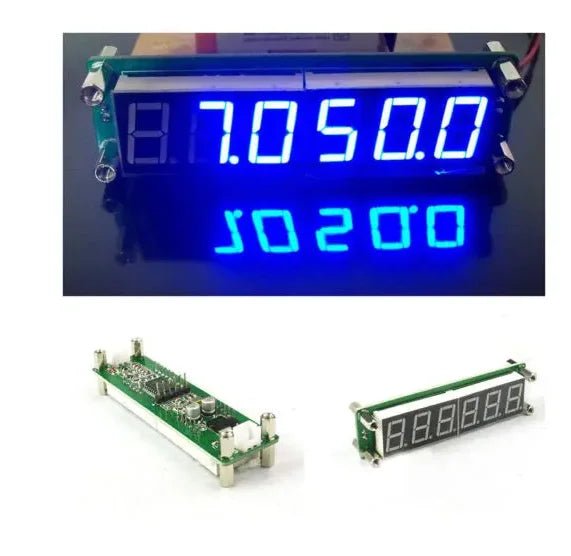
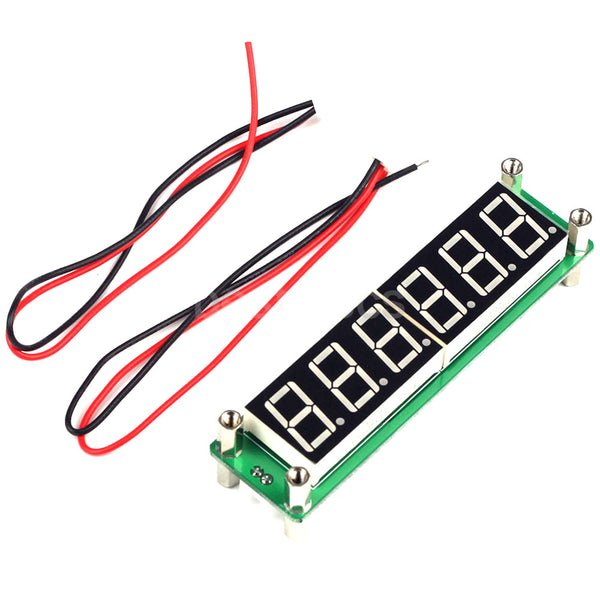
The PLJ-6LED-H is the classic frequency display module for homebrew radio. It reads 1 MHz to 1 GHz on a bright 6-digit 0.56″ LED, with 10 Hz resolution and a VC-TCXO reference (±2.5 ppm). Its killer feature is a presettable IF offset (add or subtract): feed it your VFO and it shows the real receive/transmit frequency of a superhet rig. It is a bare board running on 8–15 V, meant to be panel-mounted into your own projects rather than used as a standalone meter.
✅ Pros: Cheap; bright 6-digit readout; IF add/subtract for radio rigs; TCXO reference; perfect for panel mounting.
❌ Cons: Bare module — you supply power and a case; 1 MHz floor; ~60 mVpp sensitivity needs a decent signal.
🎯 Verdict: The best frequency readout to build into a homebrew VFO, receiver or transmitter project.
🎓 BEST LEARNING KIT · ⭐ 4.2/58. 1Hz–50MHz Frequency Counter Kit
Solder-it-yourself · 1 Hz–50 MHz · 5-digit LED · crystal/oscillator tester
Buy →

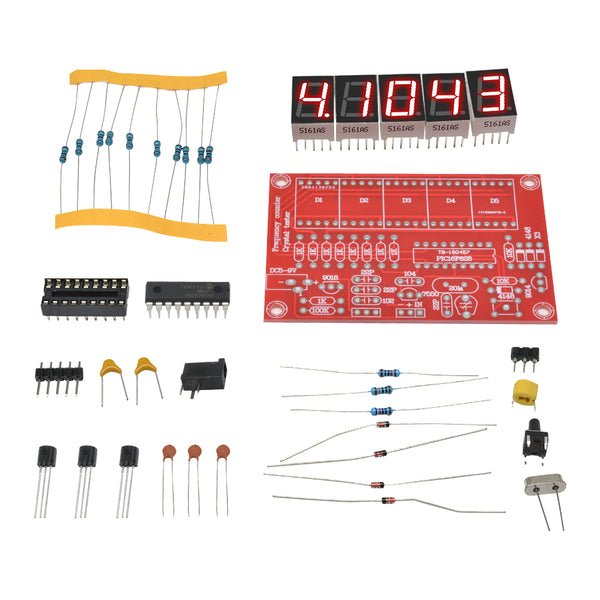
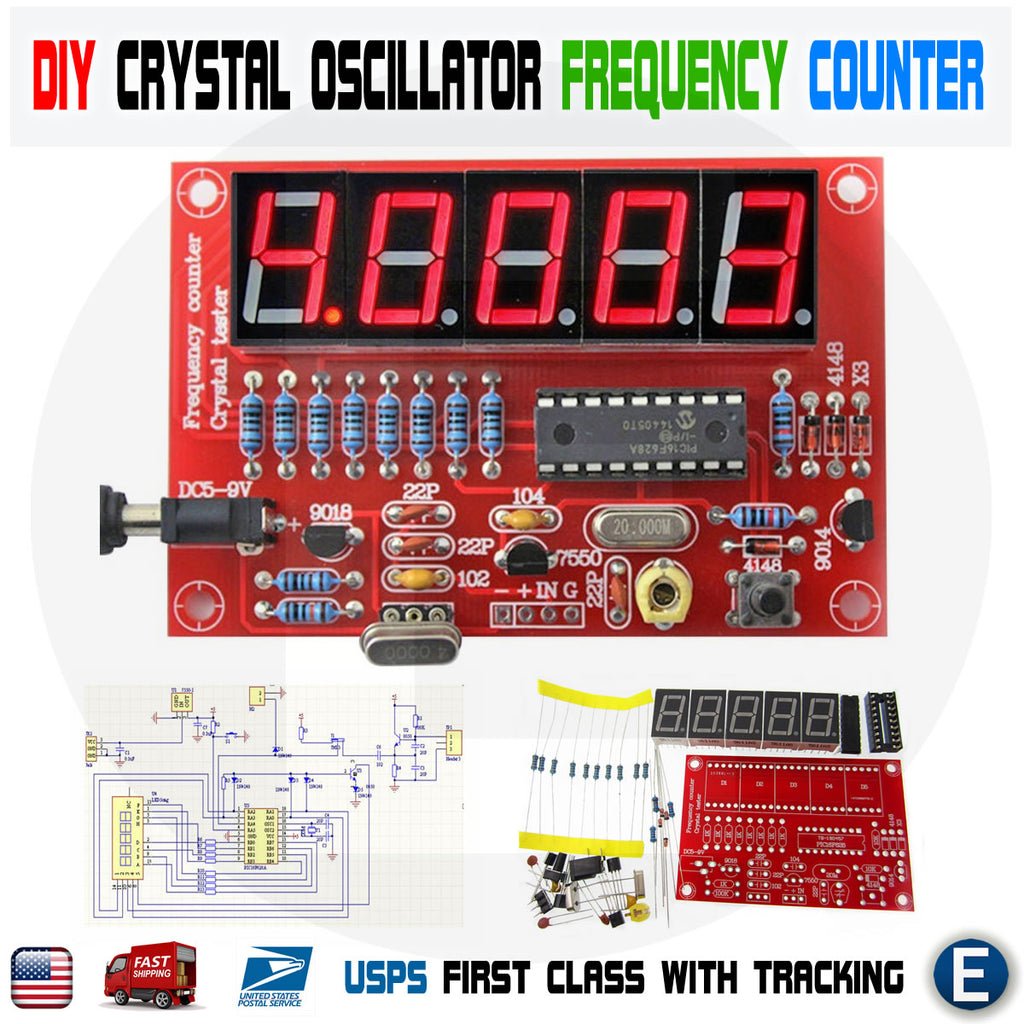
This 1 Hz–50 MHz frequency counter kit is the best way to actually understand how a counter works — you solder it together yourself. The finished board is a handy crystal and oscillator tester with a 5-digit LED display, a presettable add/subtract offset, flexible 5–12 V (or 9 V battery / USB) power and an auto power-save mode. It is inexpensive, genuinely useful for checking crystals and clock modules, and a great weekend project for a student or beginner.
✅ Pros: Teaches counter principles by building it; measures crystals/oscillators; very cheap; flexible power options.
❌ Cons: Requires soldering and assembly; 50 MHz ceiling; hobby-grade accuracy only.
🎯 Verdict: The best learning kit — build your own counter and end up with a useful crystal/oscillator checker.
💵 BEST BUDGET ASSEMBLED · ⭐ 4.1/59. Jiayouy 1Hz–50MHz Counter
Assembled module + case · 1 Hz–50 MHz · 5-digit LED · oscillator tester
Buy →

The Jiayouy 1 Hz–50 MHz counter is the same simple crystal/oscillator tester as the kit above, but it arrives assembled in a housing so you can use it straight out of the box. With a 5-digit LED display and the same add/subtract offset, it is the cheapest grab-and-go way to confirm whether a crystal, can oscillator or clock module is alive and on-frequency. No soldering, no fuss — just power it and probe.
✅ Pros: Pre-assembled and housed; dead-simple oscillator/crystal checker; extremely inexpensive; pocket size.
❌ Cons: 50 MHz maximum; basic accuracy; tiny display; no advanced measurement modes.
🎯 Verdict: The cheapest ready-to-use crystal/oscillator checker — buy this if you don’t want to solder a kit.
📻 BEST HF / VFO DISPLAY · ⭐ 4.0/510. PLJ-6LED-A Module
Panel module · 0.1–65 MHz · 6-digit LED · high-Z input · IF offset
Buy →
The PLJ-6LED-A is the ultra-budget sibling of the 6LED-H, tuned for HF. It covers 0.1–65 MHz on a 6-digit LED and — crucially — has a high-impedance input, so you can tap a VFO or oscillator without loading it down. With the same presettable IF add/subtract, it is the cheapest way to put a real frequency display on a QRP or homebrew HF rig. Like the others it is a bare module you mount and power yourself.
✅ Pros: Ultra-cheap; high-Z input ideal for tapping a VFO; IF add/subtract; bright 6-digit LED.
❌ Cons: 65 MHz ceiling (HF only); bare module, no enclosure; basic hobby accuracy.
🎯 Verdict: The best cheap HF frequency display for QRP and homebrew rigs thanks to its high-impedance input.
🛒 How to Choose the Right Frequency Counter
🔬
General Bench & Lab Work?
Get the VICTOR VC3165 (or the US-supported TekPower TP3165). 0.01 Hz–2.4 GHz, 8 digits and a stable timebase cover almost anything on a hobby bench.
📡
Ham Radio / Field Work?
The Surecom SF401 Plus (or color-screen SF-103) reads a nearby transmitter’s frequency and CTCSS/DCS tone in seconds — perfect for radios and repeaters.
🔁
Need a Signal Source Too?
The FY6900 bundles a DDS generator with a 0.01 Hz–100 MHz counter, so one affordable box both makes and measures signals on your bench.
🔧
Building It Into a Project?
The PLJ-6LED-H (VHF/UHF) or PLJ-6LED-A (HF, high-Z) give a homebrew radio a real frequency display with IF offset for a few dollars.
🎓
Learning or Checking Crystals?
The 1 Hz–50 MHz kit (solder it) or the Jiayouy assembled version (plug and read) are cheap crystal/oscillator testers and great teaching tools.
🧳
Want Wide Range on a Budget?
The VQP TFC2700L reaches 10 Hz–2.7 GHz for less than name-brand bench gear — accept no-frills build quality for the extra reach.
⚙️ Key Specs Compared — Side by Side
| Spec | VC3165 | SF401 Plus | FY6900 | TFC2700L | PLJ-6LED-H | 1Hz–50MHz Kit |
|---|
| Type | Benchtop | Handheld RF | Gen + counter | Portable bench | Module | DIY kit |
| Top frequency | 2.4 GHz ⭐ | 3 GHz | 100 MHz | 2.7 GHz | 1 GHz | 50 MHz |
| Low end | 0.01 Hz ⭐ | 27 MHz | 0.01 Hz | 10 Hz | 1 MHz | 1 Hz |
| Display | 8-digit LED | LCD | Color TFT ⭐ | 8-digit LED | 6-digit LED | 5-digit LED |
| Timebase | TCXO ⭐ | TCXO | Crystal | High-stab. | VC-TCXO | Crystal |
| Extra modes | Period, eq-prec. | CTCSS/DCS | Period, PW, duty ⭐ | Period, totalize | IF offset | Offset |
| Powered by | AC mains | Battery ⭐ | AC mains | AC mains | 8–15 V DC | 5–12 V / USB |
❓ Frequently Asked Questions
What’s the difference between a benchtop and a handheld frequency counter?
A benchtop counter (like the VC3165) connects to a signal through a probe or BNC cable and measures almost anything — from a fraction of a hertz up into the gigahertz — with high resolution. A handheld “RF counter” (like the Surecom SF401 Plus) instead picks up a strong transmitter’s carrier through an antenna, so it is built for reading live radios in the field. Use a bench counter for circuits and clocks; use a handheld for two-way radios and antennas.
How accurate are these counters — what is TCXO, and do I need it?
Accuracy comes from the internal timebase. A plain crystal can drift tens of ppm as the unit warms up, while a TCXO (temperature-compensated crystal oscillator) holds roughly ±2–3 ppm — about ±3 kHz at 1 GHz. Lab instruments go further with an oven-controlled OCXO. For hobby work a TCXO unit is plenty; the VC3165, SF401 Plus and PLJ-6LED-H all use temperature-compensated references, which is why they hold a steady reading.
Can a frequency counter measure my ham radio’s transmit frequency?
Yes — that is exactly what the handheld units are for. Key the radio near a Surecom SF401 Plus or SF-103 and it reads the carrier and decodes the CTCSS/DCS tone. Because these work in the near field, keep the radio at low power and close by, and never connect a transmitter’s full output directly to a bench counter’s input — use an attenuator or a sampling pickup instead to avoid damaging the instrument.
What frequency range do I actually need?
Match it to your highest signal with margin to spare. Audio, microcontroller clocks and HF radio live below ~50–65 MHz, so a 1 Hz–50 MHz kit or PLJ-6LED-A is enough. VHF/UHF radio, RF projects and most clocks want hundreds of MHz to a few GHz — that is where the VC3165 (2.4 GHz), TFC2700L (2.7 GHz) and SF401 Plus (3 GHz) shine. Buying more range than you need is fine; buying too little means your signal simply won’t read.
Frequency counter vs oscilloscope vs the counter in my multimeter — which should I use?
A dedicated counter gives the most precise frequency number, often 6–8 digits, and reaches far higher than the others. An oscilloscope shows the waveform and estimates frequency to a few digits — great for seeing what a signal looks like, not for nailing an exact value. The frequency function built into many multimeters typically only works to a few MHz and a few digits. For verifying an oscillator or a clock to the hertz, a counter wins; for understanding signal shape, reach for the scope.
🏁 Final Verdict — Our Top Picks
The right frequency counter for every job and budget:
🥇 Best Overall — VICTOR VC3165: 0.01 Hz–2.4 GHz bench counter with a stable timebase
Buy →🏅 Best for Ham Radio — Surecom SF401 Plus: pocket RF counter, 27 MHz–3 GHz with CTCSS/DCS
Buy →🔁 Best 2-in-1 — FY6900: DDS signal generator with a built-in 100 MHz counter
Buy →🔧 Best Build-In Module — PLJ-6LED-H: 1 MHz–1 GHz LED readout with IF offset for rigs
Buy →🎓 Best Learning Kit — 1 Hz–50 MHz DIY counter: solder it, then test crystals & oscillators
Buy →No single frequency counter is perfect for every task, but there is a clear right tool for each one. For most electronics benches the VICTOR VC3165 is the one to buy — huge range, a trustworthy timebase and simple operation. If you mostly work with radios, the pocket Surecom SF401 Plus reads transmitters in the field; if you also need a signal source, the FY6900 bundles a generator and counter together; and if you are building a homebrew rig or learning the fundamentals, a PLJ-6LED module or the 1 Hz–50 MHz kit does the job for a few dollars. Pair your new counter with our Arduino, ESP32, STM32 and Raspberry Pi tutorials and start measuring your projects with confidence.
💬 Not sure which frequency counter fits your work — bench, radio, or homebrew rig? Tell us what you need to measure in the comments below and we’ll point you to the right pick.
All Amazon links above use our affiliate tag (microlab05-20). Purchasing through them supports microcontrollerslab.com at no extra cost to you. Prices and availability change frequently — always confirm the current price on Amazon before buying.