⚠️ Affiliate Disclosure: This post contains Amazon affiliate links. If you purchase through our links, we may earn a small commission at no extra cost to you. We only recommend products we have researched and verified against live listings. Prices change constantly, so we do not list them here. Always tap through and confirm the current price on Amazon before buying.
Ultimate Buying Guide 2026
⚡ Best Programmable DC Power Supplies for Your Bench
8 programmable supplies ranked for makers, students and engineers: from the tiny DP30V5A and DPS5005 buck modules to the Riden RD6006, a 1080W RD6018 and lab-grade Korad, Siglent and Rigol benches, with real specs, honest verdicts and verified Amazon links.
✅ 8 Supplies Reviewed
✅ Verified Amazon Listings
✅ Updated September 2026
✅ Honest Pros & Cons
A programmable DC power supply is the single most useful instrument on an electronics bench. Unlike a fixed wall adapter, it lets you dial in an exact voltage, set a hard current limit, store presets for the boards you use every day, and in most cases drive the whole thing from a PC. Bring up a new ESP32 board at 3.3V with a 200 mA limit, charge a lithium cell in constant current then constant voltage, burn in a motor driver at 24V, or sweep supply voltage in a script while you log results. One instrument covers all of it.
The catch is that “programmable” covers two very different classes of product. On one side are the cheap Chinese buck modules (RD6006, DPS5005, DP30V5A) that give you astonishing control per dollar but need their own DC input source and a case. On the other are proper bench supplies from Korad, Siglent and Rigol that arrive ready to plug into the wall, with a mains transformer, a real chassis and, on the better models, SCPI remote control. This guide ranks 8 programmable DC power supplies across both camps so you can match the right one to your workflow and budget.
💡 Reality check before you buy: Budget buck modules like the RD6006, DPS5005 and DP30V5A are step-down converters, not complete power supplies. They cannot output more than their DC input, and they ship without a case or an AC-DC source, so budget for those too. They are also switching regulators, which means tens of millivolts of ripple: fine for logic, motors and battery charging, not ideal for low-noise analog or RF work. Watch the power ceiling as well, because a “60V 6A” module is still limited to roughly 360W total, so 60V and 6A at the same time is not on the menu. And on any supply, set the current limit before you connect a new board. That limit is the feature that saves prototypes.
⚡ Quick Comparison: All 8 Programmable Power Supplies
| Model | Type | Output | Control / Interface | Best For | Buy |
|---|
| 🥇 Riden RD6006 / RD6006W | Buck module | 0-60V · 0-6A · 360W | USB + WiFi app, 10 presets | Best Overall | View → |
| 🏅 Korad KD3005P | Linear bench | 0-30V · 0-5A · 150W | USB + RS232, 5 presets | Best Bench Supply | View → |
| 🔰 DP30V5A | Buck module | 0-32V · 0-5A · ~160W | Front panel, 10 presets | Best Entry-Level | View → |
| 💾 RD DPS5005 | Buck module | 0-50V · 0-5A · ~250W | USB + Bluetooth, 10 presets | Best Compact Module | View → |
| 💪 Riden RD6018 | High-power buck | 0-60V · 0-18A · 1080W | USB PC software | Best High-Power | View → |
| 🧪 Siglent SPD1305X | Linear bench | 0-30V · 0-5A · 150W | USB / LAN, SCPI | Best Lab Grade | View → |
| 🔇 Rigol DP711 | Linear bench | 0-30V · 0-5A · 150W | RS232 remote | Best Low-Noise | View → |
| 🧰 RD6006W Complete Set | Module + case + PSU | 0-60V · 0-6A · 360W | USB + WiFi app | Best Complete Kit | View → |
Output figures are the maximum settable values. Total output power is capped well below voltage times current on every model here, and buck modules are additionally limited by their DC input. Confirm the exact variant and what is in the box on the live Amazon listing before you order.
🔍 What to Look for in a Programmable DC Power Supply
📈
Voltage, Current and Power
Three numbers, not two. A 30V 5A supply is usually a 150W supply, so you get 30V at 5A only if the wattage allows it. For microcontroller and sensor work 30V and 3A is plenty; battery packs, motors and LED strips push you toward 60V or double-digit amps.
🎯
Resolution and Accuracy
Setting resolution (10 mV / 1 mA on most of these, 1 mV / 1 mA on the Siglent) decides how finely you can dial in a rail. Accuracy is a separate spec and is where lab instruments pull ahead of modules. If you need the reading to be trustworthy, use a meter alongside a cheap module.
🛡️
CC/CV and Protection
Constant current mode is what turns a power supply into a safety net: it clamps the current instead of frying your board. Look for adjustable OVP, OCP, OPP and thermal shutdown, plus an output on/off key so you can set values before anything is live.
🖥️
Remote Control and Presets
This is the “programmable” part. Memory groups let you recall 3.3V/500 mA in one keypress. USB, RS232 or LAN with a documented protocol (Modbus RTU on the Riden and RuiDeng modules, SCPI on Siglent and Rigol) lets you drive the supply from Python for automated tests.
〰️
Linear vs Switching
Linear supplies (Korad, Siglent, Rigol) are quiet, with ripple measured in hundreds of microvolts, but heavy and inefficient. Switching modules (Riden, RuiDeng) are compact, efficient and cheap, at the cost of tens of millivolts of ripple and switching noise.
🏆 Detailed Reviews: All 8 Programmable DC Power Supplies
🥇 BEST OVERALL
Riden RD6006 / RD6006W
⭐ 4.7/5 · The Maker Bench Standard
USB + WiFi
10 MEMORY GROUPS

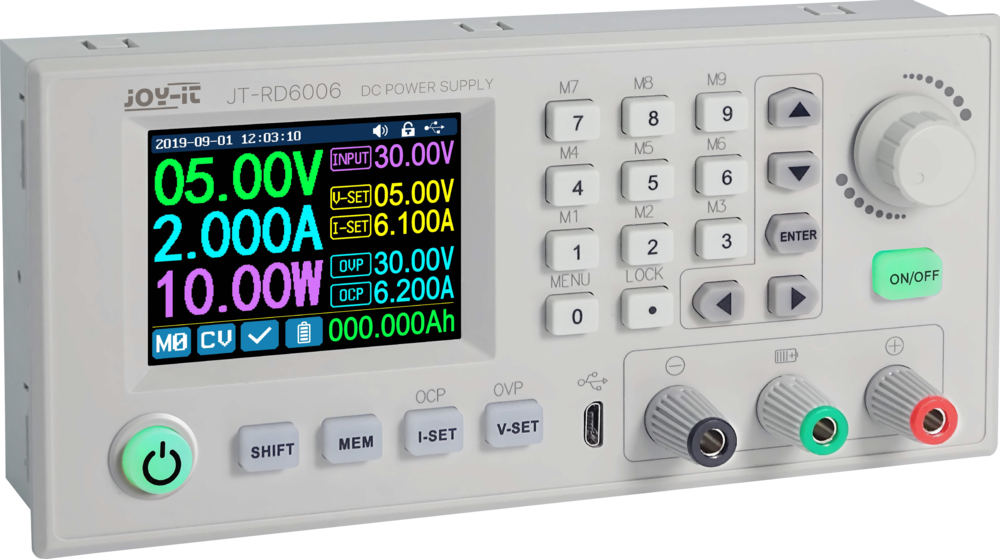
The Riden RD6006 is the module that made programmable power cheap. A 2.4 inch colour panel shows set and actual voltage, current, power, amp-hours and watt-hours at once, you get 10 storable presets, a proper output key, adjustable over-voltage, over-current and over-power protection, and full remote control over USB (the RD6006W adds WiFi and a phone app). Because it speaks a documented Modbus protocol, the community has built Python libraries, a Linux GUI and even alternate firmware for it. Set it to 3.3V with a 100 mA limit and you can probe a new ESP32 board without fear.
Be clear on what you are buying: this listing is the module only. It is a step-down converter, so it needs a DC input higher than your target output (a 48V or 60V switching brick is typical) plus a case. Build that around it and you have a supply that outperforms bench units costing three times as much.
✅ Pros- Huge 0-60V / 0-6A range for the money
- 10 presets, energy metering, full protection set
- USB and WiFi control with open Modbus protocol
- Massive community, libraries and mods
❌ Cons- Module only: no case, no AC-DC source
- Buck topology, so output must stay below input
- Switching ripple is higher than a linear bench
🎯 Verdict: The best all-round programmable supply for makers. Nothing else gives you this much range, metering and scriptable control at this price.
👉 Check Price on Amazon →
🏅 BEST READY-TO-USE BENCH SUPPLY
Korad KD3005P
⭐ 4.6/5 · Quiet Linear Workhorse
10 mV / 1 mA
4-DIGIT DISPLAY
USB + RS232
5 MEMORY PRESETS

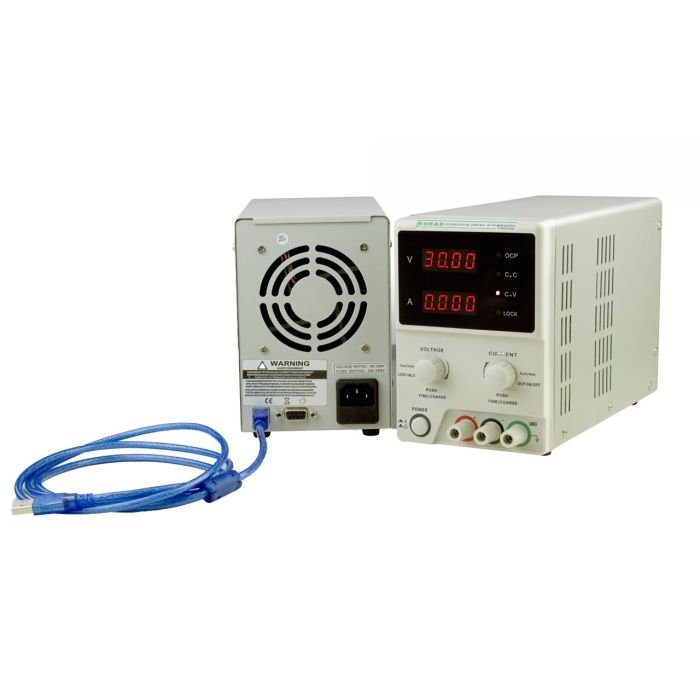
If you would rather plug something into the wall and get to work, the Korad KD3005P is the value pick. It is a genuine linear supply, so ripple and noise are far lower than any switching module, and the tracking is smooth enough for analog and audio prototyping. You get a 4 digit voltage and current readout, coarse and fine adjustment on a pushable encoder, five memory presets, over-current protection, a lock key and a switchable 110/220V input.
The P suffix is the part that matters here: it adds USB and RS232 remote control with a simple ASCII command set that is trivial to drive from Python or LabVIEW. The plain KD3005D looks identical but has no interface, so check the model letters carefully. Downsides are the usual linear ones: it runs warm, the fan is audible under load, and 30V/5A is the ceiling.
✅ Pros- Low-noise linear regulation
- USB and RS232 remote with a simple command set
- Complete, mains-powered, nothing else to buy
- Coarse/fine encoder and 5 presets
❌ Cons- Only 30V / 5A, and it runs hot
- Fan noise is noticeable under load
- Easy to confuse with the non-programmable KD3005D
🎯 Verdict: The best complete bench supply for most people. Quiet linear output plus real PC control, with no case or brick to source.
👉 Check Price on Amazon →
🔰 BEST ENTRY-LEVEL · ⭐ 4.2/53. DP30V5A Programmable Module
6-40V in · 0-32V / 0-5A out · ~160W · colour LCD · 10 preset groups
Buy →

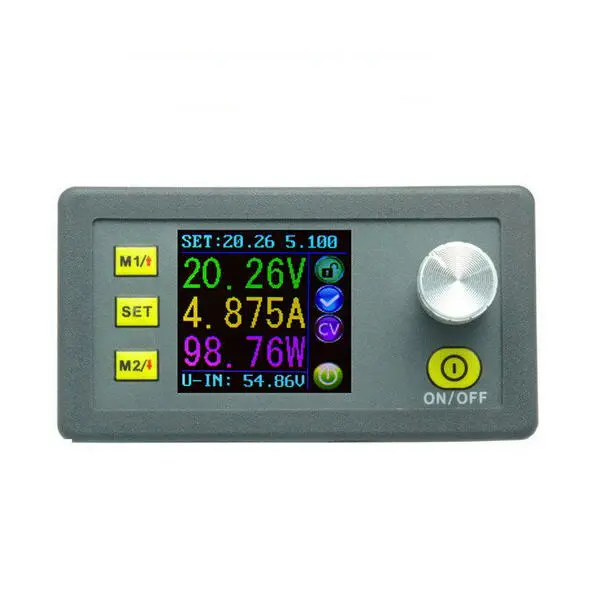
The DP30V5A is the cheapest honest way into programmable power. Feed it 6 to 40V from any laptop brick or 24V supply and it gives you 0 to 32V at up to 5A, set to 10 mV and 1 mA steps, with constant current, adjustable protection and 10 stored preset groups you can recall from the keypad. Two of those groups have dedicated quick-recall keys, which is exactly what you want when you keep switching between 3.3V and 5V rails.
What it does not have is a communication interface. The base DP30V5A is programmable in the preset sense, not the “drive it from Python” sense. If scripted control matters, step up to the DPS5005 or RD6006 instead.
✅ Pros: Cheapest real CC/CV programmable supply; 10 preset groups; tiny 79×43×48 mm footprint; runs from any DC brick.
❌ Cons: No USB or Bluetooth on the base model; needs its own input supply and case; modest accuracy.
🎯 Verdict: The best first programmable supply. Buy it, pair it with a spare 24V brick, and you have a bench rail you can actually trust.
💾 BEST COMPACT MODULE · ⭐ 4.4/54. RD DPS5005 (USB + Bluetooth)
6-55V in · 0-50V / 0-5A out · ~250W · 10 preset groups · Modbus RTU
Buy →

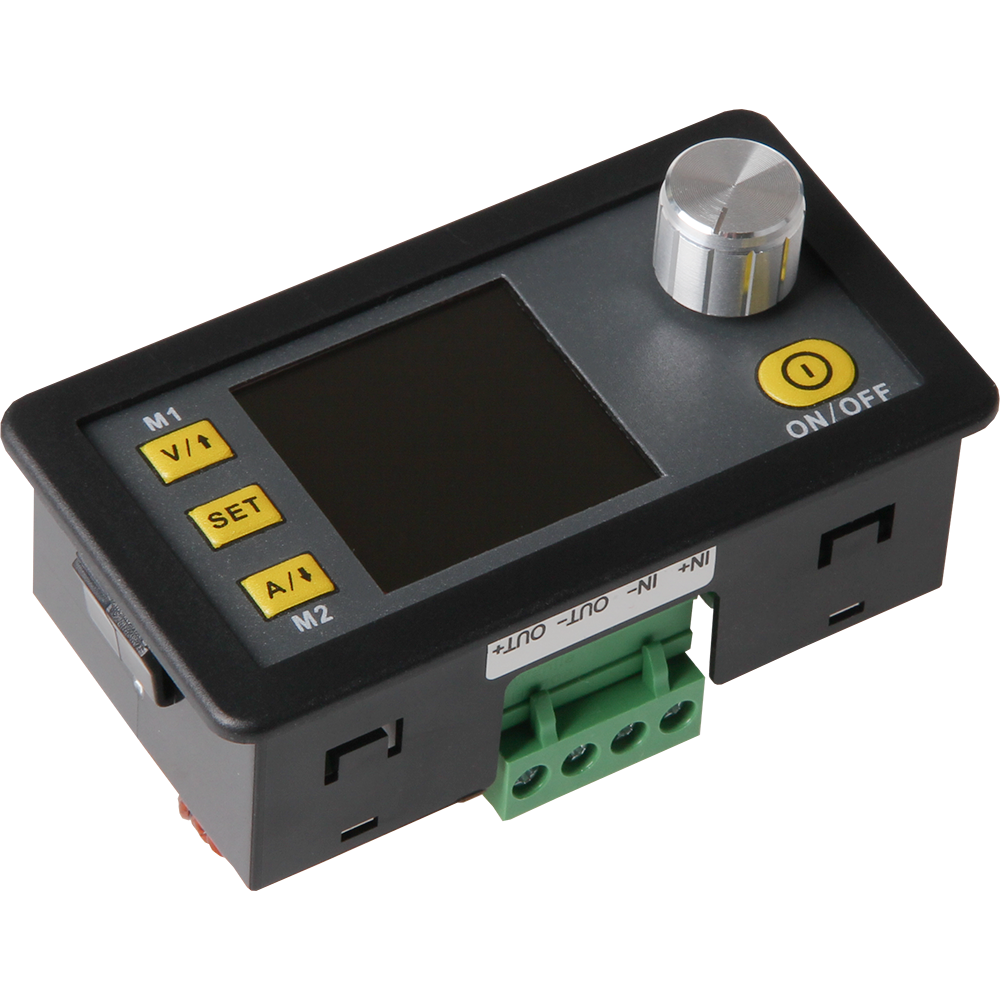
The DPS5005 squeezes a 50V, 5A programmable converter into a module the size of a matchbox. It stores 10 groups of preset values with two quick-recall slots, shows set and actual values on a colour LCD, and this USB and Bluetooth version exposes a Modbus RTU interface so you can control it from a PC or an Android phone. It is the module of choice for people building a supply into a project box, a portable field kit or a 3D printed pegboard rail.
Compared with the RD6006 you lose the bigger display, the energy metering and 1A of headroom, but you gain a much smaller footprint and a lower price. Note that the DPS5005 tops out around 250W and that the tiny heatsink means sustained high-current work needs airflow.
✅ Pros: Very small; USB and Bluetooth control; 10 preset groups; 0.01V / 0.001A steps up to 50V.
❌ Cons: Small display; needs forced air near full load; module only, so plan on a case and DC source.
🎯 Verdict: The best programmable module to embed in something. Full CC/CV control and PC comms in a package you can hide in a project box.
💪 BEST HIGH-POWER · ⭐ 4.5/55. Riden RD6018 (60V / 18A)
0-60V · 0-18A · 1080W · USB PC software · thermostatic fan · replaceable fuse
Buy →
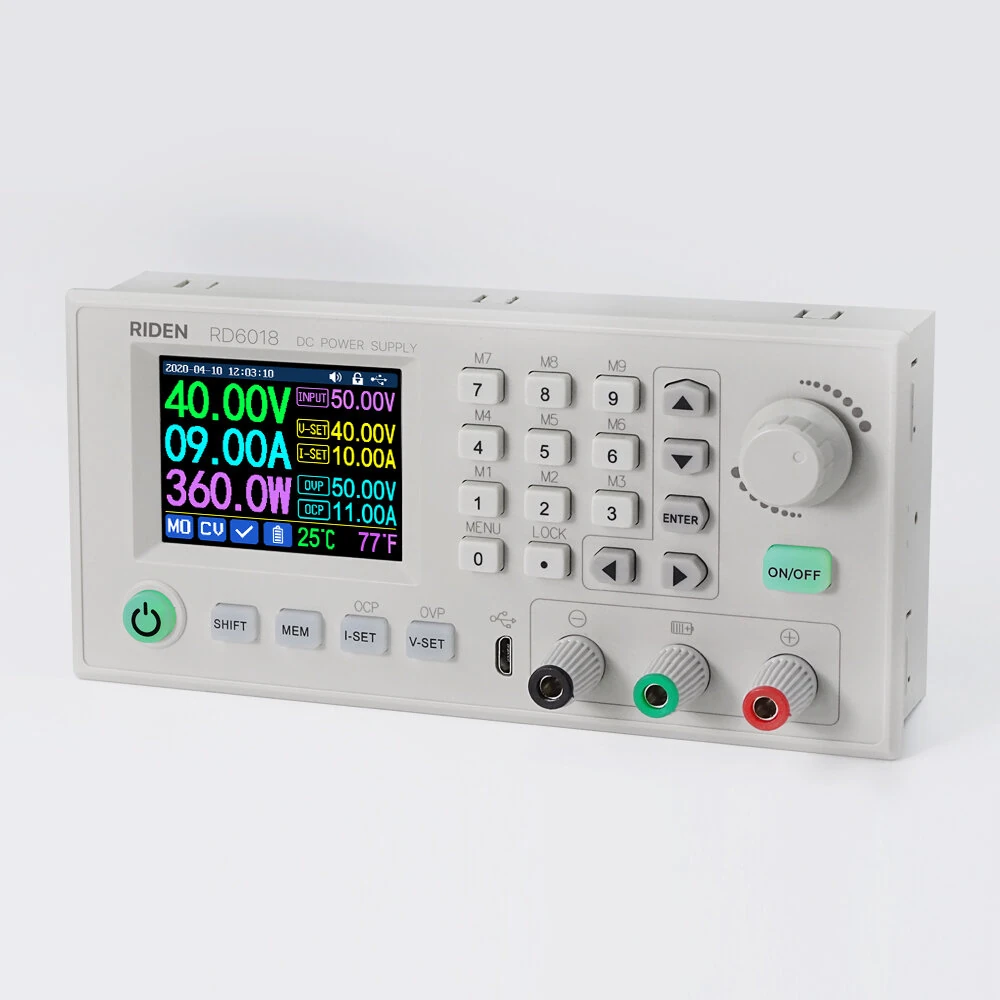
When 360W stops being enough, the RD6018 is the obvious next step. Same interface and same PC software as the RD6006, but with 18A of current and a 1080W ceiling, a thermostatically controlled fan and a snap-in replaceable fuse. That is enough to charge large lithium packs, run e-bike and scooter controllers, drive high-power LED arrays or load-test a motor driver properly.
Two honest warnings. First, this pick sits well above the price of everything else in the modules section, so only buy it if you genuinely need the current. Second, Riden sells the RD6018 as a bare module, as a case bundle and as a full set, and listings vary, so confirm on the live listing whether the case and the AC-DC supply are included before you order.
✅ Pros: 1080W and 18A; same proven UI and PC software; temperature-controlled fan; serviceable fuse.
❌ Cons: Expensive next to the RD6006; needs a large input supply; check exactly which configuration the listing ships.
🎯 Verdict: The high-current option. Overkill for microcontroller work, and exactly right for battery packs, motors and power electronics.
🧪 BEST LAB GRADE · ⭐ 4.6/56. Siglent SPD1305X
0-30V · 0-5A · 150W · 1 mV / 1 mA · 2.8″ TFT · USB / LAN with SCPI
Buy →

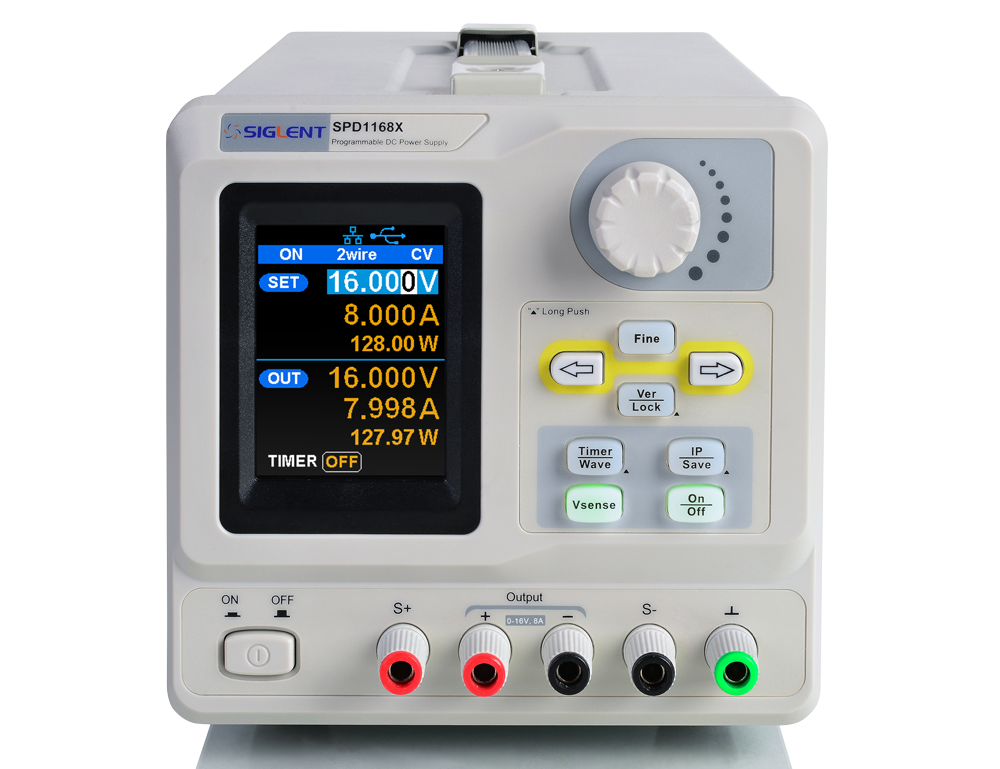
The Siglent SPD1305X is where this list crosses from hobby gear into test equipment. It resolves to 1 mV and 1 mA on a 2.8 inch colour TFT with 5 digit voltage and 4 digit current readouts, holds its accuracy specification properly, and gives you a real timer and waveform display so you can watch the output over time rather than guessing. Remote control is standard SCPI over USB, with LAN available, so it drops straight into an existing automated test setup alongside PyVISA.
This one sits far above the budget picks on price, and we will say that plainly. What you are paying for is measurement you can quote in a report, a documented instrument command set and a manufacturer that supports the product. For a student bench that is hard to justify; for a lab or a small hardware company it usually is not.
✅ Pros: 1 mV / 1 mA resolution; specified accuracy; standard SCPI over USB and LAN; timer and waveform display.
❌ Cons: Well above the price of every module here; single channel; 30V / 5A ceiling.
🎯 Verdict: The pick when the numbers have to be defensible. Buy it if you write test reports or automate with SCPI, and skip it otherwise.
🔇 BEST LOW-NOISE LINEAR · ⭐ 4.6/57. Rigol DP711
0-30V · 0-5A · 150W · linear · RS232 remote · very low ripple
Buy →

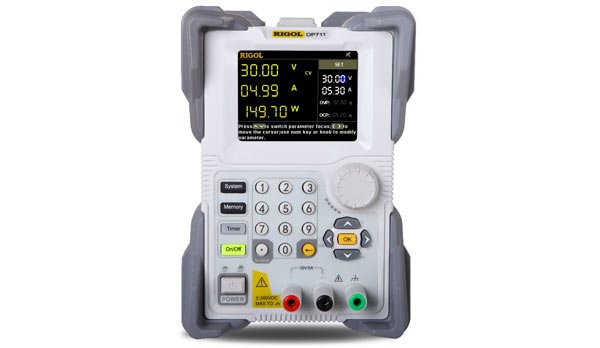
The Rigol DP711 is a single channel linear supply built around one priority: a clean rail. Ripple and noise are specified in the hundreds of microvolts rather than the tens of millivolts you get from a switching module, which matters enormously for op-amp front ends, ADC reference rails, audio and RF work where supply noise lands directly in your measurement. It also has the solid feel of proper instrument hardware, with a clear display, timer functions and RS232 remote control.
The trade-offs are the classic linear ones plus one modern annoyance: the DP711 uses RS232 rather than USB or LAN, so most people will need a USB to serial adapter. It is also heavy and expensive relative to the modules. Buy it for signal integrity, not for features per dollar.
✅ Pros: Extremely low ripple and noise; instrument-grade build; timer and remote control; trusted brand support.
❌ Cons: RS232 only, so expect an adapter; heavy; premium price for 30V / 5A.
🎯 Verdict: The cleanest rail on this list. Choose it when supply noise would contaminate what you are trying to measure.
🧰 BEST COMPLETE KIT · ⭐ 4.5/58. RD6006W + S400 Case + 400W PSU Set
0-60V · 0-6A · 360W · WiFi and USB · everything included, some assembly
Buy →
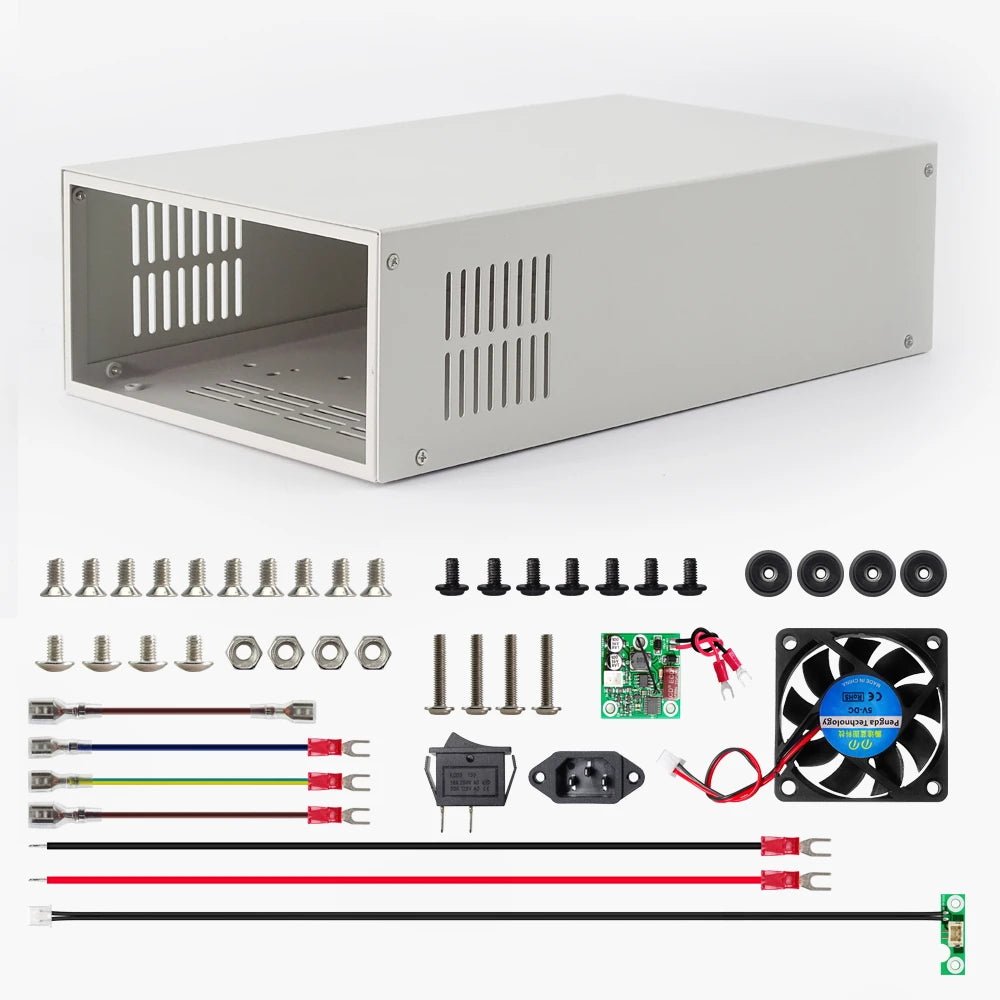
This is the answer to the most common complaint about the RD6006: that it arrives as a bare module. The set bundles the RD6006W, the matching S400 metal housing and a 400W switching supply, so you finish with a complete 0-60V, 0-6A bench instrument with WiFi and USB control for far less than a commercial equivalent. Buying the three pieces together also removes the guesswork about whether your input brick and case actually fit.
The important caveat is in the listing title: not assembled. You will be screwing the case together and wiring mains into the switching supply, which means you need to be comfortable with line voltage wiring and earthing. If that sentence makes you uneasy, buy the Korad KD3005P instead.
✅ Pros: Everything needed in one box; matched case and PSU; 360W with WiFi control; excellent value assembled.
❌ Cons: Ships unassembled; involves mains wiring; switching ripple, same as any RD6006 build.
🎯 Verdict: The best value per watt on this list, provided you are happy to build it. An afternoon of assembly buys a genuinely capable bench supply.
🛒 How to Choose the Right Programmable Supply
🔧
General maker bench?
The Riden RD6006 covers almost everything: 0-60V, 0-6A, presets, metering and scriptable control.
🔌
Want to plug in and go?
The Korad KD3005P is a finished mains supply with quiet linear output and USB plus RS232 control.
🎓
First supply on a budget?
Start with the DP30V5A and a spare 24V brick. Real CC/CV and 10 presets for pocket money.
🔋
Batteries, motors, high current?
The Riden RD6018 gives you 18A and 1080W with the same interface and PC software.
📻
Analog, audio or RF work?
Go linear. The Rigol DP711 keeps supply noise out of your measurement in a way no buck module can.
🤖
Automated test with Python?
The Siglent SPD1305X speaks standard SCPI over USB or LAN and drops into a PyVISA setup.
⚙️ Key Specs Compared, Side by Side
| Spec | Riden RD6006W | Korad KD3005P | RD DPS5005 | Riden RD6018 | Siglent SPD1305X |
|---|
| Output Range | 0-60V / 0-6A | 0-30V / 0-5A | 0-50V / 0-5A | 0-60V / 0-18A ⭐ | 0-30V / 0-5A |
| Max Power | 360 W | 150 W | ~250 W | 1080 W ⭐ | 150 W |
| Set Resolution | 10 mV / 1 mA | 10 mV / 1 mA | 10 mV / 1 mA | 10 mV / 10 mA | 1 mV / 1 mA ⭐ |
| Topology | Switching buck | Linear ⭐ | Switching buck | Switching buck | Linear ⭐ |
| Remote Interface | USB + WiFi (Modbus) | USB + RS232 | USB + Bluetooth | USB (PC software) | USB / LAN, SCPI ⭐ |
| Memory Presets | 10 groups ⭐ | 5 groups | 10 groups ⭐ | 10 groups ⭐ | 5 groups |
| Ready to Use? | Module only | Yes, mains ⭐ | Module only | Check variant | Yes, mains ⭐ |
Specifications are taken from manufacturer data and live listings and can vary by firmware revision and seller. Confirm the details on the Amazon listing before buying.
❓ Frequently Asked Questions
What actually makes a DC power supply “programmable”?
The word covers two levels. The weaker sense is stored presets: the supply remembers several voltage, current and protection combinations that you recall from the keypad, which is what the DP30V5A offers. The stronger sense is remote control, where a documented protocol over USB, RS232 or LAN lets a PC set and read values. Riden and RuiDeng modules use Modbus RTU, Korad uses a simple ASCII command set, and Siglent and Rigol use SCPI, the standard instrument language. If you plan to automate anything, buy for the second sense, not the first.
Do I need a separate power supply for the RD6006, DPS5005 or DP30V5A?
Yes. All three are step-down (buck) converters, not complete supplies. They need a DC input that is higher than the maximum output you want, plus roughly 1 to 2V of headroom, and they need a case for safety. A 48V or 60V switching brick suits the RD6006, and any 24V laptop-style adapter is fine for a DP30V5A used up to about 22V. If you would rather skip the build, either buy the RD6006W complete set or choose a mains bench supply such as the Korad KD3005P.
Linear or switching: which should I buy?
Choose by what you build. Switching supplies (RD6006, DPS5005, DP30V5A, RD6018) are efficient, compact, cheap and cover wide ranges, with ripple typically in the tens of millivolts. That is invisible to logic, motors, LEDs and battery charging. Linear supplies (Korad, Siglent, Rigol) trade efficiency and weight for ripple measured in microvolts, which matters when supply noise would end up inside your measurement: precision analog, ADC references, audio and RF. Many benches end up with one of each.
Can I control these from Python or LabVIEW?
On most of them, yes. The Siglent and Rigol units speak SCPI, so PyVISA gives you commands such as setting voltage and reading back current in a few lines. The Korad P models take short ASCII strings over a virtual COM port, which is easy with pyserial. Riden and RuiDeng modules expose Modbus RTU registers, and community libraries for the RD6006 and DPS series wrap those into simple Python calls. The one exception on this list is the base DP30V5A, which has no communication port at all.
What voltage and current do I need for Arduino, ESP32 and Raspberry Pi work?
For pure microcontroller and sensor work, 0 to 30V at 3A is comfortable, and a hard current limit matters far more than the maximum. Set 3.3V or 5V with a limit of 100 to 500 mA when you power a bare board, and the supply will fold back rather than destroy a shorted rail. Add headroom if you drive servos, motor drivers, LED strips or a Raspberry Pi with peripherals, which can pull 3A or more in bursts. Only battery packs, e-bike controllers and power electronics genuinely need the 60V or 18A class.
🏁 Final Verdict: Best Programmable Supply for Every Bench
The right programmable DC power supply for every project and budget:
🥇 Best Overall · Riden RD6006 / RD6006W: 0-60V, 0-6A, 360W, 10 presets, USB and WiFi control
Buy →🏅 Best Ready-to-Use Bench · Korad KD3005P: quiet 30V/5A linear output with USB and RS232 control
Buy →🔰 Best Entry-Level · DP30V5A: real CC/CV and 10 presets for the price of a few sensors
Buy →💾 Best Compact Module · RD DPS5005: 50V/5A with USB and Bluetooth in a matchbox footprint
Buy →💪 Best High-Power · Riden RD6018: 60V and 18A, up to 1080W for packs, motors and power electronics
Buy →🧪 Best Lab Grade · Siglent SPD1305X: 1 mV / 1 mA resolution with standard SCPI automation
Buy →🧰 Best Complete Kit · RD6006W + S400 case + 400W PSU: a full bench supply you assemble yourself
Buy →No single supply suits every bench, but each pick here earns its slot. For most makers the Riden RD6006 is the one to buy, because nothing else combines that range, those presets and open remote control at the price. If you want a finished instrument with no wiring involved, the Korad KD3005P is the sensible default. Beginners should start with a DP30V5A and a spare brick, builders embedding a supply into a project want the DPS5005, high-current work needs the RD6018, low-noise analog work wants the linear Rigol DP711, and anyone automating a test rig should look at the Siglent SPD1305X. Whichever you choose, set the current limit first and let the supply protect your work. Pair it with our Arduino, ESP32, STM32 and Raspberry Pi tutorials and start building today.
💬 Not sure which supply fits your bench? Tell us what you are powering, a microcontroller project, a battery pack, an amplifier or a motor rig, in the comments below and we will point you to the right pick.
All Amazon links above use our affiliate tag (microlab05-20). Purchasing through them supports microcontrollerslab.com at no extra cost to you. Prices, stock and listing variants change frequently, so always confirm the current price and exact configuration on Amazon before buying.