⚠️ Affiliate Disclosure: This post contains Amazon affiliate links. If you buy through our links, we may earn a small commission at no extra cost to you. We only recommend hardware we have researched and cross-checked against live listings. We deliberately do not quote fixed prices — cellular modules move around a lot, so always confirm the current price on Amazon before buying.
Ultimate Buying Guide 2026
📶 Best 4G LTE Modules for Microcontrollers & Embedded Devices
7 cellular modules for Arduino, ESP32 and Raspberry Pi — from high-speed LTE Cat-4 HATs to ultra-low-power LTE-M / NB-IoT shields — compared on speed, bands, GNSS, host interface and power, with honest verdicts and direct Amazon links.
✅ 7 Modules Reviewed
✅ Verified Amazon Listings
✅ Real Product Photos
✅ Honest Pros & Cons
A 4G LTE module is what turns a standalone microcontroller project into a connected one. It gives your Arduino, ESP32 or Raspberry Pi a real cellular link — mobile data, SMS, sometimes voice, and often built-in GNSS/GPS — anywhere there’s a signal, with no Wi-Fi router in sight. Feed it a data SIM, talk to it over UART or USB with a handful of AT commands, and your remote sensor, GPS tracker, alarm panel or field gateway can phone home from the middle of a field.
The hard part is that “4G module” covers wildly different hardware. High-speed LTE Cat-4 modules (SIMCom SIM7600, Quectel EG25) push 150 Mbps for cameras and gateways; balanced LTE Cat-1 parts (A7670, SIM7670) are cheaper and lower-power for everyday telemetry; and LTE-M / NB-IoT modules (SIM7000, SIM7080) trade speed for tiny microamp sleep currents that run for years on a battery. They also ship in different shapes — Raspberry Pi HATs, Arduino shields, all-in-one ESP32 boards and mini-PCIe cards. This guide ranks 7 of the best across all of those categories so you can match the module to your actual project.
💡 Reality check before you buy: Cellular modules are region-locked by their frequency bands. A part built for one continent may not register on your carrier, so pick a global “G” variant (SIM7600G-H, EG25-G, A7670G) unless you know your local bands. LTE-M and NB-IoT only work where the carrier has switched them on — check coverage first. You’ll also need a data-capable SIM (an IoT/M2M plan, not a voice-only card), an external LTE antenna, and a supply that can handle transmit bursts (spikes up to ~2 A on Cat-4). Finally, most of these do data and SMS but not voice — only a few SIM7600 variants add audio.
📶 Quick Comparison — All 7 4G LTE Modules
| Module | Chipset | LTE Class | Host / Form | Best For | Buy |
|---|
| 🥇 Waveshare SIM7600G-H HAT | SIM7600G-H | Cat-4 (150/50) | Raspberry Pi HAT | Best Overall | Buy → |
| 🏅 LILYGO T-SIM7600G-H | SIM7600G-H + ESP32 | Cat-4 (150/50) | All-in-one ESP32 | Best All-in-One | Buy → |
| 💡 Waveshare SIM7080G HAT | SIM7080G | Cat-M / NB-IoT | Raspberry Pi HAT | Best Low-Power IoT | Buy → |
| 🔧 Botletics SIM7000G Shield | SIM7000G | Cat-M1 / NB-IoT | Arduino shield | Best for Arduino | Buy → |
| 🎓 LILYGO T-A7670G R2 | A7670G + ESP32 | Cat-1 (10/5) | All-in-one ESP32 | Best Budget + GPS | Buy → |
| 🧰 LILYGO T-SIM7670G-S3 | SIM7670G + ESP32-S3 | Cat-1 (10/5) | All-in-one ESP32-S3 | Best Compact Cat-1 | Buy → |
| 🌐 Quectel EG25-G Mini PCIe | EG25-G | Cat-4 (150/50) | Mini PCIe | Best for Routers / SBC | Buy → |
Speeds shown are the module’s max LTE downlink/uplink in Mbps. We don’t list prices because cellular modules change price and stock often — tap Buy → to see the current Amazon price for your region.
🔍 What to Look for in a 4G LTE Module
📶
LTE Class & Speed
Cat-4 (≈150/50 Mbps) suits cameras and gateways; Cat-1 (≈10/5 Mbps) covers most telemetry; LTE-M/NB-IoT (kbps) is for tiny, infrequent battery messages. Faster isn’t always better — it costs more power and money.
🌍
Frequency Bands & Region
The letter suffix is the region: G = global, A = Americas, E = Europe/Asia, SA = South America/ANZ. Match the module’s bands to your carrier, or buy the global “G” version to be safe.
🔌
Host Interface & Form Factor
HATs stack on a Raspberry Pi, shields on an Arduino, all-in-one boards bundle an ESP32, and mini-PCIe cards slot into routers/SBCs. Control is via UART (AT commands) or USB. Pick the shape that fits your host.
🛰️
Built-in GNSS / GPS
Most modules here add GPS/GLONASS/BeiDou positioning on a second antenna — perfect for trackers and asset monitoring. It saves you a separate GPS module, but usually can’t run at the same instant as the cellular radio.
🔋
Power & Antenna
Transmit bursts can spike to 2 A on Cat-4, so give the module a solid 3.4–5 V supply and good decoupling. For battery projects, LTE-M/NB-IoT parts with PSM/eDRX sleep (microamps) are the only sensible choice.
🏆 Detailed Reviews — All 7 4G LTE Modules
🥇 BEST OVERALL
Waveshare SIM7600G-H 4G HAT
⭐ 4.7/5 · Global LTE Cat-4 for Raspberry Pi
Buy on Amazon →

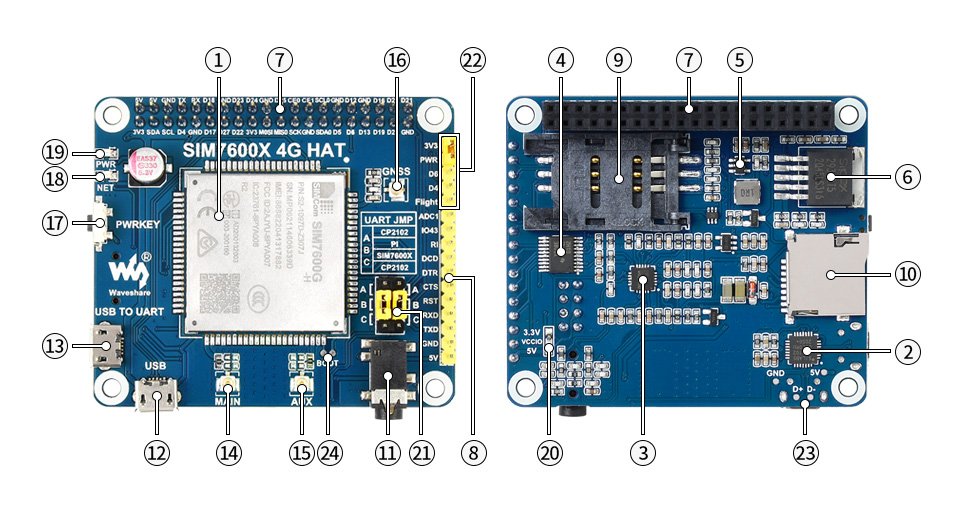
The Waveshare SIM7600G-H 4G HAT is the module we hand to most people first. It wraps SIMCom’s flagship SIM7600G-H — a genuine global LTE Cat-4 modem good for 150 Mbps down and 50 Mbps up — in a tidy Raspberry Pi HAT with an onboard USB port, so you can drive it from a Pi’s GPIO/UART, from a PC, or from an Arduino/STM32 over the broken-out control pins. You get worldwide 4G/3G/2G fallback plus GPS/GLONASS/BeiDou positioning, and Waveshare’s documentation and example code (Pi, Arduino, STM32) is some of the best in the category.
✅ Pros- True global bands — works almost anywhere
- Fast Cat-4 (150/50 Mbps) + GNSS
- USB and UART; Pi/PC/MCU friendly
- Excellent docs & sample code
❌ Cons- Higher power draw than Cat-1/NB-IoT
- No voice on this variant
- Needs a solid 5 V supply for transmit spikes
🎯 Verdict: The most versatile 4G module here. If you want one board that just works on any network and any host, start with the SIM7600G-H HAT.
👉 Check Price on Amazon →
🏅 BEST ALL-IN-ONE

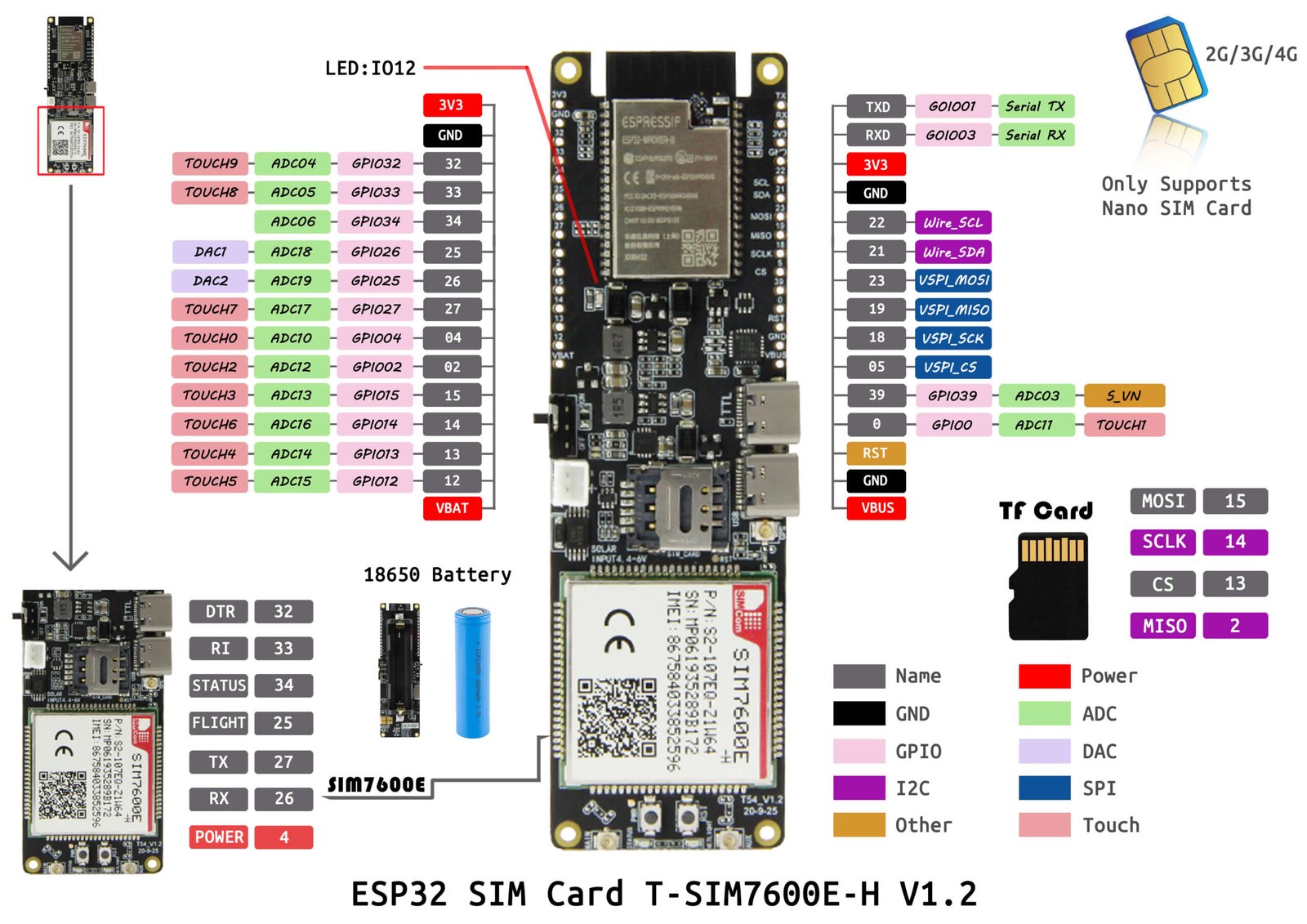
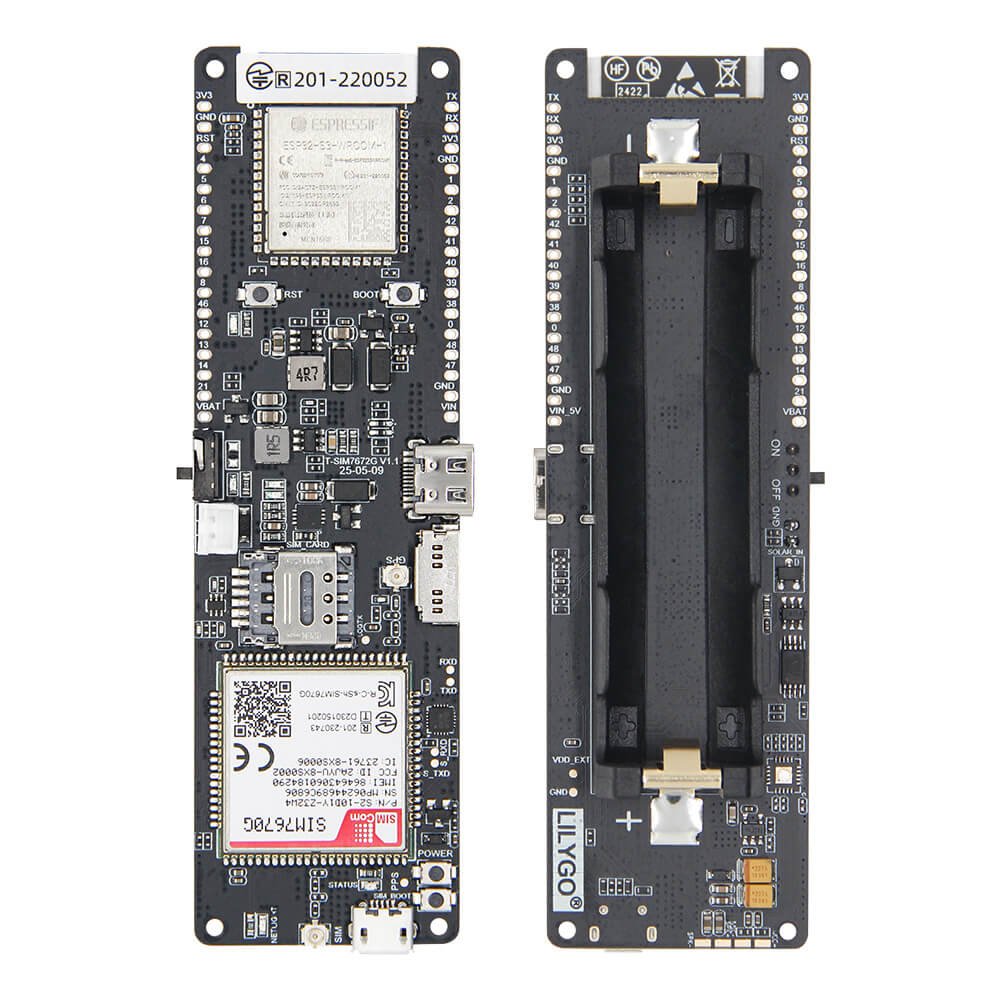
If you’d rather not bolt a modem onto a separate host, the LILYGO T-SIM7600G-H puts an ESP32-WROVER and a SIM7600G-H Cat-4 modem on a single board, complete with Wi-Fi, Bluetooth, GNSS, a microSD slot, an 18650 battery holder and a solar-charge input. Two USB-C ports keep things clean — one flashes the ESP32, the other exposes the SIM7600 as a USB network dongle. It’s the fastest route to a self-contained, battery-friendly cellular gadget you program entirely in the Arduino IDE or ESP-IDF.
✅ Pros- ESP32 + Cat-4 modem + GPS in one
- 18650 holder & solar charging built in
- Global SIM7600G-H bands
- Great LilyGo/TinyGSM example code
❌ Cons- Fixed to the ESP32 host
- Cat-4 power draw needs a healthy battery
- A few QC reports — test on arrival
🎯 Verdict: The best all-in-one. For a standalone, battery- or solar-powered ESP32 project that needs fast 4G plus GPS, nothing here is more convenient.
👉 Check Price on Amazon →
💡 BEST LOW-POWER IoT · ⭐ 4.5/53. Waveshare SIM7080G Cat-M / NB-IoT HAT
Cat-M + NB-IoT · GNSS · PSM ~3.2 µA · Raspberry Pi / Arduino / STM32
Buy →

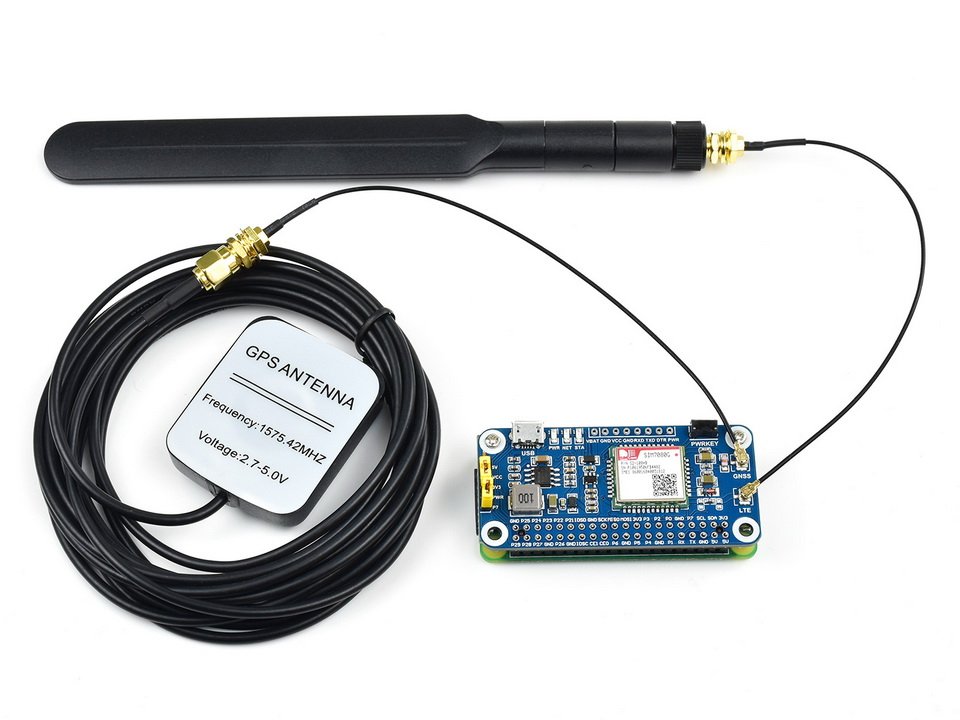
When your project sends a few readings a day and has to live on a battery for months, speed is the enemy — you want the tiny sleep currents of LTE-M and NB-IoT. The Waveshare SIM7080G HAT delivers exactly that: dual-mode Cat-M/NB-IoT with global bands, GNSS positioning, and a power-saving PSM sleep down around 3.2 µA. An onboard USB port makes AT-command testing painless, and broken-out UART pins let you drive it from an Arduino or STM32 as easily as a Raspberry Pi.
✅ Pros: Ultra-low PSM sleep (~3.2 µA); dual Cat-M + NB-IoT; global bands + GNSS; great MQTT/HTTP examples.
❌ Cons: Low data rate (kbps); needs carrier LTE-M/NB-IoT coverage; 1.8 V SIM only.
🎯 Verdict: The best low-power pick. For solar/battery sensors that phone in occasionally, the SIM7080G runs for months where a Cat-4 module would die in days.
🔧 BEST FOR ARDUINO · ⭐ 4.6/54. Botletics SIM7000G LTE Shield
Cat-M1 / NB-IoT · GNSS · ~7.4 µA sleep · LiPo charging · Arduino shield
Buy →

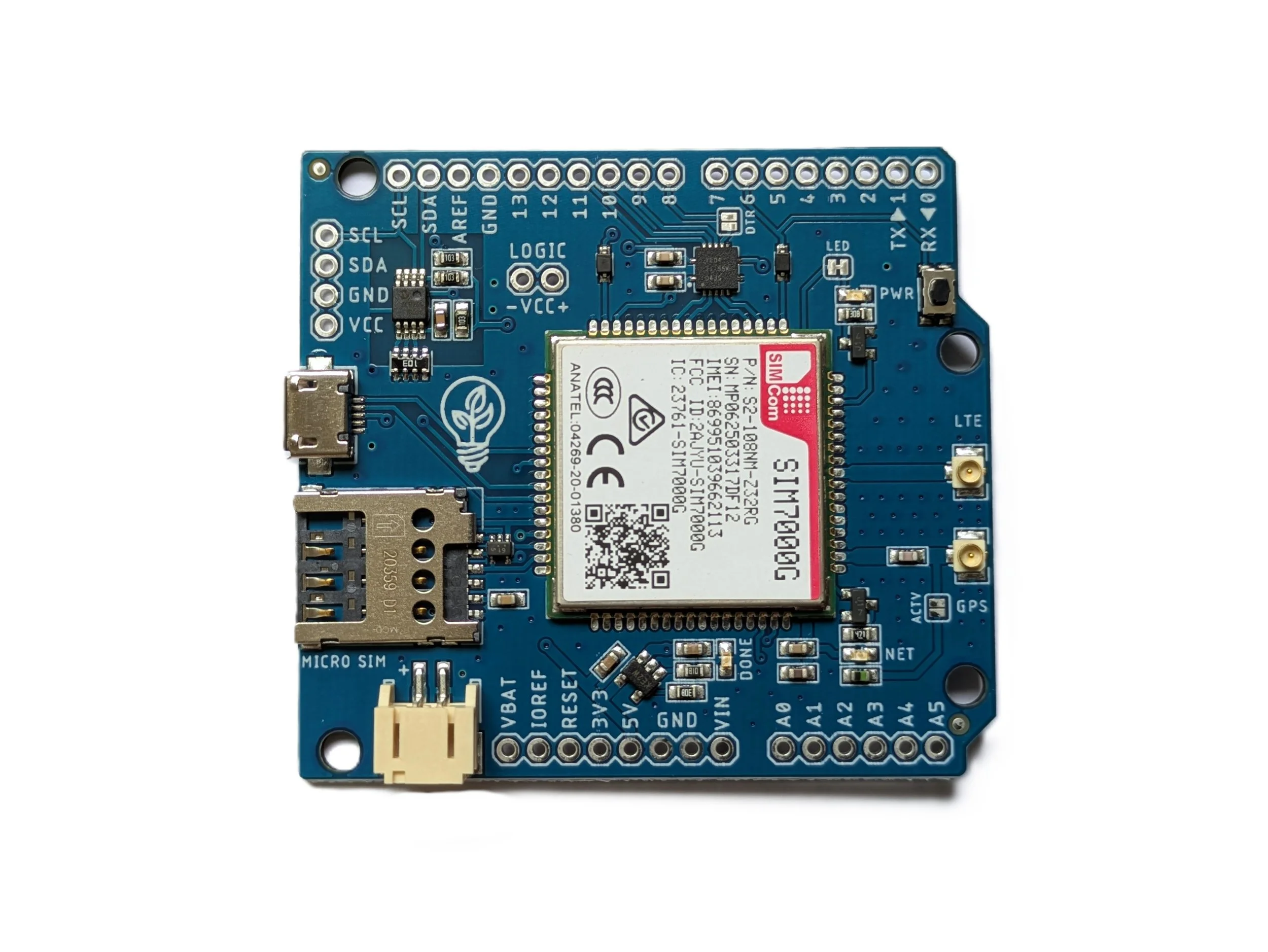
For the Arduino crowd, the Botletics SIM7000G shield is the classic answer. It stacks straight onto an Uno/Mega/Leonardo (and wires easily to ESP8266, ESP32 or a Pi), runs the low-power SIM7000-series Cat-M1/NB-IoT modem with multi-GNSS, and adds an onboard LiPo charger so a solar cell and battery make it fully off-grid. Draw drops to about 7.4 µA in its lowest state, and the open-source library plus superb wiki make it one of the most beginner-friendly cellular boards ever made. Note the global SIM7000G is the current kit — the old region-locked SIM7000A has been discontinued.
✅ Pros: Plug-and-play Arduino shield; ~7.4 µA sleep + LiPo charging; multi-GNSS; outstanding docs & library.
❌ Cons: Headers need soldering; LTE-M/NB-IoT data only (kbps); no LiPo/SIM included.
🎯 Verdict: The best Arduino cellular shield. If you’re learning IoT on an Uno or ESP32, the documentation alone makes this the safest place to start.
🎓 BEST BUDGET + GPS · ⭐ 4.4/55. LILYGO T-A7670G R2 (with GPS)
Cat-1 (10/5) · 2G GSM/GPRS fallback · L76K GPS · ESP32 · 18650
Buy →

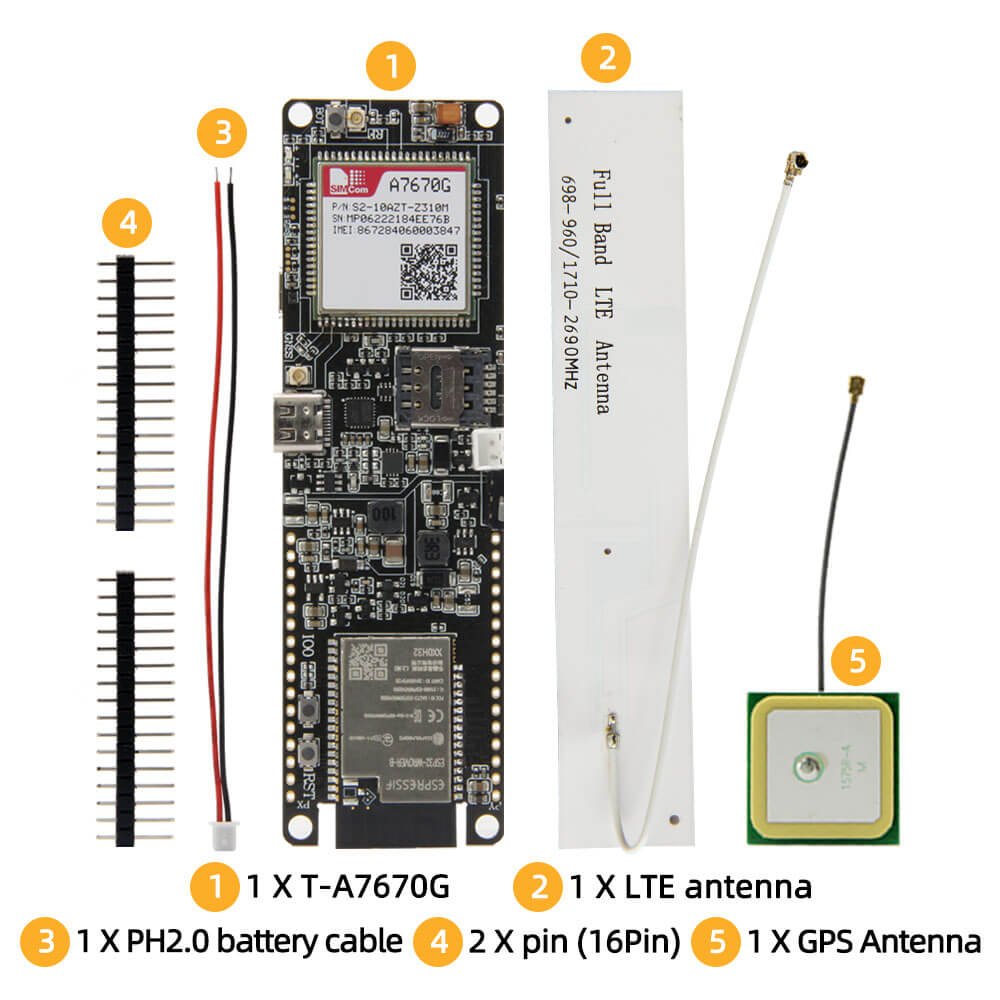
The LILYGO T-A7670G R2 is the value champion for connected ESP32 projects. Its A7670G is an LTE Cat-1 modem — around 10 Mbps down, 5 Mbps up, plenty for SMS, MQTT and telemetry — with 2G GSM/GPRS fallback so it still connects in areas without LTE. The “G with GPS” version adds a dedicated L76K GPS receiver, and the board carries an ESP32-WROVER, microSD slot and 18650 holder. It’s the natural pick for a low-cost GPS tracker or remote logger that you don’t want to overspend on.
✅ Pros: Low cost; Cat-1 with 2G fallback; dedicated L76K GPS; ESP32 + 18650 + microSD.
❌ Cons: Cat-1 speeds only; buy the correct region/GPS variant; occasional DOA units.
🎯 Verdict: The best budget board. For GPS tracking and telemetry on a tight budget, the T-A7670G R2 gives you cellular + GPS + ESP32 for the least money.
🧰 BEST COMPACT CAT-1 · ⭐ 4.3/56. LILYGO T-SIM7670G-S3
Cat-1 (10/5) · Global bands · GNSS · ESP32-S3 · Wi-Fi + BT5
Buy →
The LILYGO T-SIM7670G-S3 is the modern, compact take on an all-in-one Cat-1 board. It pairs the newer ESP32-S3 (240 MHz, 16 MB flash, 8 MB PSRAM, Wi-Fi + BT5) with SIMCom’s SIM7670G global LTE Cat-1 modem and GNSS. Because SIM7670G is LTE-only (no 2G), it’s clean and current-friendly, and the extra ESP32-S3 horsepower and RAM leave lots of headroom for a display, camera or heavier firmware. A microSD slot and battery support round out a tidy platform for trackers and remote nodes.
✅ Pros: Powerful ESP32-S3 + PSRAM; global Cat-1 + GNSS; Wi-Fi/BT5; compact and modern.
❌ Cons: No 2G fallback; Cat-1 speeds; sleep current higher than dedicated NB-IoT parts.
🎯 Verdict: The best compact Cat-1 board. Pick it when you want current-gen ESP32-S3 power and LTE-only cleanliness in a small footprint.
🌐 BEST FOR ROUTERS / SBC · ⭐ 4.5/57. Quectel EG25-G Mini PCIe
Cat-4 (150/50) · Global · GNSS · USB 2.0 · Mini PCIe
Buy →

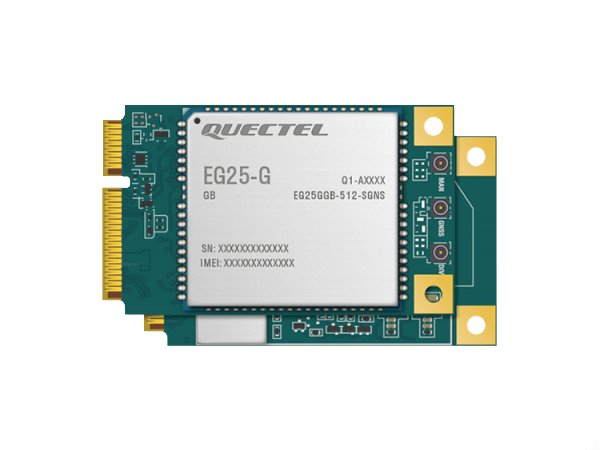
When you’re building a router, an SBC gateway or an industrial box rather than a bare-MCU gadget, the Quectel EG25-G is the professional’s module. It’s a global LTE Cat-4 card (150/50 Mbps) in standard mini-PCIe form factor with USB 2.0, multi-constellation GNSS, wide carrier certifications and an extended −35 °C to +75 °C operating range. Drop it into a Raspberry Pi base HAT, an OpenWrt router or an x86 gateway and you get carrier-grade connectivity with the reliability Quectel is known for. It needs a carrier board and antennas — it’s a module, not a plug-and-play kit.
✅ Pros: Carrier-certified global Cat-4; rugged temp range; mini-PCIe + USB; GNSS & MIMO.
❌ Cons: Needs a base HAT/carrier board + antennas; no LiPo/host on board; stock varies.
🎯 Verdict: The best module for gateways. For a router, SBC or industrial deployment that must stay online, the EG25-G is the dependable, certified choice.
🛒 How to Choose the Right 4G Module
🍓
On a Raspberry Pi, need speed?
The Waveshare SIM7600G-H HAT gives global Cat-4 (150/50) plus GNSS and stacks straight onto the Pi.
🔗
Want ESP32 + 4G in one board?
The LILYGO T-SIM7600G-H bundles ESP32, Cat-4, GPS, 18650 and solar charging — no separate host needed.
🔋
Battery sensor for months?
Go low-power with the Waveshare SIM7080G HAT or Botletics SIM7000G — LTE-M/NB-IoT with microamp sleep.
🔧
Learning on an Arduino Uno?
The Botletics SIM7000G shield plugs in directly and has the best beginner docs and library in the category.
📍
Cheap GPS tracker?
The LILYGO T-A7670G R2 (GPS) is Cat-1 with 2G fallback, a dedicated GPS chip and an ESP32 for the least money.
🌐
Building a router or gateway?
The Quectel EG25-G Mini PCIe drops into base HATs and routers for carrier-certified, always-on Cat-4.
⚙️ Key Specs Compared — Side by Side
| Spec | Waveshare SIM7600G-H | LILYGO T-SIM7600G-H | Botletics SIM7000G | LILYGO T-A7670G | Quectel EG25-G |
|---|
| LTE Class | Cat-4 ⭐ | Cat-4 ⭐ | Cat-M1 / NB-IoT | Cat-1 | Cat-4 ⭐ |
| Max DL / UL | 150 / 50 ⭐ | 150 / 50 ⭐ | ~0.3 / 0.37 Mbps | 10 / 5 Mbps | 150 / 50 ⭐ |
| Region / Bands | Global ⭐ | Global ⭐ | Global ⭐ | Global ⭐ | Global ⭐ |
| GNSS / GPS | Yes ⭐ | Yes ⭐ | Yes ⭐ | Yes ⭐ | Yes ⭐ |
| 2G Fallback | Yes ⭐ | Yes ⭐ | No | Yes ⭐ | Yes ⭐ |
| Host / Form | Pi HAT | ESP32 built-in ⭐ | Arduino shield | ESP32 built-in ⭐ | Mini PCIe |
| Best Low-Power | No | No | ~7.4 µA ⭐ | Moderate | No |
Specs from manufacturer datasheets. ⭐ marks the strongest option in each row. Confirm exact bands for your carrier before buying.
❓ Frequently Asked Questions
What’s the difference between LTE Cat-4, Cat-1 and LTE-M / NB-IoT?
They trade speed against cost and power. Cat-4 (SIM7600, EG25) does up to 150 Mbps — use it for cameras, gateways and anything bandwidth-hungry. Cat-1 (A7670, SIM7670) does around 10 Mbps at lower cost and power, which is plenty for SMS, MQTT and most telemetry. LTE-M and NB-IoT (SIM7000, SIM7080) run at kbps but sleep at microamps, so they’re built for battery sensors that send a little data occasionally over many months or years.
Will these work in my country and on my carrier?
Only if the module’s frequency bands match your network. Buy a global “G” variant (SIM7600G-H, EG25-G, A7670G, SIM7670G) unless you’ve checked your carrier’s exact LTE bands. Also remember many networks are shutting down 2G/3G, so don’t rely on GSM fallback long-term — and LTE-M/NB-IoT only work where the operator has actually deployed them, which is still patchy in some regions.
Do I need a special SIM card?
You need a data-capable SIM. A cheap IoT/M2M plan (Hologram, Twilio, 1NCE, or a data plan from a normal carrier) is ideal. For LTE-M/NB-IoT the SIM and plan must specifically support those technologies. Note the SIM voltage too — some boards (like the SIM7080G HAT) accept 1.8 V SIMs only. A voice-only SIM won’t do data, and cellular boards generally need a full data profile, not a locked handset SIM.
How do I actually control a 4G module from my microcontroller?
You send AT commands over UART (or USB) — text commands like AT+CPIN? to check the SIM and AT+CSQ to read signal strength. In practice you use a library so you don’t hand-write every command: TinyGSM is the go-to for Arduino/ESP32 across SIM7600/A7670/SIM7000, Botletics ship their own SIM7000 library, and Waveshare provide Pi/Arduino/STM32 examples. Start with the vendor’s sample sketch, confirm the module answers AT with OK, then build up.
Can these modules make phone calls?
Most do data and SMS but not voice. Voice needs an audio codec and the right module variant — some SIM7600 boards offer an “audio decoding” option, but the low-power SIM7000/SIM7080 and the Cat-1 SIM7670 are data-only. If your project needs to place or receive calls, confirm the specific variant lists voice/audio support before buying; for most IoT work, SMS and data are all you need anyway.
🏁 Final Verdict — Best 4G Module for Every Project
The right cellular module for every host and use case:
🥇 Best Overall — Waveshare SIM7600G-H HAT: global Cat-4 + GNSS, USB & UART, superb docs
Buy →🏅 Best All-in-One — LILYGO T-SIM7600G-H: ESP32 + Cat-4 + GPS + 18650/solar in one board
Buy →💡 Best Low-Power IoT — Waveshare SIM7080G HAT: Cat-M/NB-IoT with ~3.2 µA sleep
Buy →🔧 Best for Arduino — Botletics SIM7000G: plug-in LTE-M/NB-IoT shield, best-in-class docs
Buy →🎓 Best Budget + GPS — LILYGO T-A7670G R2: Cat-1 + 2G fallback + GPS + ESP32 for less
Buy →🧰 Best Compact Cat-1 — LILYGO T-SIM7670G-S3: modern ESP32-S3 + global Cat-1 + GNSS
Buy →🌐 Best for Routers / SBC — Quectel EG25-G Mini PCIe: carrier-certified global Cat-4
Buy →No single 4G module is right for every project, but there’s a clear best pick for each host and use case above. For most makers the Waveshare SIM7600G-H HAT is the safest starting point — global bands, fast Cat-4, GNSS and documentation you’ll actually enjoy. Want everything on one board? The LILYGO T-SIM7600G-H bundles an ESP32 with it. Building a battery sensor? Drop down to the low-power SIM7080G or Botletics SIM7000G; on a budget tracker, the T-A7670G R2 wins; and for routers and gateways, the Quectel EG25-G is the professional choice. Pair your new module with our Arduino, ESP32, STM32 and Raspberry Pi tutorials and get your project talking to the cloud today.
💬 Not sure which module fits your build? Tell us your host board, region and whether you need speed or battery life in the comments below, and we’ll point you to the right one.
All Amazon links above use our affiliate tag (microlab05-20). Buying through them supports microcontrollerslab.com at no extra cost to you. We don’t quote fixed prices because cellular modules change price and availability often — always confirm the current price on Amazon before buying.
| Arduino Components | Amazon Links |
|---|
| Arduino Starter Kit | Buy Now |
| Arduino Development Kit | Buy Now |
| Arduino Smart Robot Car Kit V4 | Buy Now |
| Arduino Sensors Kit | Buy Now |