⚠️ Affiliate Disclosure: This post contains Amazon affiliate links. If you purchase through our links, we may earn a small commission at no extra cost to you. Every product below was checked against its live Amazon listing before publishing. Prices change often, so we don’t list them here. Tap any Buy Here button to see the current price on Amazon.
Ultimate Buying Guide
🔀 Best Logic Level Converters and Level Shifters
12 bi-directional 3.3V to 5V converters, TXS0108E and TXB0108 boards, 74AHCT125 buffers and Pi and Arduino shields compared.
✅ 12 Picks Reviewed
✅ I2C, SPI, UART and LEDs
✅ 1.8V to 5V Options
✅ Honest Pros and Cons
Modern boards such as the ESP32, Raspberry Pi, Pico and Arduino UNO Q run 3.3V logic, while plenty of sensors, displays, LED strips and older shields still expect 5V. Wiring them directly can damage a 3.3V pin or give flaky signals. A logic level converter translates signals between the two voltages so both sides stay within spec.
Not all shifters suit all signals. MOSFET boards are ideal for I2C, TXS0108E and TXB0108 chips handle wider and faster buses, and a 74AHCT125 buffer is the best fix for addressable LEDs. This guide compares 12 options checked against live Amazon listings. It pairs well with our WS2812B LED strip and RS485 module guides.
💡 Reality check before you buy: A level shifter only translates
logic signals, not power: it cannot run a 5V motor or relay coil (see our
relay modules guide for that). The common four-channel MOSFET boards rely on pull-up resistors, so edges get slow above a few hundred kHz; they suit I2C and UART but not fast SPI displays or WS2812B data. TXS0108E boards need their OE pin pulled high and can misbehave with strong pull-ups. TXB0108 chips do not work with I2C. Many ESP32 and Pi peripherals already accept 3.3V, so check the datasheet before adding a shifter at all.
Table of Contents
- Quick Comparison: All 12 Level Converters
- How to Choose a Level Shifter
- Detailed Reviews: All 12 Picks
- Which One for Which Job
- MOSFET vs TXS0108E vs TXB0108 vs 74AHCT125
- Frequently Asked Questions
- Final Verdict: Best Logic Level Converters
🔀 Quick Comparison: All 12 Level Converters
| Product | Channels | Type | Best Signals (listing) | Best For | Buy |
|---|
| 🥇 HiLetgo 4-Channel Converter (10 pcs) | 4 | Bi-directional, auto | I2C, UART, slow SPI | Best Overall | Buy Here → |
| 🚀 HiLetgo TXS0108E 8-Ch (5 pcs) | 8 | TXS0108E, OE pin | UART, I2C, SPI | Best 8-Channel | Buy Here → |
| 📦 4-Ch I2C Converter (10 pack) | 4 | Bi-directional, auto | Works to 1.8V and 2.8V | Most Reviewed | Buy Here → |
| ⭐ SparkFun Logic Level Converter | 4 | Bi-directional | I2C, UART, GPIO | Best Brand-Name Board | Buy Here → |
| 🧰 Lonely Binary 27-Pack (2/4/6 Ch) | 2, 4 and 6 | Auto direction | I2C, SPI, UART | Best Assortment | Buy Here → |
| 🔢 WWZMDiB 4-Ch Shifter (12 pcs) | 4 | Bi-directional | I2C, SPI, UART, 1-Wire | Best for 1-Wire | Buy Here → |
| 🔷 GeeekPi TXS0108E 8-Ch (6 pack) | 8 | TXS0108E | VCCA 1.2-3.6V, VCCB 1.65-5.5V | Best TXS0108E Value | Buy Here → |
| ⚙️ TXS0108E 8-Ch Module | 8 | TXS0108E, OE high | UART, I2C, SPI | Best Single TXS0108E | Buy Here → |
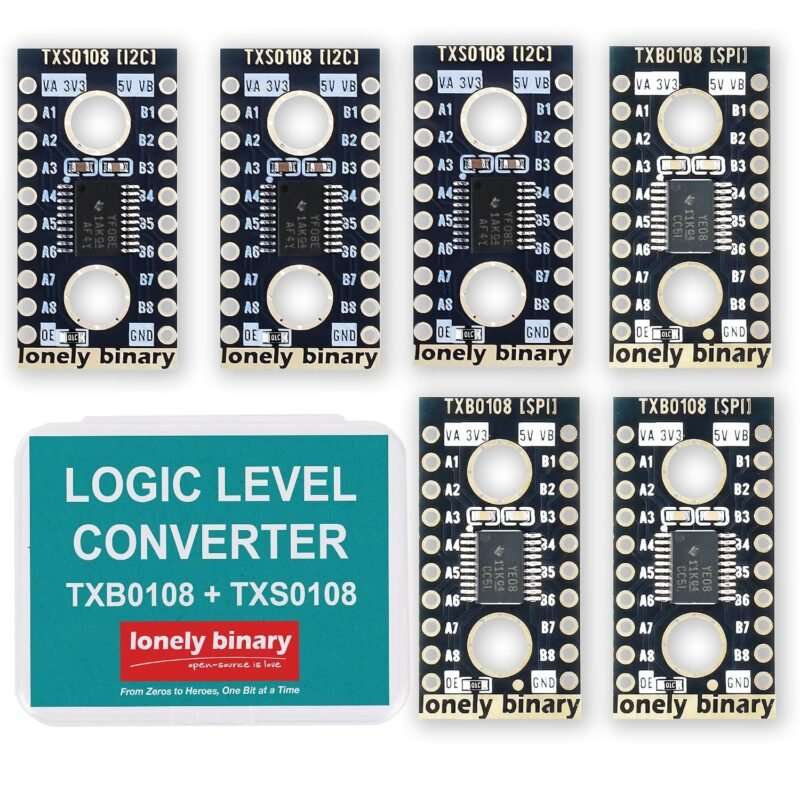
| ⚡ TXB0108 + TXS0108 Mixed 6-Pack | 8 | 3x TXB0108, 3x TXS0108 | Up to 100 Mbps (listing) | Best for Fast Push-Pull | Buy Here → |
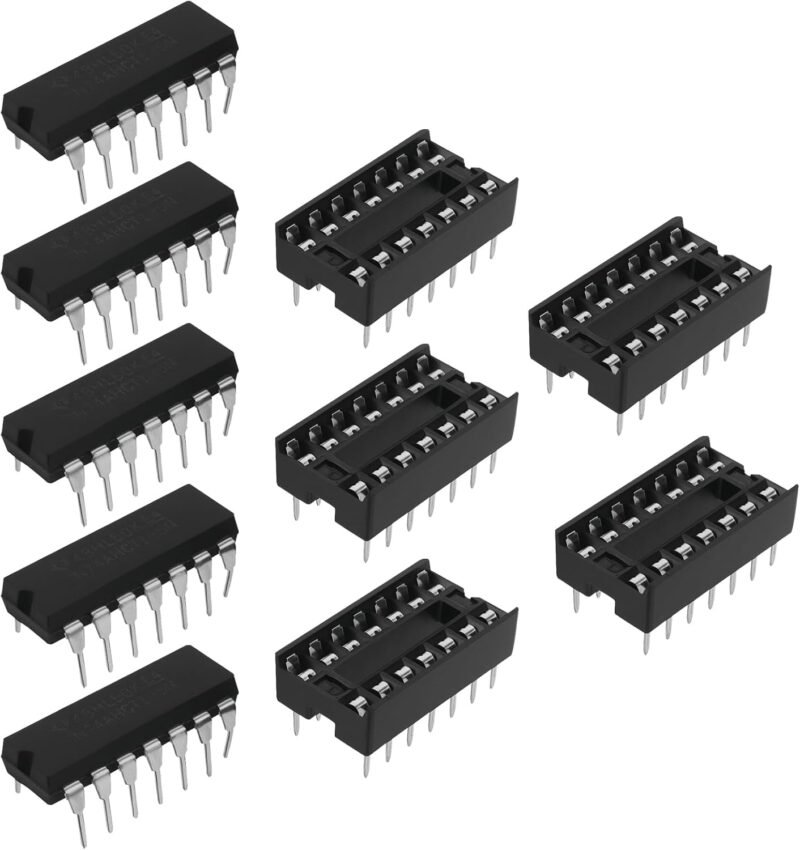
| 🌈 SN74AHCT125N Buffers (5 sets) | 4 per chip | One-way 3.3V to 5V | LED data, fast SPI | Best for WS2812B LEDs | Buy Here → |
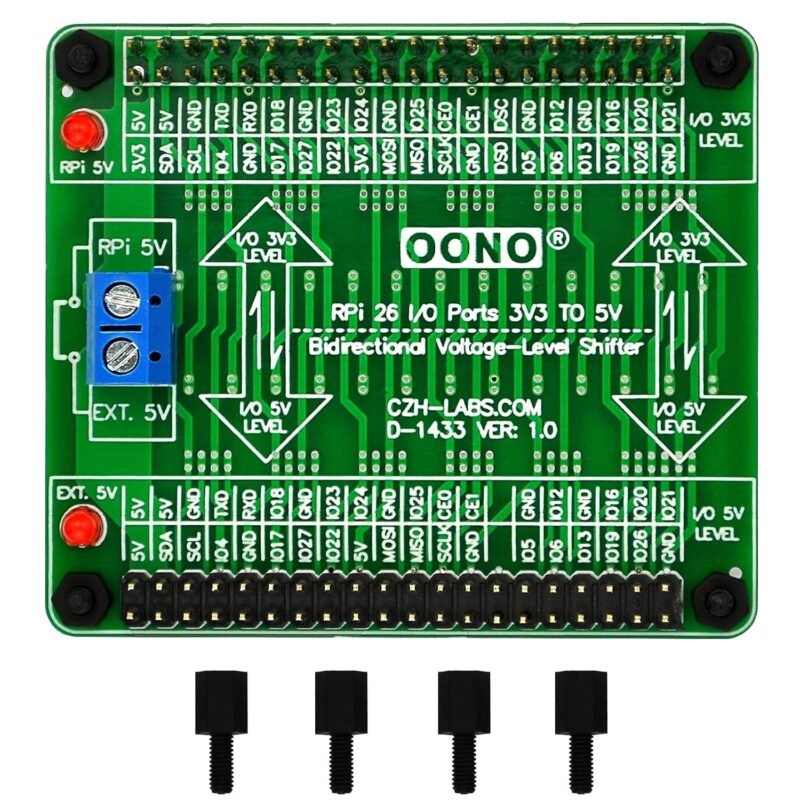
| 🍓 OONO Pi 26-I/O Level Shifter | 26 | Pi HAT-style board | Pi GPIO to 5V | Best for Raspberry Pi | Buy Here → |
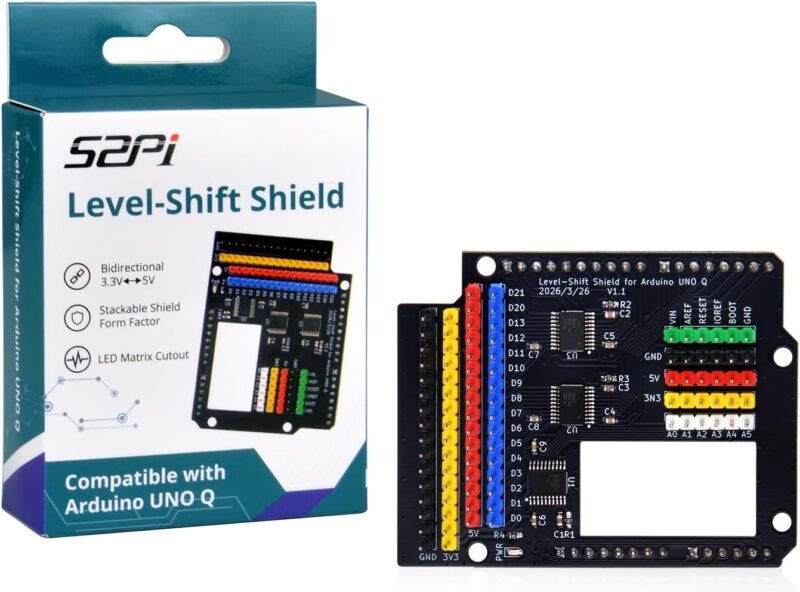
| 🧩 GeeekPi Level Shield for UNO Q | Shield | Stackable shield | Arduino UNO Q | Best for Arduino UNO Q | Buy Here → |
Specs and compatibility are taken from the Amazon listings at the time of writing. Ratings change over time, so check the listing before you buy.
🔍 How to Choose a Level Shifter
🔁
Signal Type
I2C and 1-Wire are open-drain and need a MOSFET or TXS-type shifter. SPI, UART and LED data are push-pull and work best with TXB0108 or 74AHCT125 parts.
⏱️
Speed
MOSFET boards are fine for 100 to 400 kHz I2C and normal UART. For SPI displays, SD cards or WS2812B LEDs at 800 kHz, use a TXB0108 or 74AHCT125.
↔️
Direction
Bi-directional boards sense direction automatically. A buffer like the 74AHCT125 only goes one way, which is fine for LED data or chip selects.
🔢
Channel Count
Count every signal: I2C needs 2, UART 2, SPI 4 or more. Two and four channel boards keep wiring tidy; eight channel boards suit parallel buses.
🔋
Voltage Pair
Most boards do 3.3V and 5V. If you work with 1.8V parts, check the low-side voltage range in the listing; TXS0108E boards start at about 1.2V.
🏆 Detailed Reviews: All 12 Picks
🥇 BEST OVERALL
1. HiLetgo 4-Channel Logic Level Converter (10 pcs)
⭐ 4.6/5 · The everyday 3.3V to 5V fix
Buy on Amazon →

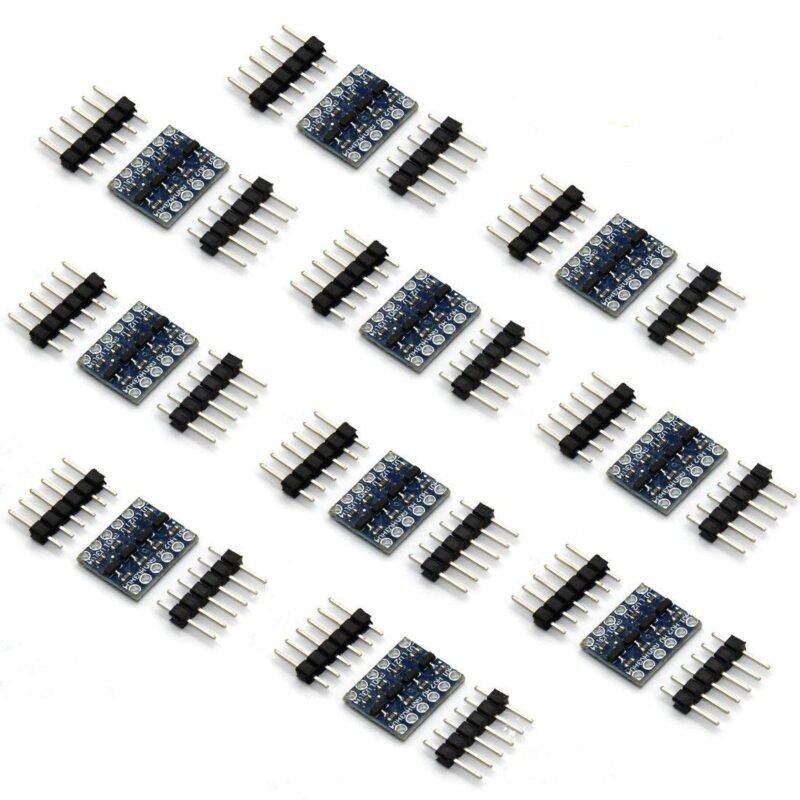
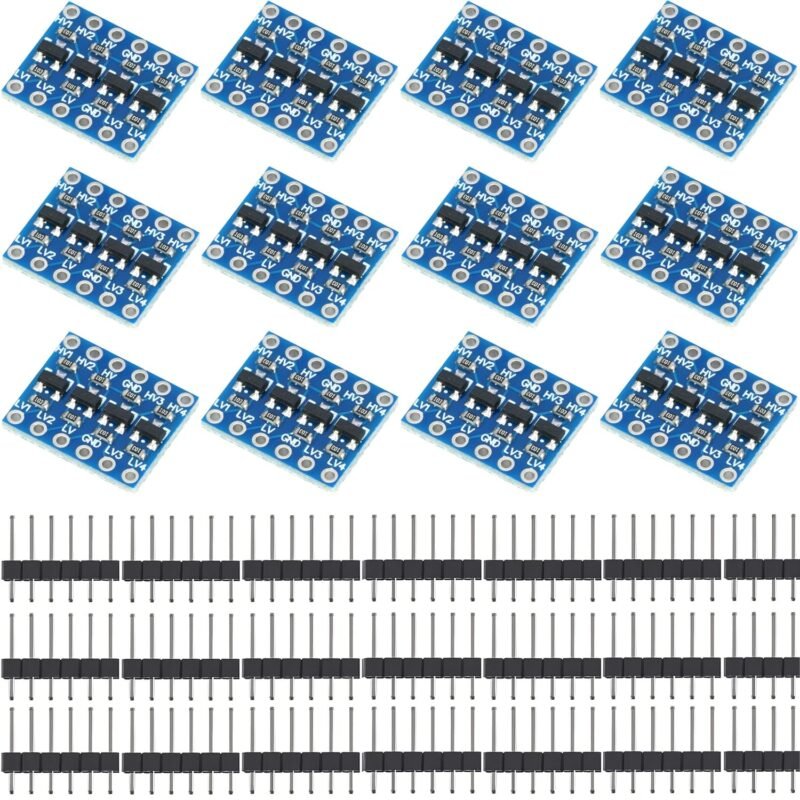
The small blue four-channel board that lives in every maker’s parts drawer. Per the listing it safely steps 5V signals down to 3.3V and 3.3V up to 5V at the same time, converting four high-side pins to four low-side pins. You wire HV to 5V, LV to 3.3V and a shared ground, and the board works out direction by itself. It is ideal for I2C sensors, UART modules and slower SPI between an ESP32 or Raspberry Pi and 5V parts. A pack of ten for one listing is great value. It averages about 4.6 stars from 317 ratings. Boards of this style typically use MOSFETs with pull-up resistors, so they are not the best choice for fast SPI displays or long LED data lines.
✅ Pros- Ten boards per pack
- Works with I2C open-drain
- Breadboard friendly
❌ Cons- Slow edges at high speed
- Headers need soldering
🎯 Verdict: The default level shifter for I2C, UART and general GPIO.
👉 Check Price on Amazon →
🚀 BEST 8-CHANNEL
2. HiLetgo TXS0108E 8-Channel Level Converter (5 pcs)
⭐ 4.4/5 · Eight fast channels on one board
Buy on Amazon →
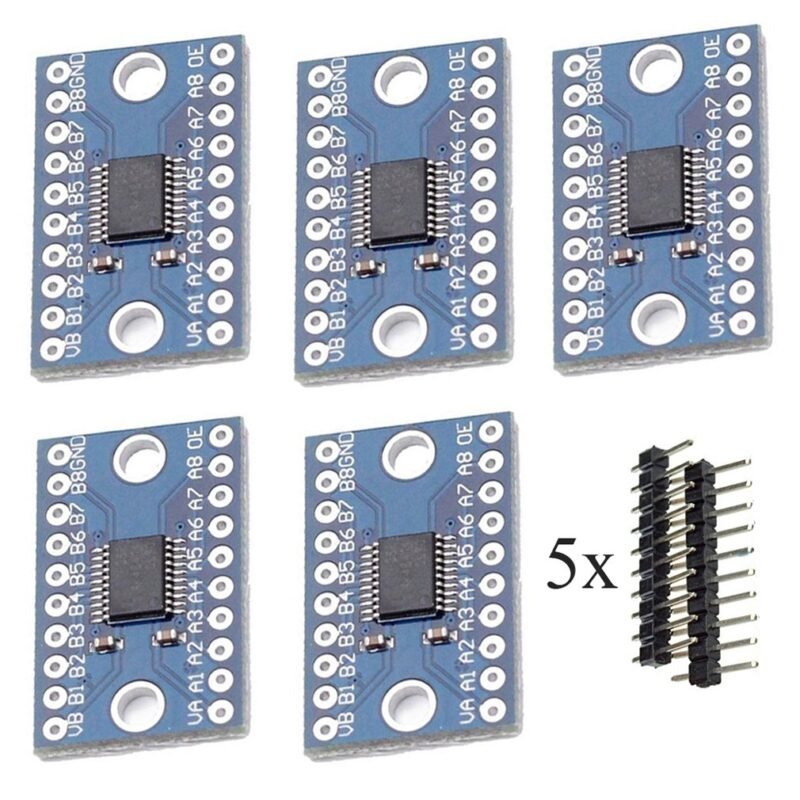
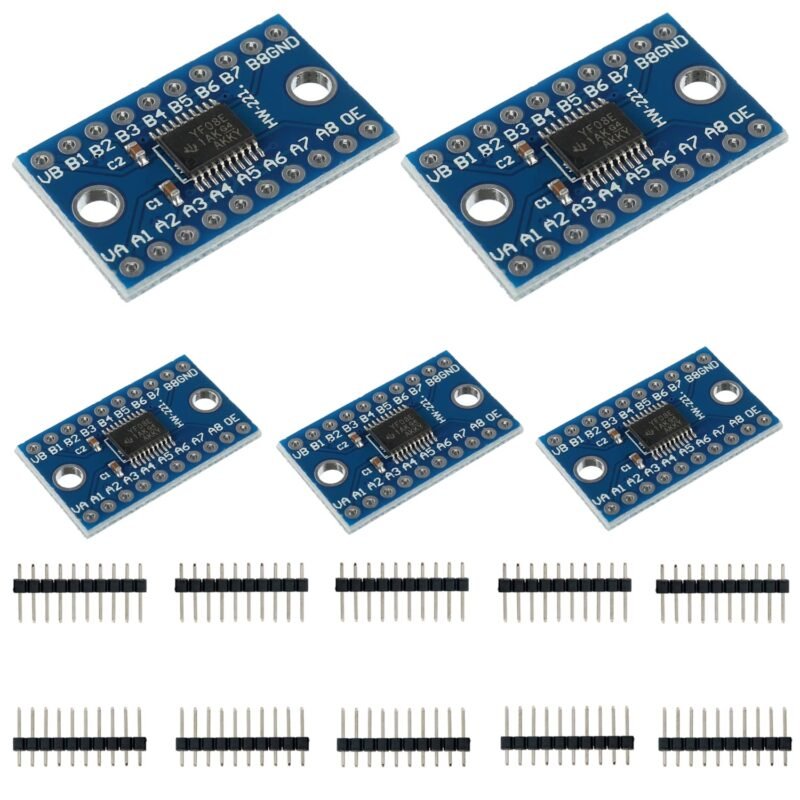
When four channels are not enough, the TXS0108E gives you eight bi-directional lines on one board. HiLetgo’s listing says it handles 3.3V to 5V, 1.8V to 3.3V and other common conversions and works with UART, I2C and SPI, for jobs like linking an MCU to an SD card or 5V serial devices. It averages about 4.4 stars from 130 ratings. The TXS0108E has an output-enable pin that must be pulled high, and it can struggle with strong external pull-ups or heavy loads, so test it with your circuit.
✅ Pros- Eight channels
- Handles 1.8V too
- Five boards per pack
❌ Cons- OE pin must be set
- Sensitive to heavy loads
🎯 Verdict: Best for wide buses like parallel displays and SD cards.
👉 Check Price on Amazon →
📦 MOST REVIEWED · ⭐ 4.5/53. 4-Channel I2C Logic Level Converter (Pack of 10)
Unbranded · 3.3V/5V plus 2.8V and 1.8V · 535 ratings
Buy Here →
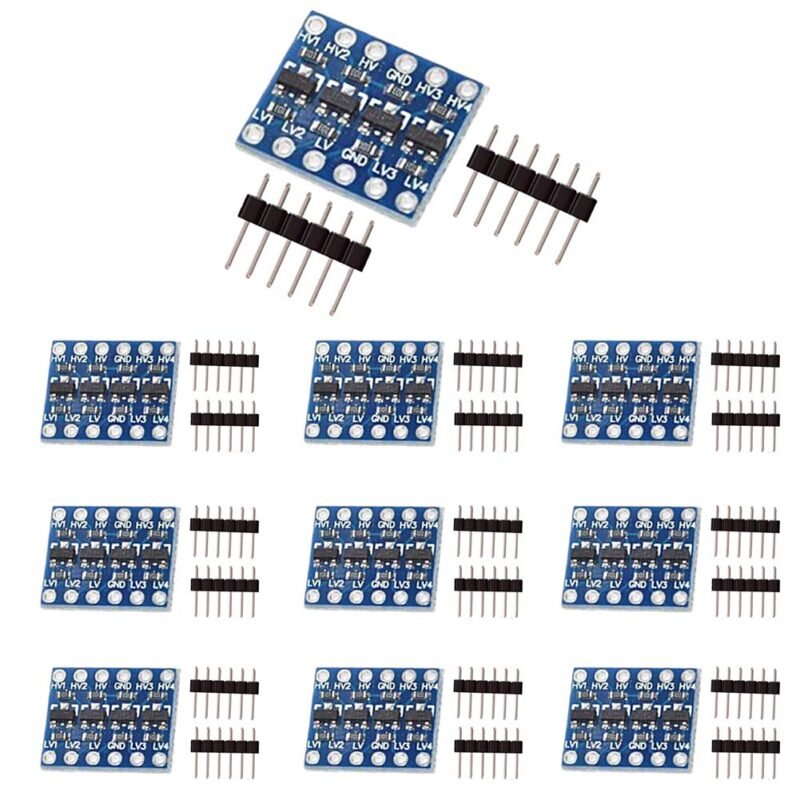
The most-reviewed level shifter listing we found, with about 4.5 stars from 535 ratings. It is the same four-channel bi-directional design as our top pick, and the listing says it also works with 2.8V and 1.8V devices. It is unbranded, so quality can vary between batches.
✅ Pros: Large review base; ten per pack.
❌ Cons: Unbranded listing.
🎯 Verdict: A proven bulk pack for I2C sensors.
⭐ BEST BRAND-NAME BOARD · ⭐ 4.8/54. SparkFun Logic Level Converter, Bi-Directional
Genuine SparkFun · 3.3V and 5V · 43 ratings
Buy Here →

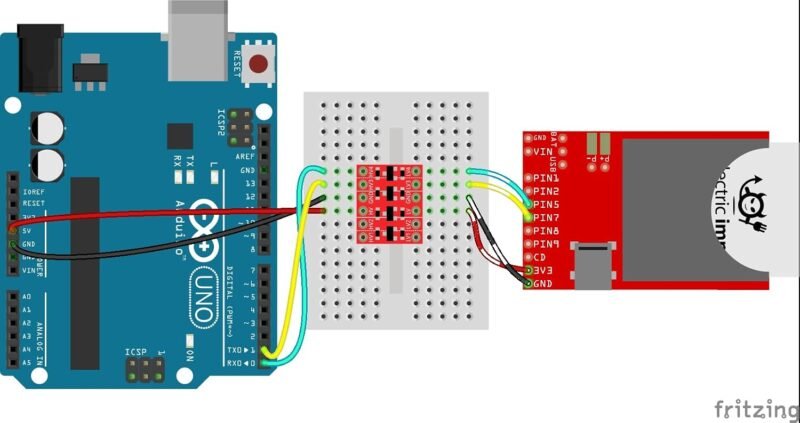
The original board most clones copy. Per the listing it steps 5V down to 3.3V and 3.3V up to 5V at the same time. SparkFun publishes a hookup guide and schematic, which helps when you are debugging. It has the top rating here, about 4.8 stars, from a smaller base of 43 ratings.
✅ Pros: Genuine, documented design.
❌ Cons: One board costs more than a clone pack.
🎯 Verdict: Buy this when you want a known-good board.
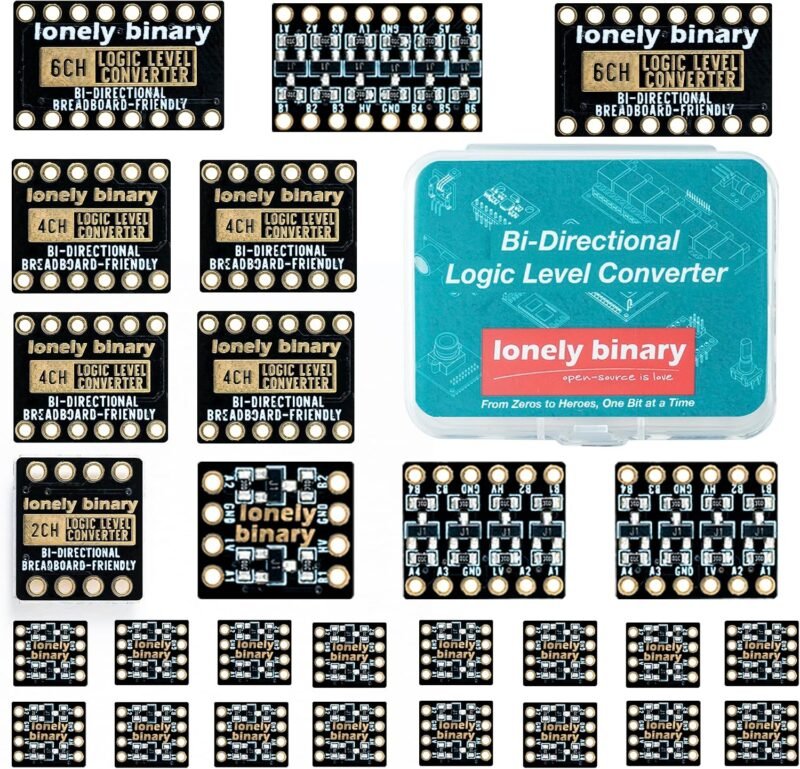
🧰 BEST ASSORTMENT · ⭐ 4.5/55. Lonely Binary 27-Pack Logic Level Converter Kit
18x 2-ch, 6x 4-ch, 3x 6-ch · 66 ratings
Buy Here →

An assortment for people who build a lot: per the listing, 18 two-channel, 6 four-channel and 3 six-channel modules with automatic direction sensing and 2.54 mm pin spacing, supporting I2C, SPI and UART. Two-channel boards are neat for a single I2C bus. About 4.5 stars from 66 ratings.
✅ Pros: Right size for every job.
❌ Cons: More boards than casual users need.
🎯 Verdict: Stock the parts drawer in one buy.
🔢 BEST FOR 1-WIRE · ⭐ 4.3/56. WWZMDiB 12 Pcs 4-Channel Level Shifter
12 boards · UART, I2C, SPI and 1-Wire listed · 49 ratings
Buy Here →
Another four-channel bi-directional pack, notable because the listing explicitly names 1-Wire alongside UART, I2C and SPI, which suits DS18B20 temperature sensors on a 5V bus. Twelve boards per pack. About 4.3 stars from 49 ratings.
✅ Pros: Twelve boards; 1-Wire listed.
❌ Cons: Generic documentation.
🎯 Verdict: A good value bulk alternative.
🔷 TXS0108E VALUE PACK · ⭐ 3.7/57. GeeekPi 6-Pack TXS0108E 8-Channel Converter
VCCA 1.2-3.6V · VCCB 1.65-5.5V · 89 ratings
Buy Here →
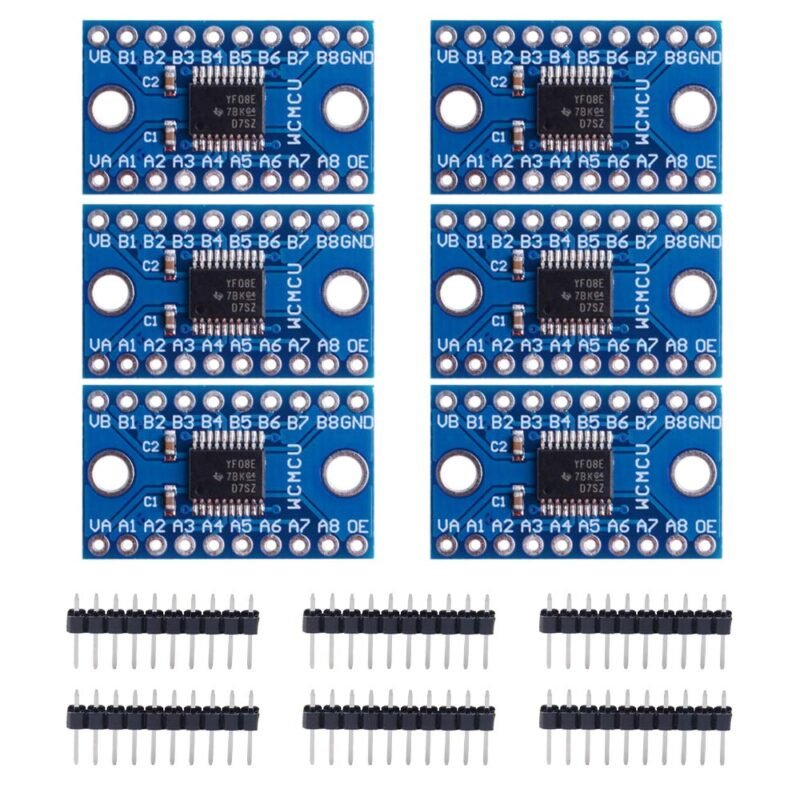
Six TXS0108E boards from GeeekPi, with the listing quoting VCCA 1.2 to 3.6V and VCCB 1.65 to 5.5V. Good value if you need several eight-bit translators. Its rating is the weakest here, about 3.7 stars from 89 ratings, so expect some boards to need testing or careful soldering.
✅ Pros: Six boards; wide voltage range.
❌ Cons: Lowest rating in this guide.
🎯 Verdict: Budget pick for multiple 8-bit buses.
⚙️ SINGLE TXS0108E · ⭐ 4.2/58. TXS0108E High Speed 8-Channel Level Converter
Unbranded · VA 1.2-3.6V, VB 1.65-5.5V · 67 ratings
Buy Here →
A generic TXS0108E module. The listing notes the OE pin is active high and should be tied to the low-voltage side, and gives VA 1.2 to 3.6V and VB 1.65 to 5.5V. It lets 5V modules work on 3.3V microcontrollers and the reverse. About 4.2 stars from 67 ratings.
✅ Pros: Clear OE note in listing.
❌ Cons: Unbranded.
🎯 Verdict: An alternative when HiLetgo is out of stock.
⚡ BEST FOR FAST PUSH-PULL · ⭐ 4.4/59. 6-Pack TXB0108 and TXS0108 8-Channel Level Shifters
Both chip variants · 1.2-3.6V to 1.65-5.5V · 37 ratings
Buy Here →
A clever pack with three TXB0108 and three TXS0108 boards. The listing explains the difference: the TXB0108 is optimised for push-pull signals such as SPI, while the TXS0108 also handles open-drain lines like I2C. It quotes data rates up to 100 Mbps and automatic direction sensing. About 4.4 stars from 37 ratings. Do not use the TXB0108 on I2C; that is what the TXS boards are for.
✅ Pros: Both variants to compare.
❌ Cons: Easy to mix the two up.
🎯 Verdict: Best for fast SPI and parallel buses.
🌈 BEST FOR WS2812B LEDS · ⭐ 4.3/510. SN74AHCT125N Quad Bus Buffer (5 chips with sockets)
DIP chips · TTL-compatible inputs · 29 ratings
Buy Here →

Not a breakout board but the chip that LED hobbyists swear by. The 74AHCT125 has TTL-compatible inputs, per the listing, so a 3.3V ESP32 output reliably drives a clean 5V signal. That makes it the classic fix for flickering WS2812B and NeoPixel strips. It is one-way only and needs to be wired on a breadboard or PCB, and this pack includes five chips with sockets. About 4.3 stars from 29 ratings.
✅ Pros: Fast, strong one-way output.
❌ Cons: One-way; needs wiring.
🎯 Verdict: The proper fix for 5V addressable LEDs.
🍓 BEST FOR RASPBERRY PI · ⭐ 4.3/511. OONO Raspberry Pi 3.3V to 5V 26 I/O Level Shifter
Pi A+ to 4B (Zero with 2 screws) · 13 ratings
Buy Here →
A board that sits on the Raspberry Pi header and converts 26 GPIO lines between 3.3V and 5V in both directions, per the listing (ID_SC and ID_SD are not included). It supports Pi A+ through 4B, and Zero boards with only two screw holes fixed. It is the cleanest way to give a Pi a full 5V I/O header. Only 13 ratings so far (about 4.3 stars), so treat it as a less proven pick.
✅ Pros: Whole Pi header in one board.
❌ Cons: Few reviews; Pi 5 not listed.
🎯 Verdict: For Pi projects with many 5V signals.
🧩 BEST FOR ARDUINO UNO Q · ⭐ 4.2/512. GeeekPi Level Converter Shield for Arduino UNO Q
Stackable · 3.3V to 5V · LED matrix cutout · 12 ratings
Buy Here →

The Arduino UNO Q runs 3.3V logic in the classic UNO shape, which surprises people who plug in old 5V shields. This stackable level-shift shield converts between 3.3V and 5V for sensors, displays and relay modules, with a cutout for the UNO Q’s LED matrix, per the listing. It is new with only 12 ratings (about 4.2 stars).
✅ Pros: Fixes UNO Q shield compatibility.
❌ Cons: Very few reviews; UNO Q specific.
🎯 Verdict: Makes 5V shields safe on an UNO Q.
🛒 Which One for Which Job
🌡️
I2C sensors on an ESP32
HiLetgo 4-Channel or a two-channel board from the Lonely Binary kit.
🌈
WS2812B or NeoPixel strip
SN74AHCT125N buffer between the ESP32 pin and the strip.
🖥️
5V SPI display or SD card
TXB0108 from the mixed pack, or a TXS0108E board.
📟
5V UART GPS or GSM module
SparkFun or HiLetgo four-channel converter.
🍓
Raspberry Pi with many 5V signals
OONO 26 I/O level shifter on the header.
🧩
Old 5V shields on an UNO Q
GeeekPi level shield stacked between board and shield.
⚙️ MOSFET vs TXS0108E vs TXB0108 vs 74AHCT125
| Aspect | MOSFET Board (BSS138 style) | TXS0108E | TXB0108 | 74AHCT125 |
|---|
| Direction | Bi-directional | Bi-directional | Bi-directional | One way (3.3V to 5V) |
| I2C / open-drain | Yes, ideal ⭐ | Yes | No | No |
| Speed | Slow edges, I2C and UART speeds | Medium to fast | Fast push-pull ⭐ | Fast, strong drive ⭐ |
| Addressable LEDs | Unreliable | Sometimes | Sometimes | Best choice ⭐ |
| Channels | 2 to 6 typical | 8 ⭐ | 8 ⭐ | 4 per chip |
| Ease of use | Very easy ⭐ | OE pin needed | OE pin needed | Breadboard wiring |
General behaviour of each chip type; always check the specific board’s listing and the chip datasheet.
❓ Frequently Asked Questions
Do I need a level shifter for an ESP32 with 5V sensors?
Only if the sensor drives its outputs to 5V or needs a 5V high level. Many 5V modules accept 3.3V inputs and some I2C boards pull up to 5V, which can stress ESP32 pins. A cheap four-channel converter removes the guesswork. Our ESP32 development boards guide covers board choices.
Can I use a voltage divider instead?
For a one-way 5V to 3.3V signal such as a UART TX line, two resistors work fine. Dividers cannot shift 3.3V up to 5V and are poor for I2C or fast signals, which is where a converter board helps.
Why does my WS2812B strip flicker on an ESP32?
The strip expects a high level close to 5V, and 3.3V data is marginal, especially over long wires. A 74AHCT125 buffer powered from 5V fixes it. See our WLED controllers guide for ready-made boards with built-in shifters.
What is the difference between TXS0108E and TXB0108?
Both are eight-bit auto-direction translators. The TXS0108E has internal pull-ups that suit open-drain buses like I2C. The TXB0108 is built for push-pull signals like SPI and does not work properly with I2C pull-ups.
Does a level converter work with USB serial adapters?
Usually you do not need one: many USB to UART adapters have a 3.3V or 5V jumper. Use a converter only when the adapter is fixed at 5V and your board is 3.3V only.
🏁 Final Verdict: Best Logic Level Converters
Our picks by job:
🥇 Best Overall: HiLetgo 4-Channel Converter (10 pcs)
Buy Here →🚀 Best 8-Channel: HiLetgo TXS0108E (5 pcs)
Buy Here →⭐ Best Brand-Name: SparkFun Logic Level Converter
Buy Here →🌈 Best for LEDs: SN74AHCT125N Quad Buffer
Buy Here →⚡ Best for Fast SPI: TXB0108 and TXS0108 Mixed Pack
Buy Here →🍓 Best for Raspberry Pi: OONO 26 I/O Level Shifter
Buy Here →For most projects, a pack of HiLetgo four-channel converters handles I2C and UART between 3.3V boards and 5V modules. Step up to a TXS0108E or TXB0108 board for wide or fast buses, and keep a few 74AHCT125 chips for LED strips. Build and test on a good breadboard, and see our related guides on relay modules, USB to UART adapters, WS2812B LED strips, TFT displays and ESP32-S3 boards.
💬 Which signals are you shifting between 3.3V and 5V? Share your setup or questions in the comments below.
All Amazon links above use our affiliate tag (microlab05-20). Purchasing through them supports microcontrollerslab.com at no extra cost to you. Prices and availability change frequently, so always confirm the current price on Amazon before buying.