⚠️ Affiliate Disclosure: This post contains Amazon affiliate links. If you purchase through our links, we may earn a small commission at no extra cost to you. Every product below was checked against its live Amazon listing before publishing. Prices change often, so we don’t list them here. Tap any Buy Here button to see the current price on Amazon.
Ultimate Buying Guide
🔌 Best Relay Modules for Arduino, ESP32 and Raspberry Pi
12 relay boards, solid state relays and safe enclosed switches compared, from single 3.3V modules to 16-channel panels.
✅ 12 Picks Reviewed
✅ 1 to 16 Channels
✅ 5V, 3.3V and 12V Coils
✅ Mains Safety Notes
A relay lets a 3.3V or 5V microcontroller pin switch something far bigger: a pump, a lamp, a fan, a heater or a garage door button. Mechanical relay boards click a real contact, so they switch both AC and DC. Solid state relays (SSRs) switch silently with no moving parts but usually handle only AC loads. The board you pick depends on your logic voltage, how many loads you need, and whether you are switching mains.
This guide compares 12 relay options on Amazon, checked against live listings. If you want Wi-Fi control without writing firmware, see our Wi-Fi smart relay modules guide, and for RS485 or Ethernet control in a panel see Modbus relay and I/O modules.
💡 Reality check before you buy: Cheap relay boards are fine for learning, but mains wiring is dangerous. Keep 120/230V wiring inside a closed enclosure, use proper wire gauge and fusing, and if you are not confident, use an enclosed switch like the Iot Relay or have an electrician do the mains side. Many 5V boards expect a 5V trigger; a 3.3V ESP32 or Pi pin may not switch them reliably, so choose a 3.3V module, a jumper-selectable board or a HAT. Contact ratings such as 10A are maximums for resistive loads; motors, compressors and LED drivers have inrush currents, so derate generously. SSR listings often quote optimistic amp ratings and need heat sinks.
Table of Contents
- Quick Comparison: All 12 Relay Modules
- How to Choose a Relay Module
- Detailed Reviews: All 12 Picks
- Which One for Which Job
- Mechanical Relay vs Solid State Relay vs Enclosed Relay
- Frequently Asked Questions
- Final Verdict: Best Relay Modules
🔌 Quick Comparison: All 12 Relay Modules
| Product | Channels | Coil / Input | Contact Rating (listing) | Best For | Buy |
|---|
| 🥇 SunFounder 4-Channel 5V Relay | 4 | 5V coil, optocoupler | AC250V/10A, DC30V/10A | Best Overall | Buy Here → |
| 🔌 Iot Relay (Enclosed) | 1 circuit, 4 outlets | Enclosed, low-voltage input | Plug-in AC outlets | Safest for Mains | Buy Here → |
| 2️⃣ SunFounder 2-Channel 5V Relay | 2 | 5V coil, low-level trigger | AC250V/10A, DC30V/10A | Best Small Board | Buy Here → |
| 1️⃣ HiLetgo 1-Channel 5V (2 pcs) | 1 (x2) | 5V, jumper high/low trigger | AC250V/10A, DC30V/10A | Best Single Channel | Buy Here → |
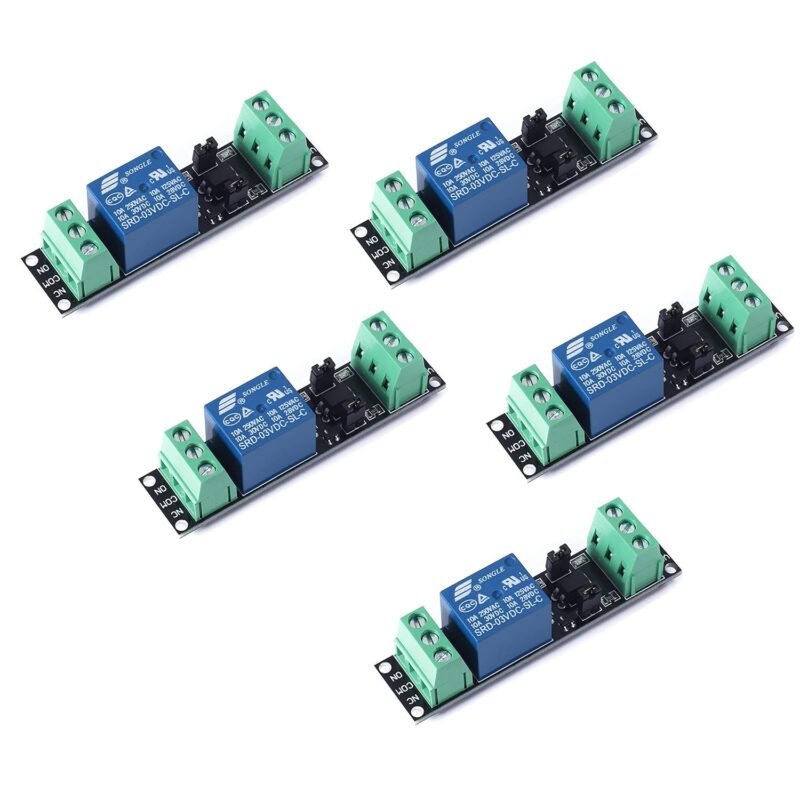
| ⚡ Teyleten 3.3V 1-Channel Relay | 1 | 3V/3.3V coil, high-level | AC250V/10A, DC30V/10A | Best for 3.3V Boards | Buy Here → |
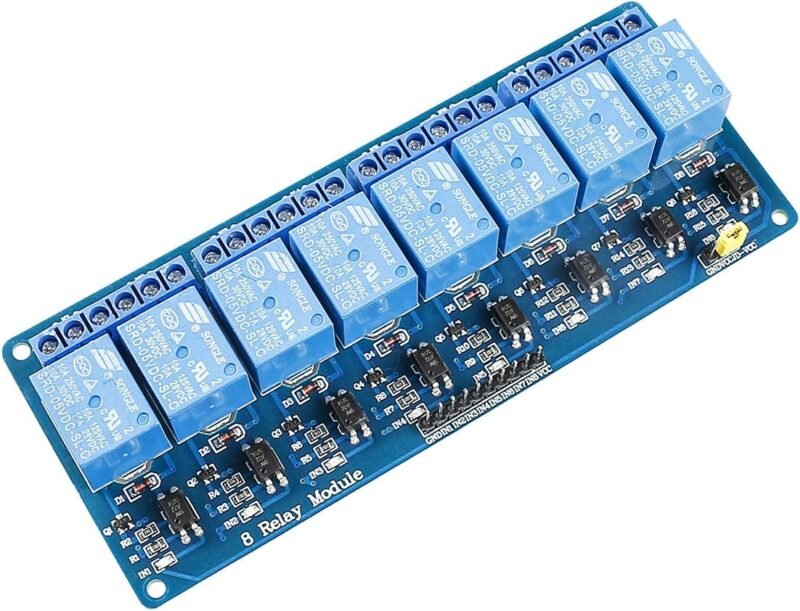
| 8️⃣ SunFounder 8-Channel 5V Relay | 8 | 5V coil, optocoupler | AC250V/10A, DC30V/10A | Best 8-Channel | Buy Here → |
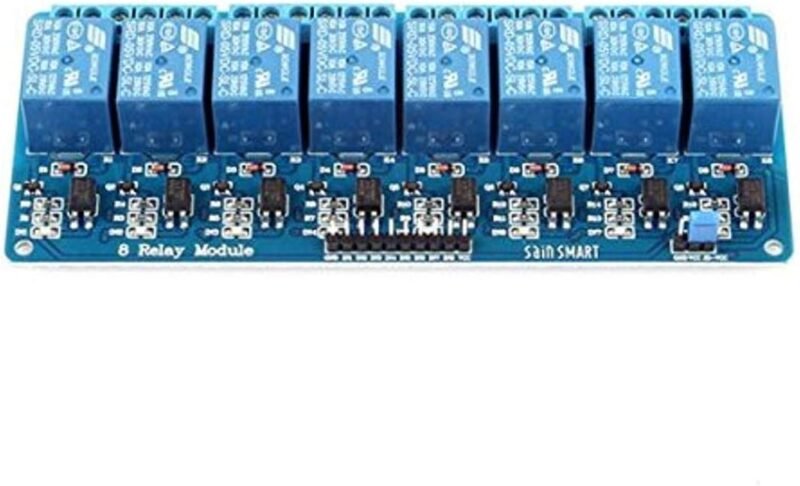
| 🔁 SainSmart 8-Channel Relay | 8 | 5V coil | AC250V/10A, DC30V | Best 8-Ch Alternative | Buy Here → |
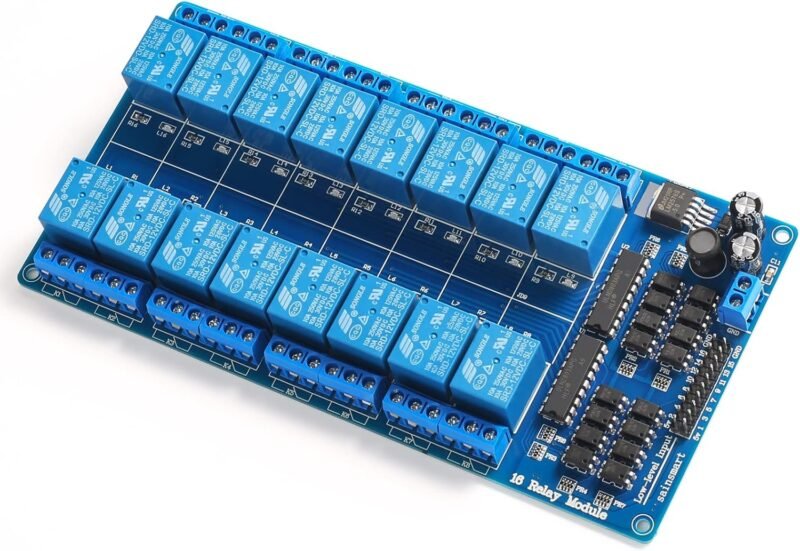
| 🧱 SainSmart 16-Channel 12V Relay | 16 | 12V coil | AC250V/10A, DC30V | Best High Count | Buy Here → |
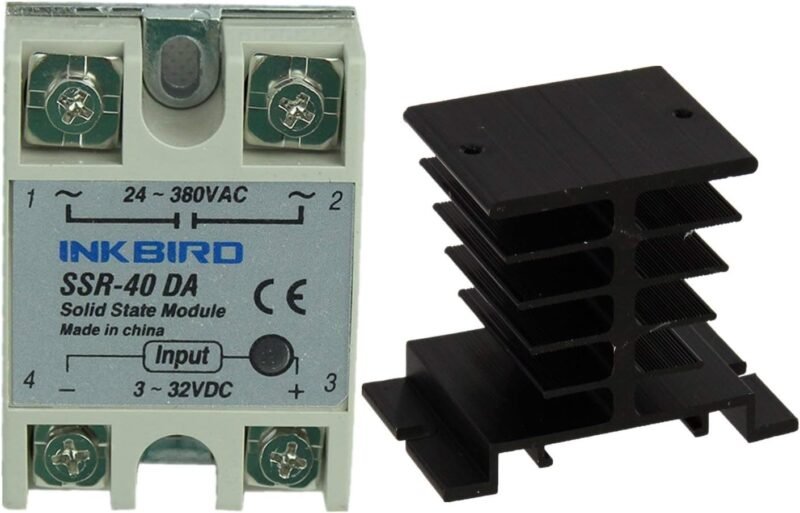
| 🔥 Inkbird SSR-40DA | 1 | DC 3-32V input | 24-380VAC, 40A | Best Solid State Relay | Buy Here → |
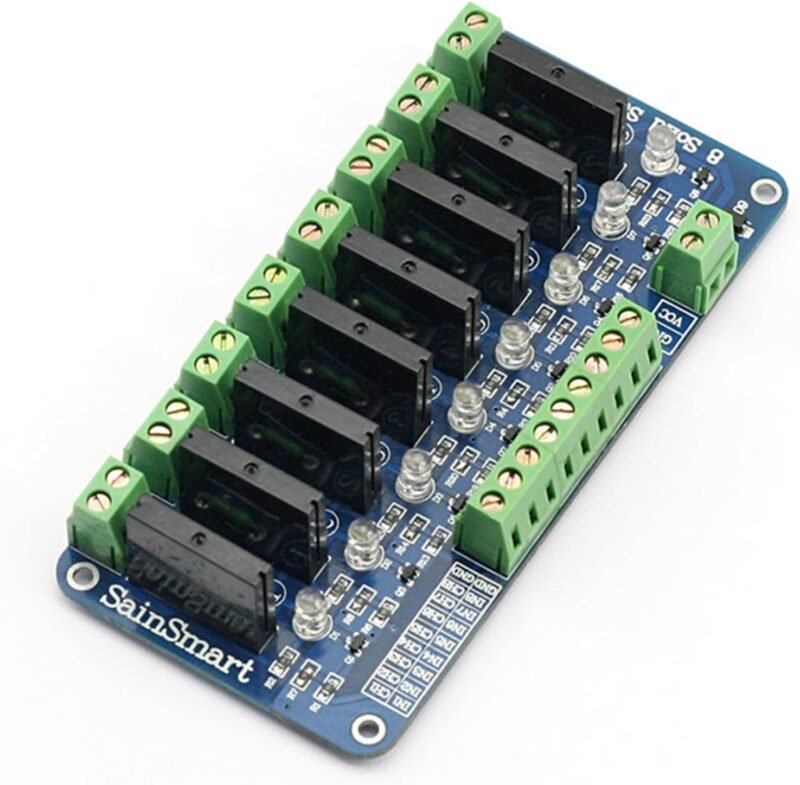
| 🤫 SainSmart 8-Ch Solid State Relay | 8 | 5V board, 2.5-20V on | 75-264VAC, 2A | Best Silent Multi-Channel | Buy Here → |
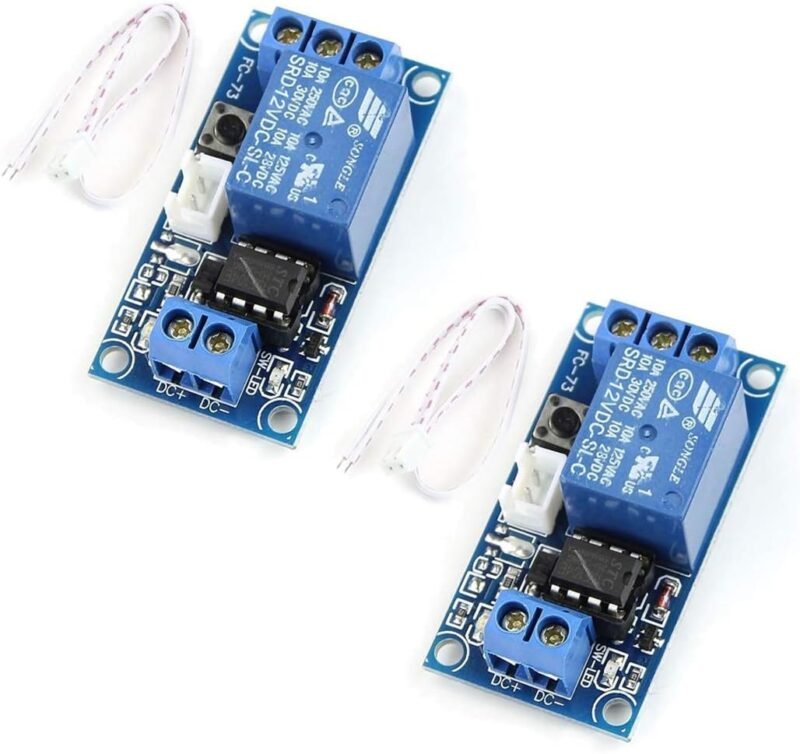
| 🔒 HiLetgo 12V Bistable Relay (2 pcs) | 1 (x2) | 12V, push on/off | See listing | Best Latching | Buy Here → |
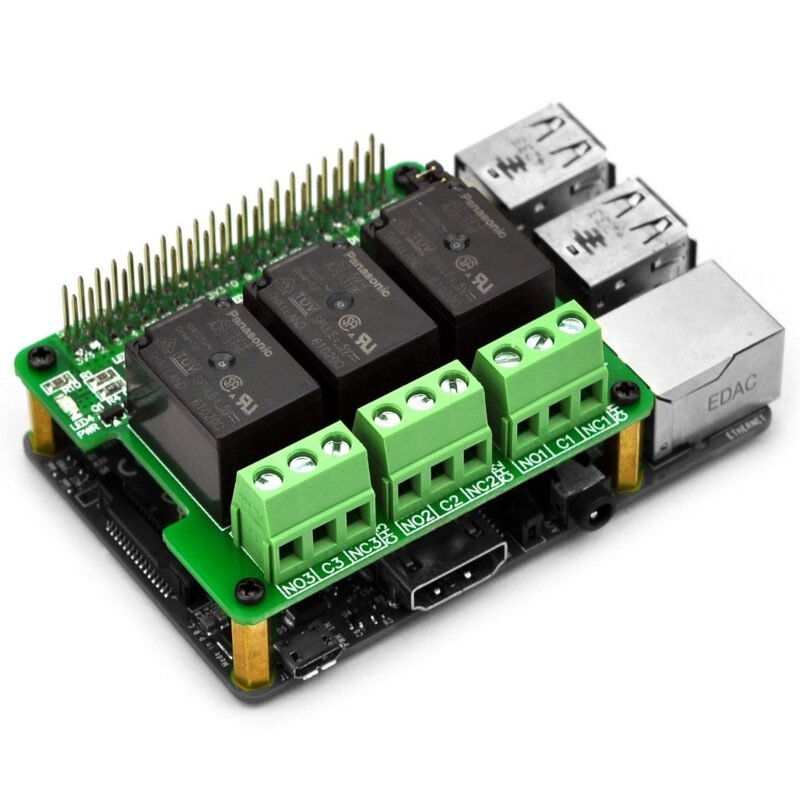
| 🍓 RPi Power Relay Board | 3 | Pi HAT, Panasonic relays | 10A/250VAC, 5A/30VDC | Best Raspberry Pi HAT | Buy Here → |
Specs and compatibility are taken from the Amazon listings at the time of writing. Ratings change over time, so check the listing before you buy.
🔍 How to Choose a Relay Module
🔋
Coil Voltage and Logic Level
Match the board to your board’s logic. 5V coils suit Arduino UNO; ESP32, ESP8266 and Raspberry Pi run 3.3V logic, so pick a 3.3V module, a high/low jumper board, or power the coils separately and confirm the input triggers at 3.3V.
🔢
Channel Count
Count your loads and add one spare. Eight and sixteen channel boards use many GPIOs and need a beefy coil supply; an I2C GPIO expander helps on large builds.
⚙️
Mechanical vs Solid State
Mechanical relays switch AC or DC and tolerate surges but click and wear out. SSRs are silent and fast, ideal for PID heaters, but are mostly AC-only and run hot.
🛡️
Isolation and Protection
Optocoupler inputs and flyback diodes protect your microcontroller from coil spikes. For mains loads, an enclosed relay or a proper enclosure matters more than any spec.
📏
Load Type and Derating
A 10A rating is for resistive loads. Motors, pumps and transformers draw high inrush currents, so pick relays well above the running current and fuse the circuit.
🏆 Detailed Reviews: All 12 Picks
🥇 BEST OVERALL
1. SunFounder 4-Channel 5V Relay Module
⭐ 4.6/5 · The classic Arduino relay board
Buy on Amazon →

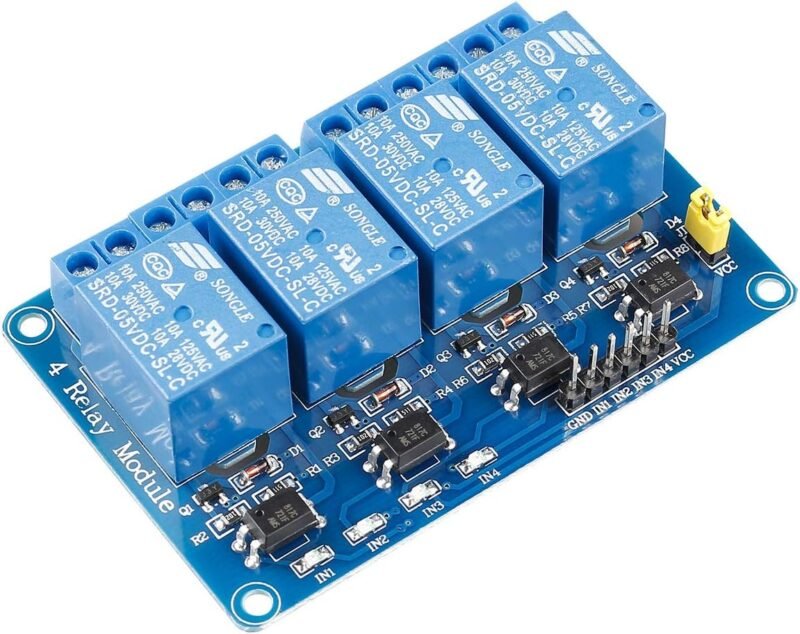
The four-channel 5V board most Arduino tutorials are written around. SunFounder’s listing says each channel needs a 15 to 20 mA drive current and the relays switch loads up to AC250V 10A or DC30V 10A, with optocoupler inputs and status LEDs. Four channels cover most home projects: a pump, a fan, a light and a spare. It averages about 4.6 stars from 1,308 ratings (the count is shared across the 2, 4 and 8 channel listings in this family). It is a 5V board, so on an ESP32 or Raspberry Pi power the coils from 5V and check the trigger logic works with 3.3V signals before you wire anything to mains.
✅ Pros- Huge review base
- Optocoupler inputs
- Status LEDs
❌ Cons- 5V coil supply needed
- Bare board, needs an enclosure
🎯 Verdict: The safe default for Arduino and ESP32 relay projects.
👉 Check Price on Amazon →
🔌 SAFEST FOR MAINS
2. Iot Relay Enclosed Power Relay
⭐ 4.8/5 · No exposed mains wiring
Enclosed
NO OPEN TERMINALS

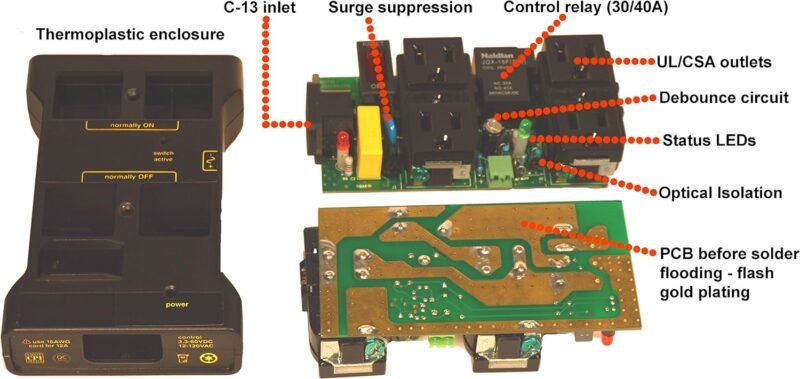
If the load plugs into a wall socket, this is the pick we would hand a beginner. The Iot Relay is a fully assembled box with one switched circuit and four outlets (two normally on, two normally off), controlled by a low-voltage signal wire from an Arduino, Raspberry Pi, PIC or Wi-Fi board, per the listing. It includes surge suppression, debounce and a safety breaker, so you never touch a mains screw terminal. It is the highest-rated pick here, about 4.8 stars from 1,539 ratings. It switches all four outlets together, so it suits one appliance group rather than four separate loads.
✅ Pros- No exposed mains wiring
- Surge suppression and breaker
- Ready to use
❌ Cons- One circuit only
- Bulky next to a relay board
🎯 Verdict: The easiest safe way to switch plug-in appliances.
👉 Check Price on Amazon →
2️⃣ BEST SMALL BOARD · ⭐ 4.6/53. SunFounder 2-Channel 5V Relay Module
2 channels · optocoupler · low-level trigger · 1,308 ratings
Buy Here →

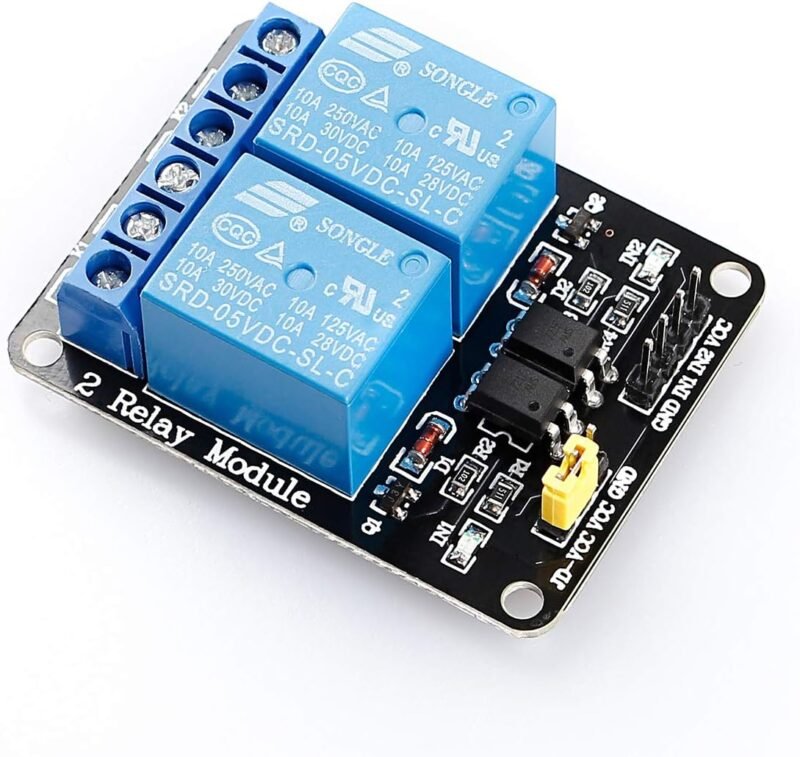
The two-channel version of our top pick, with the same 10A relays, optocoupler inputs and status LEDs per the listing, and a low-level trigger (the relay turns on when the input is pulled low). Two channels are ideal for a heater plus fan, or a garage door button plus light. About 4.6 stars from 1,308 ratings across the family.
✅ Pros: Compact; proven design.
❌ Cons: Low-level trigger confuses some beginners.
🎯 Verdict: Two loads, minimal board space.
1️⃣ BEST SINGLE CHANNEL · ⭐ 4.6/54. HiLetgo 5V One-Channel Relay Module (2 pcs)
Optocoupler · 5 mA trigger · high/low jumper · 1,200 ratings
Buy Here →

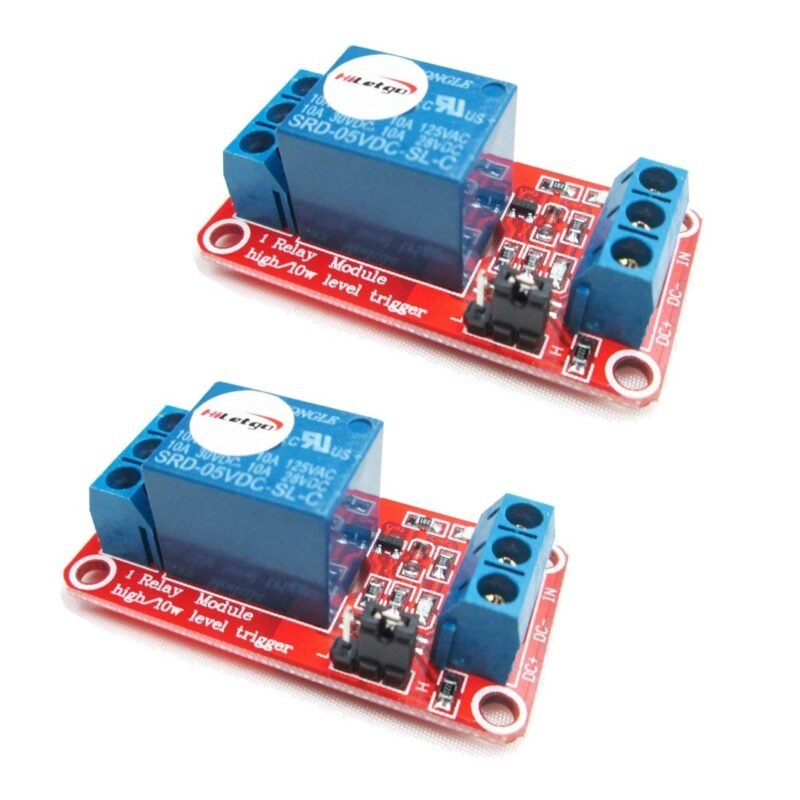
A two-pack of single-channel boards with SMD optocoupler isolation, a 5 mA trigger current and a jumper to select high or low trigger, per the listing. The listing also says the relay will not switch if the control wire breaks. Selectable trigger makes it one of the friendlier boards to use with an ESP32 or Pi. About 4.6 stars from 1,200 ratings.
✅ Pros: High/low trigger jumper; low drive current.
❌ Cons: One channel per board.
🎯 Verdict: The flexible single relay for any MCU.
⚡ BEST FOR 3.3V BOARDS · ⭐ 4.6/55. Teyleten Robot 3V/3.3V One-Channel Relay
3.3V coil · high-level trigger · Songle relay · 226 ratings
Buy Here →
Most cheap relay boards expect 5V. This one is a 3V/3.3V relay module with a high-level driver and optocoupler isolation, using a Songle relay rated 10A at 250VAC or 30VDC per the listing. That means an ESP32, ESP8266 or Raspberry Pi can power and trigger it from its own 3.3V rail without a level shifter. About 4.6 stars from 226 ratings. Check your 3.3V regulator can supply the coil current if you add several.
✅ Pros: Runs natively on 3.3V logic.
❌ Cons: Coil current loads the 3.3V rail.
🎯 Verdict: Plug-and-play relay for ESP32 and Pi.
8️⃣ BEST 8-CHANNEL · ⭐ 4.6/56. SunFounder 8-Channel 5V Relay Module
8 channels · LEDs · Arduino and Pi compatible · 1,308 ratings
Buy Here →

Eight 10A relays on one board with LEDs for each output, listed as compatible with Arduino, ARM, PIC, AVR, STM32 and Raspberry Pi. Each channel needs 15 to 20 mA of drive current. It suits sprinkler zones, aquarium controllers and lighting panels. About 4.6 stars from 1,308 ratings across the family. Power the coils from a separate 5V supply when several relays are on at once.
✅ Pros: Eight channels; trusted brand.
❌ Cons: Needs a solid 5V supply.
🎯 Verdict: The go-to 8-relay board.
🔁 8-CHANNEL ALTERNATIVE · ⭐ 4.6/57. SainSmart 8-Channel 5V Relay Module
8 channels · status LEDs · 428 ratings
Buy Here →

SainSmart’s long-running eight-channel board: 5V coils, 15 to 20 mA drive per channel, relays rated AC250V 10A and LEDs for output status, per the listing. It is a near twin of the SunFounder board, useful if that one is out of stock. About 4.6 stars from 428 ratings.
✅ Pros: Long track record.
❌ Cons: Same 5V supply needs as rivals.
🎯 Verdict: A proven backup 8-channel option.
🧱 BEST HIGH CHANNEL COUNT · ⭐ 4.4/58. SainSmart 16-Channel 12V Relay Module
16 channels · 12V coils · status LEDs · 623 ratings
Buy Here →

Sixteen relays on one board with 12V coils, 15 to 20 mA drive per channel and status LEDs, per the listing. A 12V coil supply suits control panels that already have a 12V rail, and keeps heavy coil current off your 5V logic. Sixteen GPIO pins is a lot, so many builders drive it through a GPIO expander such as an MCP23017. About 4.4 stars from 623 ratings.
✅ Pros: 16 outputs from one board.
❌ Cons: Uses many GPIOs; 12V supply needed.
🎯 Verdict: For big lighting or irrigation panels.
🔥 BEST SOLID STATE RELAY · ⭐ 4.5/59. Inkbird SSR-40DA Solid State Relay with Heat Sink
DC 3-32V control · 24-380VAC load · heat sink included · 359 ratings
Buy Here →

A silent, no-moving-parts relay for AC loads such as heaters, kilns and sous-vide cookers. The listing specifies a DC 3 to 32V input (so a 3.3V GPIO can drive it), 24 to 380VAC load and a 40A rating, and it ships with a black heat sink. SSRs suit fast PID switching that would wear out a mechanical relay. Treat the 40A figure as a peak rating and derate heavily for real loads; SSRs run hot and can fail shorted. About 4.5 stars from 359 ratings.
✅ Pros: Silent; 3.3V compatible input.
❌ Cons: AC loads only; needs heat sinking.
🎯 Verdict: Best for PID heaters and AC loads.
🤫 BEST SILENT MULTI-CHANNEL · ⭐ 4.4/510. SainSmart 8-Channel 5V Solid State Relay Module
8 SSR channels · AC loads 0.1 to 2A · 245 ratings
Buy Here →

Eight solid-state outputs on one board. Per the listing, a control signal from 2.5V to 20V turns a channel on, and each output switches 75 to 264VAC at 0.1 to 2A. That suits silent lighting control and small AC loads, but not DC loads or anything above 2A. About 4.4 stars from 245 ratings.
✅ Pros: Silent; 3.3V logic turns it on.
❌ Cons: AC only, 2A max per channel.
🎯 Verdict: Quiet switching for small AC loads.
🔒 BEST LATCHING RELAY · ⭐ 4.0/511. HiLetgo 12V Bistable Self-Locking Relay (2 pcs)
12V · push to start, push to stop · 177 ratings
Buy Here →

A 12V self-locking (bistable) relay module that toggles on with one pulse or button press and off with the next, per the listing. That is handy for a single push button controlling a light or pump, or for a microcontroller that should not hold a pin high all day. The listing is light on detail, so check the contact rating in the photos before switching big loads. About 4.0 stars from 177 ratings, the lowest score here.
✅ Pros: One-button toggle behaviour.
❌ Cons: Sparse listing; lower rating.
🎯 Verdict: For push-button on/off control.
🍓 BEST RASPBERRY PI HAT · ⭐ 4.7/512. RPi Power Relay Board Expansion Module
3 relays · Pi A+ to 4B · Panasonic JS1 relays · 180 ratings
Buy Here →
A HAT that stacks on the Raspberry Pi header and adds three Panasonic JS1-5V-F relays rated 10A at 250VAC or 5A at 30VDC, with Darlington transistor drivers, LEDs and a jumper to move relays to custom pins, per the listing. No jumper wires and no 3.3V trigger worries. The listing names Pi A+ through 4B; it may also fit a Pi 5 header, but check clearance with your cooler. About 4.7 stars from 180 ratings.
✅ Pros: Stacks directly on the Pi.
❌ Cons: Only three channels.
🎯 Verdict: The tidy way to add relays to a Pi.
🛒 Which One for Which Job
💧
Garden pump or sprinkler
SunFounder 4-Channel or 8-Channel on an ESP32 with a 5V coil supply.
🔥
PID heater or sous-vide
Inkbird SSR-40DA on a heat sink, driven by a 3.3V pin.
🛋️
Lamp or plug-in appliance
Iot Relay so no mains wiring is exposed.
📶
ESP32 or ESP8266 node
Teyleten 3.3V relay or HiLetgo with its trigger jumper.
🍓
Raspberry Pi automation
RPi Power Relay Board stacked on the header.
🏭
Large lighting panel
SainSmart 16-Channel 12V with an MCP23017 expander.
⚙️ Mechanical Relay vs Solid State Relay vs Enclosed Relay
| Aspect | Mechanical Relay Board | Solid State Relay | Enclosed Relay (Iot Relay) |
|---|
| Loads | AC and DC ⭐ | Mostly AC (DA types) | Plug-in AC appliances |
| Noise | Audible click | Silent ⭐ | Quiet click inside box |
| Switching speed and life | Contacts wear over time | Fast, no contact wear ⭐ | Rated for appliance use |
| Heat | Little ⭐ | Needs heat sink | Handled inside |
| Mains safety | Exposed screw terminals | Exposed terminals | No exposed mains wiring ⭐ |
| Best Role | General projects | PID heaters, lighting | Beginners and plug-in loads |
Ratings vary by model, so always read the specific listing and relay datasheet.
❓ Frequently Asked Questions
Can an ESP32 or Raspberry Pi drive a 5V relay module?
Sometimes. The GPIO outputs 3.3V, and many 5V boards with low-level triggers switch fine, while others stay on or chatter. The reliable options are a 3.3V relay module, a board with a high/low trigger jumper, a transistor driver, or a Pi relay HAT. Always power 5V coils from a 5V supply, not the 3.3V pin.
What does low-level trigger mean?
The relay turns on when the input pin is pulled low (0V) and off when it is high. That can cause a relay to switch on briefly at boot before your code sets the pin, so set the pin high early in setup or pick a high-level trigger board.
Do I need a separate power supply for relays?
For one or two relays, a board’s 5V pin is usually fine. For four or more, each coil draws tens of milliamps, so a separate 5V or 12V supply avoids brownouts and resets. Many boards have a JD-VCC jumper to separate coil power from logic power. Our step-down regulator guide covers suitable modules.
Mechanical relay or SSR for a heater?
For a heater controlled by a PID loop that switches every second or so, an SSR is better because it does not wear out. For occasional on/off switching or DC loads, a mechanical relay is simpler and cooler running.
How do I control relays over Wi-Fi without writing code?
Use a ready-made Wi-Fi relay such as SONOFF or Shelly running ESPHome or Tasmota. See our Wi-Fi smart relay modules guide for local-control options.
🏁 Final Verdict: Best Relay Modules
Our picks by job:
🥇 Best Overall: SunFounder 4-Channel 5V Relay
Buy Here →🔌 Safest for Mains: Iot Relay Enclosed Power Relay
Buy Here →⚡ Best for 3.3V Boards: Teyleten 3.3V One-Channel Relay
Buy Here →🔥 Best Solid State Relay: Inkbird SSR-40DA
Buy Here →🍓 Best Raspberry Pi HAT: RPi Power Relay Board
Buy Here →🧱 Best High Channel Count: SainSmart 16-Channel 12V Relay
Buy Here →For most Arduino and ESP32 builds, the SunFounder 4-Channel board is the right start, the Teyleten 3.3V module removes logic-level worries on ESP32 and Pi, and the Iot Relay is the safe answer whenever mains appliances are involved. Mount your relay board in a proper project enclosure, and see our related guides on Wi-Fi smart relays, Modbus relay modules, PLCs for makers and industrial Raspberry Pi accessories.
💬 What are you switching with a relay? Share your project or questions in the comments below.
All Amazon links above use our affiliate tag (microlab05-20). Purchasing through them supports microcontrollerslab.com at no extra cost to you. Prices and availability change frequently, so always confirm the current price on Amazon before buying.