⚠️ Affiliate Disclosure: This post contains Amazon affiliate links. If you purchase through our links, we may earn a small commission at no extra cost to you. We only recommend sensors we have researched and whose listings we checked live on Amazon. Prices change frequently, so we don’t list them here. Tap through and confirm the current price on Amazon before buying.
Ultimate Buying Guide
🧲 Best Hall Effect Sensors for Arduino, ESP32 & Raspberry Pi
7 magnetic sensors ranked for makers and embedded engineers: the A3144 digital switch, SS49E and AH49E linear sensors, KY-003 and KY-024 modules, the AS5600 magnetic encoder and the MLX90393 3-axis sensor, with real specs, honest verdicts and direct Amazon links.
✅ 7 Hall Sensors Reviewed
✅ Verified Amazon ASINs
✅ Switch, Linear & 3D Picks
✅ Honest Pros & Cons
A Hall effect sensor turns a magnetic field into an electrical signal, which makes it one of the most useful and least appreciated parts in an embedded toolbox. Glue a small magnet to a wheel and a Hall sensor becomes a contactless tachometer. Put one in a door frame and it is a sealed, bounce-free door switch. Use a linear Hall sensor and you can measure position, joystick deflection or field strength, and a dedicated Hall angle sensor turns a magnet on a motor shaft into a 12-bit rotary encoder. Because nothing touches and nothing wears out, Hall sensors outlast reed switches and mechanical encoders by a wide margin.
The catch is that “Hall sensor” covers several very different parts. The A3144 is a digital on/off switch, the SS49E and AH49E are analog linear sensors, latches like the US1881 flip state on alternating poles for BLDC motors, and chips like the AS5600 and MLX90393 give you angle or full 3-axis field data over I2C. Buy the wrong type and your project simply won’t work. This guide ranks 7 Hall effect sensors on the specs that matter in real embedded work: output type, supply voltage, magnetic polarity behaviour, interface and ease of use.
💡 Reality check before you buy: Almost every cheap Hall sensor on Amazon is a generic clone. Allegro discontinued the original A3144 years ago, so “A3144” packs are compatible parts sold as OH3144 or AH3144E, and “49E” packs are SS49E, OH49E or AH49E equivalents from various makers. That is fine for hobby and prototype work, but expect some unit-to-unit variation and buy multi-packs. Polarity matters too: an A3144 only responds to one pole (the south pole facing its branded face), so if nothing happens, flip the magnet before you blame the sensor. Finally, most switch-type Hall sensors have an open-collector output that needs a pull-up resistor, and many classic parts are rated for 4.5V or more, so check the supply range before wiring them to a 3.3V-only board.
🧲 Quick Comparison: All 7 Hall Effect Sensors
| Sensor | Type | Output | Supply | Best For | Buy |
|---|
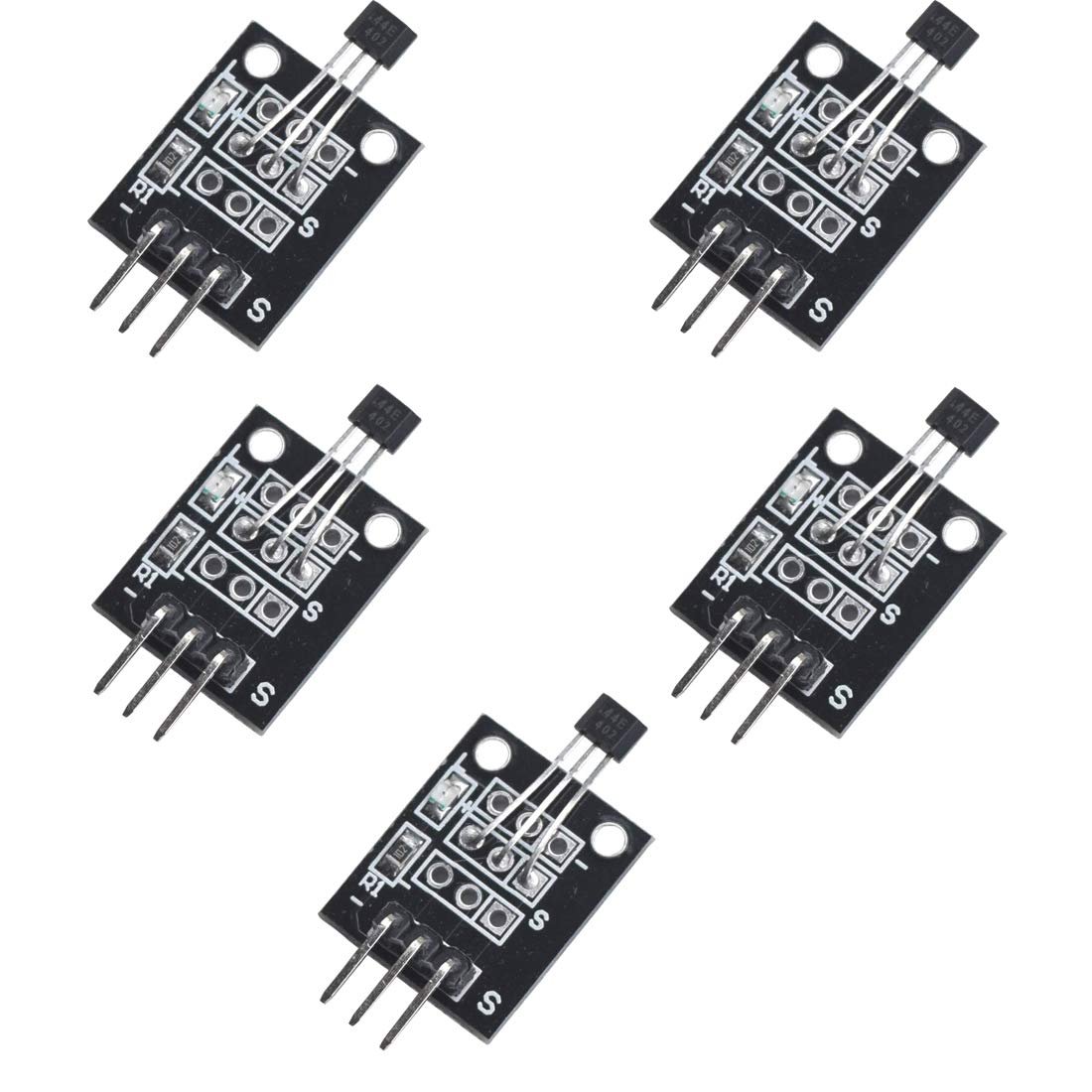
| 🥇 HiLetgo KY-003 A3144 Module (5-Pack) | Unipolar switch | Digital + LED | 5V | Best Overall | Buy Here → |
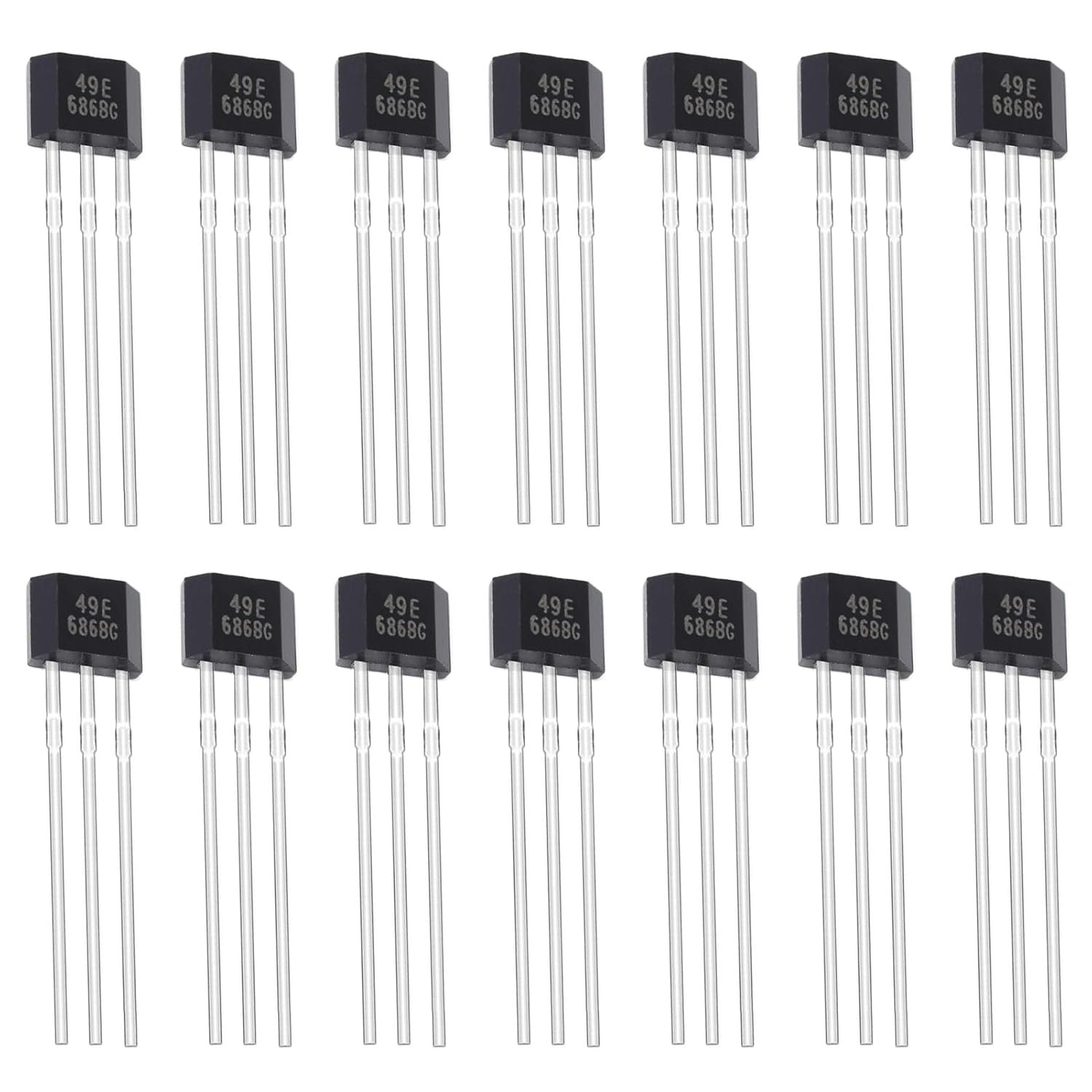
| 🏅 ALLECIN 49E / SS49E (20-Pack) | Linear (ratiometric) | Analog voltage | 3–6.5V | Best Linear / Analog | Buy Here → |
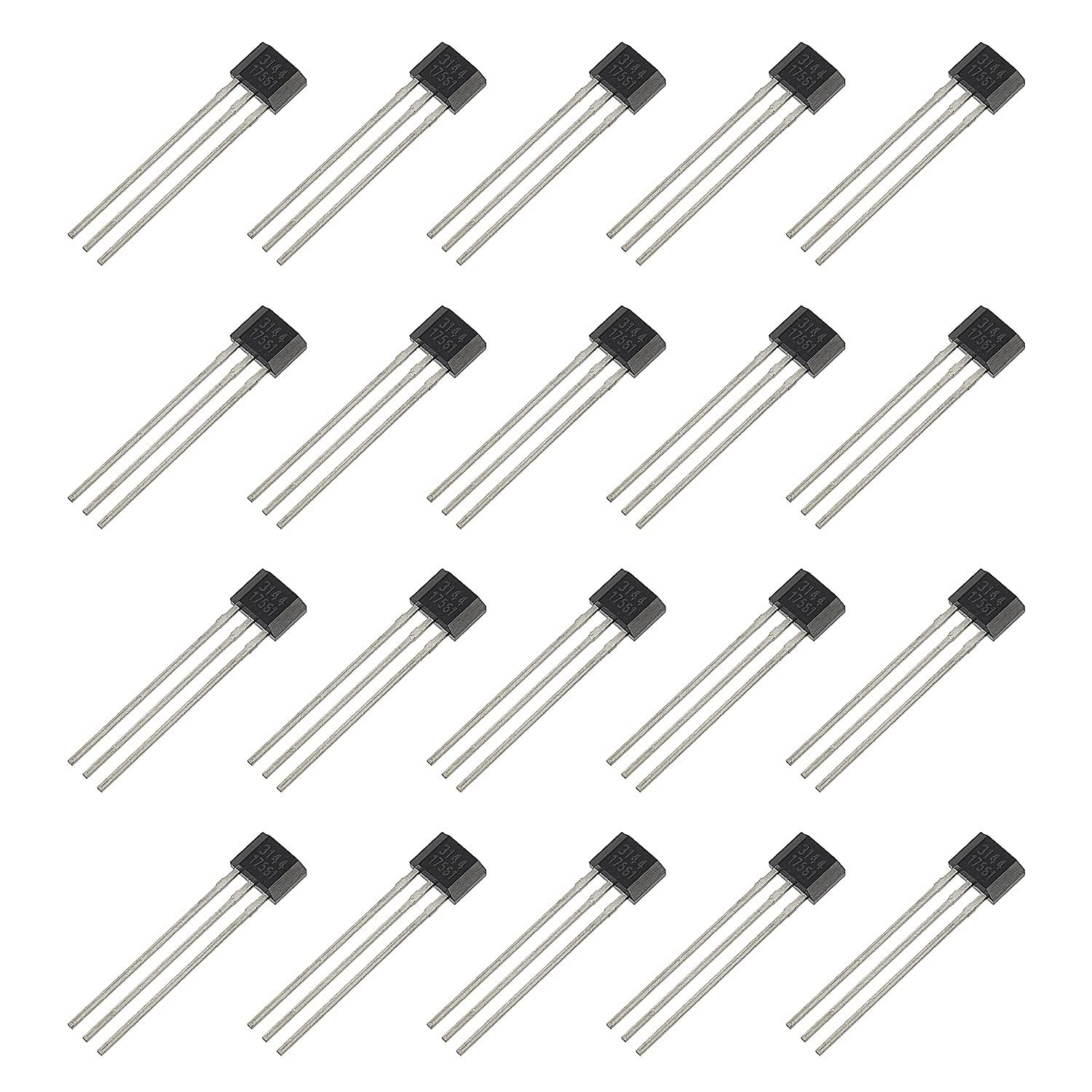
| 🔩 EPLZON A3144 Bare TO-92 (20-Pack) | Unipolar switch | Open-collector | 4–24V | Best for Custom PCBs | Buy Here → |
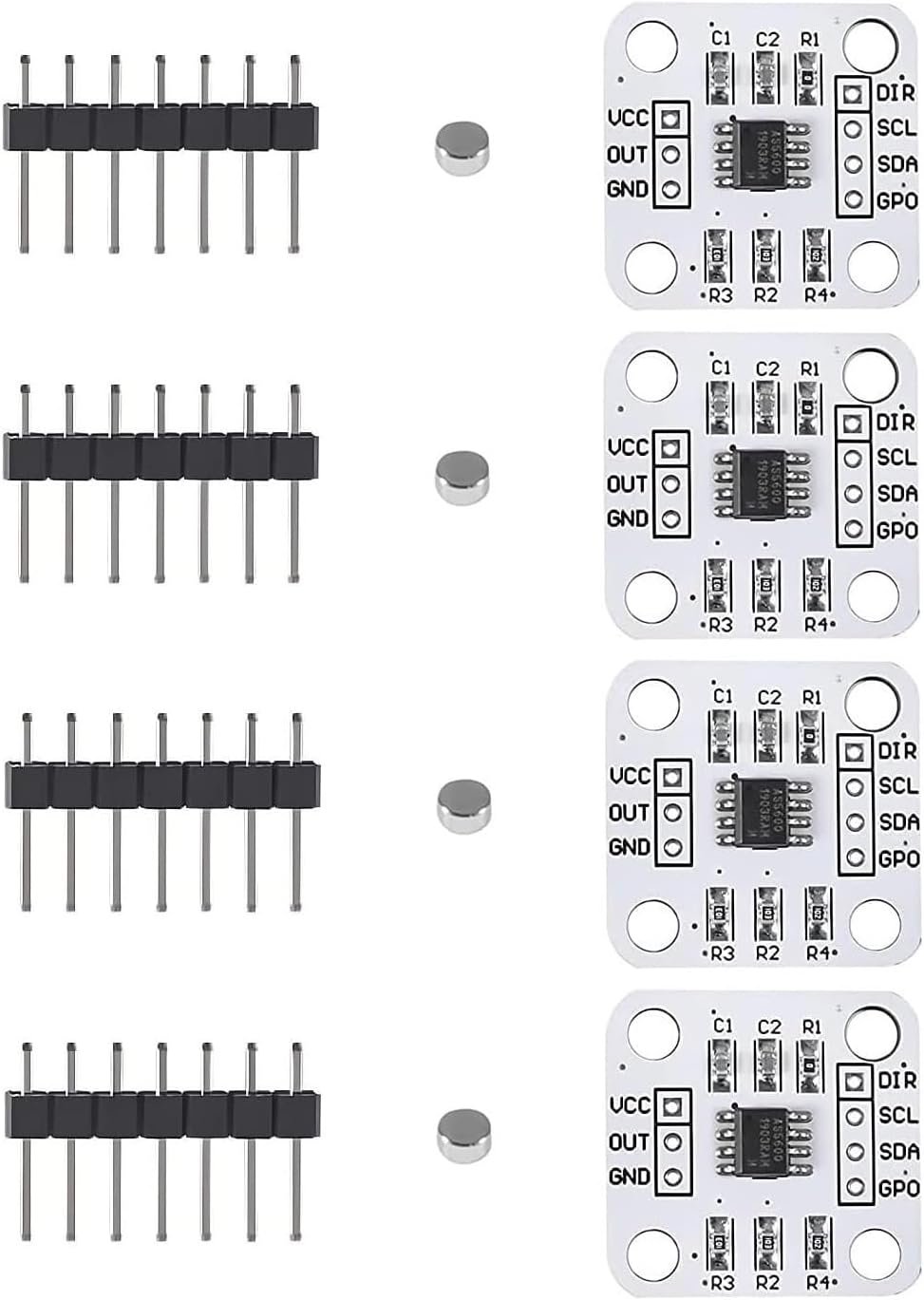
| 🔄 WWZMDiB AS5600 Encoder (4-Pack) | Hall angle sensor | I2C, PWM, analog | 3.3V | Best for Angle / Encoders | Buy Here → |
| 🎚️ HUABAN KY-024 Linear Module (3-Pack) | Linear + comparator | Analog + digital | 5V | Best Adjustable Module | Buy Here → |
| 🧰 VANXY 80-Piece Hall Sensor Kit | 8 types | Switch, latch, linear | Varies by part | Best Assortment | Buy Here → |
| 🌐 MLX90393 3-Axis Breakout (2-Pack) | 3D Hall magnetometer | I2C / SPI | 3.3V | Best 3-Axis / Advanced | Buy Here → |
Supply ranges come from the Amazon listings and typical datasheets for each part family; clones can differ slightly. Prices change often, so tap “Buy Here” to see the current price on Amazon.
🔍 What to Look for in a Hall Effect Sensor
🔀
Switch vs Linear Output
Switch sensors like the A3144 give a clean ON/OFF digital signal, perfect for counting, limit switches and door sensors. Linear sensors like the SS49E and AH49E output a voltage proportional to field strength, read with an ADC for position and proximity.
🧲
Unipolar, Latch or Omnipolar
A unipolar switch (A3144) turns on with one pole and off when it leaves. A latch (US1881, SS41F) turns on with one pole and stays on until the opposite pole arrives, which is what BLDC commutation and ring-magnet RPM sensing need. Omnipolar parts react to either pole.
🔋
Supply Voltage & Logic Level
Classic switches such as the A3144 are rated from about 4.5V upward, while 49E linear sensors run from roughly 3V. The AS5600 and MLX90393 boards are 3.3V parts. Match the supply and make sure the output never exceeds your MCU’s pin voltage.
🧩
Bare Part vs Module
Bare TO-92 sensors are cheap and tiny, ideal for custom PCBs and tight spaces, but you add the pull-up resistor yourself. Modules like the KY-003 and KY-024 add the resistor, an indicator LED and header pins for instant breadboard use.
📐
Angle & 3-Axis Sensing
When you need absolute shaft angle or the full X, Y and Z field vector, step up to an integrated chip. The AS5600 reads a diametric magnet as a 12-bit angle, and the MLX90393 reports all three axes digitally over I2C or SPI.
🏆 Detailed Reviews: All 7 Hall Effect Sensors
🥇 BEST OVERALL
HiLetgo KY-003 A3144 Hall Sensor Module (5-Pack)
⭐ 4.6/5 · The Plug-and-Play Magnet Switch
Buy on Amazon →

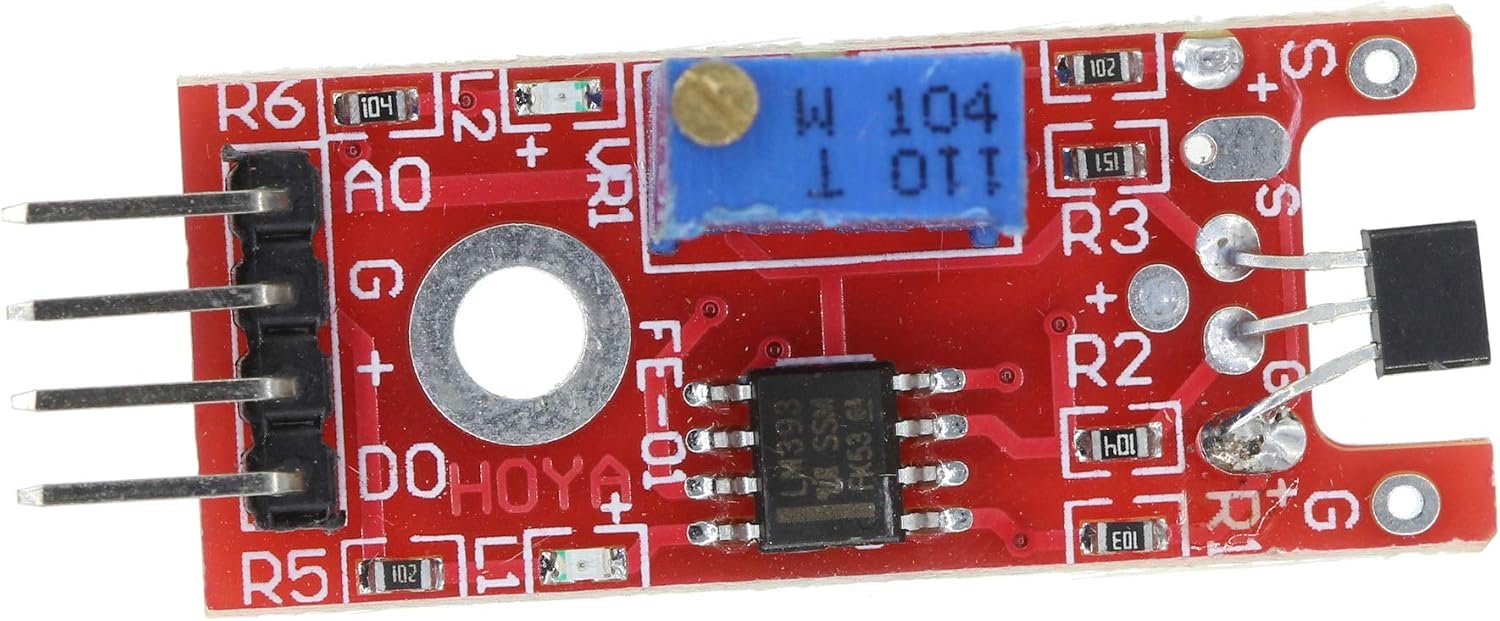
The KY-003 is the Hall sensor module most Arduino kits and tutorials use, and HiLetgo’s five-pack is one of the best-reviewed ways to buy it on Amazon. Each small board carries an A3144-type unipolar Hall switch plus the pull-up resistor and an indicator LED, so you just connect VCC, GND and signal. Bring the south pole of a magnet near the sensor face and the output snaps LOW and the LED lights; take it away and the output returns HIGH. Inside, a Schmitt trigger gives clean, bounce-free edges, which makes it ideal for RPM counting, door and lid detection, limit switches and position homing where a reed switch would wear out or chatter. Read it with digitalRead() or wire it to an interrupt pin for counting pulses.
✅ Pros- Pull-up and LED already on board
- Clean digital edges, no debouncing
- Huge tutorial and kit support
- Five modules covers spares
❌ Cons- Responds to one magnet pole only
- Pull-up goes to VCC, so 5V on the signal line
- No field-strength information
🎯 Verdict: The default Hall sensor for Arduino counters, door sensors and limit switches. On a 3.3V board like the ESP32, add a simple voltage divider on the signal line.
👉 Check Price on Amazon →
🏅 BEST LINEAR / ANALOG HALL SENSOR
ALLECIN 49E Linear Hall Sensor, SS49E / OH49E (20-Pack)
⭐ 4.5/5 · Measure Field Strength, Not Just Presence
Buy on Amazon →

The 49E family (Honeywell’s SS49E and pin-compatible equivalents such as the OH49E and Diodes’ AH49E) is the go-to linear Hall sensor. Instead of switching, it outputs a voltage that sits at about half the supply with no field and rises or falls depending on which pole approaches and how close it is, with a typical sensitivity in the low single-digit millivolts per gauss. Feed that into any ADC and you can measure magnet distance, build a contactless joystick, throttle, gear-position or liquid-level sensor, detect both poles, or even experiment with DIY current sensing using a toroid core. This ALLECIN 20-pack lists a 3–6.5V supply, so it runs from 3.3V as well as 5V. Because the output is ratiometric, powering it from the same rail as your ADC reference keeps readings stable, and at 3.3V the zero-field point simply drops to about 1.65V.
✅ Pros- Measures strength and polarity
- Runs from 3.3V or 5V
- Detects both north and south poles
- 20 sensors for very little money
❌ Cons- Bare part, no breakout board
- Needs calibration in firmware
- Generic clone, not branded Honeywell
🎯 Verdict: The best pick whenever you need “how strong” or “how far” rather than just “magnet present”. Every maker should keep a pack in the parts drawer.
👉 Check Price on Amazon →
🔩 BEST FOR CUSTOM PCBs · ⭐ 4.4/53. EPLZON A3144 Hall Effect Sensor, Bare TO-92 (20-Pack)
4–24V · unipolar switch · open-collector output · 50V output breakdown · −40 to 125°C
Buy Here →
If you are designing your own board, building a compact tachometer or need many sensors, skip the modules and buy the bare A3144. This EPLZON 20-pack lists a 4–24V supply and an extended −40 to 125°C range, which suits 12V automotive and industrial-style projects. The output is open-collector, and that is actually an advantage on 3.3V boards: power the sensor from 5V, add a 10kΩ pull-up from the output to 3.3V, and the signal is safe for an ESP32, Raspberry Pi or Pico GPIO. The small TO-92 body fits inside a motor housing, a bike frame or a 3D-printed bracket. Our A3144 pinout and working guide covers the details.
✅ Pros: Tiny and cheap in bulk; wide 4–24V supply; open-collector output easy to level-match.
❌ Cons: Needs an external pull-up; easy to insert backwards; not rated for 3.3V-only supplies; clone part.
🎯 Verdict: The best value for custom PCBs, multi-sensor builds and 12V systems. Twenty sensors means you can afford mistakes.
👉 Check Price on Amazon →
🔄 BEST FOR ANGLE / ENCODERS · ⭐ 4.4/54. WWZMDiB AS5600 Magnetic Encoder Module (4-Pack)
3.3V · 12-bit (4096 steps per turn) · I2C, PWM and analog output · contactless
Buy Here →

The AS5600 packs an array of Hall elements and a signal processor into one chip that reads the angle of a diametrically magnetized magnet spinning above it. The result is a 12-bit absolute angle (4096 positions per revolution) over I2C, or as a PWM or analog voltage, with no contact and no wear. That makes it the favourite sensor for closed-loop stepper motors, gimbal and FOC brushless motor controllers, robot joints and smart knobs. WWZMDiB’s four-pack lists 3.3V operation, which matches ESP32, STM32 and Raspberry Pi Pico boards directly. One practical tip: on many cheap AS5600 boards the DIR pin is left floating, so tie it to GND or VCC or the reading may jump around.
✅ Pros: Absolute 12-bit angle; I2C plus analog and PWM options; ideal for FOC and closed-loop steppers.
❌ Cons: Needs a diametric magnet centred over the chip; fixed I2C address limits one per bus; floating DIR pin trips beginners.
🎯 Verdict: The best Hall-based sensor when you need shaft angle or a contactless rotary encoder, not just a pulse.
👉 Check Price on Amazon →
🎚️ BEST ADJUSTABLE MODULE · ⭐ 4.1/55. HUABAN KY-024 Linear Magnetic Hall Sensor Module (3-Pack)
49E linear sensor · comparator with threshold pot · analog + digital outputs · indicator LEDs
Buy Here →

The KY-024 puts a 49E-class linear Hall sensor on a board with a comparator and a trim potentiometer. You get the best of both worlds: the analog pin gives you the raw field reading for an ADC, and the digital pin switches when the field crosses a threshold you set with the pot, so it works as an adjustable-sensitivity magnet switch too. That is handy for speed counting where the magnet passes at different distances, or for tuning a trigger point without touching code. The standard KY-024 layout exposes AO, GND, VCC and DO pins; check the photos on the listing to confirm the pinout before wiring.
✅ Pros: Analog and digital outputs; adjustable trigger point; breadboard-ready with LEDs.
❌ Cons: Only three modules per pack; small review base; listing description is sparse; bulkier than a bare 49E.
🎯 Verdict: The best choice when you want to tune magnet sensitivity with a screwdriver and still have the analog reading available.
👉 Check Price on Amazon →
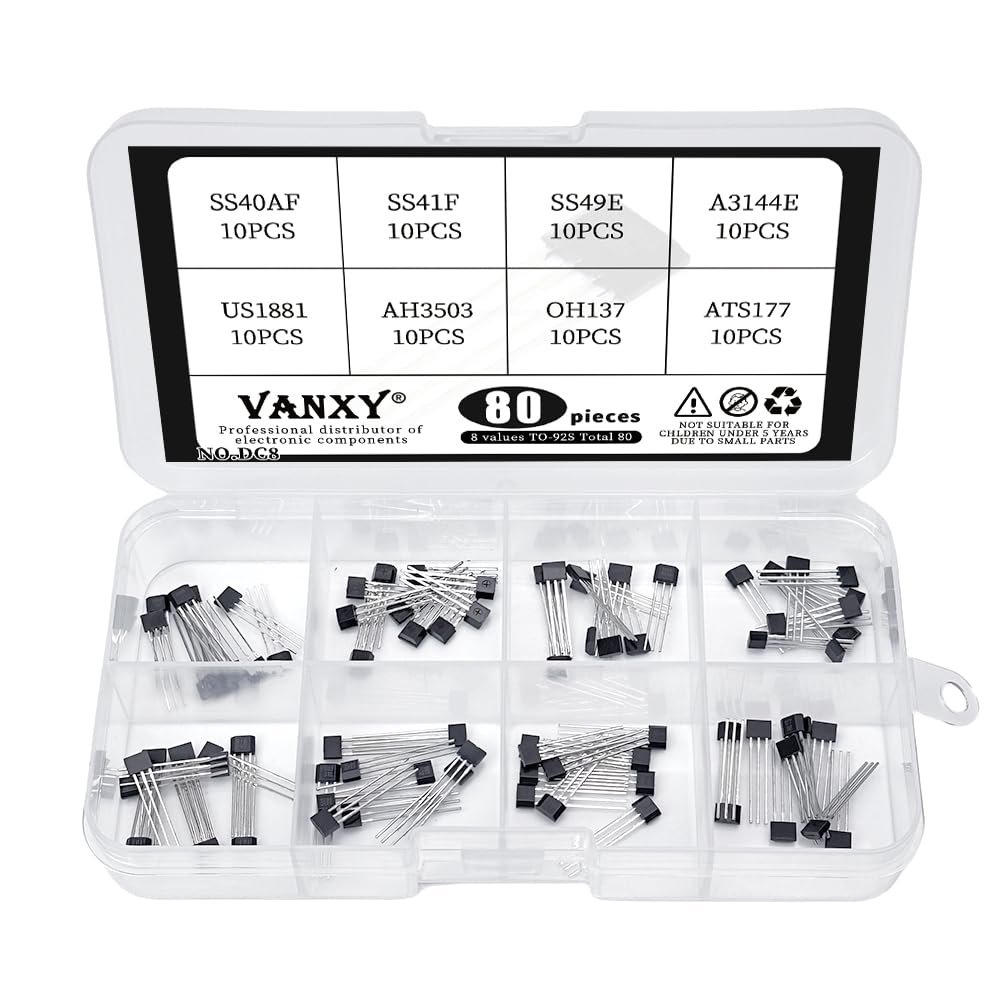
🧰 BEST ASSORTMENT KIT · ⭐ 4.3/56. VANXY 80-Piece Hall Sensor Kit (8 Types × 10)
SS40AF · SS41F · SS49E · A3144E · US1881 · AH3503 · OH137 · ATS177 · all TO-92
Buy Here →

Not sure which Hall behaviour your project needs? This kit gives you ten each of eight common parts, covering every major family: unipolar switches (A3144E, OH137, ATS177), bipolar sensors and latches (SS40AF, SS41F and the popular US1881 latch used for BLDC motors and ring-magnet RPM sensing) and linear sensors (SS49E and the older AH3503). It is the cheapest way to try each type on a breadboard, and it doubles as a stock of replacement sensors for repairing fans, brushless motors, e-bikes and printers. Look up each part’s datasheet, because supply ranges and pinouts differ between families.
✅ Pros: Switches, latches and linear parts in one box; great for learning and repairs; labelled storage.
❌ Cons: Very few reviews so far; bare parts only; you must check each datasheet; generic sources.
🎯 Verdict: The best buy for students, repair techs and anyone who wants latches and switches on hand without ordering each part separately.
👉 Check Price on Amazon →
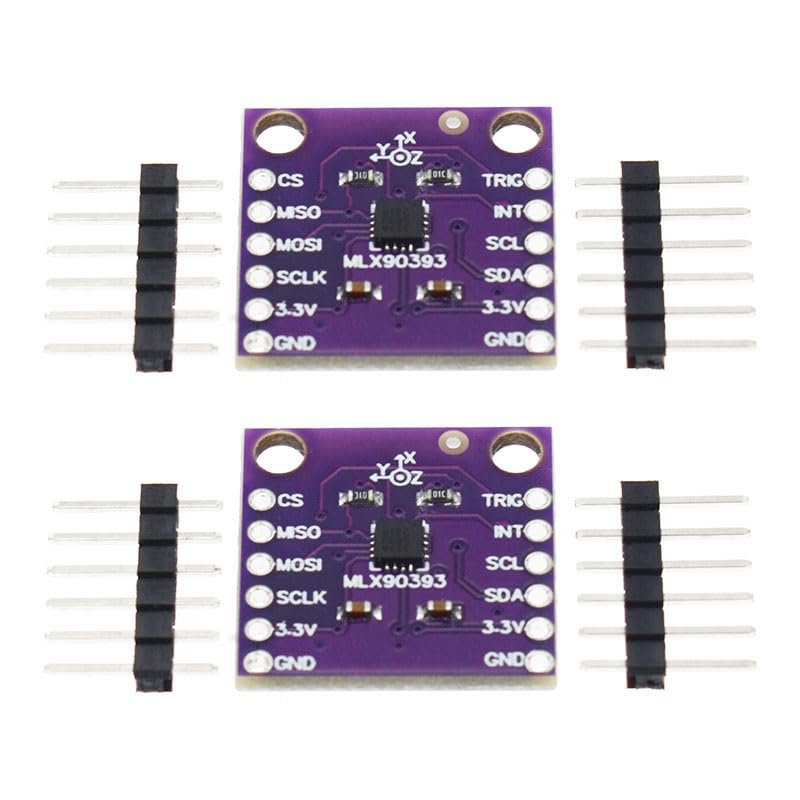
🌐 BEST 3-AXIS / ADVANCED · ⭐ 4.0/57. MLX90393 3-Axis Digital Hall Sensor Breakout (2-Pack)
Melexis MLX90393 · X, Y and Z field · I2C or SPI · programmable gain · 3.3V
Buy Here →

The Melexis MLX90393 is a full 3-axis Hall magnetometer on a chip. It measures the X, Y and Z components of the field and returns them as digital values over I2C or SPI, with programmable gain and resolution so you can trade range for precision. That opens up projects a single-axis sensor can’t do: 3D joysticks, linear and rotary position tracking, magnet-based gesture input and tamper detection. This listing is a two-pack of the common purple breakout. Honest caveats: it is a no-name seller with no reviews yet and slow international shipping, so order early. Our MLX90393 with Arduino tutorial walks through wiring and code.
✅ Pros: True 3-axis field data; I2C or SPI; configurable gain; low-power modes for battery nodes.
❌ Cons: 3.3V only; more complex to configure; no reviews on this listing yet; long delivery window.
🎯 Verdict: The pick for advanced projects that need the full magnetic field vector, not just one axis or an on/off signal.
👉 Check Price on Amazon →
🛒 How to Choose the Right Hall Effect Sensor
🚪
Detecting a door, lid or limit position?
Start with the HiLetgo KY-003 module: magnet near, output LOW, no extra parts needed.
📏
Measuring distance, position or field strength?
Use the 49E (SS49E / AH49E) linear sensor and read it with your ADC.
⚙️
Counting RPM on a custom PCB or 12V system?
Buy the bare A3144 20-pack and add your own pull-up resistor.
🔄
Need motor shaft angle or a rotary encoder?
The AS5600 gives a 12-bit absolute angle from a single magnet.
🔧
Repairing BLDC motors or learning every type?
Get the VANXY 80-piece kit with US1881 latches, switches and linear parts.
🌐
Tracking a magnet in 3D?
Choose the MLX90393 for X, Y and Z field readings over I2C or SPI.
⚙️ Key Specs Compared: Side by Side
| Spec | A3144 / KY-003 | 49E (SS49E / AH49E) | KY-024 | AS5600 | MLX90393 |
|---|
| Sensing | On/off switch | 1-axis linear | 1-axis linear + threshold | Rotation angle | 3-axis field ⭐ |
| Output | Digital, active-low | Analog voltage | Analog + digital ⭐ | I2C, PWM, analog | I2C or SPI |
| Supply (listing) | 5V module / 4–24V bare | 3–6.5V (3.3V OK) ⭐ | 5V | 3.3V | 3.3V |
| Poles Detected | South only | Both (sign shows pole) | Both on analog pin | Diametric magnet | Both, all axes ⭐ |
| Resolution | 1 bit (on/off) | Set by your ADC | Set by your ADC | 12-bit angle ⭐ | Up to 16-bit per axis |
| Ease of Use | Easiest (digitalRead) ⭐ | Easy (analogRead) | Easy | Moderate (library) | Moderate (library) |
| Typical Use | RPM, door, limit switch | Position, joystick, level | Tunable magnet trigger | Encoders, FOC motors | 3D position, joysticks |
Specs are drawn from the Amazon listings and common datasheets for each part family and vary slightly between manufacturers. ⭐ marks the strongest value in each row. Always confirm details on the live Amazon listing.
❓ Frequently Asked Questions
What is the difference between the A3144, SS49E and AH49E?
The A3144 is a digital unipolar Hall switch: its open-collector output pulls LOW when a south pole gets close enough and releases when it moves away, so it tells you only whether a magnet is present. The SS49E (originally Honeywell) and AH49E (Diodes Incorporated) are linear sensors: their output voltage sits near half the supply with no field and moves up or down in proportion to field strength and polarity. The SS49E and AH49E are pin-compatible and can usually replace each other, though exact sensitivity differs slightly between manufacturers.
Can I use a Hall effect sensor with an ESP32 or Raspberry Pi (3.3V)?
Yes, with a little care. A bare A3144 should be powered from 5V, but because its output is open-collector you can pull it up to 3.3V with a 10kΩ resistor and it is safe for 3.3V GPIO. Modules like the KY-003 pull the output up to their own VCC, so on 5V use a voltage divider before the GPIO pin. The 49E linear sensors run directly from 3.3V, and the AS5600 and MLX90393 boards are 3.3V parts. Note that the Raspberry Pi has no ADC, so a linear sensor needs an external ADC there. The ESP32 also had a built-in Hall sensor, but it is very insensitive and was dropped from newer ESP32 chips, so an external sensor is the better choice.
Why is my A3144 Hall sensor not detecting the magnet?
The three most common causes are the wrong pole, a missing pull-up and reversed pins. The A3144 only reacts to the south pole facing its branded (marked) face, so flip the magnet. A bare sensor needs a pull-up resistor (or INPUT_PULLUP) on the output, otherwise the pin floats. Finally, looking at the marked face with leads down, the pinout is VCC, GND, OUT from left to right; it is easy to insert backwards. Weak fridge magnets may also be too weak, so test with a small neodymium magnet.
Which Hall sensor should I use to measure motor or wheel RPM?
With one magnet glued to the shaft or wheel, a unipolar switch like the A3144 or KY-003 is all you need: count falling edges on an interrupt pin and divide by time. If you use a multi-pole ring magnet with alternating north and south poles, a latch such as the US1881 or SS41F (both in the VANXY kit) gives a clean square wave with one transition per pole. If you need speed and exact shaft angle, use an AS5600 instead.
Can a Hall effect sensor measure current?
Yes, that is how isolated current sensors such as the ACS712 work: an internal Hall element measures the magnetic field created by current in a conductor. You can experiment with a 49E sensor in the gap of a slotted ferrite toroid, but accuracy and calibration are hard to get right. For real current measurement, a dedicated Hall current sensor IC is far easier; see our best current and voltage sensors buying guide for proven options.
🏁 Final Verdict: Best Hall Effect Sensor for Every Project
The right magnetic sensor for every build and budget:
🥇 Best Overall: HiLetgo KY-003 A3144 module 5-pack, a plug-and-play digital magnet switch
Buy Here →🏅 Best Linear / Analog: ALLECIN 49E (SS49E / OH49E) 20-pack for field strength and position
Buy Here →🔩 Best for Custom PCBs: EPLZON bare A3144 20-pack with a 4–24V supply range
Buy Here →🔄 Best for Angle / Encoders: WWZMDiB AS5600 4-pack with 12-bit contactless angle sensing
Buy Here →🎚️ Best Adjustable Module: HUABAN KY-024 3-pack with analog output and a tunable digital trigger
Buy Here →🧰 Best Assortment: VANXY 80-piece kit with switches, latches and linear sensors
Buy Here →🌐 Best 3-Axis / Advanced: MLX90393 breakout 2-pack for X, Y and Z field readings
Buy Here →For most projects the HiLetgo KY-003 A3144 module is the Hall sensor to buy first: it detects a magnet with a single digital pin and no extra parts. When you need to know how strong or how close the field is, add a pack of 49E (SS49E / AH49E) linear sensors; for custom boards and 12V systems, buy the bare A3144; for shaft angle and encoders, go straight to the AS5600. Ready to wire one up? Start with our A3144 Hall effect sensor pinout and working guide, try the MLX90393 Arduino tutorial, measure fields with our magnetic field strength measurement project, and explore more Arduino, ESP32, STM32 and Raspberry Pi tutorials on Microcontrollers Lab.
💬 Not sure which Hall sensor fits your project? Tell us what you’re building (a tachometer, a door sensor, a joystick or a motor encoder) in the comments below, and we’ll point you to the right pick.
All Amazon links above use our affiliate tag (microlab05-20). Purchasing through them supports microcontrollerslab.com at no extra cost to you. Prices and availability change frequently, so always confirm the current price on Amazon before buying.
| Arduino Components | Amazon Links |
|---|
| Arduino Starter Kit | Buy Now |
| Arduino Development Kit | Buy Now |
| Arduino Smart Robot Car Kit V4 | Buy Now |
| Arduino Sensors Kit | Buy Now |