⚠️ Affiliate Disclosure: This post contains Amazon affiliate links. If you purchase through our links, we may earn a small commission at no extra cost to you. We only recommend products we have thoroughly researched and verified.
Ultimate Buying Guide 2026
⚡ Best Multimeters for Microcontroller Projects
8 multimeters ranked for Arduino, ESP32, STM32 and Raspberry Pi work — from a $13 starter meter to a pro-grade Fluke — with real specs, honest verdicts, and direct Amazon links.
✅ 8 Meters Reviewed
✅ Verified Amazon ASINs
✅ Updated June 2026
✅ Honest Pros & Cons
A multimeter is the first tool every microcontroller hobbyist should own — and the one you’ll reach for on almost every project. Whether you’re checking that your ESP32’s 3.3 V rail is actually 3.3 V, hunting a cold solder joint with a continuity beep, measuring the sleep current of a battery-powered sensor node, or confirming a pull-up resistor’s value before you power up, the meter is what turns “I think it’s wired right” into “I know it is.”
The good news: you don’t need a $400 bench instrument to debug an Arduino. A $15 meter measures voltage and continuity perfectly well, and for around $35 you can add true-RMS accuracy, capacitance, frequency, duty-cycle and temperature — everything a maker bench needs. This guide ranks 8 multimeters across every budget, with the specs that actually matter for microcontroller work, so you can match the right meter to your projects without overspending.
💡 Reality check before you buy: For microcontroller work, the most useful features aren’t the headline voltage range — they’re a fast continuity beep (for tracing nets and shorts), a low µA/mA current range (for measuring deep-sleep current), and capacitance + frequency/duty-cycle (for caps, crystals and PWM). Almost none of these meters is mains-isolated to Fluke 87V standards, so don’t probe live mains with the cheap ones. Match the meter to your bench, not to a spec sheet, and even a $15 unit will serve you for years.
⚡ Quick Comparison — All 8 Multimeters
| Multimeter | Counts | True-RMS | Cap / Freq | Best For | Price | Buy |
|---|
| 🥇 KAIWEETS HT118A | 6000 | ✅ | ✅ / ✅ | Best Overall | ~$36 | View → |
| 🏅 Fluke 117 | 6000 | ✅ | ✅ / ✅ | Best Professional | ~$240 | View → |
| 💵 AstroAI DM6000AR | 6000 | ✅ | ✅ / ✅ | Best Budget TRMS | ~$33 | View → |
| 🎒 ANENG AN8008 | 9999 | ✅ | ✅ / ✅ | Best Pocket Meter | ~$28 | View → |
| 🛠️ Klein MM600 | 4000 | ❌ | ✅ / ✅ | Best Rugged / Field | ~$80 | View → |
| 📏 Fluke 101 | 6000 | ❌ | ✅ / ✅ | Best Brand Pocket | ~$70 | View → |
| 🎓 INNOVA 3320 | 2000 | ❌ | ❌ / ❌ | Best for Beginners | ~$28 | View → |
| 👶 AstroAI AM33D | 2000 | ❌ | ❌ / ❌ | Best Ultra-Budget | ~$13 | View → |
🔍 What to Look for in a Multimeter for Electronics
🔔
Fast Continuity
A quick, latching beep is the #1 feature for tracing nets and finding shorts on a PCB.
🔋
µA / mA Current
A low microamp range lets you measure the deep-sleep current of battery MCU nodes.
🎚️
Capacitance
Verify decoupling and timing caps, and spot dead electrolytics before they bite you.
📶
Frequency / Duty
Confirm crystal oscillators and read PWM duty cycle straight from a pin.
🎯
Resolution & TRMS
More counts = finer readings; true-RMS keeps AC and noisy signals accurate.
🏆 Detailed Reviews — All 8 Multimeters

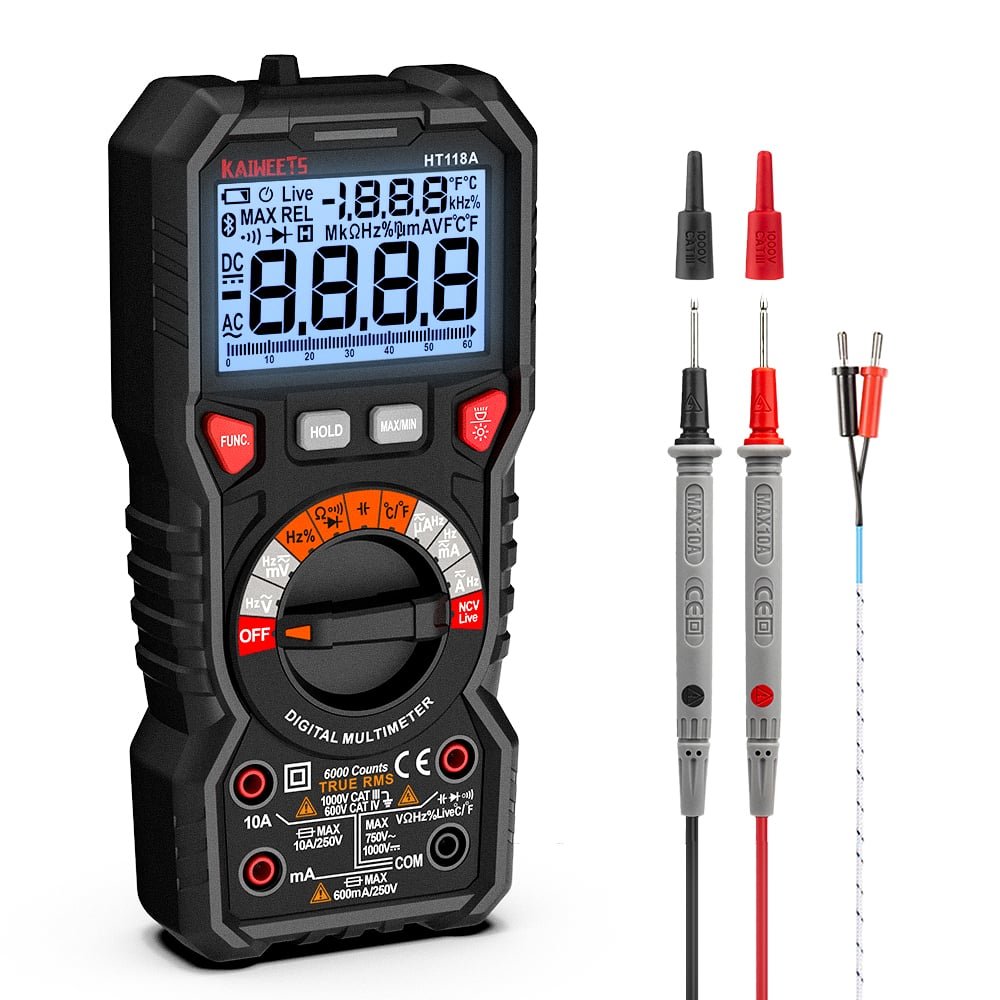
The KAIWEETS HT118A hits the sweet spot for a microcontroller bench. You get true-RMS, a fast 6000-count auto-ranging display, and — crucially — a genuine 600 µA / 6000 µA current range for measuring low sleep currents, plus capacitance to 100 mF, frequency to 10 MHz, duty-cycle, temperature and NCV. The continuity beep is quick and the LED-lit input jacks are a thoughtful touch in a dim workspace. Build quality and safety (CAT III 1000V, dual fuses) punch well above the ~$36 price.
✅ Pros- True-RMS, 6000 counts, auto-range
- Real µA current range for sleep current
- Cap, freq, duty, temp, NCV — all in one
- Fast continuity + LED-lit jacks
❌ Cons- Manual-style probes are basic
- No Bluetooth/logging
- Bezel is chunky in a pocket
🎯 Verdict: The best all-round meter for makers. It does everything an Arduino/ESP32 bench needs — including the µA range most cheap meters skip — for around $36.
👉 Check Price on Amazon: amazon.com/dp/B07SHLS639 🏅 BEST PROFESSIONAL
Fluke 117
⭐⭐⭐⭐⭐ 4.9/5 · The Gold Standard

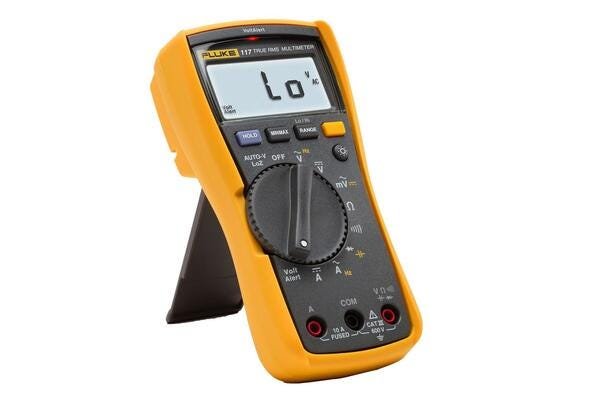
If you want a meter that will outlast every microcontroller on your bench, the Fluke 117 is the answer. It’s true-RMS with a 6000-count display, fast and accurate readings, an exceptionally quick continuity beep, plus capacitance, frequency, min/max and Fluke’s legendary input protection. The AutoVolt and LoZ features and built-in NCV lean toward electricians, but the rock-solid DC accuracy and reliability are exactly why it lives on so many engineering benches. The catch is price (~$240) and that it has no temperature mode or sub-mA µA range.
✅ Pros- Reference-grade accuracy & reliability
- Superb input protection & safety
- Lightning-fast continuity beep
- Will last decades — buy once
❌ Cons- ~$240 — premium price
- No temperature mode
- No fine µA range for sleep current
🎯 Verdict: The buy-it-for-life pick. If your projects pay for themselves — or you simply want the most trustworthy reading on the bench — the 117 is worth every dollar.
👉 Check Price on Amazon: amazon.com/dp/B000O3LUEI 💵 BEST BUDGET TRMS · ⭐ 4.7/5
3. AstroAI DM6000AR
True-RMS · 6000 counts · cap, freq, duty, temp · ~$33
Buy →

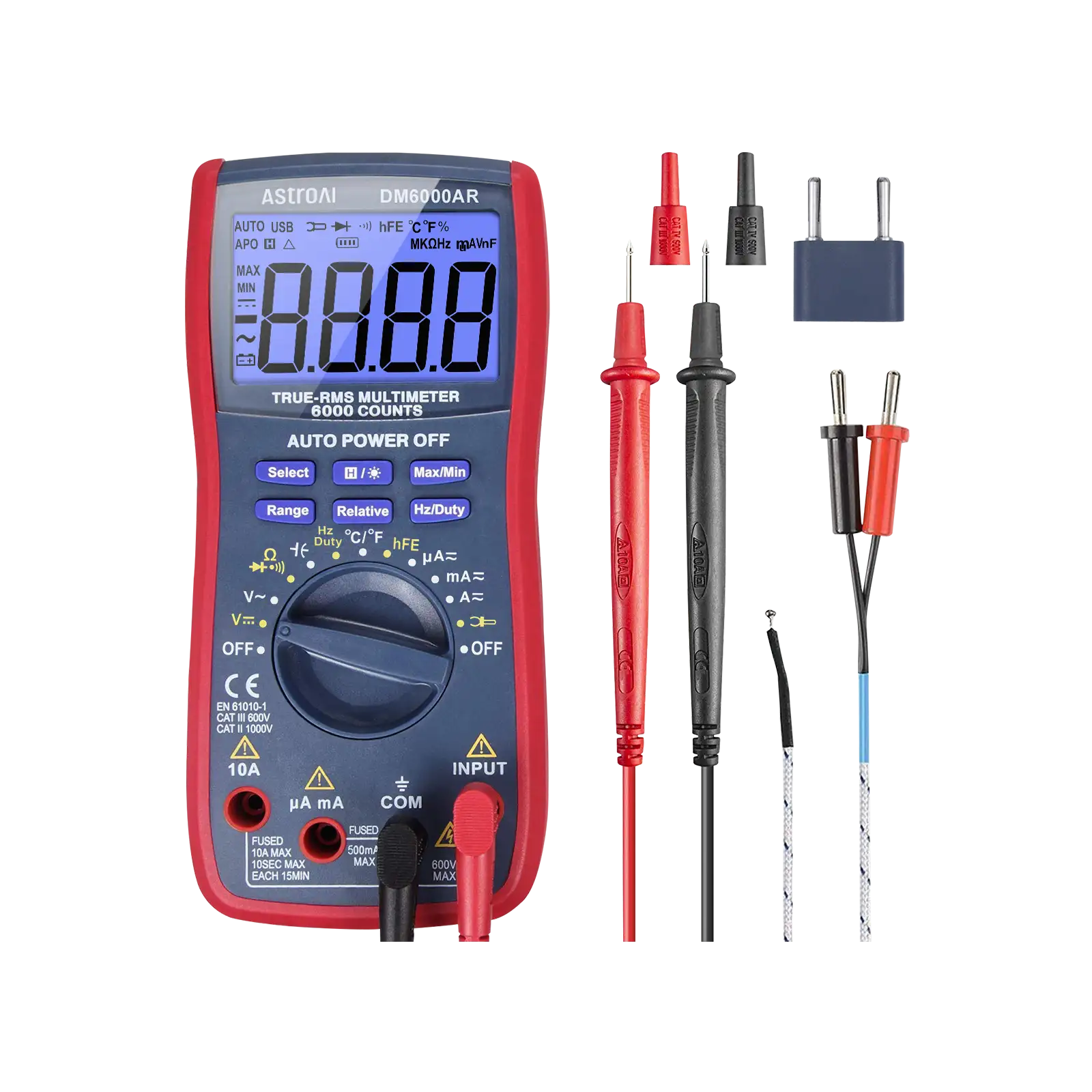
The AstroAI DM6000AR is the internet’s default budget true-RMS meter, and for good reason. For around $33 you get a 6000-count display, manual and auto ranging, AC/DC voltage and current, capacitance, frequency, duty-cycle, temperature and a clear backlit screen. It’s the cheapest meter here that still covers nearly every feature a maker needs day to day — the main thing it lacks versus the HT118A is a dedicated low-µA range.
✅ Pros: TRMS at a low price; manual+auto range; cap/freq/temp; bright backlight.
❌ Cons: No fine µA range; slower continuity than Fluke; basic probes.
🎯 Verdict: The best value true-RMS meter. If $36 is a stretch, this gives you 90% of the HT118A for a few dollars less.
👉 amazon.com/dp/B071JL6LLL 🎒 BEST POCKET METER · ⭐ 4.4/5
4. ANENG AN8008
True-RMS · 9999 counts · slim pocket body · square-wave out · ~$28
Buy →
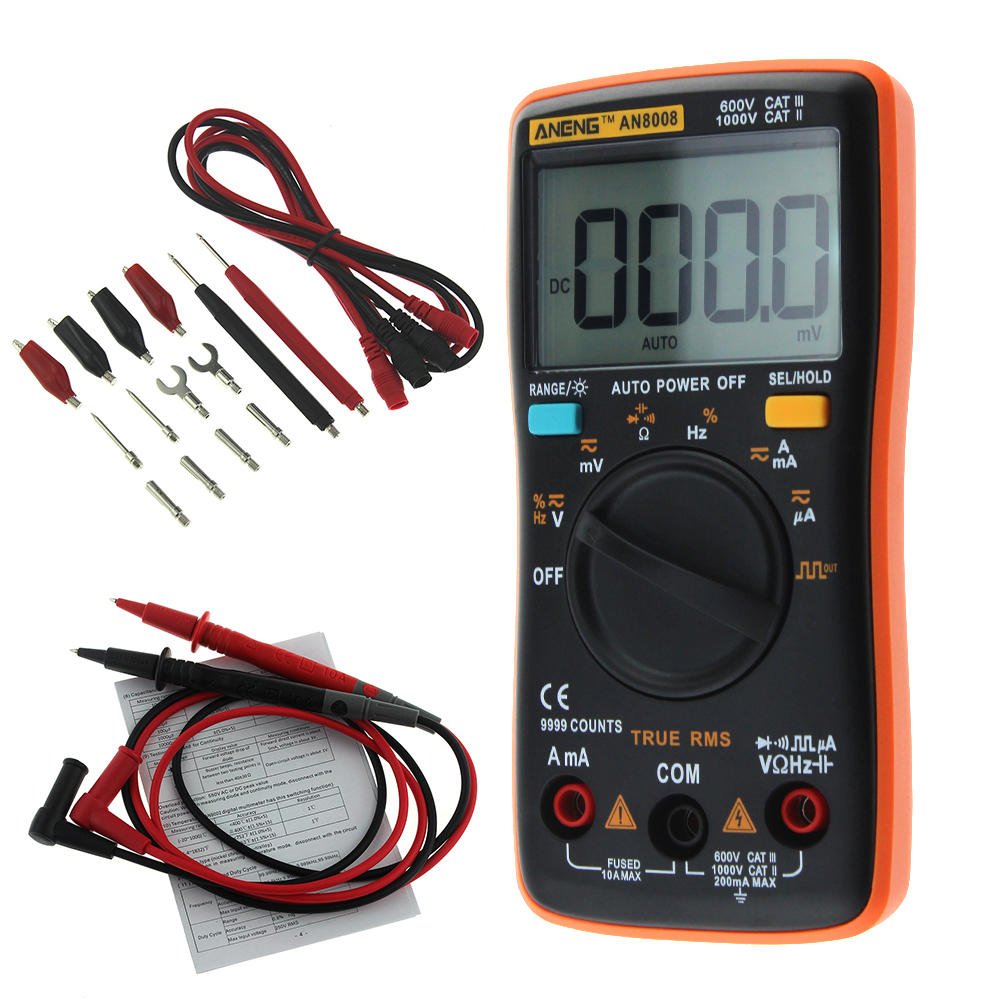
A cult favorite among hobbyists, the ANENG AN8008 packs a 9999-count true-RMS meter into a slim, credit-card-thin body that lives easily next to your breadboard. It’s fast, reads voltage/current/resistance/capacitance/frequency/duty, and even outputs a square wave for quick logic tests. There’s no temperature mode and the auto-ranging can hunt, but for ~$28 the resolution and form factor are hard to beat for everyday Arduino tinkering.
✅ Pros: 9999-count TRMS; ultra-slim; cap/freq/duty; square-wave output; cheap.
❌ Cons: No temperature; range-hunting; not for mains; tiny probes.
🎯 Verdict: The best grab-and-go bench meter. Keep one by the breadboard for fast, high-resolution checks.
👉 amazon.com/dp/B0828GVQBH 🛠️ BEST RUGGED / FIELD · ⭐ 4.7/5
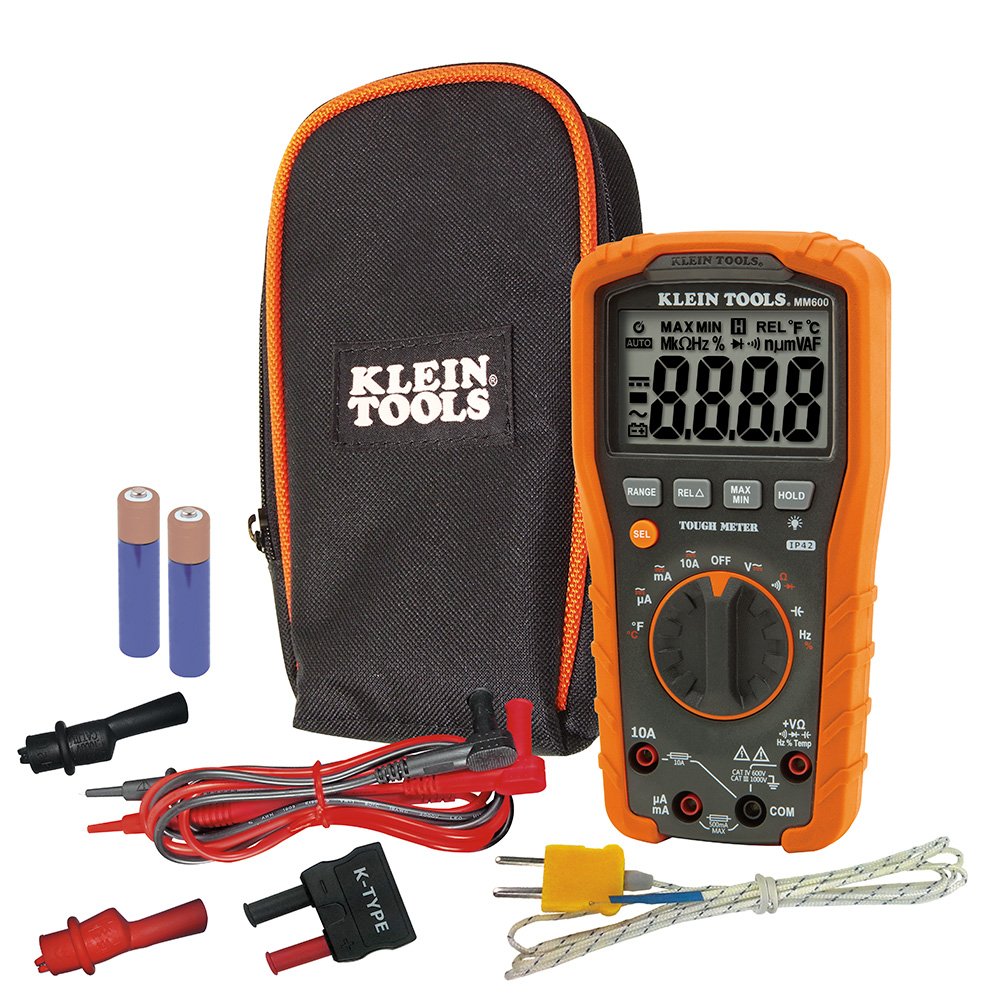
5. Klein Tools MM600
Auto-range · 4000 counts · 2 m drop-proof · CAT IV 600V · ~$80
Buy →
When your bench doubles as a workshop or you carry your meter around the house, the Klein MM600 earns its keep. It’s a tough, auto-ranging 4000-count meter rated to survive a 6.6 ft drop, with 1000V/10A ranges, temperature, capacitance, frequency and duty-cycle. It is not true-RMS, and Klein has now succeeded it with the MM720 — but it remains widely sold, dependable, and a great choice if durability and brand support matter more than headline resolution.
✅ Pros: Rugged 2 m drop-proof; CAT IV 600V safety; temp/cap/freq; trusted brand.
❌ Cons: Not true-RMS; only 4000 counts; superseded by the MM720; ~$80.
🎯 Verdict: The toughest meter here. Buy it if you want a take-anywhere meter that shrugs off drops — just know the newer MM720 adds true-RMS.
👉 amazon.com/dp/B018CLOSTC 📏 BEST BRAND POCKET · ⭐ 4.6/5
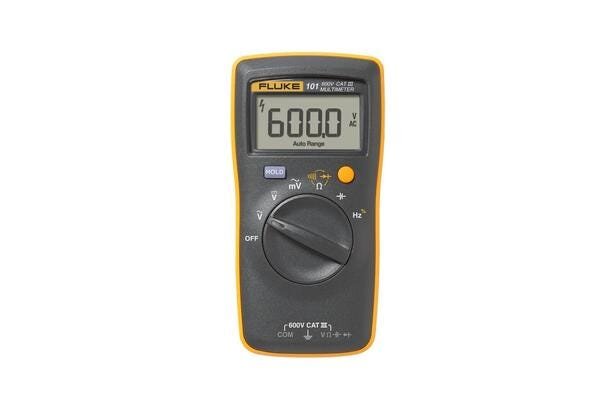
6. Fluke 101
6000 counts · pocket size · Fluke reliability · ~$70
Buy →
The Fluke 101 brings Fluke build quality and a fast continuity beep into a tiny, lightweight pocket meter. It’s a 6000-count unit that measures voltage, resistance, capacitance, frequency, continuity and diodes — perfect for a “trust the reading” quick-check tool. The big honest caveat for makers: it has no current (amps) measurement at all, so it can’t measure your project’s draw. Think of it as a premium voltage/continuity pen, not a do-everything meter.
✅ Pros: Genuine Fluke quality; pocketable; fast continuity; cap & freq.
❌ Cons: No current measurement; not TRMS; ~$70 for limited functions.
🎯 Verdict: The best pocket Fluke. A superb secondary voltage/continuity checker — just pair it with a meter that measures amps.
👉 amazon.com/dp/B00HE6MIJY 🎓 BEST FOR BEGINNERS · ⭐ 4.6/5
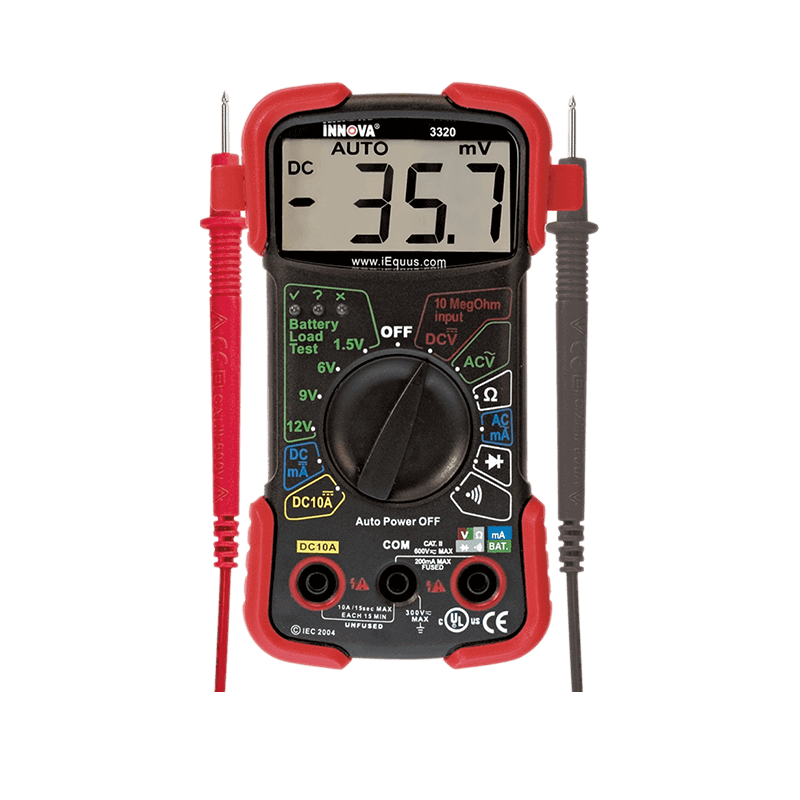
7. INNOVA 3320
Auto-range · 2000 counts · battery-test LEDs · ~$28
Buy →

The INNOVA 3320 is one of the friendliest first meters you can buy. Auto-ranging means beginners don’t have to guess a range, the 10 MΩ input is safe for sensitive electronics, and the color-coded battery-test LEDs are a nice touch. It covers AC/DC voltage, DC current to 10A, resistance, continuity and diodes — all the essentials for learning. It skips capacitance, frequency and temperature, so you may outgrow it, but at ~$28 with rubber corner guards it’s a sturdy, no-stress starting point.
✅ Pros: Auto-ranging & beginner-friendly; 10 MΩ safe input; rugged guards; battery test.
❌ Cons: No cap/freq/temp; only 2000 counts; not TRMS.
🎯 Verdict: The best learner’s meter. Auto-ranging takes the fear out of your first measurements; upgrade to the HT118A when you want more features.
👉 amazon.com/dp/B000EVYGZA 👶 BEST ULTRA-BUDGET · ⭐ 4.8/5
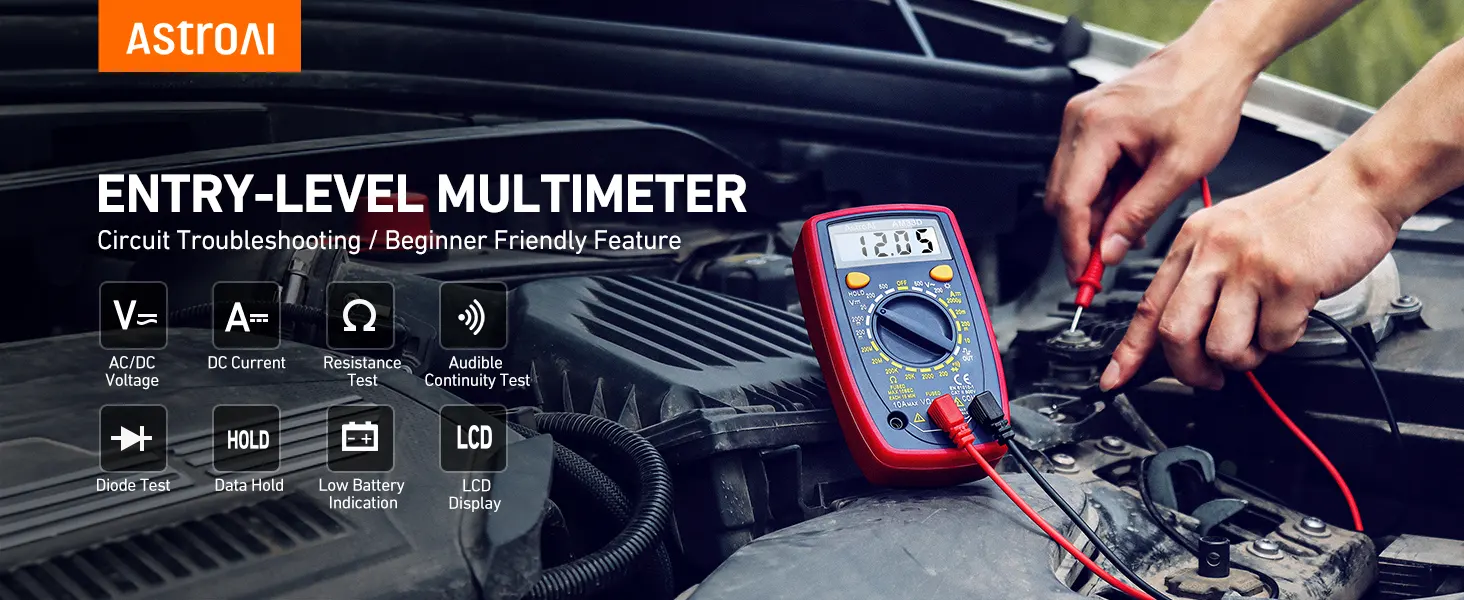
8. AstroAI AM33D
2000 counts · manual range · the $13 first meter · ~$13
Buy →

If you just need a meter on the bench today for almost nothing, the AstroAI AM33D is the one. For around $13 it measures DC/AC voltage, DC current, resistance, continuity and diodes with a backlit 2000-count display — everything you need to check a power rail, confirm continuity, or read a resistor. It’s manual-ranging and basic (no AC current, capacitance or frequency), but with 600+ strong reviews it’s a brilliant, low-risk way to get started or to keep a spare in the toolbox.
✅ Pros: Incredibly cheap (~$13); backlit; covers the essentials; great reviews.
❌ Cons: Manual ranging; DC current only; no cap/freq/temp; 2000 counts.
🎯 Verdict: The best risk-free starter. Perfect first meter or toolbox spare — you’ll genuinely use it even after you upgrade.
👉 amazon.com/dp/B01ISAMUA6 🛒 How to Choose the Right Multimeter
🏆
Want the Best All-Rounder?
Get the KAIWEETS HT118A. True-RMS, a real µA range, plus cap/freq/temp/NCV — the complete maker meter at ~$36.
💎
Buying for Life?
The Fluke 117 is the gold standard for accuracy, safety and longevity. Buy once, use for decades.
💵
Best Bang for Buck?
The AstroAI DM6000AR (~$33) gives you true-RMS and nearly every feature for the price of a cable.
🎒
Need It By the Breadboard?
The slim ANENG AN8008 (9999 counts, ~$28) is the perfect always-on-the-desk pocket meter.
🎓
Just Starting Out?
The auto-ranging INNOVA 3320 (~$28) or ultra-cheap AstroAI AM33D (~$13) make a stress-free first meter.
🧰
Carry It Everywhere?
The drop-proof Klein MM600 (~$80) is built to survive a toolbox and the occasional fall.
⚡ Key Specs Compared — Side by Side
| Spec | HT118A | Fluke 117 | DM6000AR | AN8008 | MM600 | AM33D |
|---|
| Counts | 6000 | 6000 | 6000 | 9999 ⭐ | 4000 | 2000 |
| True-RMS | ✅ | ✅ ⭐ | ✅ | ✅ | ❌ | ❌ |
| Low µA range | ✅ ⭐ | ❌ | ❌ | ✅ | ❌ | ❌ |
| Capacitance | ✅ | ✅ | ✅ | ✅ | ✅ | ❌ |
| Freq / Duty | ✅ | ✅ | ✅ | ✅ | ✅ | ❌ |
| Temperature | ✅ | ❌ | ✅ | ❌ | ✅ | ❌ |
| Safety / Build | CAT III | CAT III ⭐ | CAT III | CAT II | 2m drop ⭐ | CAT II |
| Price | ~$36 | ~$240 | ~$33 | ~$28 | ~$80 | ~$13 ⭐ |
❓ Frequently Asked Questions
Do I really need a true-RMS multimeter for Arduino projects?
For pure DC work — checking rails, reading resistors, measuring continuity — true-RMS makes no difference. It matters when you measure AC or non-sinusoidal/noisy signals accurately. Since true-RMS now costs only a few extra dollars (HT118A, DM6000AR, AN8008), it’s worth having, but a basic meter like the AM33D is perfectly fine for getting started.
Can a multimeter measure my microcontroller’s sleep current?
Yes, if it has a low microamp (µA) range — the KAIWEETS HT118A and ANENG AN8008 do. Put the meter in series with the supply on the µA range. Note that meters add “burden voltage” that can disturb very low-power circuits; for sub-µA precision a dedicated current tester (like a Nordic PPK2) is better, but a good µA meter is plenty for most battery projects.
What’s the single most useful feature for PCB debugging?
A fast, latching continuity beep. You’ll use it constantly to trace nets, verify solder joints, and hunt shorts between a pin and ground. The Fluke meters and the KAIWEETS HT118A have notably quick continuity; very cheap meters can lag, which gets frustrating when probing dozens of points.
Is it safe to measure mains voltage with these meters?
For 5V/3.3V electronics they’re all fine. For mains, only the higher-rated meters (Fluke 117 at CAT III 600V, KAIWEETS HT118A and Klein MM600 at CAT III/IV) should be used, and only if you know what you’re doing. Pocket meters like the AN8008 are CAT II and best kept to low-voltage bench work. When in doubt, don’t probe live mains.
Auto-ranging or manual-ranging — which should a beginner pick?
Auto-ranging (INNOVA 3320, Klein MM600, and the auto mode on the HT118A/DM6000AR) is easier when you’re learning because the meter picks the range for you. Manual ranging is faster once you know roughly what you’re measuring and avoids the meter “hunting.” The best meters here offer both, so you get the convenience now and the speed later.
🏁 Final Verdict — Our Top Picks
🎯 Best Pick for Every Budget
🥇 Best Overall — KAIWEETS HT118A: true-RMS, µA range, cap/freq/temp/NCV at ~$36
Buy →💎 Best Professional — Fluke 117: reference accuracy, safety and longevity
Buy →💵 Best Value — AstroAI DM6000AR: true-RMS and nearly every feature for ~$33
Buy →🎒 Best Pocket — ANENG AN8008: 9999-count slim TRMS for the breadboard
Buy →🎓 Best for Beginners — INNOVA 3320: auto-ranging and stress-free at ~$28
Buy →👶 Best Ultra-Budget — AstroAI AM33D: a capable first meter for ~$13
Buy →No single meter is perfect for everyone, but every pick on this list will make your microcontroller work faster and less frustrating. For most makers the KAIWEETS HT118A is the meter to buy — it does everything an Arduino, ESP32 or STM32 bench needs, including the low-current range most cheap meters skip. If budget is tight, start with the AstroAI AM33D and you’ll still cover the essentials. Pair your new meter with our embedded and electronics tutorials and put it to work right away.
💬 Not sure which meter fits your projects? Tell us what you’re building in the comments below — we read and reply to every question.
All Amazon links above use our affiliate tag. Purchasing through them supports microcontrollerslab.com at no extra cost to you. Prices and availability change frequently — always confirm the current price on Amazon before buying.