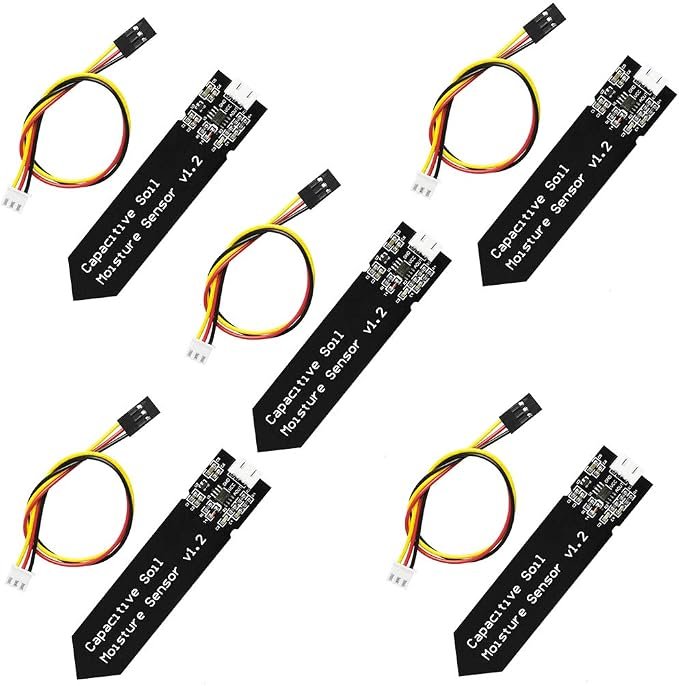
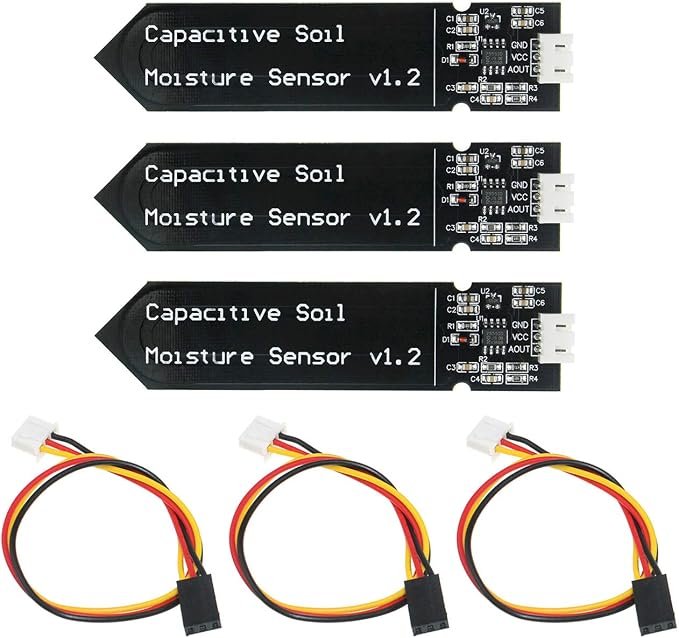
Best Soil Moisture Sensors for Arduino, ESP32 & Embedded Projects (Buying Guide)

⚠️ Affiliate Disclosure: This post contains Amazon affiliate links. If you purchase through our links, we may earn a small commission at no extra cost to you. We only recommend products we have thoroughly researched and verified. Prices change frequently — always tap through and confirm the live price on Amazon before buying.
ULTIMATE BUYING GUIDE 2026

Best Soil Moisture Sensors for Arduino, ESP32 & Embedded Projects

7 sensors ranked for makers, students and engineers — from a budget resistive beginner module to a corrosion-proof capacitive 10-pack — with real specs, honest verdicts, and direct Amazon links.

✅ 7 Sensors Reviewed ✅ Verified Amazon ASINs ✅ Updated July 2026 ✅ Honest Pros & Cons

A soil moisture sensor is one of the most useful additions to any embedded project involving plants, agriculture, or smart irrigation. Whether you’re building an automated plant watering system with an ESP32, a smart garden monitor with Arduino, or a multi-zone field data-logger on a Raspberry Pi, the right sensor gives you reliable, real-time readings of water content — the single most important variable for plant health and irrigation efficiency.

The tricky part is choosing wisely. Sensors range from cheap resistive modules with dual digital/analog output (great for first experiments but prone to corrosion) to long-lived capacitive sensors with industrial-grade TLC555I or TL555 timer chips, Gravity 3-pin interfaces, and 3.3–5.5 V wide-voltage support that works directly with ESP32, ESP8266, STM32, and Pico without level-shifting. This guide ranks 7 soil moisture sensors across every use-case and budget on the specs that actually matter for embedded and IoT work.

⚡ Reality Check Before You Buy

Capacitive sensors are far superior to resistive ones for permanent installations — but quality varies wildly between clones. The probe PCB is corrosion-resistant, but the top electronics section is not waterproof — seal it with conformal coating, clear nail polish, or hot glue for outdoor use. Calibration is mandatory: every sensor and every soil type produces different dry/wet ADC reference voltages, so measure both extremes and map linearly in code. For battery-powered IoT nodes, switch sensor VCC through a GPIO or transistor and power it only during a measurement — most sensors stabilise in under 1 second, so this can cut average current draw by 99%. And never assume readings are interchangeable between batches without re-calibrating.

Quick Comparison — All 7 Soil Moisture Sensors

SensorTypeVoltageOutputPackBest ForBuy
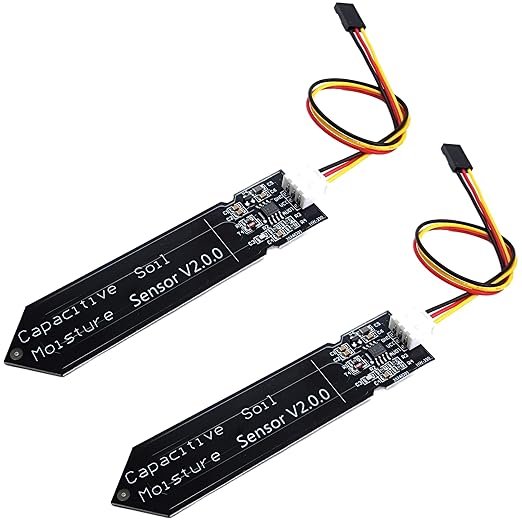
Gikfun EK1940Capacitive3.3–5.5VAnalog2 pcsBest OverallBuy Here →
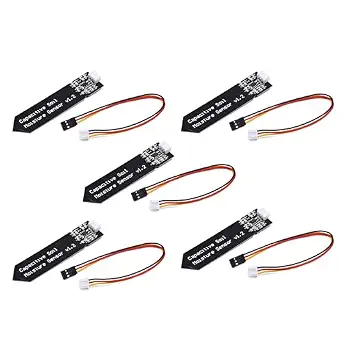
Songhe TL555 5-PackCapacitive3.3–5.5VAnalog5 pcsBest Value PackBuy Here →
DIYables TLC555ICapacitive3.3–5.5VAnalog2 pcsBest for BeginnersBuy Here →
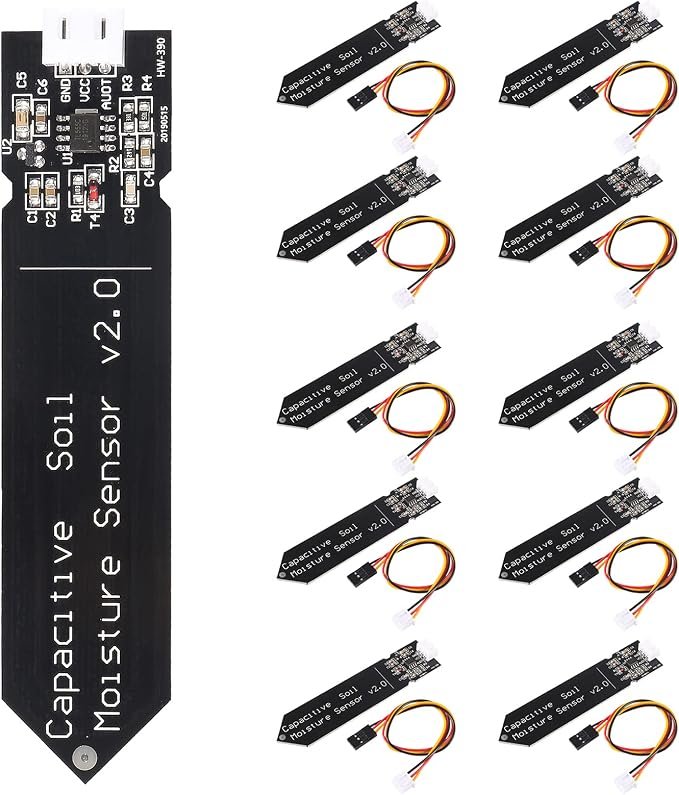
AITRIP 10-PackCapacitive3.3–5.5VAnalog10 pcsBest Bulk BuyBuy Here →
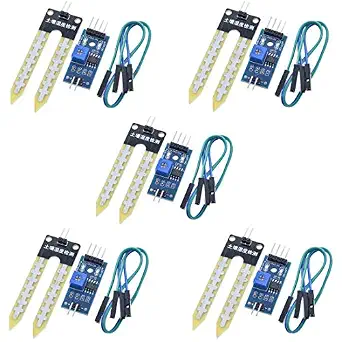
HiLetgo LM393Resistive3.3–5VDigital + Analog5 pcsBest BudgetBuy Here →
HiLetgo CapacitiveCapacitive3.3–5.5VAnalog5 pcsBest Plug-and-PlayBuy Here →
KeeYees 3-PackCapacitive3.3–5.5VAnalog3 pcsBest High SensitivityBuy Here →

Prices change frequently — always tap through and confirm the live price on Amazon before buying. No prices are listed here intentionally.

What to Look for in a Soil Moisture Sensor

🔬
Capacitive vs Resistive

Capacitive sensors measure dielectric permittivity — no current flows through the soil, so there’s no electrolysis and no corroding probes. Resistive sensors are cheaper but degrade within weeks in moist soil. Always choose capacitive for any permanent installation.

⚙️
Timer Chip Quality

The TLC555I (industrial) and TL555 chips operate correctly from 3V–5.5V. The cheap NE555 is only rated to 4.5V — at 3.3V it behaves unpredictably. For ESP32, ESP8266, or Pico projects, always verify you’re getting a TLC555 or TL555 sensor.

📊
Output Type

Analog output (0–3V) gives a continuous moisture reading via ADC — ideal for precision monitoring and data logging. Digital output gives a simple dry/wet threshold — easier to code but loses resolution. Most capacitive sensors are analog-only.

Voltage Compatibility

Modern capacitive sensors with an onboard regulator support 3.3–5.5V, meaning they work directly with ESP32/ESP8266 at 3.3V or Arduino at 5V without level-shifting. Always confirm this before buying if you’re on a 3.3V board.

🛡️
Durability & Sealing

The probe PCB itself is corrosion-resistant, but the top electronics section is exposed. For outdoor or long-term deployments, apply conformal coating or clear nail polish to the electronics area. Budget extra time for weatherproofing when planning your project.

Detailed Reviews — All 7 Soil Moisture Sensors
🏆 Best Overall

1. Gikfun EK1940 Capacitive Soil Moisture Sensor

⭐ 4.5/5
Capacitive
SENSOR TYPE
3.3–5.5V
VOLTAGE
0–3V
ANALOG OUT
98×23mm
BOARD SIZE
Buy on Amazon →
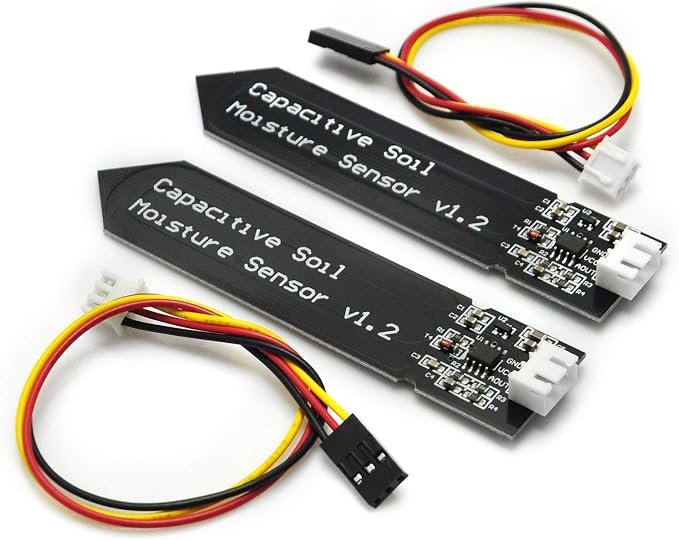
Gikfun EK1940 capacitive soil moisture sensor for Arduino and ESP32

The Gikfun EK1940 is the sensor to reach for first on any new plant-monitoring build. It uses capacitive sensing — no current flows through the soil, so there is no electrolysis and no corroding probes — with a built-in voltage regulator that handles 3.3 V ESP32/ESP8266 boards and 5 V Arduinos equally. At 240+ reviews and a 4.2-star average it has one of the strongest community track records in its price bracket. The standard 3-pin Gravity-compatible interface drops straight into almost every breakout and expansion board. The 2-pack is handy: use one in soil and keep the other dry for in-air calibration reference. One caveat: seal the electronics section at the top with conformal coating for any outdoor installation.

✅ Pros
  • 240+ reviews — proven track record
  • True capacitive, no corrosion
  • Works at 3.3V and 5V natively
  • Gravity 3-pin compatible
  • Affordable 2-pack with spare
❌ Cons
  • Electronics section not waterproof
  • Clone chip quality can vary
  • Calibration required per soil type
🏆 Verdict: The best all-round soil moisture sensor for embedded projects. Proven, broadly compatible, and truly capacitive — the right default choice.
Check Price on Amazon →
💰 Best Value Pack

2. Songhe TL555 Capacitive Soil Moisture Sensor (5-Pack)

⭐ 4.4/5
TL555
TIMER CHIP
3.3–5.5V
VOLTAGE
5 pcs
PACK SIZE
0–3V
ANALOG OUT
Buy on Amazon →
Songhe TL555 capacitive soil moisture sensor 5-pack for Arduino

The Songhe 5-pack earns its Amazon’s Choice badge by getting the fundamentals right: a genuine TL555 timer chip (not the cheaper NE555 that struggles below 4.5 V), a Gravity-compatible 3-pin PH2.54 interface, and consistent readings across all five sensors. With 225+ reviews and a 4.3-star average it has one of the strongest community track records in the multi-pack category. Five sensors let you instrument multiple plant pots, garden beds, or soil depths in one purchase — and because calibration curves are similar across the batch, one set of dry/wet reference values in firmware covers all units. The seller updated the design from NE555 to TL555 after early user complaints, so the current listing is substantially more reliable than early batches.

✅ Pros
  • Amazon’s Choice, 225+ reviews
  • TL555 chip for true 3.3V stability
  • Good inter-sensor consistency
  • 5-pack — great cost per sensor
  • Gravity 3-pin interface
❌ Cons
  • Occasional dead unit in batch
  • Top electronics not sealed
  • Some older batches shipped NE555
💰 Verdict: The best value pack for multi-zone garden or smart agriculture. TL555 chip gives genuine 3.3 V reliability; five sensors for less than the cost of two premium units.
Check Price on Amazon →
🌱 Best for Beginners · ⭐ 4.3/5

3. DIYables TLC555I Capacitive Soil Moisture Sensor (2-Pack)

Buy on Amazon →
DIYables TLC555I capacitive soil moisture sensor for Arduino ESP32

DIYables equips this 2-pack with the TLC555I — the industrial-grade variant of the 555 timer, specified down to 3V — making it one of the safest choices for 3.3V microcontrollers including ESP32, ESP8266, STM32, and Raspberry Pi Pico. The onboard voltage regulator accepts 3.3–5.5V and delivers a clean 0–3V analog output. Reviewers consistently praise the stable, repeatable readings and painless hookup. At a lower per-sensor cost than many single-unit competitors and with a clean, well-documented product page from an established DIY electronics brand, it’s a great starting point for anyone new to soil sensing.

✅ Pros
  • TLC555I industrial chip
  • 3.3V and 5V native support
  • Stable, repeatable readings
  • Well-documented by DIYables
  • Affordable 2-pack
❌ Cons
  • Fewer reviews than Gikfun/Songhe
  • Electronics not waterproof
  • Basic cable included only
🌱 Verdict: The safest beginner pick for 3.3V MCUs. Industrial TLC555I chip, clean output, and an established brand make this an easy first sensor.
📦 Best Bulk Buy · ⭐ 4.0/5

4. AITRIP 10-Pack Capacitive Soil Moisture Sensor

Buy on Amazon →
AITRIP 10-pack capacitive soil moisture sensor for Arduino Raspberry Pi

When you need to monitor ten or more planting zones, AITRIP’s 10-pack delivers the lowest cost-per-sensor of any kit here. Each unit uses capacitive sensing with a built-in 3.3–5.5V regulator, a 3-pin PH2.54 Gravity interface, and individual cables included in the box. The design uses the TL555C timer chip — several long-term reviewers specifically confirm the boards are fully populated with no cost-cutting component omissions, which is the main failure mode of cheap clone sensors. With 87 reviews at 4.0 stars and an Amazon’s Choice badge, it’s a proven pick for smart agriculture, greenhouse monitoring, and classroom kits where you need identical sensors across many nodes.

✅ Pros
  • Lowest cost-per-sensor
  • TL555C chip, fully populated board
  • 10 cables included
  • Amazon’s Choice badge
  • Good for classroom/farm deployments
❌ Cons
  • Calibration offsets vary slightly per unit
  • Electronics not waterproof
  • Occasional bad unit in batch
📦 Verdict: The best bulk buy for multi-zone monitoring. Ten fully-populated sensors with cables at a price that makes large deployments practical.
💵 Best Budget / Learning · ⭐ 4.2/5

5. HiLetgo LM393 Resistive Soil Moisture Sensor (5-Pack)

Buy on Amazon →
HiLetgo LM393 resistive soil moisture hygrometer sensor 5-pack for Arduino

This is a resistive sensor — the two exposed metal prongs pass a small current through the soil to measure conductivity. That means it will eventually corrode if left in moist soil permanently, but for classroom experiments, quick proof-of-concept builds, and short-term testing it’s unbeatable on price. The LM393 comparator board gives you both an analog output (variable voltage proportional to moisture) and a digital output (threshold triggered by an onboard potentiometer), which is ideal for teaching the difference between analog ADC reading and simple threshold-based control. With 160+ reviews and Amazon’s Choice at 4.3 stars, it consistently works out of the box. Just don’t bury it for months — use a capacitive sensor for anything permanent.

✅ Pros
  • Cheapest per sensor of any pick
  • Dual digital + analog output
  • 160+ reviews, Amazon’s Choice
  • Great for learning and prototyping
  • Adjustable threshold potentiometer
❌ Cons
  • Resistive — corrodes over weeks/months
  • Not suitable for permanent installs
  • Readings drift as probes oxidize
💵 Verdict: The best budget pick for learning and prototyping. Don’t deploy it permanently — use it to understand moisture sensing before upgrading to capacitive.
🔌 Best Plug-and-Play · ⭐ 4.1/5

6. HiLetgo Capacitive Soil Moisture Sensor with Cable (5-Pack)

Buy on Amazon →
HiLetgo capacitive soil moisture sensor 5-pack wide voltage with cable wire

HiLetgo’s capacitive 5-pack differentiates itself by including cable wire with each sensor — a small but practically important detail when you’re wiring sensors into enclosures or routing them across a planter box. The wide-voltage 3.3–5.5V support and capacitive design make it compatible with any modern MCU without extra circuitry. It’s a solid middle-ground option: more sensors per pack than the Gikfun 2-pack, cheaper per-unit than DIYables, and with the cable convenience that the bare-board-only packs lack. Note stock levels can be low on this listing — check availability before ordering for a critical project.

✅ Pros
  • Cables included — genuinely useful
  • Wide voltage 3.3–5.5V
  • True capacitive design
  • Good mid-range pack size
❌ Cons
  • Fewer reviews than top picks
  • Stock can be limited
  • Electronics not waterproof
🔌 Verdict: Best when cable convenience matters. Pre-attached cables save time on wiring, and the wide-voltage support handles any 3.3V or 5V board.
🎯 Best High Sensitivity · ⭐ 4.2/5

7. KeeYees High Sensitivity Capacitive Soil Moisture Sensor (3-Pack)

Buy on Amazon →
KeeYees high sensitivity capacitive soil moisture sensor 3-pack for Arduino

KeeYees markets this 3-pack on its high-sensitivity detection — a wider analog voltage swing between dry and wet extremes means better ADC resolution and finer-grained moisture mapping. The corrosion-resistant PCB probe, 3.3–5.5V operating range via onboard regulator, and standard 3-pin interface make it compatible with Arduino, ESP32, ESP8266, STM32, and Raspberry Pi (with ADC). The 3-pack is a sweet spot for small to medium installations where you need more than one or two sensors but don’t want a 10-pack. A good pick if you’re prioritising reading accuracy and fine moisture-level discrimination over raw sensor count.

✅ Pros
  • High-sensitivity claim — wider ADC range
  • Corrosion-resistant probe
  • 3.3V and 5V compatible
  • Standard 3-pin interface
❌ Cons
  • 3-pack only — fewer sensors
  • Electronics not sealed
  • Fewer community reviews
🎯 Verdict: Best for precision monitoring where fine moisture-level resolution matters more than raw sensor count. Good alternative to Gikfun for accuracy-focused builds.

How to Choose the Right Soil Moisture Sensor

Building a smart plant-watering system?

Get the Gikfun EK1940 — proven, capacitive, and Gravity-compatible. Add one sensor per plant, wire VCC through a GPIO, and read ADC in your ESP32 or Arduino loop.

Monitoring multiple garden zones?

The Songhe TL555 5-pack or AITRIP 10-pack gives you the best cost per sensor. The TL555/TL555C chip handles 3.3 V boards reliably across all units.

Just learning soil sensing for the first time?

Start with the HiLetgo LM393 resistive modules — cheapest way to understand analog ADC reading and threshold control. Upgrade to capacitive once you’ve got the code working.

Using an ESP32 or ESP8266 at 3.3 V?

Pick the DIYables TLC555I — the industrial-grade chip is explicitly rated to 3V minimum, giving you the cleanest readings on low-voltage MCUs without unpredictable behaviour.

Need cables included out of the box?

The HiLetgo Capacitive 5-pack comes with cable wire attached — a small but genuinely useful detail when routing sensors inside enclosures or through pots.

Prioritising fine moisture resolution?

The KeeYees 3-pack is marketed on high sensitivity — a wider ADC swing between dry and wet extremes gives better fine-grained moisture discrimination for precision research or data-logging projects.

Key Specs Compared — Side by Side

SpecGikfun EK1940Songhe TL555DIYables TLC555IAITRIP 10-PackHiLetgo LM393
Sensor TypeCapacitive ✓Capacitive ✓Capacitive ✓Capacitive ✓Resistive
Timer Chip555-basedTL555TLC555I ✓TL555CLM393
Voltage Range3.3–5.5V3.3–5.5V3.3–5.5V3.3–5.5V3.3–5V
OutputAnalog 0–3VAnalog 0–3VAnalogAnalog 0–3VDigital + Analog
InterfacePH2.54-3PPH2.54MM3-PinPH2.54-3P3-Pin + DO
Pack Size2 pcs5 pcs2 pcs10 pcs ✓5 pcs
Corrosion Resistance✓ Yes✓ Yes✓ Yes✓ Yes✗ Corrodes
Board Size98×23mm~98×23mm~98×23mm98×23mm~76×30mm

Specs sourced from Amazon listings and manufacturer data. Always verify on the live Amazon listing before purchasing.

Frequently Asked Questions

What is the difference between a capacitive and a resistive soil moisture sensor?

A resistive sensor passes a small current between two metal prongs through the soil and measures conductivity. It works initially but the prongs corrode through electrolysis within weeks in moist soil, causing readings to drift upward permanently. A capacitive sensor measures the dielectric permittivity of the soil around a PCB probe — no current flows through the soil, so there’s no electrolysis and no corrosion. For any project intended to last more than a few weeks, always use capacitive. Resistive sensors are only appropriate for short-term prototyping and learning.

Why does the timer chip matter — what is wrong with the NE555?

Most capacitive soil moisture sensors use a 555-family timer chip to generate the capacitive measurement signal. The classic NE555 is specified to operate from 4.5V to 15V — at 3.3V it is out of spec and can produce erratic, unstable readings. The TL555 and TLC555I variants are specified down to 3V (TLC555I is the industrial version, rated to 2.7V). If you’re using an ESP32, ESP8266, STM32 or Raspberry Pi Pico — all of which run at 3.3V — you need a sensor built around a TL555, TLC555, or TLC555I chip. Look for it explicitly in the product description before buying.

How do I calibrate a soil moisture sensor for my soil?

Calibration is mandatory — don’t skip it. Insert the sensor into completely dry soil (or hold it in open air) and read the ADC value: this is your “dry” reference, typically ~2.8–3V analog output (higher ADC value). Then saturate the same soil with water until it cannot absorb more, insert the sensor, and read the ADC again: this is your “wet” reference, typically ~1–1.5V analog output (lower ADC value). Map these two endpoints to 0% and 100% in your firmware using a linear formula. Note: different soil types, compaction levels, and temperatures will shift these values, so calibrate in the actual deployment soil. Temperature compensation may be needed for outdoor seasonal deployments.

Can I power a soil moisture sensor directly from an ESP32 or Arduino 3.3V / 5V pin?

Yes, for the current draw. These sensors draw only 5–10 mA when active — well within what a GPIO or VCC rail can supply for a single sensor. However, for battery-powered IoT devices, you should switch sensor power via a GPIO pin and a small transistor or MOSFET so the sensor only draws current during a measurement (usually less than 1 second). This can reduce average sensor current from ~7mA continuous to under 0.1mA, dramatically extending battery life. For mains-powered or USB projects, always-on power is fine. Also note: on ESP32, ADC2 pins are disabled when Wi-Fi is active — use ADC1 pins (GPIO32–39) to read moisture sensors while Wi-Fi is running.

How do I waterproof the sensor electronics for outdoor use?

The probe section of a capacitive sensor is PCB-based and inherently corrosion-resistant. The risk area is the top of the board where the timer chip, regulator, and connector sit. The most common approaches are: (1) brush two coats of conformal coating (acrylic or silicone type) over the electronics and let it fully cure; (2) apply clear nail polish or liquid electrical tape; (3) pot the electronics section in a small 3D-printed cap filled with silicone sealant or two-part epoxy, leaving the probe exposed. The connector area is the hardest to seal — use heat-shrink tubing and silicone sealant around the cable entry point. A fully weather-sealed setup can survive months outdoors without degradation.

Final Verdict — Best Soil Moisture Sensor for Every Project

The right sensor for every use-case and budget:

🏆 Best Overall
Gikfun EK1940 — proven capacitive, 240+ reviews, Gravity compatible
Buy →
💰 Best Value Pack
Songhe TL555 5-Pack — Amazon’s Choice, genuine TL555, consistent batch
Buy →
🌱 Best for Beginners
DIYables TLC555I — industrial chip, safest 3.3V option, well-documented
Buy →
📦 Best Bulk Buy
AITRIP 10-Pack — lowest cost per sensor, cables included, TL555C chip
Buy →
💵 Best Budget
HiLetgo LM393 — cheapest way to learn moisture sensing, dual output
Buy →
🔌 Best Plug-and-Play
HiLetgo Capacitive — cable included, wide voltage, easy wiring
Buy →
🎯 Best High Sensitivity
KeeYees 3-Pack — fine-grained moisture resolution for precision monitoring
Buy →

For most embedded and IoT builds, the Gikfun EK1940 is the one to start with — a proven capacitive sensor with a wide user base, endless Arduino and ESP32 tutorials on microcontrollerslab.com, and a 3.3–5.5V operating range that covers almost every modern MCU. If you need more sensors in one order, the Songhe TL555 5-pack or AITRIP 10-pack are the best value choices. For ESP32 and 3.3V MCU projects where chip quality really matters, the DIYables TLC555I is the most reliable option. New to sensing altogether? Start with the cheap HiLetgo LM393 resistive kit to learn the concepts, then upgrade to capacitive for any permanent installation.

Have a question about which sensor fits your project — a greenhouse controller, a self-watering pot, a field data logger, or an ESPHome home-automation node? Drop it in the comments below and we’ll help you choose. All Amazon links above use our affiliate tag (microlab05-20). Purchasing through them supports microcontrollerslab.com at no extra cost to you.

Arduino ComponentsAmazon Links
Arduino Starter KitBuy Now
Arduino Development KitBuy Now
Arduino Smart Robot Car Kit V4Buy Now
Arduino Sensors KitBuy Now

Leave a Comment