Recommended Components
The following parts are used in this article, along with a generic electronics kit that is handy for building and testing the circuit.
| Component | How it’s used | Buy on Amazon |
|---|---|---|
| Electronic component assortment kit (1390 pcs) | A handy assortment of resistors, capacitors, LEDs, diodes and transistors for building circuits. | Check Price |
| Digital multimeter (AstroAI) | Measures voltage, current, resistance and checks continuity while you build and debug. | Check Price |
| Breadboard | Solderless base for prototyping the circuit. | Check Price |
| Jumper Wires | Make the connections on the breadboard. | Check Price |
As an Amazon Associate we earn from qualifying purchases. Prices and availability are accurate as of the date/time indicated and are subject to change.
CD4560 Pinout Diagram
CD4560 4-bit adder IC consists of sixteen pins. This is a pinout diagram.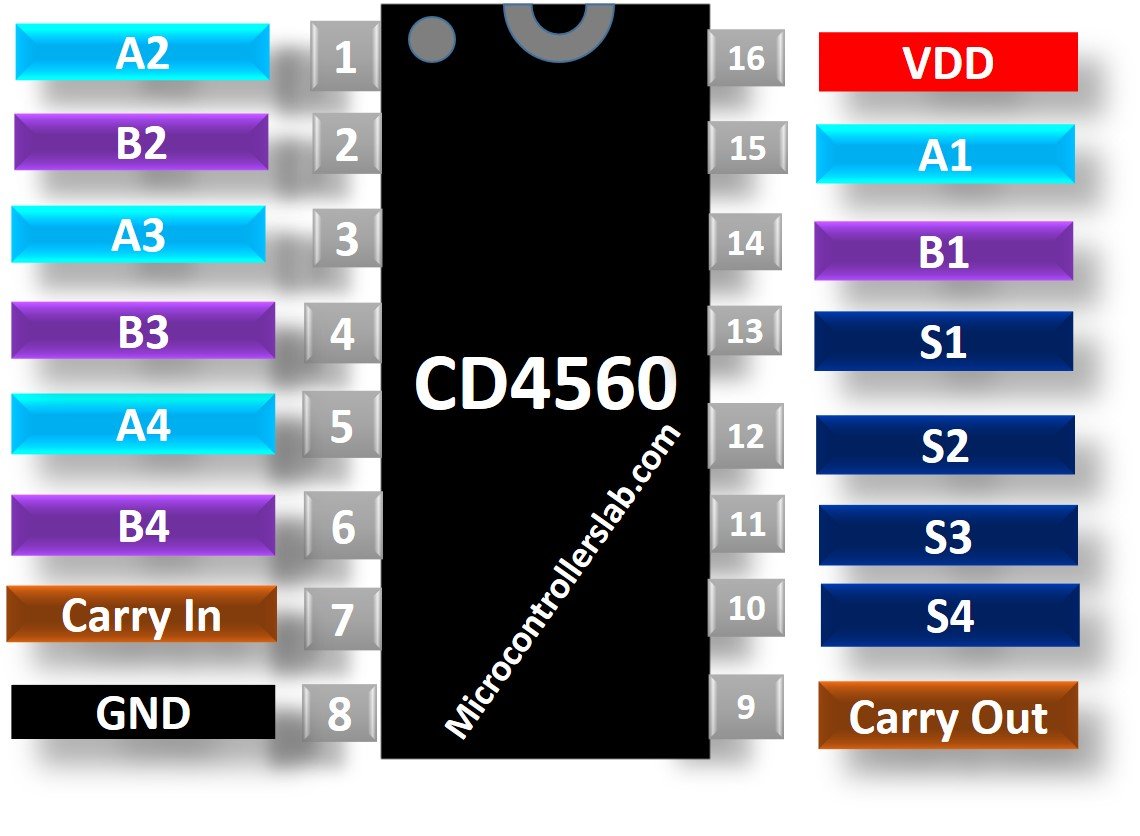
Pin Configuration Details
As we mentioned earlier, this IC has 16 pins in total and each having different functions. Nine pine are input pins such as A1-A4, B1-B4 and Carry In pin. It has 5 output pins and two power supply pins.All pins along with their functions are described below:- Pins with names A1, A2, A3 and A4 are the 4-bits of first number
- Also second number pins B1, B2, B3 and B4 are the 4-bits of second number
- Pins 10, 11, 12 and 13 are the output pins that generate the result of sum of the two numbers
- Carry input pin (pin 7) is used for cascading to add numbers longer than 4 bits.
- Carry Output pin generates one when the sum of two numbers is greater than 9 or 4-bits.
- VDD is the positive supply voltage and Vss is the negative supply voltage.
CD4560 Adder Features
- It has a very low Quiescent Current.
- Noise Immunity is high
- Single supply operation is either positive or negative
- It has a very wide range of voltage supply which is from 3V to 18V.
- Internally diode protection is provided on all inputs.
- Minimum Operating Temperature (°C) = -55°C
- Maximum Operating Temperature (°C) = 125°C
How and Where to use it?
This IC is used for carrying out arithmetic operations. If you are adding only 4-bit numbers, then carry input is connected to Vss. If you want to add bigger number like 8 bits, 16 bits etc. then this can be achieved by cascading the two IC’s. The carry output pin of the least significant adder is connected with the carry input pin of the corresponding most significant adder8-bit Cascaded Example CD4560
For example, you want to add two 8-bit numbers. But you only have 4-bit adder ICs. In this case, we can cascade two adder ICs to perform 8-bit addition. You can see from the diagram how can make connection diagram for cascading. We connect carry out pin of one adder with carry in pin of second CD4560 IC.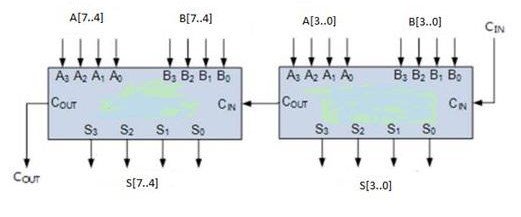 Adders are used basically for performing calculations like arithmetic addition in digital calculators and they are also used in devices that works on the increment or arithmetic processes.
CD4560 Proteus Example
This adder can perform addition of two 4-bit numbers. In decimal 4-bit number is equivalent to 0-15. Therefore, it can perform addition upto 0-14. For example, Input A = 8 and Input B= 9, Carry out signal shows, adder overflow.In this figure, we can see that we give both binary inputs as 00001. CD4560 gives output 0010 which is equal to decimal 2.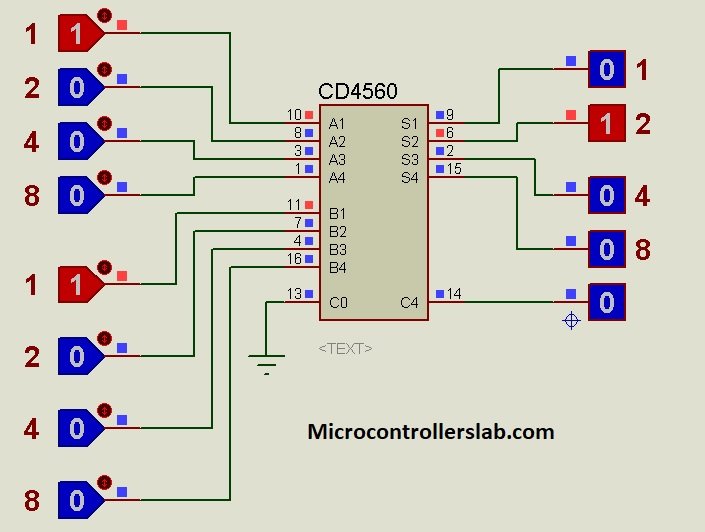 Similarly, in this proteus simulation, we provide both input in decimal 7 and the output should be 14 or 1110 in binary. As we can see a same binary output.
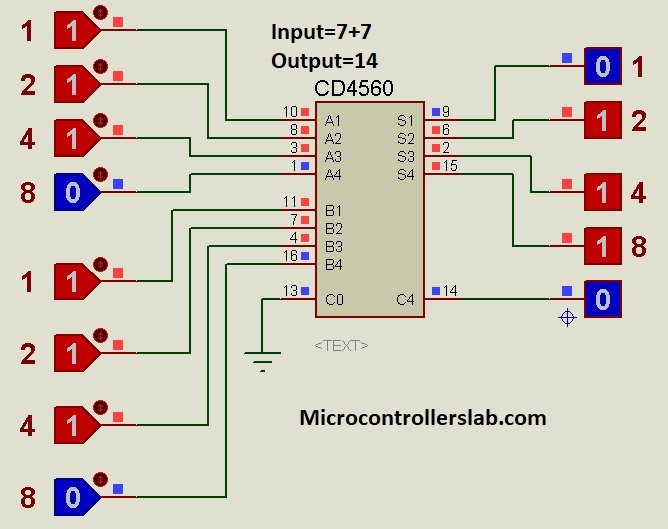 We demonstrates carry out feature in this circuit diagram. Input A=15 and Input B = 7, Therefore, the ouput should be equal to 21. But this IC gives output between 0-15 only. However, if value increased this limit, carry out signal gives high output.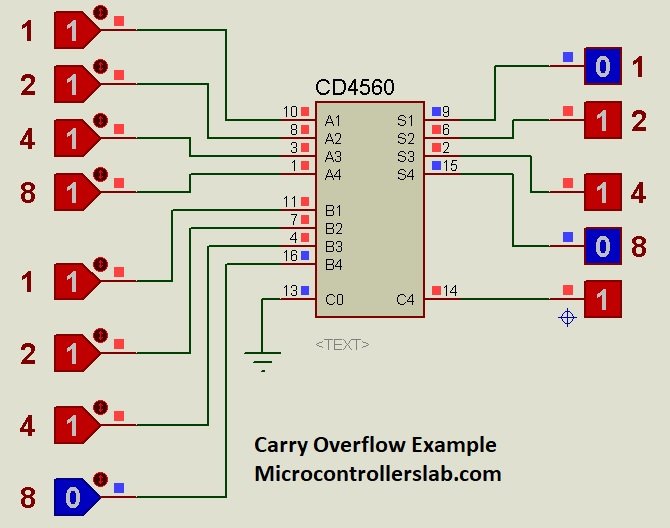
CD4560 Applications
CD4560 is mostly used in devices and applications performing calculations like addition.- These ICs are wildly used in Arithmetic logic unit (ALU) to compute addition, Central Processing unit (CPU) and Graphics Processing unit (GPU) for graphics applications to reduce the circuit complexity.
- Adder is used in digital devices and electronic calculators for performing arithmetic operations like addition, subtraction, multiplication and division.
- They are also used in microcontrollers also for PC (program counter) and timers.
- In processors, they are used to calculate addresses, tables and similar operations
- It is also used in Digital signal processor and networking systems.